Key Takeaways
- AI stocks surged on Monday, 23 November 2026, after Nvidia reinstated Jensen Huang as CEO. Nvidia itself closed up 31.5%.
- Companies that supply Nvidia or depend on its chips gained the most: CoreWeave rose about 22%, Dell about 21%, Micron about 18-19% and TSMC’s US shares about 15%.
- Nvidia’s chip rivals lagged: AMD gained about 7% and Broadcom about 2%, reversing their gains from the day Huang resigned.
- Ten Nvidia-linked companies added roughly $500 billion in market value between them, about half of Nvidia’s own gain.
- European chip stocks such as ASML, STMicroelectronics and BE Semiconductor rose around 9-10%. Asian suppliers rallied on Tuesday, led by TSMC’s 9.9% limit-up move.
- Not every AI name rose: CrowdStrike fell about 9% after agreeing to buy Zscaler, and newly listed Anthropic slipped below $88.
- Much of the rally reversed on Tuesday and Wednesday as investors went back to their doubts about AI spending.
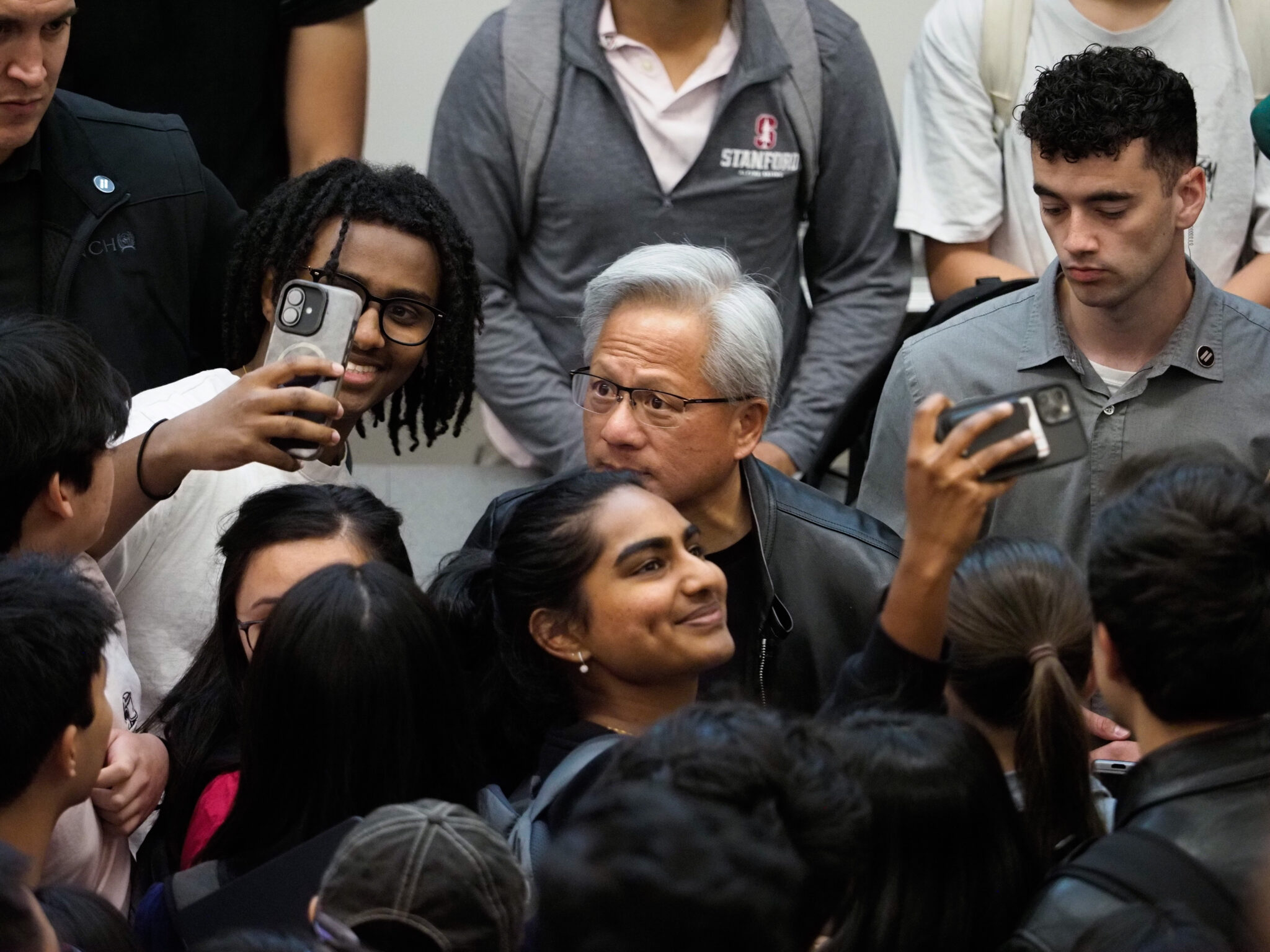
Jensen Huang, founder and CEO of Nvidia, poses for selfies with students after his talk in Stanford University’s CS 153 course on April 30, 2026. Image source: Anders Eidesvik via Wikimedia, Creative Commons Attribution-Share Alike 4.0 International license.
Other AI stocks reacted to Jensen Huang’s Nvidia return with one of their strongest single-day rallies in years, but the gains were uneven. On Monday, 23 November 2026, the biggest winners were companies that make Nvidia’s chips, supply its memory, build its servers or rent out its GPUs. Nvidia’s direct competitors in AI chips, AMD and Broadcom, gained much less.
That split tells you what the market was pricing in. When Huang resigned on 12 November, investors bet that an Nvidia without its founder would move more slowly and lose ground to rivals. On Monday they unwound that bet in a single session, and the companies most tied to Nvidia’s roadmap rose the most.
The Monday Scoreboard: Nvidia’s Partners Led the Rally
The broad market had its best day since April 2025. The Nasdaq Composite rose about 6.5%, the S&P 500 gained close to 5% and the Philadelphia Semiconductor Index climbed 12% to 14%. Within that, individual AI stocks moved by very different amounts.
| Company | Link to Nvidia | Move on 23 November |
|---|---|---|
| Nvidia | – | +31.5% (close $165.05) |
| CoreWeave | GPU cloud provider, Nvidia-backed | About +21% to +22.5% (close $48.33) |
| Dell | AI server builder | About +20% to +21% |
| Nebius | GPU cloud provider | About +20% to +21% |
| Micron | High-bandwidth memory supplier | About +18% to +19.3% (close $707.70) |
| Marvell | Networking and custom silicon | About +17% |
| Lumentum / Coherent | Optical components | About +17% / +15% |
| Taiwan Semiconductor (US shares) | Makes Nvidia’s chips | About +14% to +15% |
| Super Micro | AI server builder | About +14% |
| Intel | Nvidia is an investor | About +13% to +16% |
| Oracle | AI cloud customer | About +12.5% |
| AMD | AI chip rival | About +7% |
| Broadcom | AI chip rival | About +2% |
Figures vary slightly between data providers because some reports used intraday prices. Micron, for example, is listed at +18% by 24/7 Wall St, +19.04% by TipRanks and +19.3% by Morningstar.
Neoclouds and Data-Centre Stocks Bounced Hardest
The sharpest rebounds came from the companies that had fallen hardest. AI cloud providers that rent out Nvidia GPUs, often called neoclouds, borrow heavily to build data centres. Investors worried that any delay in Nvidia’s product roadmap would hurt them first.
CoreWeave had dropped about 35% after Huang’s exit, according to TipRanks, amid concerns about leadership and the debt behind its expansion. On Monday it jumped about 22%. Nebius gained around 20%, while IREN rose 23.8% and Applied Digital about 20% in premarket trading, according to Fox Business. Even so, CoreWeave did not win back everything it had lost since the resignation, Reuters noted.
Memory and Server Makers Rode the Nvidia Roadmap
Micron supplies the high-bandwidth memory that sits inside Nvidia’s AI accelerators. It had slid about 27% during Huang’s 11-day absence and gained about 19% on Monday, adding roughly $123 billion in value by 24/7 Wall St’s count. SK Hynix’s US-listed shares rose about 20%, Stocktwits reported, ahead of a strong session in Seoul the next day.
Server makers followed the same pattern. Dell rose about 21% and Super Micro about 14%. 24/7 Wall St noted that both companies also had their own news, including reports of server price increases, so not all of the gain came from the Nvidia headline.
Why AMD and Broadcom Lagged
AMD and Broadcom design chips that compete with Nvidia’s for AI data-centre budgets. On 12 November, when the resignation was announced, both rose about 6% while Nvidia and its partners fell. Monday reversed that trade. AMD gained about 7%, adding roughly $47 billion, and Broadcom rose about 2%, adding roughly $28 billion.
Measured from the 11 November close, Broadcom was still down about 10% and AMD about 18% after Monday, while Nvidia was down only about 5%. 24/7 Wall St added a fair warning: the pattern rests on only two trading days, and the whole market rose on Monday, so the reading should not be pushed too far.
Analysts at Stifel described the reinstatement as “removing a key-person overhang on the AI infrastructure roadmap,” NBC News reported. That roadmap is why suppliers and customers rallied harder than competitors.
Europe Joined In; Asia Followed on Tuesday
European chip equipment and component makers rose on Monday afternoon. ASML and STMicroelectronics gained about 9.5%, BE Semiconductor about 9.8% and Austrian circuit-board maker AT&S about 13.4%, according to Morningstar. The broader Morningstar Europe Index rose about 1.8%.
Asian markets had already closed in the red on Monday before the news broke, with Japan down about 5% and South Korea about 3%. They caught up on Tuesday. TSMC rose 9.9%, its daily limit, and Foxconn and Wistron rose almost 10%. The Kospi gained about 6.3% as South Korea’s memory chip makers SK Hynix and Samsung rose between roughly 6.6% and 10%, depending on the quote. SoftBank climbed more than 8%, while Hong Kong’s Hang Seng slipped about 0.8%.
| Region | Notable moves |
|---|---|
| Europe (23 November) | ASML +9.5%, STMicro +9.5%, BESI +9.8%, AT&S +13.4% |
| Taiwan (24 November) | TSMC +9.9% (limit, about +$158 billion), Foxconn and Wistron near +10% |
| South Korea (24 November) | Kospi +6.3%; SK Hynix and Samsung roughly +6.6% to +10% |
| Japan (24 November) | Nikkei +3.9%; SoftBank +8% or more |
The AI Stocks That Went the Other Way
A few AI-related names fell on Monday for their own reasons. CrowdStrike dropped about 9% to 9.6% after agreeing to buy Zscaler, whose shares rose about 13%. Anthropic, which listed only days earlier, fell about 1.4% to 1.7% and traded below $88. Its IPO priced at $83, and the stock had risen 17% on its first day before falling 9% the next. Morningstar noted that tech stocks had their worst two-day stretch since 2020 in the days after Anthropic’s recent IPO.
How Long the Rally Lasted
Not long. Nvidia closed about 5.9% lower on Tuesday and fell another 5% in Wednesday’s premarket session. Nebius, CoreWeave and IREN each lost about 12% on Tuesday and around 7% more before Wednesday’s open. Broadcom, Amkor, Applied Materials, TSMC, Intel, KLA and GlobalFoundries were down between 3% and 8% in early Wednesday trading.
Raymond James’ Amish Patel had told Morningstar that the reinstatement removed one big source of uncertainty and let investors look at fundamentals again. Those fundamentals, including doubts about AI funding, profitability and public resistance to data centres, were what had pushed the S&P 500 into a correction before Huang resigned.
What Monday’s Reaction Reveals About the AI Trade
Monday showed how much of the AI market moves with Nvidia. Suppliers, server builders and GPU landlords now trade almost like extensions of Nvidia’s own stock. Rivals sometimes move the opposite way when Nvidia looks weak.
For investors, the gap between the two groups is the useful part. Owning several AI companies can still mean owning one bet if all of them depend on Nvidia’s execution, its leadership and its relationship with Washington.
This article is for information only and is not investment advice. Percentage moves are taken from the cited reports and may differ slightly between data sources.
If you are interested in this topic, we suggest you check our articles:
- AI Cloud vs Traditional Cloud: What Businesses Need to Know
- Kospi’s 10 Percent Plunge and the AI Rally
- South Korea’s AI Memory Chip Production
- CrowdStrike’s Importance in the AI Boom
- Anthropic IPO Compared With Other AI Players
Sources: Morningstar, 24/7 Wall St, TipRanks, Fox Business, Yahoo Finance, Reuters analysis via Investing.com, NBC News, Fortune, Stocktwits
Written by Alius Noreika