Key Takeaways
- SK hynix and Samsung together held about 79% of the high-bandwidth memory market in the first quarter of 2026 — SK hynix at 58%, Samsung at 21%, with Micron holding the remaining 21%.
- The two Korean firms also control roughly 67% of the broader DRAM market, where Samsung led at 38% and SK hynix followed at 29% in Q1 2026.
- SK hynix is reported to supply about two-thirds of Nvidia’s HBM4 requirement for the Vera Rubin platform, after earlier expectations of just over half.
- Samsung posted record Q2 2026 results with KRW 171.5 trillion revenue and KRW 89.5 trillion operating profit; SK hynix reported KRW 79.3 trillion revenue at a 76% operating margin.
- SK hynix began HBM4 mass shipments in Q2 2026; Samsung says it shipped the industry’s first HBM4E samples and showed a 16 Gbps, 4.0 TB/s part at GTC in March 2026.
- Twelve-layer HBM4 sells for more than $600 per stack, and Samsung reached price parity with SK hynix after discounting HBM3E by around 30%.
- Both companies are expanding hard: Samsung’s P5 fab in Pyeongtaek arrives by 2028, SK hynix’s M15X in mid-2027, alongside a combined commitment to supply 900,000 DRAM wafers a month toward OpenAI’s Stargate project.
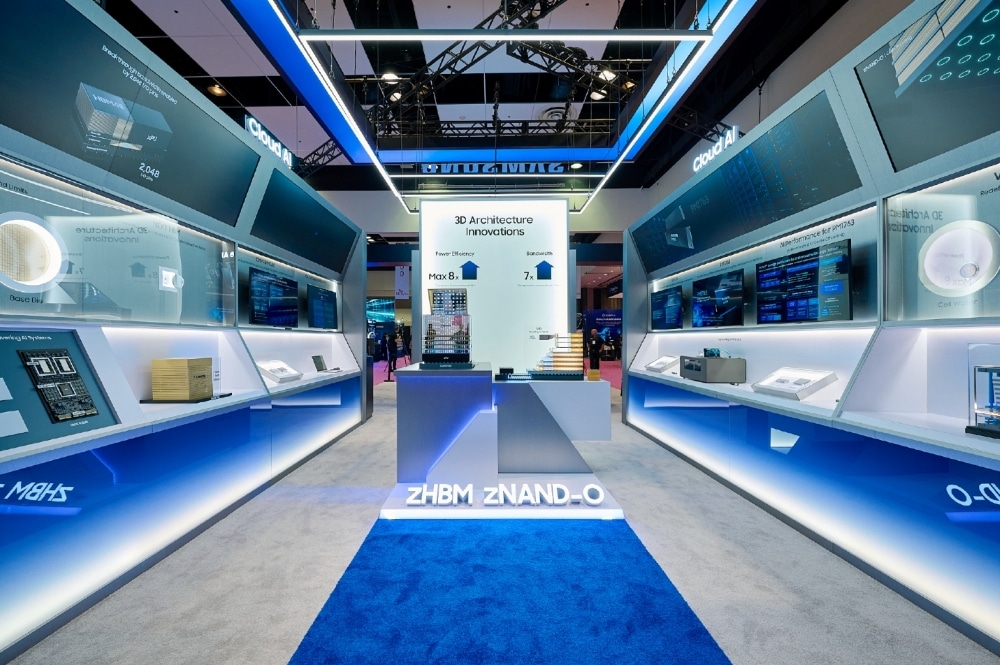
Image credit: Samsung
South Korean companies supply the memory that makes AI accelerators usable. SK hynix and Samsung between them held roughly 79% of the high-bandwidth memory market in early 2026, and HBM is the component that feeds data to a GPU fast enough to keep its compute units busy. Without it, an Nvidia accelerator spends most of its time waiting.
That position gives two Korean firms structural leverage over the entire AI buildout. Nvidia can design a faster chip, but it cannot ship one without HBM stacks that only three companies in the world can manufacture — and two of them are Korean. SK hynix alone is reported to cover about two-thirds of Nvidia’s HBM4 demand for the Vera Rubin generation.
How Big Is the Korean Share of AI Memory?
| Company | HBM share Q1 2026 | DRAM share Q1 2026 |
|---|---|---|
| SK hynix | 58% | 29% |
| Samsung | 21% | 38% |
| Micron | 21% | 22% |
The HBM figures have moved considerably. SK hynix held 69% in Q1 2025 and slid to 56% by Q3 2025 before stabilising near 58%. Samsung climbed the other way, from 13% to 23% over the same period, then settled around 21%. Micron roughly doubled from 18% to a steady 21%.
In standard DRAM the ranking flips: Samsung reclaimed leadership at 38% in Q1 2026 while SK hynix fell from 36% a year earlier to 29%. That divergence tells you something about strategy. SK hynix concentrated on the high-margin AI memory niche; Samsung defended breadth across the whole memory market while catching up on HBM.
Why HBM Decides How Fast AI Runs
An AI accelerator is not compute-limited in the way people assume. It is fed-limited. Training and inference both involve moving enormous quantities of weights and activations between memory and processing units, and conventional DRAM cannot supply data at anything close to the required rate.
HBM solves this by stacking DRAM dies vertically, connecting them with through-silicon vias, and sitting the stack directly beside the processor on the same package. The result is bandwidth measured in terabytes per second rather than gigabytes. This is why memory suppliers, not just chip designers, sit on the critical path of every AI infrastructure deployment.
Manufacturing it is genuinely hard. Stacking sixteen thin dies with sub-micron alignment, bonding them without trapping voids, keeping thermal resistance low enough that the bottom die does not cook, and achieving acceptable yield across the whole stack — that combination is why only three companies produce HBM at scale. The material science involved is covered in our overview of materials required for AI chip production.
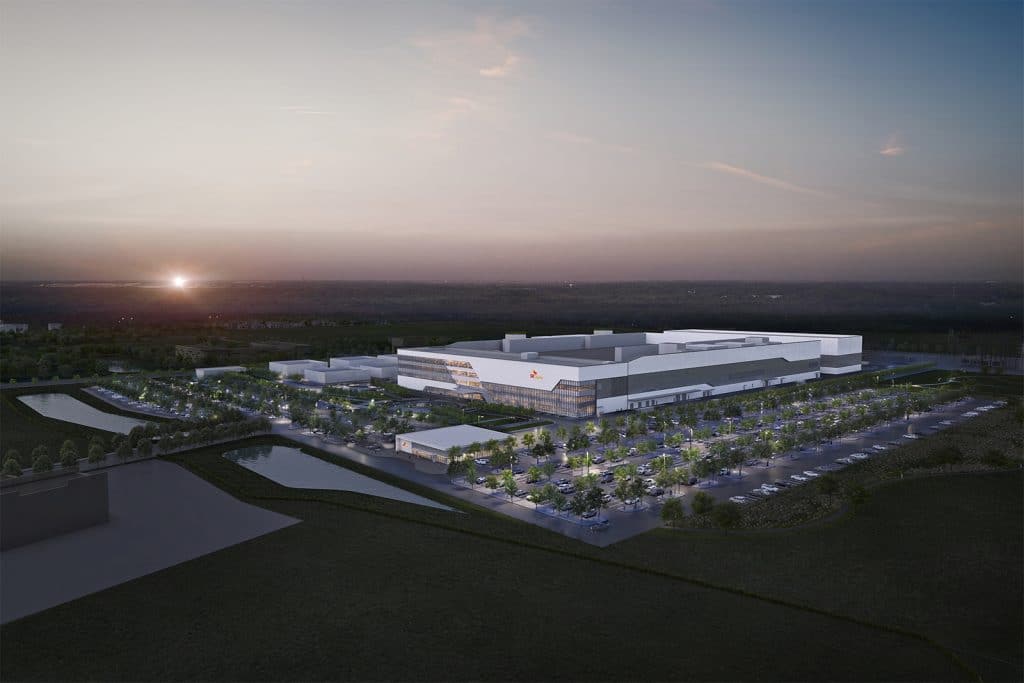
Rendering of the AI memory advanced packaging production base being constructed by SK Hynix in West Lafayette, Indiana, U.S. Image credit: SK hynix
SK hynix: The Incumbent With the Nvidia Relationship
SK hynix built its lead by being first and staying qualified. It established a mass-production system for HBM4 in September 2025 and began mass shipments during the second quarter of 2026, with parts hitting customer-required operating speeds and what the company describes as industry-leading power efficiency and cost competitiveness. HBM4E samples went out in the first half of 2026.
The financial result has been extraordinary. Q2 2026 revenue reached KRW 79.32 trillion, roughly $55 billion, up 51% from the prior quarter and 257% year on year. Operating profit came in at KRW 60.54 trillion for a 76% operating margin — a figure more typical of software than of capital-intensive manufacturing.
The company has sold out its DRAM, NAND and HBM supply through 2026 and is pursuing long-term agreements with roughly ten major customers to lock in volumes. Its expansion runs through the P&T7 packaging facility, the M17 NAND base and a new semiconductor cluster, with M15X scheduled for utilisation in mid-2027 and infrastructure investment raised to more than four times previously announced levels.
Samsung: The Comeback
Samsung spent 2024 and much of 2025 struggling to qualify its HBM with Nvidia, and priced HBM3E around 30% below SK hynix to compete. That gap has closed. With HBM4, Samsung reached price parity, and co-chief executive Jun Young-hyun reported the shift in customer sentiment directly: “On HBM4 in particular, customers have even stated that ‘Samsung is back’.”
Its Q2 2026 numbers were the strongest in company history: KRW 171.5 trillion in revenue, up 28% quarter on quarter, and KRW 89.5 trillion in operating profit. The Device Solutions semiconductor division alone produced KRW 127.5 trillion of revenue and KRW 89.2 trillion of operating profit, with sales up 56% sequentially.
Pricing did much of that work. Average selling prices rose by a mid-40% margin for DRAM and a high-60% margin for NAND against the previous quarter, while DRAM bit shipments grew only in the low teens. Samsung expects HBM4 sales to more than triple quarter on quarter in Q3 2026, reaching well over 60% of its total HBM revenue mix.
Samsung’s HBM4E Specifications
At GTC in March 2026 Samsung unveiled seventh-generation HBM4E running at 16 Gbps per pin for 4.0 TB/s of bandwidth, built on 16-plus-layer stacking with hybrid copper bonding that cuts thermal resistance by more than 20% against conventional bonding. Its shipping HBM4 for Vera Rubin runs at 11.7 Gbps per pin with headroom to 13 Gbps.
The construction is a two-process product: sixth-generation 1c DRAM on a 10nm-class node for the memory dies, paired with a control logic die built on a 4nm foundry process. That logic die is where memory makers now differentiate, and it pulls them into competition with foundries as much as with each other. For context on what these stacks attach to, see our breakdown of Nvidia Blackwell server specifications.
Capacity, Capital and the Supply Squeeze
Demand outpaces what either company can produce, and both are spending accordingly.
| Commitment | Samsung | SK hynix |
|---|---|---|
| HBM capacity plan for 2026 | Roughly 50% increase; pledged at GTC to triple capacity within the year | Expansion tied to packaging capacity at P&T7 |
| Major new fab | P5, Pyeongtaek, operational by 2028 | M15X, utilisation from mid-2027 |
| HBM4 status | Shipping to Nvidia and AMD from February 2026 | Mass shipments from Q2 2026 |
| HBM4E status | First samples shipped to major customers | Samples completed in H1 2026 |
The single largest supply commitment sits outside the Nvidia relationship. In October 2025 both companies signed on to OpenAI’s Stargate project with a target of 900,000 DRAM wafers per month — a volume that would consume a meaningful share of global capacity on its own. Industry expectations put the shortage at roughly two more years, given how quickly AI data centre construction is running ahead of fab schedules.
Both firms also appeared as infrastructure partners in Anthropic’s $65 billion Series H alongside Micron, which shows how far up the value chain memory suppliers have moved. They are no longer only vendors to AI companies; they are investors in them.
What This Concentration Means
Three companies supplying all HBM, with two of them in one country, creates a chokepoint that no amount of GPU design work removes. Nvidia anticipates close to $1 trillion in chip orders through 2027, and every one of those accelerators needs Korean or American memory stacks that take years of qualification to bring online.
It also concentrates macroeconomic risk. Memory has become a large enough share of Korean exports and of the KOSPI index that AI sentiment now moves the country’s equity market directly — a linkage visible in our coverage of the KOSPI’s 10% plunge and the AI stock rally.
The competitive question for the rest of 2026 is whether Samsung’s HBM4E momentum converts into a larger share of Nvidia’s next allocation, and whether Micron’s steady 21% grows as customers deliberately diversify away from a single dominant supplier. Custom accelerator programmes add another variable, since designs such as Google’s TPUs also consume HBM in volume — the reason our guide to tensor processing units matters to memory demand as much as to compute.
The Short Version
South Korea does not design the AI chips that get the headlines. It manufactures the memory without which those chips deliver a fraction of their rated performance, holds close to four-fifths of that market, and is now earning software-like margins from it. That is the role, and for the next two years at least, nobody is positioned to take it.
If you are interested in this topic, we suggest you check our articles:
- Essential Materials for AI Chip Production & Manufacturing
- NVIDIA Blackwell Server: Specs, Power and Capabilities
- AI Infrastructure: Essential Components in Modern ML Systems
- KOSPI’s 10% Plunge: What It Means for the AI Stock Rally
- What Is a Tensor Processing Unit (TPU)? A 2026 Guide
Sources: Counterpoint Research, SK hynix Newsroom, Samsung Global Newsroom, TrendForce, Data Center Dynamics
Written by Alius Noreika