Key Takeaways
- On June 23, 2026, South Korea’s KOSPI fell 9.99% to close at 8,204 points — its steepest single-day drop in more than three months — triggering a circuit breaker that halted trading for 20 minutes.
- Samsung Electronics and SK Hynix each lost more than 12%. The two memory makers account for roughly 40–50% of the index and drove about 70% of its 2026 gains, so their fall dragged the whole market down.
- The KOSPI had climbed more than 100% during 2026, peaking above 9,000, almost entirely on demand for AI memory chips. One day before the crash, SK Hynix became South Korea’s most valuable listed company at about $1.35 trillion.
- The trigger was a leverage flush, not a collapse in AI demand. Borrowed-stock positions had hit a record ₩29 trillion, up 71% from late 2025, leaving the market stretched and primed for a fast unwind.
- Foreign investors sold a net ₩5.79 trillion (about $3.8 billion); local retail investors bought a record net ₩11.11 trillion, betting the AI story stayed intact.
- The shock spread to Japan, Taiwan, and Wall Street, hitting memory and AI names: Micron and SanDisk fell about 13%, Nvidia about 4%, and Japan’s Nikkei dropped roughly 3.5%.
- The KOSPI rebounded more than 3% the next day, and Micron’s record June 24 earnings — revenue up 346% and an $50 billion guide — reset confidence in the AI memory cycle.
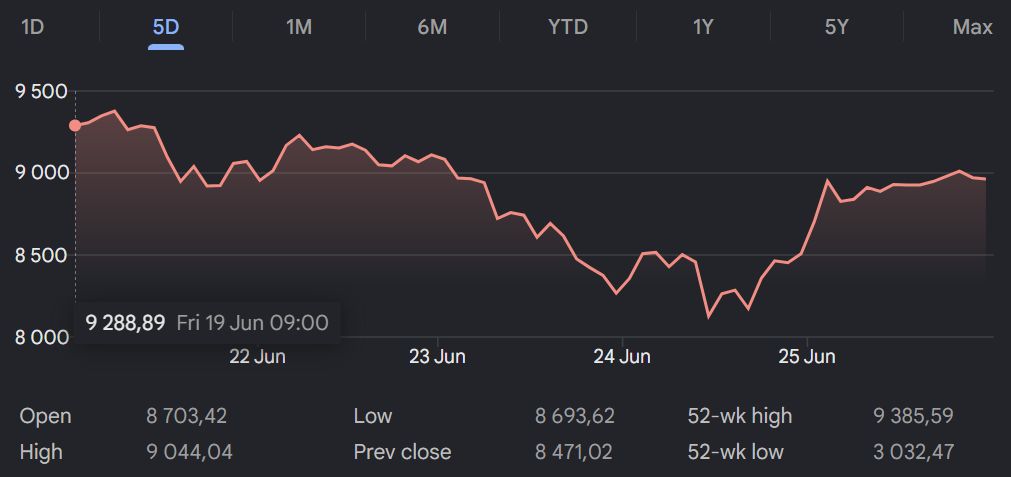
KOSPI plunge and the steady recuperation. Image credit: Google
The KOSPI’s near-10% drop on June 23, 2026 was a concentration-and-leverage shock, not the end of the AI trade. Because Samsung Electronics and SK Hynix together make up close to half of South Korea’s benchmark and produced roughly 70% of its 2026 gains, a sharp sell-off in those two memory makers mechanically pulled the entire index down with them. The decline then rippled into AI and semiconductor stocks across Asia and the United States, since the same chips power the global build-out of AI data centers.
What the plunge did not do was break the rally’s engine. Demand for the high-bandwidth memory that feeds AI accelerators stayed strong, and the proof arrived within 48 hours: the KOSPI bounced back more than 3%, and Micron — the clearest public gauge of AI memory demand — posted record results and a forecast far above estimates. So the real impact on the AI rally was a hard test of nerves and a warning about froth and crowded positioning, rather than a verdict that the boom is over.
What happened on June 23, 2026
The KOSPI fell 9.99% and closed at 8,203.84 points, its third-worst session of the year and its largest single-day decline in over three months. The drop was severe enough to trip a market-wide circuit breaker, freezing trading for 20 minutes. Samsung Electronics slid about 12.3% and SK Hynix dropped roughly 12.5% in the same session. The Kospi 200 Volatility Index spiked to around 75, far above its usual reading near 20 — a measure of how violently prices were swinging.
The timing was striking. Just one day earlier, on June 22, SK Hynix had become South Korea’s most valuable publicly traded company, reaching a market capitalization of about $1.35 trillion after a 5.6% gain. The stock had run up nearly 190% during 2026. A market that celebrated a record on Monday went into freefall on Tuesday.
| Metric | Figure |
|---|---|
| KOSPI single-day move | −9.99%, closing at 8,204 |
| Samsung Electronics | −12.3% |
| SK Hynix | −12.5% |
| Kospi 200 Volatility Index | ~75 (normal ~20) |
| Foreign net selling | ₩5.79 trillion (~$3.8 billion) |
| Retail net buying | ₩11.11 trillion (record) |
| 2026 KOSPI run before the drop | +100%, peak above 9,000 |
Why two companies can sink an entire market
South Korea’s benchmark carries a structural vulnerability: a huge share of its weight sits in two names. Samsung and SK Hynix combined represent close to half of the KOSPI’s total market value, and they supplied the bulk of its 2026 climb. As long as both keep rising, the index looks healthy. When they drop together, nothing else on the exchange can offset the math — a 12% fall in two stocks that big guarantees a brutal index-level decline regardless of how every other company trades that day.
That concentration is the same reason the rally was so powerful on the way up. Investors weren’t only buying chipmakers; they were buying a direct claim on the AI hardware cycle. SK Hynix leads the high-bandwidth memory market, the specialized chips that sit beside Nvidia and AMD accelerators inside AI servers. When expectations get that ambitious, corrections tend to be just as dramatic.
The real trigger: a leverage flush, not collapsing demand
The sell-off began as a positioning reset rather than a demand scare. The Korean market had grown unusually stretched. Retail investors poured roughly ₩79 trillion into KOSPI shares during 2026, and borrowed-stock investment reached a record ₩29 trillion — up 71% from the end of 2025. When a market is leaning that hard on borrowed money, even a modest drop forces margin-related selling that feeds on itself. South Korean authorities have since moved toward tighter rules on leveraged products that amplified the swings.
There was no single catalyst. A mild U.S. tech sell-off on Monday spilled into Asian hours and intensified on Tuesday. The Federal Reserve had nudged its 2026 inflation forecasts higher, lifting bond yields and pressuring rate-sensitive growth stocks — and Korean tech, treated by traders as a high-beta proxy for the AI trade, is especially sensitive to those shifts. Nervousness ahead of Micron’s earnings added to the unease. James Reilly, senior markets economist at Capital Economics, read the wild moves as evidence of excessive froth in tech, questioning whether the rally could hold its pace. That framing captures the bear case neatly: when valuations price in years of flawless growth, it doesn’t take much to set off a stampede.
How the shock spread to global AI and chip stocks
The fear did not stay in Seoul. Japan’s Nikkei 225 fell about 3.5%, ending an eight-day winning streak, with SoftBank sliding more than 10% and chipmaker Kioxia tumbling around 15%. Taiwan’s market felt it too. On Wall Street, the Nasdaq dropped roughly 2% as memory and AI hardware names led the rout. The episode showed how tightly the global AI trade is now wired together — the same memory supply chain, the same handful of buyers, and the same anxious money moving in lockstep.
| Market / stock | Move during the sell-off |
|---|---|
| KOSPI (South Korea) | −9.99% |
| Nikkei 225 (Japan) | ~−3.5% |
| SoftBank | more than −10% |
| Kioxia | ~−15% |
| Micron / SanDisk (US) | ~−13% |
| Nvidia (US) | ~−4% |
| Nasdaq Composite | ~−2% |
Underneath the headline panic sits a genuine constraint that keeps drawing money into these names: AI’s enormous appetite for electricity and compute. Every frontier lab is racing to secure chips, power, and cooling, which is exactly why memory suppliers and the wider AI infrastructure stack have commanded such rich valuations. The volatility is the flip side of that scarcity-driven boom.
Why the KOSPI bounced back so quickly
The recovery was nearly as fast as the fall. On June 24, the KOSPI jumped more than 3% to around 8,471. Samsung rose 7–8% on news of a share buyback, SK Hynix added about 2.7%, and the index carved out a V-shaped session. This was not a one-off pattern: earlier in June, the KOSPI had plunged 8.2% and recovered almost the entire amount the next day. Retail investors, who bought a record amount during the crash, were positioned for exactly that snapback.
Dan Ives, head of tech research at Wedbush Securities, told clients his channel checks across Asia and enterprise AI demand showed no cracks in the armor, describing the Korean rout as a pause after a near-100% run rather than weakening fundamentals. The split in views — froth on one side, intact demand on the other — is the central tension hanging over the AI rally.
Micron’s record quarter and what it says about AI memory demand
The decisive evidence came after the U.S. close on June 24, when Micron reported fiscal third-quarter results. The numbers were not just a beat; they were a different order of magnitude. Revenue reached $41.46 billion, up 346% year over year and 74% sequentially, against roughly $35.8 billion expected. Adjusted earnings landed at $25.11 per share. Gross margin hit a company record of 84.9%, and the data center business multiplied more than sevenfold to about $11.5 billion. CEO Sanjay Mehrotra called it an exceptional quarter, and the stock surged 13–15% in after-hours trading toward roughly $1,186.
The forward guidance mattered even more than the quarter. Micron pointed to about $50 billion in revenue for the next quarter — far above the roughly $43.6 billion analysts expected — at gross margins near 86%. The company is also locking in multi-year “Strategic Customer Agreements,” shifting memory away from volatile spot pricing toward contracted, infrastructure-style deals. Markets tend to value contracted infrastructure more highly than commodity cycles, which is part of why the report reset sentiment so sharply.
| Micron fiscal Q3 2026 | Result | Expectation |
|---|---|---|
| Revenue | $41.46 billion (+346% YoY) | ~$35.8 billion |
| Adjusted EPS | $25.11 | ~$20.60 |
| Gross margin | 84.9% (record) | ~81.6% |
| Q4 revenue guidance | ~$50 billion ± $1B | ~$43.6 billion |
The bull case and the bear case for the AI rally
The plunge crystallized both sides of the debate. The bear case is straightforward: indexes leaning on two stocks and a record pile of margin debt are fragile, and memory has always been a cyclical business that mean-reverts once new capacity floods in. Synchronized expansion by Samsung, SK Hynix, and Micron in 2027–2028 could eventually pressure prices, and a 100% index gain in a single year leaves little room for disappointment.
The bull case rests on supply that is genuinely sold out. Micron’s entire 2026 high-bandwidth memory output is contracted, HBM4 is ramping for next-generation accelerators, and the DRAM shortage is among the most severe in years. Demand is no longer a single-customer story; it spans every major cloud builder. This is the same logic that pushes leading labs to control their own compute rather than rent it, and that turns an AI factory — chips, power, networking, and cooling assembled at scale — into the product itself. For now, the fundamentals are running ahead of the fear.
What to watch next
The clearest signals ahead are concrete, not promotional. Watch whether South Korean authorities keep tightening rules on leveraged trading, since draining speculative money would remove a source of buying pressure and demand genuine long-term investors to fill the gap. Watch the next round of HBM and DRAM pricing, which tests whether the shortage holds into 2027. And watch the policy track: Seoul is negotiating large semiconductor investments with Samsung and SK Hynix and has compressed its chip-cluster timeline by more than a decade, to a target of 2034–2035.
The June episode is best read as a stress test the AI rally passed — barely, and noisily. A market this concentrated will keep producing sharp drops, because the same factors that powered the climb also amplify every wobble. The plunge proved how quickly sentiment can crack; Micron’s quarter proved how quickly it can heal when the demand numbers show up. As long as AI servers keep absorbing every memory chip the three suppliers can make, the dips are likely to look more like leverage flushes than the top of the tower.
If you are interested in this topic, we suggest you check our articles:
- AI Infrastructure: Essential Components in Modern ML Systems
- OpenAI’s Infrastructure Push: Becoming Its Own Cloud Provider
- How Much Electrical Power Does AI Require?
- What Is Required for a Premium AI Infrastructure System?
- How AI Factory Engineering Works and Top Sectors to Benefit
Sources: CNN Business, CNBC, CNBC (Micron), Micron SEC Form 8-K, Investing.com, Investing.com (leverage flush), KuCoin, Cryptonomist, NBC News
Written by Alius Noreika