Key Takeaways
- Bankers have told prospective investors that Anthropic could raise upwards of $100 billion at a valuation near $2 trillion, which would make it the largest initial public offering on record.
- The figure rests on projected 2028 revenue of $190 billion to $200 billion, not on current results — roughly 10 times a forecast two years out, and about 31 times the present run rate.
- Anthropic’s annualised revenue run rate reached $65 billion at the end of July 2026, up from about $9 billion at the end of 2025.
- The company reported more than $11.5 billion in second-quarter revenue against $787 million a year earlier, with its first positive adjusted operating income.
- Anthropic has chosen Nasdaq, filed a confidential draft S-1 on 1 June 2026, and is working with Morgan Stanley, Goldman Sachs and JPMorgan toward an October listing.
- Analysts at ION Analytics estimate $59 billion to $79 billion in annual profit would be needed to justify $2 trillion at common Nasdaq 100 multiples.
- No Anthropic executive has confirmed the valuation. Every number in circulation comes from banker and investor discussions reported by the press.
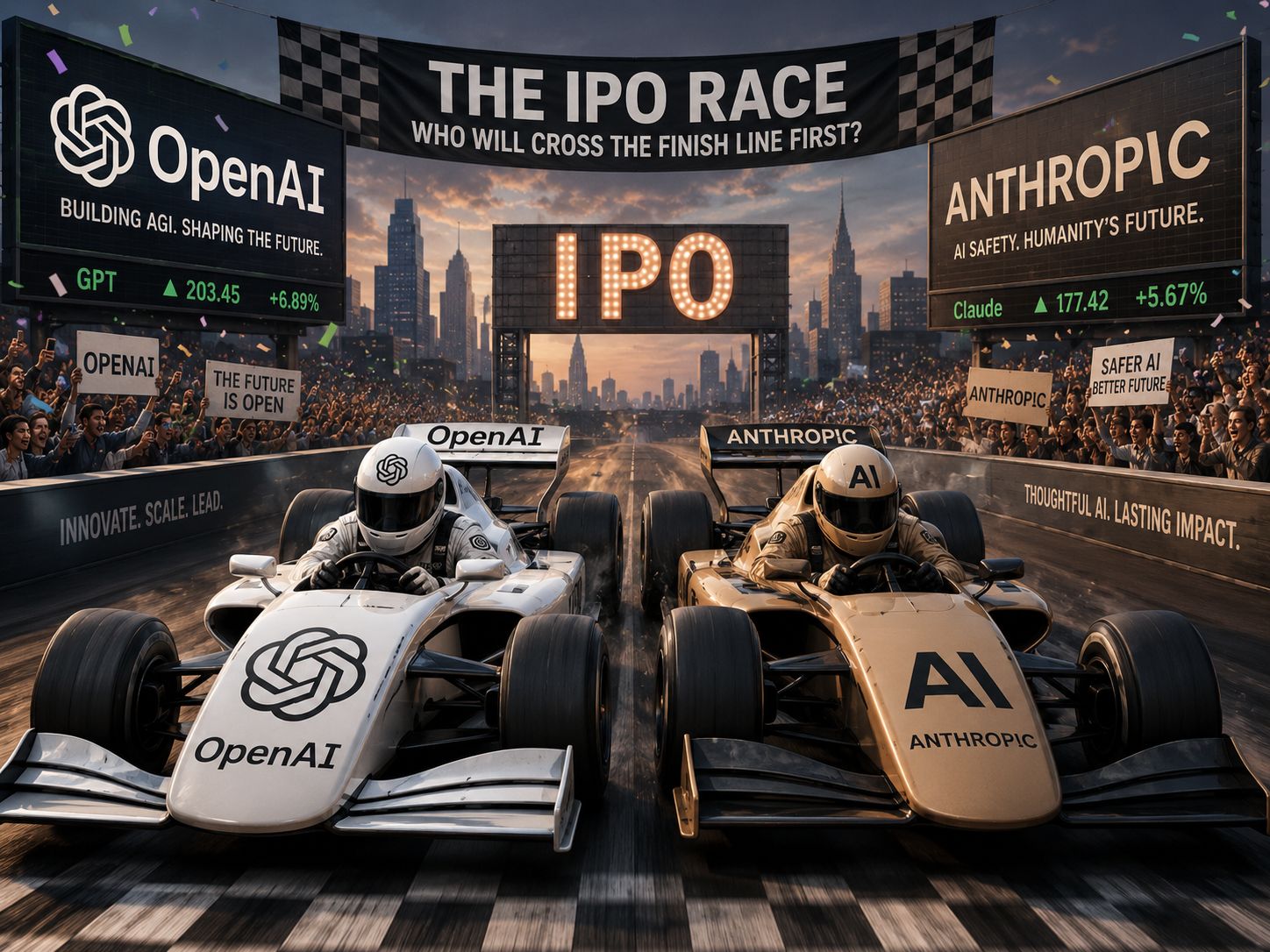
OpenAI vs Anthropic IPO race – artistic impression. Image source: Alius Noreika / AI
The $2 trillion figure is a forward bet, not a valuation of the business as it stands today. Bankers arriving at that number are applying revenue multiples to Anthropic’s projected 2028 performance — an unusually long reach that says as much about the current market for AI equity as it does about the company. At the top of the discussed range, the price implies roughly 10 times forecast 2028 revenue and about 31 times the annualised rate Anthropic is actually running at now.
The reason investors accept that stretch is the shape of the revenue curve underneath it. Anthropic’s run rate went from about $9 billion at the end of 2025 to $65 billion by the end of July 2026, a sevenfold rise in seven months, and the second quarter produced the company’s first positive adjusted operating income. A listing near $2 trillion would more than double the $965 billion post-money valuation set in May and would surpass SpaceX’s $86.3 billion June debut as the largest IPO ever completed.
The Revenue Curve That Anchors the Number
Run rate is the metric doing the heavy lifting, and it deserves a caveat before the numbers: it annualises a short recent period rather than reporting audited results, so it moves faster than recognised revenue and overstates a business that is decelerating. With that noted, the progression is the clearest argument the bankers have.
| Date | Annualised revenue run rate |
|---|---|
| End of 2025 | ~$9 billion |
| February 2026 | ~$14 billion |
| April 2026 | ~$30 billion |
| May 2026 (Series H close) | $47 billion |
| End of July 2026 | $65 billion |
| December 2026 (investor projection) | $100–120 billion |
Quarterly figures tell a similar story with firmer ground under them. First-quarter 2026 revenue was $4.73 billion. The second quarter passed $11.5 billion, more than fourteen times the $787 million booked in the same quarter of 2025 and a sequential gain above 140 percent. Bloomberg reported positive adjusted operating income for that quarter, with one analysis putting the figure at $559 million.
Two things temper the picture. The 2025 full-year recognised revenue was roughly $4.5 billion against reported net losses in the region of $42 billion, driven by compute costs. And the $65 billion print landed just under the $69 billion to $74 billion that third-party trackers had estimated, which is consistent with Anthropic tightening its own definition of run rate ahead of a listing. The S-1, expected in late September, will be the first time investors see audited numbers.
What Is Driving the Growth
The engine is enterprise, and within enterprise it is coding. Claude Code, the command-line agent that takes high-level instructions and executes them through tool calls, crossed $1 billion in annualised revenue by November 2025 and reached $2.5 billion by February 2026, with enterprise use making up more than half. Customers named publicly include Netflix, Spotify, KPMG and Salesforce.
Market-share data supports the pitch. Ramp’s corporate-spend figures put Anthropic at 34.4 percent of enterprise AI spending as of June 2026, ahead of OpenAI’s 32.3 percent for the first time. Menlo Ventures survey data has Anthropic at roughly 40 percent of enterprise API spending against OpenAI’s 27 percent, and around 54 percent of enterprise AI coding work. That gap is the core of the case, and it runs in the opposite direction on the consumer side — a split examined in more detail in our look at how OpenAI and Anthropic compare on sales.
Margins have moved as well. SemiAnalysis reported Anthropic’s gross margin on inference infrastructure rising from roughly 38 percent to above 70 percent in a year, as improving hardware cut the marginal cost of serving each token while customer prices held. That expansion is what turned a loss-making operation into one posting an operating profit, and it explains why investors treat the growth as more than a land-grab.
The Arithmetic Behind $2 Trillion
Working backwards from the price makes the assumptions visible. Analysts at ION Analytics estimate that justifying a $2 trillion valuation at multiples common among Nasdaq 100 companies would require $59 billion to $79 billion in annual profit. Anthropic has just posted its first profitable quarter. Getting from one to the other requires the 2028 revenue forecast to arrive roughly intact, plus margins holding while compute spending continues.
| Measure | Figure | Implied on a $2 trillion valuation |
|---|---|---|
| Current run rate (end July 2026) | $65 billion | ~31x |
| Projected 2028 revenue | $190–200 billion | ~10x |
| Last private valuation (May 2026) | $965 billion | ~2.1x uplift |
| Secondary market implied value | $1.05–1.15 trillion | ~1.8x uplift |
| Profit needed at Nasdaq 100 multiples | $59–79 billion annually | ION Analytics estimate |
The gap between the secondary market at $1.05–1.15 trillion and the banker figure near $2 trillion is the part worth watching. Private holders trading shares today are pricing the company roughly 40 to 45 percent below the discussed listing valuation. That spread has to close through the roadshow, and it is the reason the final number remains unsettled.
Who Is Underwriting It, and When
Anthropic confidentially submitted a draft S-1 to the SEC on 1 June 2026 and selected Nasdaq, the venue that hosted SpaceX’s record debut. Morgan Stanley is reported as the likely lead-left bank, with Goldman Sachs handling post-listing stabilisation and JPMorgan also in a senior role; Citigroup and Barclays are expected in syndicate positions. Nvidia has been discussed as an anchor investor with a potential commitment of up to $10 billion. The company has also finalised a $15 billion credit facility while the process runs.
The public S-1 is expected in late September, with the formal roadshow beginning in mid-October and the listing targeted before the November midterm elections. No share price, share count or ticker has been announced, and the timetable remains subject to market conditions and SEC review.
The SpaceX Precedent Cuts Both Ways
The closest available comparison is not encouraging for anyone buying at the open. SpaceX priced at $135 per share on 12 June 2026, closed its first day at about $161, and peaked around $225 within days. By late July, shares had fallen roughly 50 percent from that peak, wiping out about a trillion dollars of paper value and costing Elon Musk his trillionaire status. The lesson public markets delivered was that a mega-valuation built on banker projections gets tested against quarterly results within weeks.
Anthropic’s defenders argue its case is harder to inflate, because enterprise revenue is a more verifiable number than a total addressable market slide. The counter-argument is that the multiple being asked for is higher relative to proven profit, and that the AI trade as a whole has shown it can move violently — as it did when the KOSPI fell nearly 10 percent in a single session on leverage unwinding rather than any change in AI demand. Investors weighing indirect exposure may also want context on how concentrated AI has become within the S&P 500, where AI-linked names now account for roughly 45 percent of index market capitalisation.
Risks the Prospectus Has to Address
Several items sit between the pitch and the price.
Compute obligations. Anthropic has committed to compute deals totalling roughly $517 billion across the next decade, including $45 billion with Nscale, $18 billion with Akamai, a partnership with AMD for two gigawatts of MI450 GPUs, and a six-year, $13.7 billion agreement with RUM Group signed this month. The company does not own its data centres, renting instead from AWS, Google, Nscale, Akamai and others. That asset-light structure helped the margin improvement and creates dependency risk the S-1 must quantify.
Governance. Anthropic is a Delaware public benefit corporation, a form that permits directors to weigh non-shareholder interests, including the company’s safety mission, against returns. A Long-Term Benefit Trust holds special shares designed to elect a majority of the board over time, meaning public shareholders may not control the board after listing. No PBC has attempted to trade at anything close to this valuation, and whether that structure survives into the prospectus is among the most consequential open questions.
Legal and political exposure. The Pentagon designated Anthropic a supply chain risk in March 2026 after the company refused to remove contractual prohibitions on mass domestic surveillance and fully autonomous weapons. A federal judge ruled the designation unconstitutional in August; a separate challenge in Washington DC remains pending. The Pentagon has also been reviewing whether Claude played a role in a strike in Iran, a matter that remains unresolved and that the prospectus will need to disclose.
Public sentiment. A Gallup survey published in May found roughly seven in ten Americans opposed AI data centre construction in their local area. Anthropic has pre-emptively listed “AI backlash” as a formal risk factor.
What to Watch Next
Three dates matter. The public S-1 in late September brings audited financials, the voting structure and the full scope of legal exposure. The mid-October roadshow will show whether institutional demand supports the discussed range or pulls it toward the secondary-market level. And the pricing itself will set the benchmark against which every other private AI company gets measured — OpenAI, valued at roughly $852 billion and confirmed as not listing in 2026, most of all.
For a fuller comparison of how the numbers stack up against rivals heading to market, see our breakdown of Anthropic’s IPO filing against its AI competitors, and for the wider market backdrop, which AI stocks have actually delivered returns this year.
This article is for information only and is not investment advice. Valuations, run rates and raise sizes described here come from press reporting of private banker and investor discussions and have not been confirmed by Anthropic. Figures are accurate as of 18 September 2026 and may change before any listing.
If you are interested in this topic, we suggest you check our articles:
- Anthropic Files for IPO: How It Compares to AI Rivals
- Is OpenAI More Successful in Sales Than Anthropic Claude?
- Which AI Stock is the Biggest in the S&P 500?
- Best-Performing AI Stocks as of June 2026: Top Gainers
- KOSPI’s 10% Plunge: What It Means for the AI Stock Rally
Sources: Bloomberg, CNBC, Tech Times, European Business Magazine, Wikipedia (SpaceX IPO)
Written by Alius Noreika