Key Takeaways
- It depends entirely on which sale you mean. OpenAI dominates consumer distribution; Anthropic leads where businesses buy model capacity by the token.
- OpenAI’s annualised revenue passed $40 billion in August 2026, roughly doubling from more than $20 billion at the end of 2025.
- Anthropic announced its run-rate revenue crossed $47 billion in May 2026. Bloomberg noted the two companies may calculate run rate differently, so the comparison is not exact.
- In enterprise LLM API spending, Anthropic holds about 40% against OpenAI’s 27%, according to Menlo Ventures survey data.
- For AI coding specifically, Claude commands roughly 54% of enterprise usage against Codex at about 21%.
- OpenAI reaches more than 900 million weekly ChatGPT users, over 50 million consumer subscribers and more than 9 million paying business users. Claude sits near 30 million weekly users.
- OpenAI’s gross margin runs around 33%, weighed down by inference costs of $8.4 billion in 2025 rising toward $14.1 billion in 2026, and it lost $38.5 billion in 2025 on $13.07 billion of revenue.
OpenAI logo on a smartphone screen. Image source: Levart_Photographer via Unsplash, free license
Neither company is straightforwardly ahead. OpenAI sells to more people than any software company in history and takes more consumer subscription money than Anthropic will see for years. Anthropic sells more model capacity to businesses, wins a larger share of developer spending, and appears to be running a healthier business per dollar of revenue.
On the headline number, Anthropic reported crossing $47 billion in run-rate revenue in May 2026 while OpenAI passed $40 billion in August 2026 — but Bloomberg flagged that the two may compute run rate on different bases, so a direct comparison overstates precision. On distribution, the gap runs the other way and is not close: roughly 900 million weekly ChatGPT users against about 30 million weekly Claude users.
Two Companies Selling Two Different Products
The revenue mix explains almost everything else.
| Revenue source | OpenAI | Anthropic |
|---|---|---|
| Token-based API | Minority of revenue | Roughly 70% to 75% |
| Subscriptions | Large share, driven by 50M+ consumer subscribers | Roughly 10% to 15% |
| Enterprise | More than 50% of revenue as of mid-2026 | About 80% of revenue from business customers |
| Advertising | Early-stage, newly introduced | None |
OpenAI runs a consumer business with a rapidly growing enterprise attachment. Anthropic runs a developer and enterprise business with a small consumer tail. Those are different companies wearing similar labels, and judging them on one metric flatters whichever one that metric favours. Our comparison of OpenAI and Anthropic valuations works through the same divergence from the investor side.
Where OpenAI Is Clearly Ahead
Reach and Consumer Monetisation
ChatGPT passed 900 million weekly active users and over a billion monthly. More than 50 million people paid for a consumer subscription as of February 2026, alongside more than 9 million paying business users. No other AI product is within an order of magnitude, and consumer subscription revenue at that scale is difficult for a rival to replicate quickly.
Growth Rate
Quarterly revenue moved from $5.7 billion in Q1 2026 to $6.7 billion in Q2 2026, and co-founder Greg Brockman said the company posted more than 20% month-over-month revenue growth in July 2026. CFO Sarah Friar confirmed OpenAI ended 2025 above $20 billion in annualised revenue, meaning it doubled inside eight months.
Product Surface Area
Growth came from three distinct places: coding tools including Codex, which reached 20 million weekly active users by mid-August 2026; ChatGPT Work subscriptions for enterprise teams; and an advertising business that barely existed a year earlier. Anthropic sells nothing comparable to that third line. OpenAI has also built out distribution through partners, including a partner network reportedly targeting hundreds of thousands of AI consultants.
Where Anthropic Is Clearly Ahead
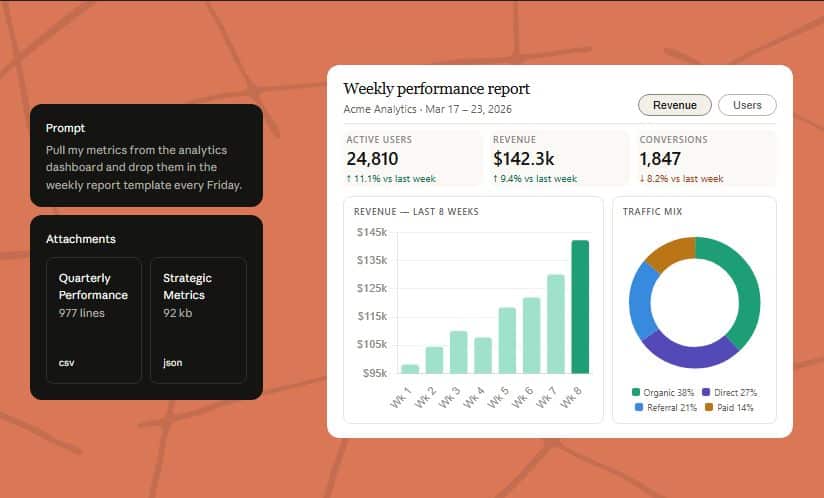
Working with Claude Cowork. Image source: Anthropic
Enterprise API Share
Among businesses buying model capacity through APIs, Anthropic holds roughly 40% of spending against OpenAI’s 27%, based on Menlo Ventures survey data. That reverses a position OpenAI held decisively as recently as 2023, when it took about half the market. Google has taken share from both.
Coding, the Largest Enterprise Workload
| Vendor | Enterprise AI coding share |
|---|---|
| Anthropic (Claude) | About 54% |
| OpenAI (Codex) | About 21% |
Claude Code alone reached $2.5 billion in annualised revenue by February 2026, having more than doubled since the start of that year. Coding is the single largest category of enterprise AI spending, and Anthropic’s lead there is wide and has been growing.
Customer Value
Anthropic counted more than 300,000 business customers as of October 2025 and over 100,000 running Claude through Amazon Bedrock by April 2026. The more telling figures are at the top of the base: customers spending more than $100,000 a year grew sevenfold in twelve months, and customers spending over $1 million a year doubled to more than 1,000, up from roughly a dozen two years earlier.
That is a company landing large contracts rather than accumulating small ones — the pattern our review of Claude’s 2026 trajectory traces through the year.
The Cost Side Nobody Puts in a Press Release
Sales success is not only revenue. It is revenue against what the revenue costs to serve, and here the two businesses diverge sharply.
| Measure | OpenAI |
|---|---|
| Gross margin | About 33% |
| Inference cost 2025 | $8.4 billion |
| Inference cost 2026, projected | $14.1 billion |
| 2025 revenue | $13.07 billion |
| 2025 net loss | $38.5 billion |
| Projected 2026 cash burn | $27 billion |
A 33% gross margin is the structural cost of serving hundreds of millions of free users. Every free ChatGPT conversation consumes inference capacity and returns nothing directly. Anthropic’s customer base pays per token, which means its serving costs scale with revenue rather than against it. Anthropic has not published gross margin, so this comparison is one-sided, but the business model difference is real and it favours the enterprise seller.
What the Capital Markets Think
| OpenAI | Anthropic | |
|---|---|---|
| Latest valuation | $852 billion (March 2026) | $965 billion (May 2026) |
| Most recent raise | $122 billion | $65 billion Series H |
| IPO status | Confidential filing June 2026, listing targeted 2027 | Confidential filing 1 June 2026 |
| Total funding raised | Not disclosed in full | About $125 billion |
Anthropic’s Series H drew Altimeter, Dragoneer, Greenoaks and Sequoia as leads, with Amazon, Blackstone, Fidelity, GIC, T. Rowe Price and Temasek participating, plus memory suppliers Micron, Samsung and SK hynix as infrastructure partners. Anthropic CFO Krishna Rao framed the round around demand: “Claude is increasingly indispensable to our growing global community of customers.”
Both companies filed confidentially for public listings in June 2026, which means the sales comparison stops being a matter of selective disclosure within a year. Our analysis of Anthropic’s IPO filing against its rivals covers what those documents will have to reveal.
So Which One Is Winning?
Score it by category and the picture is unambiguous.
| Category | Leader |
|---|---|
| Total users | OpenAI, by roughly 30 to 1 |
| Consumer subscription revenue | OpenAI |
| Reported run-rate revenue | Anthropic, with a methodology caveat |
| Enterprise API spend share | Anthropic, 40% to 27% |
| AI coding share | Anthropic, 54% to 21% |
| Product breadth and new revenue lines | OpenAI |
| Revenue per customer | Anthropic |
| Unit economics | Likely Anthropic, on available evidence |
If “successful in sales” means selling to the most people, OpenAI wins and it is not close. If it means capturing the most enterprise budget per unit of effort, Anthropic wins. If it means building a business that survives without perpetual fundraising, Anthropic’s model looks sturdier today — though OpenAI’s advertising and consumer scale give it options Anthropic does not have.
The most useful framing is that these are complementary rather than identical races, a point developed further in our wider look at how competitive the GenAI model race has become.
What Would Settle It
Three things. Standardised revenue reporting once both companies are public, which ends the run-rate ambiguity. Anthropic’s gross margin disclosure, which will show whether the enterprise model really is healthier or merely smaller. And whether OpenAI’s enterprise push — already above 50% of revenue and growing 50% quarter to date — recaptures API share from Anthropic, or whether coding remains a category Claude simply owns.
Until then, anyone claiming a clean winner is choosing a metric first and drawing the conclusion second.
If you are interested in this topic, we suggest you check our articles:
- OpenAI vs Anthropic: Who Will Have the Higher Valuation?
- Anthropic Files for IPO: How It Compares to AI Rivals
- xAI vs OpenAI vs Anthropic: Which AI Lab Wins in 2026?
- GenAI Model Race: Competition Analysis 2026
- Claude’s 2026 Trajectory: Growth, Features, and Market Position
Sources: Anthropic, Bloomberg via Yahoo Finance, Sacra (OpenAI), Sacra (Anthropic), Menlo Ventures, Menlo Ventures State of Generative AI, ValueAdd VC
Written by Alius Noreika