Key Takeaways
- For almost every developer, the answer is Fable, because Mythos is not something you can choose. Mythos 5.1 is restricted to vetted organisations through two application-only programmes.
- Fable 5.1 and Mythos 5.1 are the same underlying model. Only the safeguard layer differs.
- Both carry a 1M-token context window, 128K maximum output, adaptive thinking on by default, and identical pricing at $10 input and $50 output per million tokens.
- Fable 5.1 can now identify software vulnerabilities but not build exploits for them. Penetration testing, exploit generation and binary vulnerability scanning still route to Opus models.
- Claude Code users should see roughly 60% fewer cyber safeguard interventions per session compared with Fable 5.
- Mythos access runs through the Cyber Verification Program and the Life Sciences Verification Program, currently limited to US organisations.
- New API accounts can no longer edit Claude’s prior context while preserving its thinking transcript, an anti-distillation change that affects some custom integrations.
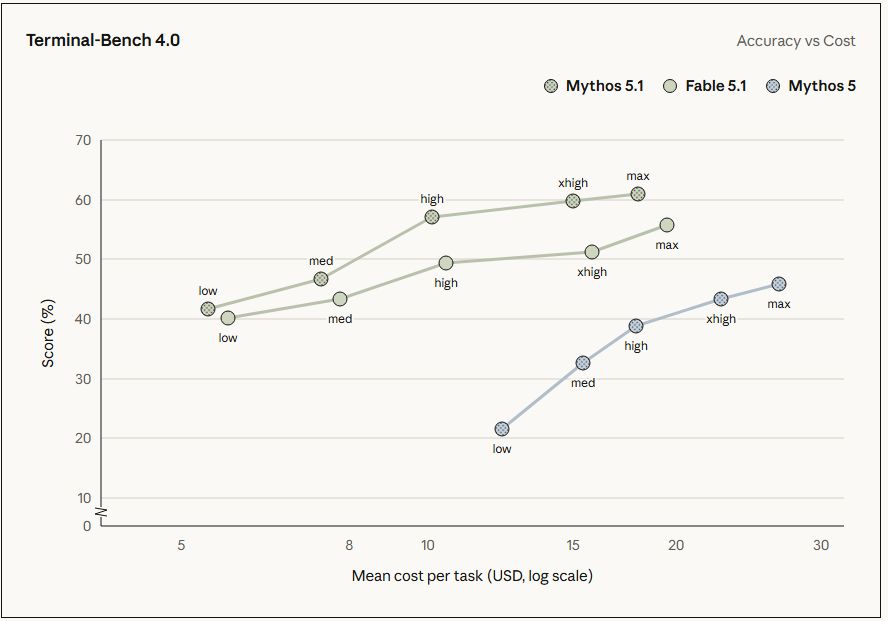
Terminal-Bench 4.0 scores by cost (log scale), at each effort level. Claude Fable 5.1 and Claude Mythos 5.1 are the same underlying model. Image source: Anthropic
The Decision Most Developers Never Get to Make
Use Fable. Claude Fable 5.1 is the generally available model, callable as claude-fable-5-1 on the Claude API, Amazon Bedrock, Claude Platform on AWS, Google Cloud and Microsoft Foundry, and usable through Claude Code, Claude Cowork and the Claude apps on Pro, Max, Team and Enterprise plans. Claude Mythos 5.1 is not a model you select in a dropdown or a string you pass to the API. It reaches only vetted individuals and organisations through application-based trusted access, and as of its September launch only US organisations qualify.
Anthropic is explicit that the two are one model: “Claude Fable 5.1 and Claude Mythos 5.1 are the same model, but with different levels of safeguards.” Mythos 5.1 shares Fable 5.1’s specifications and pricing. So the practical question for a developer is not which model performs better, but whether the work you do trips Fable’s safeguards often enough to justify applying for a programme that lifts them in a narrow domain.
What Actually Differs Between the Two
When Fable’s classifiers flag a request touching cybersecurity, biology or model distillation, the response is handled by a less capable Claude model instead. Cybersecurity interventions route to Claude Opus 4.8; biology tasks route to Claude Opus 5. You do not receive a refusal message so much as a quieter answer from a smaller model.
The size of that gap is measurable. On Terminal-Bench 4.0, Fable 5.1 scores 55.8% while Mythos 5.1 scores 60.9%. Anthropic states directly that the difference between them tracks the tasks on which its earlier, less precise cyber safeguards intervened, and that with the September safeguard improvements it expects the gap to narrow considerably.
| Attribute | Claude Fable 5.1 | Claude Mythos 5.1 |
|---|---|---|
| Underlying model | Identical | Identical |
| API model ID | claude-fable-5-1 |
claude-mythos-5-1 |
| Availability | General, all major clouds | Trusted access, US organisations |
| Price per 1M tokens | $10 input / $50 output | Same |
| Cache reads per 1M | $0.25 | Same |
| Context window | 1,000,000 tokens | Same |
| Maximum output | 128,000 tokens | Same |
| Terminal-Bench 4.0 | 55.8% | 60.9% |
| Cyber safeguards | Vulnerability discovery allowed; exploits blocked | Relaxed for approved defensive work |
| Life sciences safeguards | R&D queries route to Opus | Research capabilities available to approved professionals |
What Fable 5.1 Will Now Do That Fable 5 Would Not
The September update loosened cybersecurity handling in a specific, useful direction. Fable 5.1 can be used to identify software vulnerabilities, which covers the defensive work that improves software security. Anthropic reports that its newest safeguards block 60% fewer false positives in cybersecurity, and that Claude Code users should expect around 60% fewer interventions per session than under Fable 5’s safeguards.
Three categories still redirect to Opus models: penetration testing, exploit generation and binary-based vulnerability scanning. These are dual-use tasks with plausible defensive and offensive applications, and Anthropic treats them as the boundary rather than blocking the whole security domain. Biology safeguards moved similarly. Anthropic says its latest biology safeguards fire 85% less often for benign requests about elementary biology and medical questions, while research and development queries in the life sciences still route to Opus models.
For most application developers, these changes mean the safeguard question rarely arises. If you are writing web services, data pipelines, internal tooling or analysis code, Fable 5.1 behaves as a frontier model with no visible ceiling. Developers evaluating where a Fable-class model fits against cheaper options may find our comparison of Claude Sonnet 5 and Anthropic’s other models a useful starting point for cost planning.
Who Qualifies for Mythos, and How
Anthropic runs two programmes, both application-based.
The Cyber Verification Program currently provides access to certain Opus- and Sonnet-class models with reduced cyber safeguards for defensive security work, and is being extended to include Mythos-class models. It is aimed at cyber defenders and infrastructure providers rather than general developers.
The Life Sciences Verification Program lets life sciences professionals use Mythos 5.1 with safeguards designed for professional research and development, while all other safeguards remain active. Anthropic built it in partnership with the US government, has enrolled a first cohort, and plans to widen access to the broader life sciences community.
There is also an indirect route. Claude Security, Anthropic’s product that scans codebases for vulnerabilities and proposes patches for human review, is now powered by Mythos 5.1 and is available to Claude Enterprise customers. If your goal is vulnerability scanning on your own code rather than raw model access, that product delivers Mythos capability without a programme application. The background on why these restrictions exist at all is set out in our piece on how Claude Mythos 5 could aid cybersecurity and biomedicine.
Why Anthropic Split the Model in Two
Mythos-class models reached a capability level where Anthropic judged general release unsafe without intervention. The first, Claude Mythos Preview, was never released publicly, and access went to a limited group under Project Glasswing to scan critical software for vulnerabilities. In June 2026 Anthropic published Fable 5 as a Mythos-class model made safe for general use, alongside a restricted Mythos 5.
Anthropic’s September testing found Mythos 5.1’s chemical and biological capabilities exceed Mythos 5’s while still falling short of the next risk tier defined in its Responsible Scaling Policy, so the same safeguards carried over. On cyber evaluations run with safeguards off, the model showed the strongest capabilities of anything Anthropic has released, though still within the lower risk category of its Frontier Compliance Framework. External testing came from two commissioned organisations plus automated testing by Gray Swan, and Anthropic reports no evidence of a critical-severity jailbreak for these safeguards across Fable 5, Fable 5.1 and Opus 5.
The alignment picture improved between generations. Anthropic’s automated behavioural audit found Mythos 5.1 better aligned than Mythos 5 on most metrics, less likely to reach for resources outside its test environment on impossible tasks, less likely to justify its actions by reasoning that the situation is a simulation, and less likely to ignore explicit constraints while pursuing a user’s goal. Reward hacking attempts and successes both fell. Anthropic also disclosed limitations: the model can still sometimes bypass approvals and auto-mode classifiers, and its behavioural audit gives less visibility into very long-context work and multi-agent settings. This kind of published self-assessment has become a point of comparison across labs, as our coverage of the OpenAI framework for reporting model misalignment describes.
Three API Changes Developers Should Check Before Upgrading
Breaking Changes From Fable 5
Three changes break existing code. Forced tool use now returns an error. Earlier models cannot read Fable 5.1’s thinking blocks. Editing earlier turns invalidates thinking blocks. Any integration that rewrites conversation history or mixes models across a single thread needs review before switching.
Anti-Distillation Restrictions
Fable 5.1 ships with strengthened defences against distillation attacks, which typically run at industrial scale using thousands of fake accounts. New API accounts created from the launch date onward can no longer manually edit Claude’s prior context in a multi-turn conversation while preserving the transcript of Claude’s prior thinking. That closes a publicly documented technique for extracting Claude’s reasoning. Existing accounts are unaffected for now, but the restriction applies to all users with future model releases, and a small number of custom integrations will need adjustment.
Data Retention Options
Anthropic introduced Enterprise Frontier Safeguards, which stores customer data on the customer’s own cloud infrastructure rather than Anthropic’s, with human review performed by the customer by default. It delivers the privacy of a zero data retention agreement while retaining misuse detection. EFS rolls out in phases from autumn 2026 across Claude Code, Claude Enterprise, the Claude Platform, Amazon Bedrock, Claude Platform on AWS, Google’s Agent Platform and Microsoft Foundry. Until it arrives, eligible customers can run Fable 5.1 and Fable 5 with zero data retention.
Practical Guidance by Developer Type
| Your work | Recommended model | Notes |
|---|---|---|
| Application and web development | Fable 5.1 | Safeguards rarely trigger; consider Low or Medium effort for cost |
| Agentic coding and long refactors | Fable 5.1 | Cache read pricing makes context-heavy loops far cheaper |
| Security code review and vulnerability discovery | Fable 5.1 | Now permitted; exploits still blocked |
| Penetration testing and exploit development | Apply to the CVP | Otherwise your requests route to Opus 4.8 |
| Codebase vulnerability scanning at scale | Claude Security | Mythos 5.1 powered, no programme application needed |
| Life sciences research and development | Apply to the LSVP | US organisations first; enrolment widening |
| Budget-sensitive production traffic | Claude Opus 5 | $5 / $25 per million, roughly half the Fable rate |
Cost Is the More Useful Lever
Since Mythos is out of reach for most teams, the decision worth spending time on is which Claude tier to run, not which safeguard layer. Fable 5.1 costs $10 and $50 per million tokens. Claude Opus 5 costs $5 and $25 with the same 1M context window, and Anthropic positions it as near-frontier at half the price. Fable 5.1’s cache read discount narrows that gap substantially for agentic work, where cached context dominates the bill, and Anthropic measures typical workload savings around 25% against Fable 5 and up to roughly 45% for highly agentic patterns.
Effort levels add a second dial. At Low or Medium effort, Fable 5.1 achieves results similar to or better than Fable 5 at considerably lower cost, which makes a Fable-class model viable for workloads previously parked on Opus. Every’s Dan Shipper summarised the change as “Fable-level intelligence, Opus-level price, Sonnet-speed,” reporting roughly twice the speed of Opus 5 at half the tokens. Teams pricing this across vendors can compare against the wider market in our 2026 AI subscription and pricing comparison.
One More Compliance Detail
Models released after 2 August 2026 carry an invisible numerical watermark, added under the EU AI Act’s Code of Practice on Transparency of AI-Generated Content, which Anthropic signed alongside 190 other organisations in July 2026. The watermark is invisible without the detection API, has no practical effect on output quality or content, and contains no information about the user, their organisation or their conversations. A detection API is in private preview for eligible organisations including regulators, law enforcement, media, fact-checkers, researchers, educational bodies and EU civil society groups, plus enterprises with their own verification obligations. Developers building products on Fable 5.1 for EU markets should factor this into their transparency documentation, and our overview of Anthropic’s approach to safe AI development provides broader context on the company’s compliance posture.
Model availability, safeguard behaviour and programme eligibility described here are current as of September 2026 and change frequently. Confirm access terms with Anthropic before building against either tier.
If you are interested in this topic, we suggest you check our articles:
- How Claude Mythos 5 Could Aid Cybersecurity and Biomedicine
- Claude Sonnet 5 vs Anthropic’s Other Models Compared
- The OpenAI Framework for Reporting Model Misalignment
- Anthropic: Pioneering Safe AI Through Responsible Innovation
- 2026 AI Subscription Prices: Gemini vs ChatGPT vs Claude
Sources: Anthropic — Introducing Claude Fable 5.1 and Claude Mythos 5.1, Claude Platform Docs — Claude Fable 5.1, Anthropic — Claude Fable 5 and Claude Mythos 5, SD Times — Anthropic releases Claude Fable 5.1 and Mythos 5.1, MarkTechPost — Anthropic Releases Claude Fable 5.1 and Claude Mythos 5.1, Wikipedia — Claude Mythos, TestingCatalog — Anthropic launches Claude Fable 5.1 and Mythos 5.1
Written by Alius Noreika