Key Takeaways
- Claude Sonnet 5, released June 30, 2026, is Anthropic’s most agentic mid-tier model, sitting between Haiku 4.5 and the Opus tier.
- It reaches close to Opus 4.8 quality on many tasks at a fraction of the price, and it is the new default model for Free and Pro users.
- Pricing is $2 input / $10 output per million tokens through August 31, 2026, then $3 / $15 — versus Opus 4.8’s $5 / $25 and Fable 5’s $10 / $50.
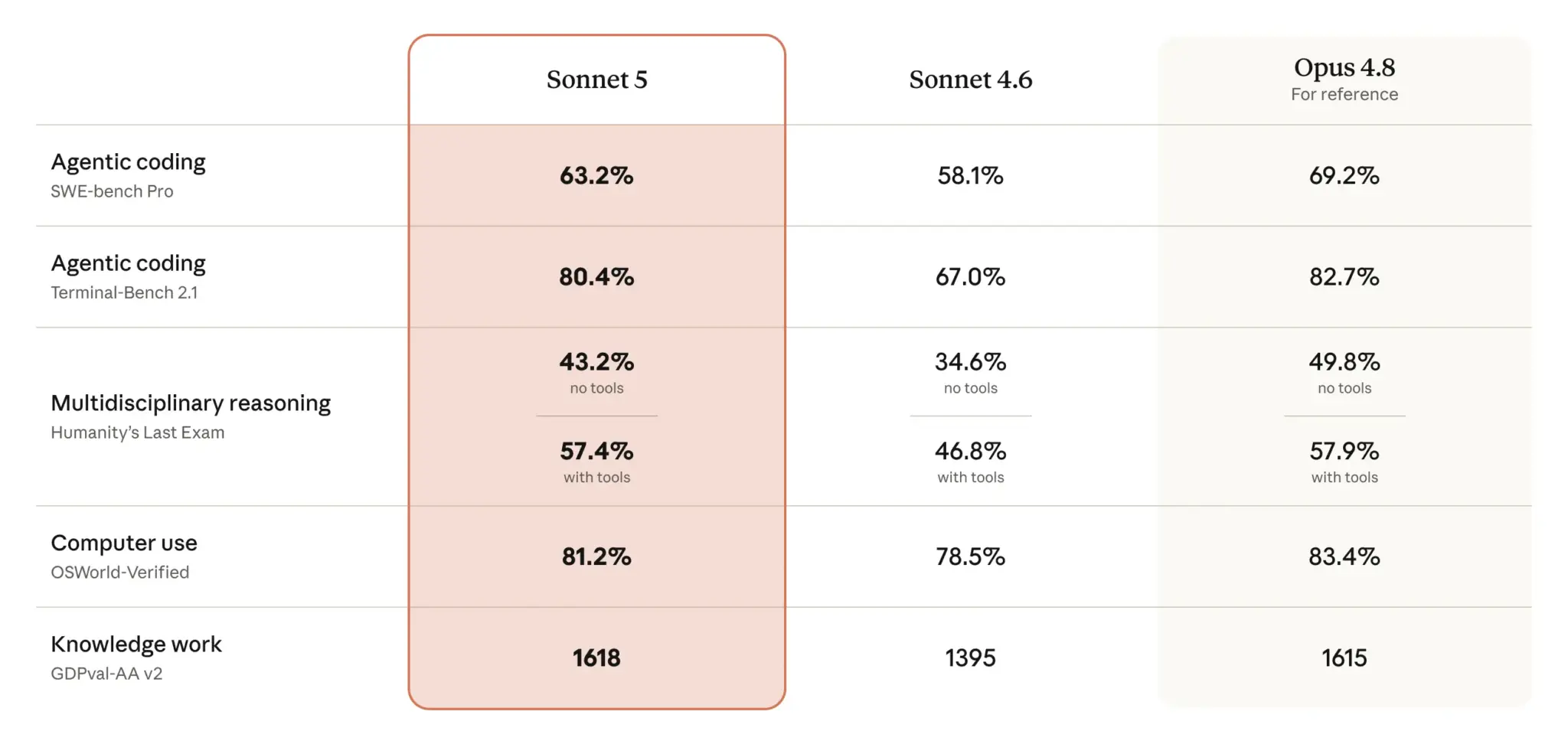
- It beats Sonnet 4.6 on every published benchmark and even edges Opus 4.8 on Terminal-Bench and on GDPval knowledge work.
- Opus 4.8 still leads on the hardest coding (SWE-Bench Pro), advanced mathematics and accuracy-critical cybersecurity.
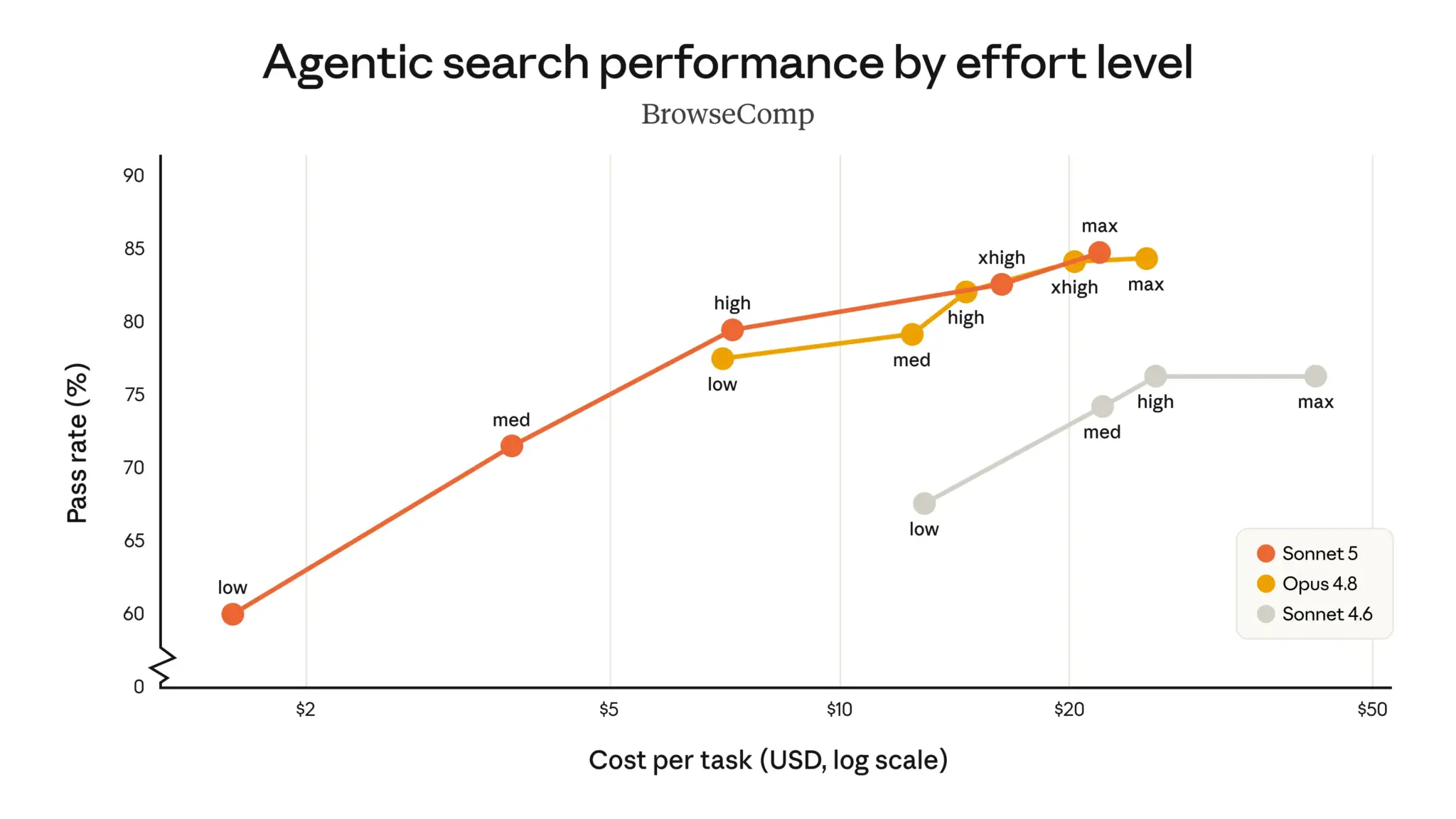
- At the highest effort setting, Sonnet 5 can cost more than Opus 4.8 for similar quality, so effort level matters.
- The lineup moved again on July 24, 2026 when Claude Opus 5 launched as the new Opus-tier flagship, slotting between Sonnet 5 and Fable 5.

Claude Sonnet 5 art. Image credit: Anthropic
Claude Sonnet 5 is the model that collapses the old gap between Anthropic’s mid tier and its flagship. Released on June 30, 2026, it delivers near-Opus-4.8 performance at Sonnet pricing, which makes it the right default for the large majority of coding, agentic and knowledge-work tasks. Where earlier generations forced a stark choice between a cheap Sonnet and a much stronger, much pricier Opus, Sonnet 5 and Opus now sit on a single cost-performance curve.
The practical framing is a routing decision rather than a single winner. Send most agentic coding, tool use and knowledge work to Sonnet 5. Reserve the Opus tier for accuracy-critical tasks and the hardest problems. Keep Haiku 4.5 for high-volume, latency-sensitive calls. That policy holds even after the lineup shifted again with Opus 5’s late-July arrival.
Claude Sonnet 5 across the Anthropic lineup – graphic. Image credit: Anthropic
Where Sonnet 5 Sits in the Lineup
Anthropic’s family runs from fast and cheap to most capable: Haiku 4.5 for speed and volume, Sonnet 5 as the balanced default, the Opus tier for hard, long-horizon work, and Fable 5 — the first generally available Mythos-class model — above them all. Sonnet 5 replaced Sonnet 4.6 as the balanced pick and became the default on Free and Pro plans, while also running in Claude Code, the Claude API, Cursor, VS Code and GitHub Copilot. It ships with a 1-million-token context window and selectable reasoning effort.
| Model | Role | Price (input / output per million) | Released |
|---|---|---|---|
| Haiku 4.5 | Fast, high-volume, low latency | $1 / $5 | Oct 2025 |
| Sonnet 5 | Balanced default, most agentic Sonnet | $2 / $10 intro, then $3 / $15 | Jun 30, 2026 |
| Opus 4.8 | Hard coding, accuracy-critical work | $5 / $25 | May 2026 |
| Opus 5 | New Opus flagship, long agentic chains | $5 / $25 | Jul 24, 2026 |
| Fable 5 | Most capable widely available (Mythos-class) | $10 / $50 | Jun 9, 2026 |
Benchmarks: Sonnet 5 Against Sonnet 4.6 and Opus 4.8
Against its predecessor, Sonnet 5 wins across the board. It scores 72.7% on SWE-bench Verified versus Sonnet 4.6’s 62.3%, and its biggest jump is on Terminal-bench, up more than 20 points to 76.1%. On the harder SWE-bench Pro it reaches 63.2%, and on OSWorld it hits 81.2%.
The surprising part is how close it runs to Opus 4.8. Sonnet 5 actually edges Opus on Terminal-Bench 2.1 and draws level or ahead on GDPval knowledge-work ratings. Opus 4.8 keeps a meaningful lead where it counts most for demanding users: roughly six points on SWE-bench Pro, a wide margin on advanced mathematics, and a clear edge on cybersecurity accuracy. Sonnet 5 was also tuned with deliberately low cyber capability, which is a safety feature rather than a shortfall. For a fuller read on how the Opus versions line up behind Fable, see our Opus 4.6 vs 4.7 vs 4.8 comparison.
Claude Sonnet 5 across the Anthropic lineup. Image credit: Anthropic
The Cost Story, and a Catch
Sonnet 5’s headline appeal is value. Through August 31, 2026 it runs at $2 input and $10 output per million tokens, then $3 / $15 — comfortably under Opus 4.8’s $5 / $25. For high-volume agent workflows, that is a large saving on work that used to justify the flagship. There is a catch worth auditing: Sonnet 5 uses a new tokenizer that can map the same text to between 1.0 and 1.35 times more tokens than earlier models, and Anthropic set introductory pricing to be roughly cost-neutral against Sonnet 4.6 to account for it. A second catch: at the highest effort setting, Sonnet 5 can cost more than Opus 4.8 for comparable quality, so the best value sits at low and medium effort. Our wider AI subscription price comparison shows how these tiers land for everyday users.
What It Feels Like in Real Work
Early partners described concrete jobs rather than benchmark abstractions. One tester asked Sonnet 5 to investigate a bug; it wrote a reproducing test, implemented a fix, and confirmed the bug returned without the change, all in a single pass. Another ran it on hard pull requests, where it traced failures to root causes and shipped durable fixes rather than symptom patches. Zapier handed it a two-part business task — updating Salesforce account tiers, then sending a launch email to enterprise contacts — which it finished end to end. That agentic reliability, more than any single score, is what Anthropic built the release around. Developers who work in the terminal will find our guide to Claude Code a useful companion.
The Lineup Moved Again: Opus 5
Any comparison dated to late July 2026 has to note the newest arrival. Claude Opus 5 launched on July 24, 2026 as the drop-in successor to Opus 4.8 at the same price, built for long-running agents and the hardest coding chains. It slots into the ladder between Sonnet 5 and Fable 5, which sharpens the routing logic rather than changing it: Sonnet 5 stays the fast, cheap workhorse for everyday professional work, Opus 5 becomes the pick for genuinely hard code and long agentic runs, Haiku 4.5 wins on speed and scale, and Fable 5 sits on top when maximum capability justifies its separate billing. The role of the top tier, and why its access is handled carefully, is covered in our piece on Claude Mythos 5.
Which Claude Should You Use?
For most people and most tasks, Sonnet 5 is now the correct default: it delivers results that recently required a $5 model, at a mid-tier price. Reach past it only when the job is unusually hard, accuracy-critical, or cyber-sensitive, in which case the Opus tier or Fable 5 earns its premium — and drop down to Haiku 4.5 whenever latency and volume dominate over raw capability.
Benchmarks and pricing are anchored to Anthropic’s June 30, 2026 announcement and to independent testing through late July 2026. Introductory pricing and the lineup change frequently, so verify current rates before committing production workloads. This is informational, not procurement advice.
If you are interested in this topic, we suggest you check our articles:
- Claude Opus 4.6 vs 4.7 vs 4.8: Which Model Wins?
- Best AI LLM for Vibe Coding: Complete 2026 Tier List
- Claude Code: Anthropic’s AI Terminal Assistant for Developers
- How Claude Mythos 5 Could Aid Cybersecurity and Biomedicine
- 2026 AI Subscription Prices: Gemini vs ChatGPT vs Claude
Sources: Build Fast with AI, Codersera, Tech Insider
Written by Alius Noreika