Key Takeaways
- Dario and Daniela Amodei left OpenAI at the end of 2020 over disagreements about safety and how AI should be developed, not over the Microsoft investment.
- Dario has stated the reason directly: “It is incredibly unproductive to try and argue with someone else’s vision,” and later added that a lack of trust made continuing impossible.
- Dario spent roughly five years at OpenAI leading research, including work on GPT-2 and GPT-3; Daniela led safety and policy.
- Five other researchers left with them, and the group founded Anthropic in early 2021 with Dario as CEO and Daniela as President.
- Their core conviction was that scaling works predictably, and that safety therefore has to be built into training from the start rather than added afterwards.
- Dario has said publicly that he does not trust Sam Altman while describing Google DeepMind’s Demis Hassabis as trustworthy.
- The decision looks different in 2026: Anthropic closed a $65 billion round at a $965 billion valuation in May and is heading toward a Nasdaq listing.
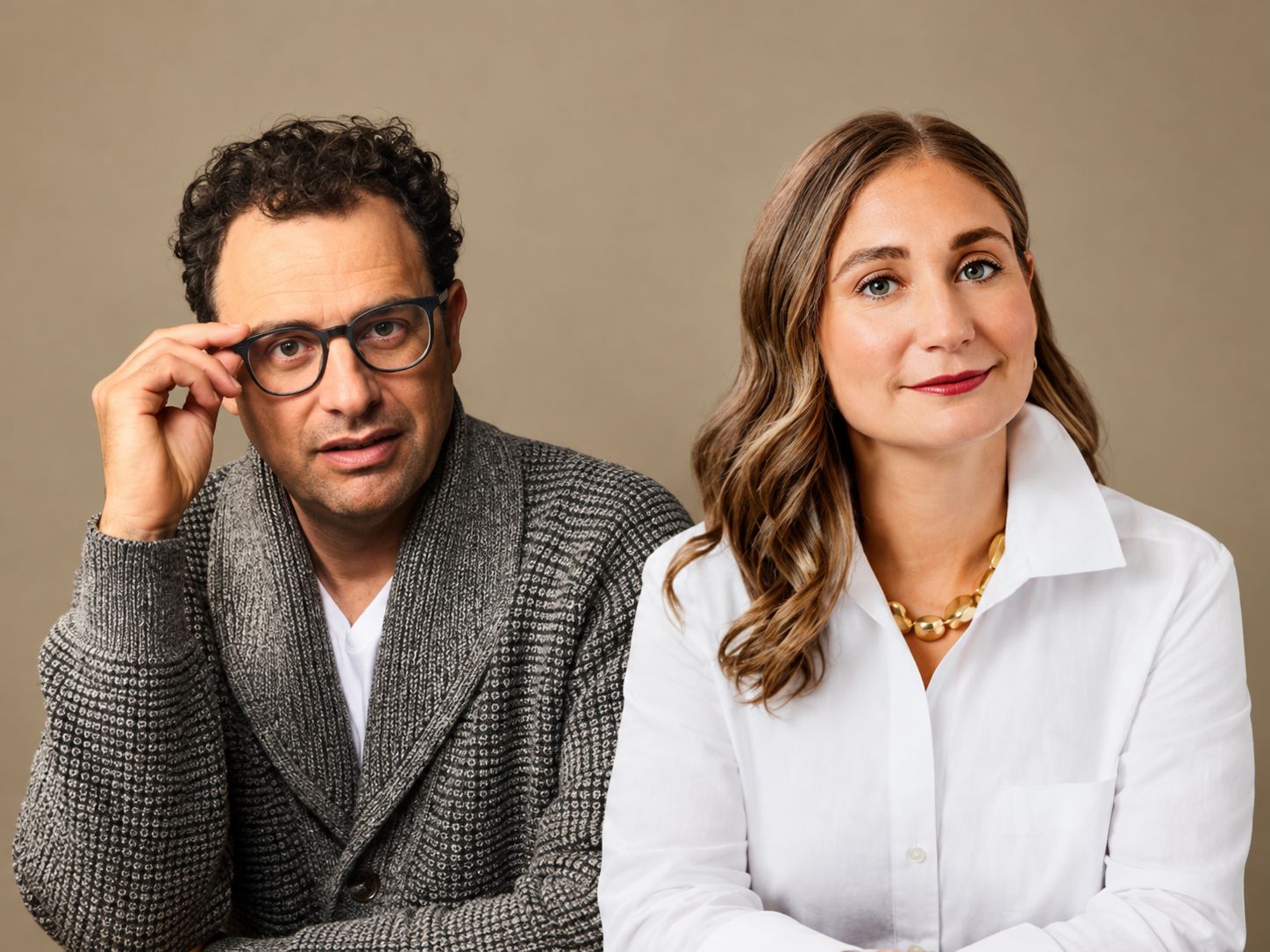
Dario and Daniela Amodei. Image source: Anthropic
Dario and Daniela Amodei left OpenAI because they had a specific view of how powerful AI should be built and concluded they could not implement it from inside someone else’s organisation. Dario has given the reason in almost the same words on several occasions, most compactly in his interview with Lex Fridman: “It is incredibly unproductive to try and argue with someone else’s vision.” Rather than stay and fight for his approach, he told himself to “take some people you trust and go make your vision happen.”
He has also been unusually direct about what he was not leaving over. “There’s a lot of misinformation out there” about the departure, he said. “People say we left because we didn’t like the deal with Microsoft. False.” Dario had been directly involved in commercialising GPT-3 and did not object to commercial work as such. The disagreement was about safety practice and how a company building increasingly capable systems should govern itself.
What Each of Them Did at OpenAI
Dario joined OpenAI in 2016 and became one of its most senior research leaders, eventually serving as Vice President of Research. He helped scale the early GPT models and pushed the argument that more data and more compute produce predictably more capable systems — a position OpenAI came around to. Daniela held senior responsibility for safety and policy. By the end of 2020, both had concluded the company’s direction no longer matched their own.
Two convictions drove the split, and they are connected. The first is that scaling works: capability improves reliably with compute and data, which means the trajectory is foreseeable rather than surprising. The second follows from it — if these systems approach human-level capability on a predictable schedule, then how they are governed is the central problem rather than a footnote. Dario, Daniela and their colleagues wanted safety treated as part of training from the beginning, with interpretability, steerability and alignment built in rather than patched on afterwards. That argument did not land internally with the weight they thought it deserved.
The Trust Question
For years Dario framed the departure primarily around vision. In a June 2026 Bloomberg interview for “The Circuit with Emily Chang” he added the other half openly, in remarks widely read as directed at Sam Altman.
“At the end of the day, why argue with someone when you don’t have the same vision and you don’t trust them?” he said. “The way to resolve it is you go off and do your thing, they go off and do their thing. And I am completely at peace with the idea that we’re doing things our way and they’re doing things their way.”
He was more specific elsewhere in the same conversation: “When you feel that you can’t trust someone, when you feel that their values are not what they say they are, when you feel that they’re not honest, that makes it very hard to continue to work with a company.” He contrasted that with his view of Google DeepMind CEO Demis Hassabis, whom he described as trustworthy — making clear the objection was to a particular person rather than to competitors generally.
Those remarks drew attention partly because of timing. Ronan Farrow’s New Yorker investigation examining whether Altman could be trusted had recently been published, and Dario’s contemporaneous notes about his interactions with Altman during his OpenAI years are cited throughout that report. Altman has offered his own reading of the friction, telling the Core Memory podcast in April 2026: “I think the doomerism talk hasn’t helped. I think the way certain other labs talk about us hasn’t helped,” adding, “I think the way Anthropic talks about OpenAI doesn’t help.”
Dario’s stated position is that the argument is not worth continuing. The verdict, he has said, will come from customers and public opinion rather than from relitigating what happened in 2020.
Who Left and What They Built
Seven people walked out together, and Anthropic was founded in early 2021 with Dario as Chief Executive and Daniela as President. The founding group included researchers who had worked on OpenAI’s most significant results, among them Tom Brown, Jared Kaplan, Sam McCandlish, Chris Olah, Jack Clark and Ben Mann.
| Element | Detail |
|---|---|
| Departure | End of 2020 |
| Company founded | January 2021 |
| Founders | Dario Amodei (CEO), Daniela Amodei (President), and five other former OpenAI researchers |
| Corporate form | Delaware public benefit corporation |
| Stated mission | Responsible development and maintenance of advanced AI for the long-term benefit of humanity |
| Governance feature | Long-Term Benefit Trust holding special shares designed to elect a board majority over time |
The structural choices carry the original argument forward. Incorporating as a public benefit corporation explicitly permits directors to weigh non-shareholder interests, including the safety mission, against returns. The Long-Term Benefit Trust was designed to keep market pressure from overriding that mission. Both exist because the founders believed good intentions alone are not durable when incentives pull the other way — which was, in essence, their read on what they had just left.
The technical programme followed the same logic. Anthropic developed Constitutional AI, which trains models against an explicit set of principles rather than relying solely on human feedback, alongside interpretability research aiming to reverse-engineer neural networks into something humans can audit. The company describes the difficulty with a chess analogy worth repeating: it is easy for a grandmaster to spot a novice’s bad moves, and very hard for a novice to spot a grandmaster’s. Our profile of Anthropic’s approach to safe AI development covers that research portfolio in more detail.
Dario’s “Race to the Top”
The strategy that followed was not to win by dominating the market. Dario called it a race to the top: build a company that demonstrates the responsible approach is also commercially viable, and competitors will be pressured to match it. Leading by example rather than by market share.
That framing has been tested repeatedly. In February 2026, Defence Secretary Pete Hegseth threatened to remove Anthropic from the Pentagon supply chain unless it dropped contractual prohibitions on using Claude for mass domestic surveillance and fully autonomous weapons. Anthropic refused. The Pentagon designated it a supply chain risk in March, an action a federal judge later ruled unconstitutional as First Amendment retaliation. Whatever one concludes about the underlying dispute, it demonstrated the company treating its stated limits as binding when they carried a real commercial cost.
In September 2026, Dario published an essay calling on the whole industry, his own company included, to slow the rate of capability gains, committing Anthropic to permanent employee-level access for independent evaluators. Sam Altman backed the call within hours and said OpenAI would match that commitment. Six years after the split, both labs are now competing on safety posture as well as capability — which is closer to the outcome Dario described than to a simple rivalry.
How the Decision Looks in 2026
By any commercial measure, the bet worked. Anthropic closed a $65 billion Series H in May 2026 at a $965 billion post-money valuation, briefly passing OpenAI in private worth for the first time. Annualised revenue reached $65 billion by the end of July, up from about $9 billion at the end of 2025, and the second quarter produced the company’s first positive adjusted operating income. Bankers have discussed a Nasdaq listing at a valuation near $2 trillion.
The position is lopsided in a revealing way. Anthropic leads on enterprise spending and dominates enterprise AI coding, while ChatGPT holds an overwhelming share of consumer traffic — a contrast examined in our comparison of how OpenAI and Anthropic perform on sales and in our wider look at which AI lab wins in 2026. The safety-first positioning turned out to be an enterprise sales argument as much as a philosophical one, since buyers in regulated industries want models that behave predictably.
Dario himself holds views that sit awkwardly with running a company of this size. He has put 90 percent confidence on AGI-level capability within ten years, said half of white-collar entry-level jobs could disappear within five, and called for mandatory third-party testing of frontier models along with government authority to block unsafe deployments. He is asking regulators for power to constrain systems his own company sells — which is either the most consistent position available to him or the least comfortable, depending on your reading.
The short answer to why they left, then, is that they wanted to build AI a particular way and concluded arguing about it was wasted effort. Whether that judgment was right is a question the market and the public are still answering, which is roughly where Dario himself has left it. For the products that came out of the decision, see our overview of Claude’s 2026 trajectory, and for the financial picture heading into the listing, our breakdown of Anthropic’s IPO filing against its rivals.
If you are interested in this topic, we suggest you check our articles:
- Anthropic: Pioneering Safe AI Through Responsible Innovation
- Anthropic Files for IPO: How It Compares to AI Rivals
- xAI vs OpenAI vs Anthropic: Which AI Lab Wins in 2026?
- Claude’s 2026 Trajectory: Growth, Features, and Market Position
- Is OpenAI More Successful in Sales Than Anthropic Claude?
Sources: Inc., Business Insider via AOL, Wikipedia, Fortune, Tech Times, Forbes
Written by Alius Noreika