Key Takeaways
- Yes. SpaceX completed the acquisition of Anysphere, the company behind the Cursor coding tool, in mid-August 2026, confirming the close through an SEC Form 8-K filing.
- The price was $60 billion, paid entirely in SpaceX stock — roughly 391 million Class A shares, with Cursor’s outstanding options and restricted stock units assumed by the buyer.
- The purchase route was unusual: xAI secured an option in April 2026 to either buy Cursor for $60 billion or pay $10 billion for a collaboration, and SpaceX exercised the buy side on 16 June 2026.
- Cursor now sits inside the SpaceXAI division as a wholly owned subsidiary, alongside Grok and X.
- SpaceX had listed on Nasdaq under the ticker SPCX on 12 June 2026, raising $85.7 billion, four days before announcing it would exercise the option.
- Cursor’s stated reason for accepting was compute: the company said the deal gives it “access to the largest fleet of GPUs in the world.”
- Anysphere reached $1 billion in annual recurring revenue by November 2025 and was valued at $29.3 billion in its Series D that same month, meaning SpaceX paid roughly double the private round price nine months later.
- The transaction is the largest startup acquisition on record.
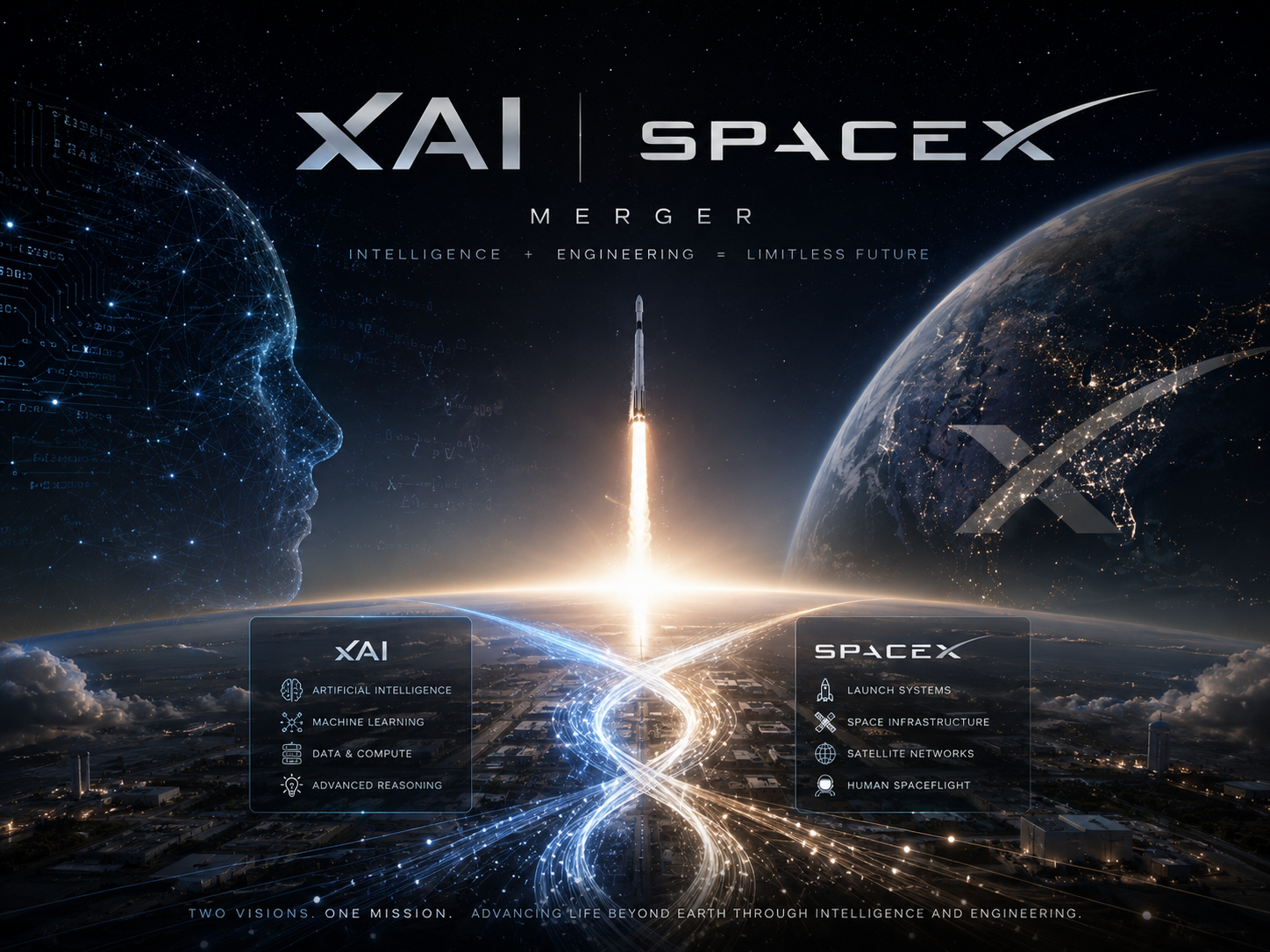
xAI and SpaceX merger – artistic impression. Image credit: Alius Noreika / AI
SpaceX closed its acquisition of Cursor in the middle of August 2026. The company confirmed completion in a filing with the US Securities and Exchange Commission, and TechCrunch reported the close on 15 August, a day after other outlets dated the filing itself. Either way, the deal is done: Anysphere is a wholly owned SpaceX subsidiary, and its roughly 150-person engineering team now reports into the SpaceXAI unit that already contains Grok and X.
The consideration was $60 billion in SpaceX stock rather than cash — approximately 391 million Class A shares, of which 389.3 million converted directly from Cursor’s outstanding equity, with the remainder covering assumed options and restricted stock units. No cash left the balance sheet, which matters for a company that had just raised $85.7 billion in its Nasdaq listing and is funding an enormous compute build-out at the same time.
How the SpaceX–Cursor Deal Was Structured
The route to the close was not a conventional bid. In April 2026, xAI announced an agreement that gave it the right either to acquire Cursor for $60 billion or to pay $10 billion for a joint working arrangement. That option sat unexercised through the spring while SpaceX prepared its stock market debut.
SpaceX listed on Nasdaq on 12 June 2026, the largest initial public offering ever completed. Four days later, on 16 June, the company announced it was exercising the purchase option, filing the paperwork the following day. Regulatory review ran through July and into early August, and the transaction closed mid-month.
| Date | Event |
|---|---|
| 21 April 2026 | xAI announces an option to buy Cursor for $60 billion or pay $10 billion for collaboration. |
| 12 June 2026 | SpaceX lists on Nasdaq as SPCX, raising $85.7 billion. |
| 16 June 2026 | SpaceX announces it will exercise the purchase option; SEC filing follows on 17 June. |
| Early August 2026 | Definitive agreement executed; regulatory reviews near completion. |
| 13 August 2026 | Cursor announces the Firetiger team is joining the company. |
| 14–15 August 2026 | Deal closes; SpaceX confirms via Form 8-K. |
Why a Rocket Company Bought a Code Editor
The logic runs through hardware, not software. SpaceX absorbed xAI in February 2026 and dissolved it into an internal AI division in May, inheriting the Colossus supercomputer clusters and a stated goal of scaling toward a million GPUs. That fleet is large enough that SpaceX rents capacity to outside customers, including Anthropic and Google.
A coding assistant is one of the few AI products with clear, repeat, paid demand from enterprises, and it consumes inference at volume. Owning Cursor gives SpaceX a way to convert idle and reserved compute into recurring subscription revenue rather than renting it out at wholesale rates. The pattern mirrors the argument set out in the SpaceX and xAI merger and what it means for Grok: the parent company is assembling energy, chips and distribution, then acquiring the applications that fill them.
Cursor described the trade in its own announcement, saying the company will have “access to the largest fleet of GPUs in the world, giving us the compute to build stronger models that are also more economical to run,” and adding that “SpaceX is building the computing capacity needed to scale intelligence far beyond what exists today.” Frontier coding models are expensive to serve; a captive GPU supply changes the unit economics of every request.
What SpaceX Paid For
Anysphere was incorporated in 2022 by four MIT students — Michael Truell, Sualeh Asif, Aman Sanger and Arvid Lunnemark — and built Cursor as a fork of Visual Studio Code with model-assisted editing at its centre. Growth was steep even by the standards of the period: $100 million in annual recurring revenue by January 2025, $500 million by June, and past $1 billion by November, when a $2.3 billion Series D co-led by Accel and Coatue valued the company at $29.3 billion. Reports in early 2026 put the annualised revenue rate above $3 billion.
SpaceX therefore paid roughly twice the last private mark, nine months on, in its own equity. Analysts at Morgan Stanley have projected the acquisition could add as much as $13 billion to SpaceX revenue by 2027 — a forecast, not a booking, and one that assumes enterprise adoption keeps its current pace.
| Milestone | Value | Date |
|---|---|---|
| Seed round (OpenAI Startup Fund) | $8 million | October 2023 |
| Series A valuation | $400 million | July 2024 |
| Series C valuation | $9.9 billion | June 2025 |
| Series D valuation | $29.3 billion | November 2025 |
| SpaceX acquisition price | $60 billion | August 2026 |
What Changes for Cursor Users
Very little, immediately. The Cursor platform continues to serve its existing enterprise and individual customers, and the product roadmap stayed in place through the close — the company was still adding teams the day before the deal completed, announcing on 13 August that the Firetiger group had joined. That is not the behaviour of a product being wound down.
The medium-term questions are about models and branding. Cursor built its reputation partly on letting developers choose between models from Anthropic, OpenAI and others. Sitting inside a company that owns Grok creates an obvious incentive to steer usage toward in-house models, and some analysts expect the Cursor name to give way to Grok branding over time. Whether the multi-model choice survives is the single most consequential open question for existing users, and it will show up in release notes long before it shows up in a press release. Readers tracking that competition can compare positions in xAI, OpenAI and Anthropic head to head.
What Cursor Gives SpaceX Internally
Beyond the commercial product, SpaceX has an unusually large in-house software estate: flight software and avionics for Falcon 9 and Starship, constellation routing across thousands of Starlink satellites, ground-segment billing and telemetry, and simulation frameworks for re-entry and landing. Applying its own coding tools to that codebase is the kind of internal dividend that never appears on an income statement but compounds quickly. The company already leans on machine learning for autonomous flight operations, as set out in how SpaceX uses AI across its missions.
Open Questions After the Close
Three issues remain live. Retention is the first: Cursor’s founders and senior engineers now hold SpaceX stock rather than startup equity, and the usual post-acquisition departures tend to arrive around the first vesting cliff. Second, the price was set in shares of a newly listed company, so the real cost of the deal moves with SPCX. Third, concentrating a coding assistant, a social platform, a satellite network and a frontier model programme under one owner invites the kind of competition review that no filing schedule can fully anticipate.
The wider pattern is familiar. Labs that once rented compute are buying it outright, in the same way that OpenAI has pushed to become its own cloud provider. SpaceX has taken the idea one step further by buying the software that will consume the compute it owns.
If you are interested in this topic, we suggest you check our articles:
- SpaceX-xAI Merger: What It Means for Grok and AI Output
- How SpaceX Uses AI for Rockets, Dragon and Starlink
- xAI vs OpenAI vs Anthropic: Which AI Lab Wins in 2026?
- What to Expect from Grok in 2026
- OpenAI’s Infrastructure Push: Becoming Its Own Cloud Provider
Sources: TechCrunch, The Next Web, Yahoo Finance, Wikipedia (Anysphere), Nasdaq, Forbes
Written by Alius Noreika