Key Takeaways
- Falcon 9 boosters land themselves using G-FOLD (Guidance for Fuel-Optimal Large Diverts), a convex-optimization algorithm that computes a fuel-optimal trajectory onboard in real time.
- Crew Dragon docks autonomously by tracking the ISS with machine vision, cross-checked against LIDAR and relative GPS for redundancy.
- Starlink satellites avoid collisions on their own, ingesting U.S. Department of Defense tracking data and firing krypton ion thrusters without waiting for human approval.
- SpaceX uses a far stricter collision-risk threshold than the rest of the industry, triggering avoidance moves at extremely low probabilities.
- AI also supports trajectory planning, engine and structure design, and data analysis across the company’s missions.
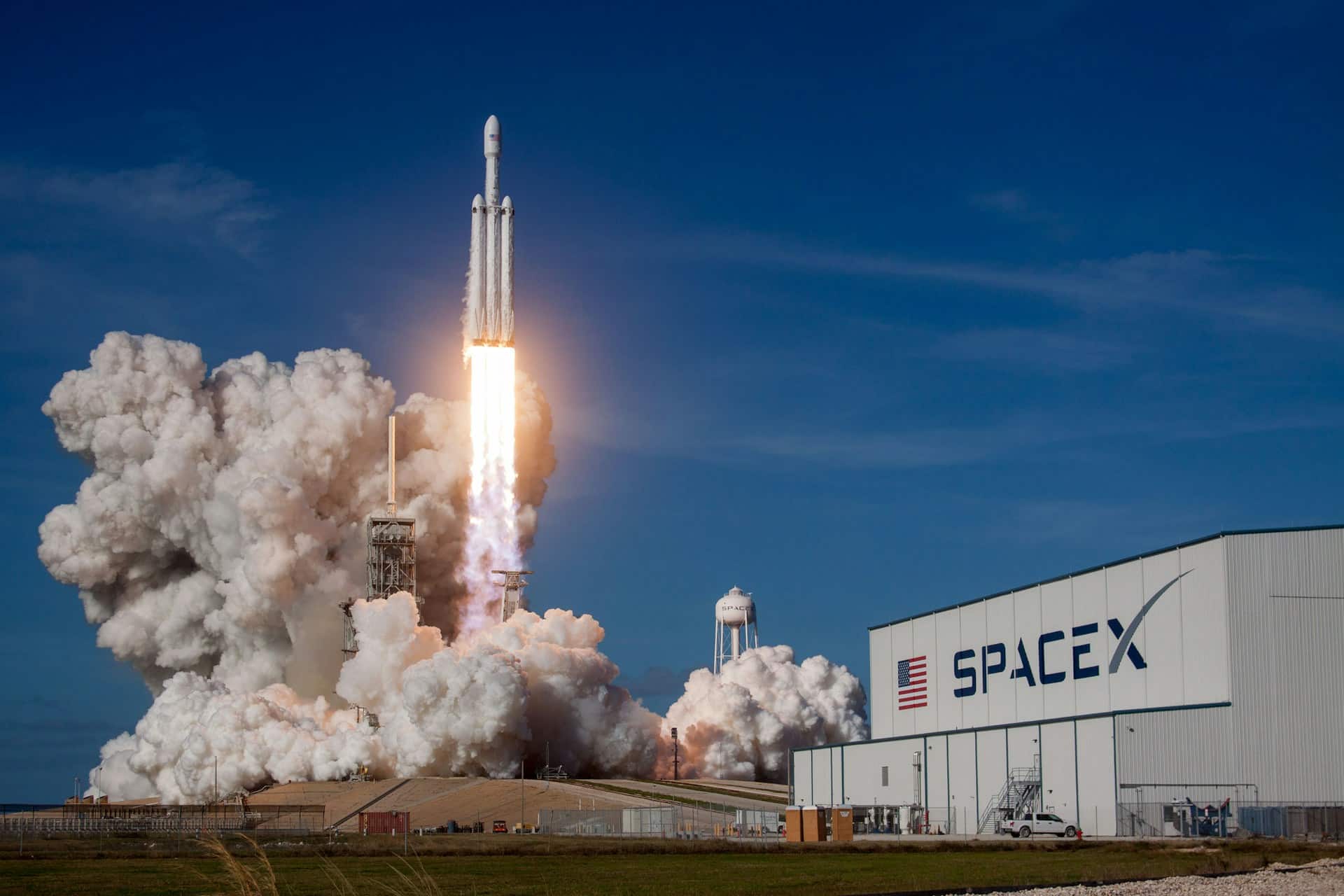
SpaceX rocket launch – illustrative photo. Image credit: SpaceX
SpaceX uses artificial intelligence and machine learning to fly, land, dock, and protect its spacecraft with little or no human input. The clearest examples are the self-landing Falcon 9 boosters, which run a fuel-optimal guidance algorithm onboard during descent; the Crew Dragon capsule, which navigates to the International Space Station on its own using machine vision and laser ranging; and the Starlink constellation, where each satellite decides when to dodge debris by itself.
Across these systems, AI does the same core job: it reads sensor data in real time, calculates the safest and most efficient path, and acts faster than a person could. That speed lets SpaceX reuse rockets, cut launch costs, and run thousands of satellites at once. Below is a clear breakdown of where the AI lives, how each system works, and how authoritative sources describe the engineering behind it.
The AI behind autonomous rocket landings
The self-landing Falcon 9 is the most visible piece of AI at SpaceX. After stage separation, the booster has to flip, slow down, and touch a target a few meters wide, either a ground pad or a drone ship at sea. It does this while burning the least fuel possible, because every spare kilogram of propellant cuts into payload.
SpaceX solves this with an algorithm called G-FOLD, short for Guidance for Fuel-Optimal Large Diverts. Lars Blackmore, who leads landing work at SpaceX and helped develop the method, built it around a technique called lossless convexification. The trick is mathematical: powered descent with thrust limits is naturally a hard, non-convex problem, but lossless convexification reshapes it into a second-order cone program that a computer can solve quickly and reliably. Published research notes that SpaceX uses the code generator CVXGEN to produce the customized flight software that runs this on the booster itself.
The payoff is that the rocket plans its own descent during the flight rather than following a fixed script. It accounts for its current speed, position, fuel, and thrust limits, then settles on a globally optimal path to the pad. The first successful Falcon 9 landing at Cape Canaveral in December 2015 proved the approach in practice, and the booster fleet has since logged hundreds of precision touchdowns.
| Landing approach | How the path is set | Limitation |
|---|---|---|
| Apollo-era guidance (1960s) | Pre-computed reference trajectory followed by the vehicle | Little room to adjust for large diverts or new conditions |
| G-FOLD (SpaceX) | Fuel-optimal trajectory solved onboard in real time as a convex problem | Needs fast, reliable onboard computing and accurate sensors |
How Crew Dragon docks itself with AI
When a Crew Dragon capsule reaches the ISS, it lines up and connects with the station on its own. According to R&D World, the spacecraft’s computer uses machine vision to track the docking target on the station and checks that reading against LIDAR for redundancy. The capsule also draws on relative GPS, so it can locate a target moving at roughly 28,000 km/h and approach it within tight margins.
The hardware lineage runs through SpaceX’s early flights. NASA technical records describe the DragonEye flash LIDAR, a 128-by-128 pixel sensor that captured ranging data from hundreds of meters out all the way to docking, and that helped SpaceX tune its later sensor setups. On the capsule, small Draco thrusters fire in short bursts to nudge the vehicle along the docking axis and slow it to a crawl for contact.
The Demo-2 mission in May 2020 showed how the handover works. Astronaut Doug Hurley flew the capsule manually using touchscreen controls down to about 220 meters, after which the spacecraft took over and soft-docked to the Harmony module on its own. The system is built to align with the International Docking System Standard port, the same interface used across modern station traffic.
A stylized SpaceX logo. Image credit: Mariia Shalabaieva via Unsplash, free license
Starlink’s self-driving collision avoidance
Starlink is where SpaceX runs AI at the largest scale. With thousands of satellites in low Earth orbit, no ground team could approve every move fast enough, so each satellite handles collision avoidance by itself. The onboard system pulls tracking data from the U.S. Department of Defense, evaluates the risk of a close pass, and fires its krypton-powered ion thrusters to move clear, all without a human in the loop. People stay in an oversight role as a backup.
The numbers show how busy this gets. Space.com reported that Starlink satellites performed about 50,000 collision-avoidance maneuvers over six months in late 2023 and 2024, working out to roughly 275 moves a day. More recent figures put the fleet at around 300,000 maneuvers across 2025, a sharp jump driven by growing traffic in orbit. The onboard software refreshes satellite positions on a regular cycle and can decide on and start a maneuver within seconds.
What sets SpaceX apart is caution. The company triggers an avoidance move at a far lower collision probability than the common industry standard, choosing to act early rather than wait. Operating below roughly 600 kilometers also means a dead satellite re-enters the atmosphere within a few years instead of lingering as debris.
| Starlink autonomy detail | What it does |
|---|---|
| Tracking input | Ingests U.S. Department of Defense orbital data on debris and spacecraft |
| Decision-making | Onboard AI assesses risk and plans maneuvers without human approval |
| Propulsion | Krypton ion thrusters reposition the satellite and handle deorbiting |
| Risk threshold | Far stricter than the typical industry standard, prompting earlier moves |
| Scale (2025) | Roughly 300,000 avoidance maneuvers across the fleet |
AI in rocket design, engines, and manufacturing
AI also works behind the scenes, before anything leaves the ground. SpaceX engineers use optimization and modeling tools to refine engine and structural designs, testing many configurations faster than physical prototyping allows. The Raptor engine that powers Starship is one product of this iterative, software-heavy design culture, where simulation guides the hardware that gets built.
On the flight side, predictive models help plan launch trajectories by weighing weather, wind, and atmospheric conditions to pick an efficient path to orbit. During ascent, the software tracks the vehicle’s position and orientation from sensor and camera data so the rocket stays on its planned route. The same instinct toward automation runs through assembly and inspection, where machine-driven analysis aims to catch problems early and keep reusable hardware reliable.
How SpaceX’s approach differs from older space programs
For decades, much of spaceflight relied on fixed plans and heavy ground control. SpaceX pushed decision-making onto the vehicles themselves. A booster solves its own landing problem mid-descent, a capsule pilots its own approach to the station, and a satellite picks its own moment to dodge. This shift toward onboard autonomy is what lets the company fly often, recover hardware, and manage a fleet too large to babysit by hand.
It is worth keeping the limits in view. AI at SpaceX is not a single thinking system; it is a set of specialized algorithms tuned for narrow, well-defined jobs like guidance, navigation, and risk assessment. Humans still set the missions, write the rules, and watch over operations. As SpaceX works toward Starship flights and longer-range goals such as crewed trips to Mars, the appeal of onboard autonomy grows, since a spacecraft far from Earth cannot wait minutes for instructions to arrive.
If you are interested in this topic, we suggest you check our articles:
- AI in Space Exploration: Enhancing Autonomous Capabilities
- The Future of Autonomous AI
- NVIDIA Cosmos Platform to Drive Physical AI Advancements in Robotics and Autonomous Vehicles
- The Role of AI in Self-Driving Cars
- AI Ocean Mapping: How Underwater Drones Find New Species
Sources: Space.com, ScienceDirect, NASA NTRS, R&D World, Crew Dragon Demo-2 via Wikipedia, Basenor
Written by Alius Noreika