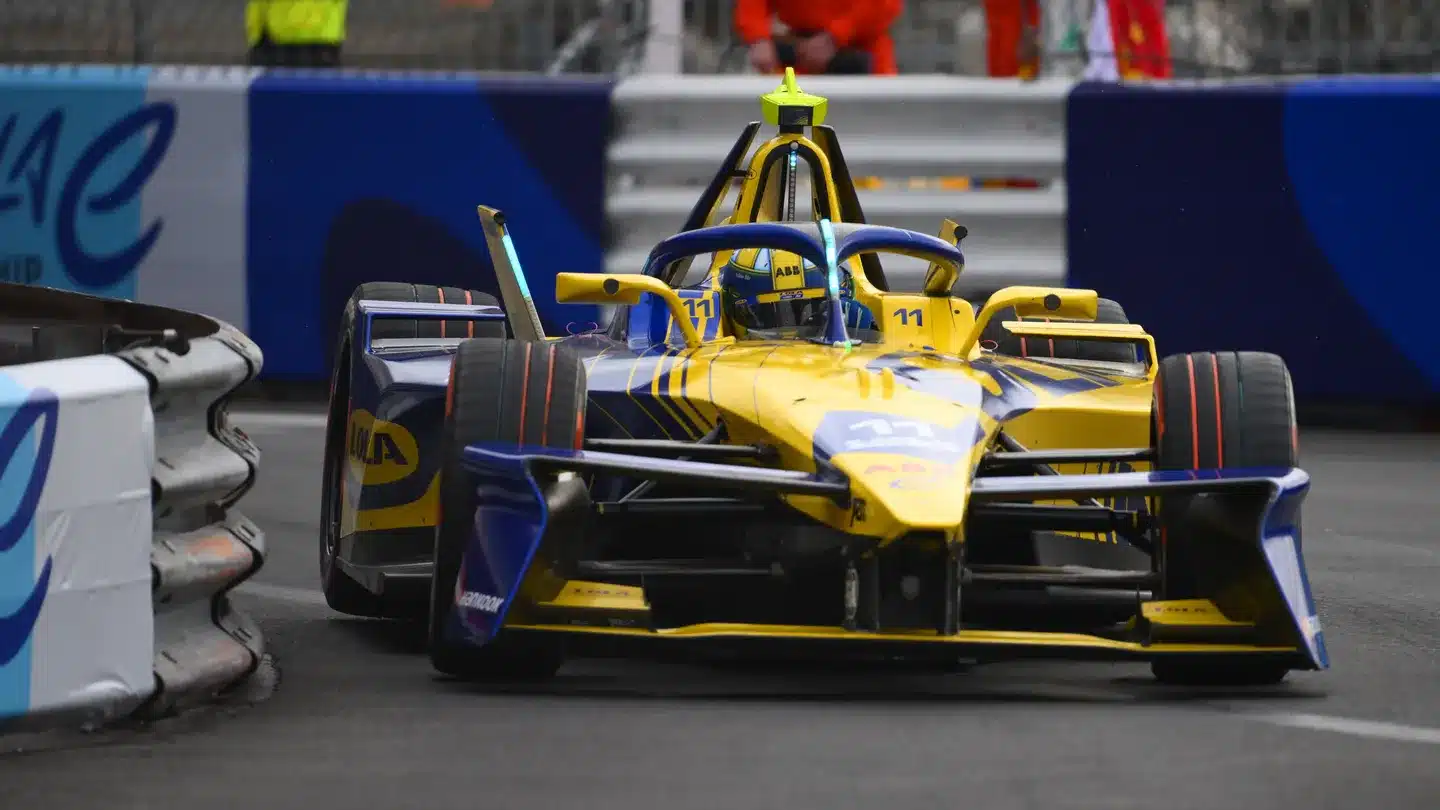
Image credit: Formula E World Championship
Key Takeaways
- AI manages real-time energy use, regenerative braking, and Attack Mode timing on cars with limited onboard power.
- The Driver Agent, built on Vertex AI and Gemini, compares amateur laps against professional reference laps and returns text or audio coaching.
- Formula E uses digital twins to simulate cars, circuits, and event sites before crews arrive on location.
- Live broadcasts include a Strategy Agent and a generative AI Stats Centre powered by Infosys Topaz.
- AI helped set the GENBETA indoor land speed record of 218.7 km/h and mapped the route for the Mountain Recharge project.
- Google Cloud became Principal AI Partner of the ABB FIA Formula E World Championship in January 2026.
Artificial intelligence runs through nearly every part of Formula E, acting as a hidden race engineer that manages battery energy, sharpens driver technique, predicts strategy, and even shapes how fans watch the sport. Because Formula E cars carry a strict energy budget and rely on software to govern power delivery, AI has become as central to the championship as the powertrain itself.
The most visible push came in January 2026, when Google Cloud was named Principal Artificial Intelligence Partner of the ABB FIA Formula E World Championship. The deal builds on a partnership formalised a year earlier and brings Gemini models into team operations, broadcasts, simulators, and event logistics across the global series.
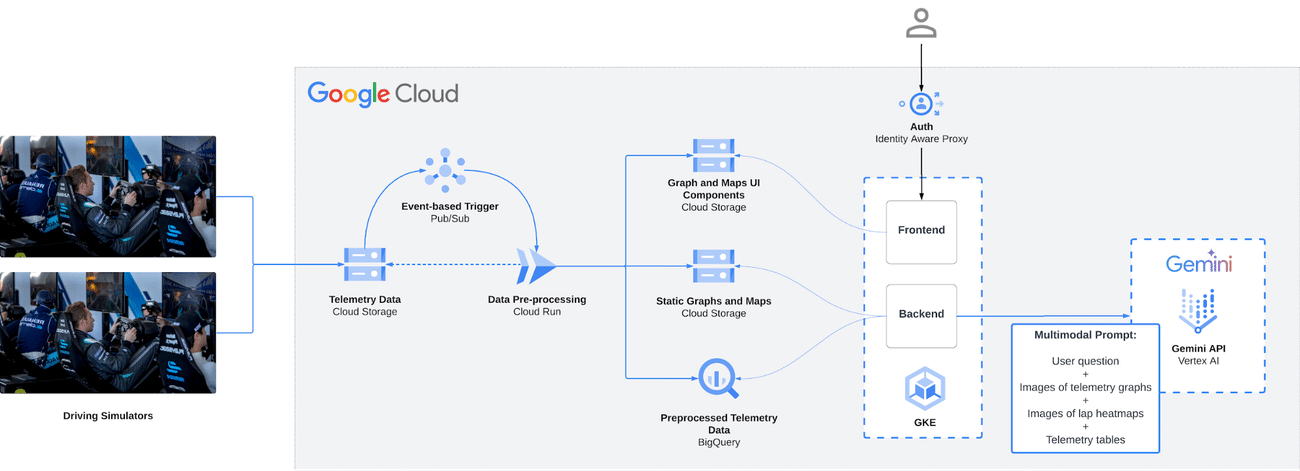
Image credit: Google Cloud
Why AI Matters More in Formula E Than in Other Series
Every Formula E car starts a race with a finite amount of energy. Drivers cannot simply press harder for the entire stint; they have to balance speed against battery state, regeneration windows, and the timing of Attack Mode boosts. That math runs constantly in the background, and humans alone cannot resolve it lap by lap. AI fills that gap by processing telemetry as it streams off the car and recommending the cleanest path through the trade-off.
The series has leaned into this since switching to a software-defined approach to powertrain control. With brake-by-wire systems, regenerative braking, and energy-deployment maps all governed by code, AI has natural points to plug in and add value.
Energy Management and Strategy on Race Day
Teams use AI to calculate the ideal energy use per lap and identify where to push or save. The same systems analyse braking phases to maximise energy recovery, tuning the brake-by-wire balance so the car stops cleanly while sending as much power as possible back to the battery.
Attack Mode adds another layer. Activating the boost requires drivers to leave the racing line and pass through an off-line zone, which costs lap time. AI helps engineers and drivers decide when that cost is worth paying by modelling what rivals are likely to do and what the ranking might look like a few laps later.
| Race-Day Decision | What AI Does |
|---|---|
| Energy budget per lap | Calculates push vs. save targets from live telemetry |
| Regenerative braking | Adjusts brake-by-wire balance for maximum recovery |
| Attack Mode timing | Models competitor behaviour and projected race outcomes |
| Tyre and setup choices | Runs predictive scenarios from prior session data |
The Driver Agent: AI Coaching for the Cockpit
Formula E and Google Cloud built a tool called the Driver Agent that gives drivers feedback the way a senior coach would, but in seconds rather than days. It runs on Google’s Vertex AI platform and uses Gemini foundation models to interpret multimodal data, including text, tables, telemetry graphs, and heatmap images.
The system tracks lap times, speed, braking, acceleration, G-force, downforce, latitude and longitude, and steering inputs. It compares a driver’s lap against a reference lap from a professional Formula E driver on the same track, then returns text or audio notes on where time was lost and what to change.
The pipeline behind it is straightforward. A racing simulator writes detailed logs to Google Cloud Storage. A Pub/Sub trigger starts a Cloud Run service, which pre-processes the logs to identify the fastest lap, build interactive heatmaps for the user interface, prepare BigQuery tables, and join the new lap data with the professional reference lap. A frontend handles display while a backend API orchestrates the requests sent to Gemini.
Tests have shown the Driver Agent can help drivers improve lap times. The tool is also being shared with More than Equal, an organisation focused on developing elite female racing talent, which uses simulators at the Manchester Metropolitan University Institute of Sport. Five drivers in the More than Equal Driver Development Programme now train with the Driver Agent.
Beth Paretta, VP Sporting at Formula E, framed the goal in plain terms: “Formula E has always been a platform for innovation, and we are thrilled to partner with Google Cloud to push the boundaries of what’s possible when you combine world-class technology with world-class motorsport.” She added: “By developing and offering these cutting-edge tools, we are helping to create a future where racing talent is determined by skill, not resources, enabling a more diverse pool of drivers and especially women, rise to the very top of our sport.”
Digital Twins for Cars, Circuits, and Event Sites
Formula E builds digital twins, virtual replicas of cars and tracks, to test ideas before anyone touches the real machine. Teams run thousands of simulations to predict tyre wear, study car behaviour in different conditions, and trial setup changes without burning through track time.
The same approach now extends beyond the cockpit. AI-driven digital twins of race weekend sites help planners design layouts, paddock builds, and broadcast infrastructure remotely. Less travel for advance crews and lighter equipment movement translate into a smaller carbon footprint, which matters for an all-electric championship that markets itself on sustainability.
How Fans See AI During a Race
The broadcast feed is where most viewers meet Formula E’s AI work. A Strategy Agent integrated into live coverage delivers tailored predictions, explanations, and insights as the race unfolds. Millions of viewers have already used it to follow what each driver is doing with energy and Attack Mode without needing a degree in race engineering.
The Formula E Stats Centre, powered by Infosys Topaz, layers generative AI on top of historical and live data. Fans can interrogate driver milestones, season records, and race performance through a conversational interface, then pull up automated highlight reels of the moments that mattered. Google Cloud and Formula E also use AI to generate audio race reports for visually impaired fans.
| Fan-Facing Tool | Powered By | Purpose |
|---|---|---|
| Strategy Agent | Google Cloud | Live race predictions and explanations |
| Stats Centre | Infosys Topaz | Conversational access to historical data |
| Automated highlights | Generative AI | Instant clips of key race moments |
| Audio race reports | Google Cloud + Formula E | Accessibility for visually impaired fans |
Records Set With AI in the Loop
Formula E used AI on the GENBETA project to help set an indoor land speed record of 218.7 km/h. Real-time telemetry analysis fed precise readings on speed, power, and grip, allowing engineers to chase the limit safely.
The Mountain Recharge project pushed the idea further. Using Google AI Studio and Gemini, the team mapped the optimal descent route for the GENBETA car around Monaco and pinpointed braking zones that would allow regenerative braking alone to generate enough energy for a full lap of the circuit.
The 2026 Principal Partnership With Google Cloud
On 26 January 2026, Formula E confirmed Google Cloud as Principal Artificial Intelligence Partner of the ABB FIA Formula E World Championship. The multi-year deal expands an earlier January 2025 agreement and embeds Gemini models more deeply into business operations, including Google Workspace with Gemini for day-to-day work across the organisation.
Jeff Dodds, CEO of Formula E, called the deal “a true game-changer for Formula E and for motorsport as a whole. We are already pushing the boundaries of technology in sport, and this Principal Partnership confirms our vision. The integration of Google Cloud’s AI capabilities will unlock a new dimension of real-time performance optimisation and strategic decision-making, both for the Championship and for our global broadcast audience. This collaboration will redefine how fans experience our races and set a new benchmark for technology integration in sport worldwide.”
Tara Brady, President of Google Cloud EMEA, framed the technical case: “Formula E is a hub of innovation, where milliseconds can define success. This expanded partnership is a testament to the power of Google Cloud’s AI and data analytics, showing how our technology can deliver a competitive advantage in the most demanding scenarios.”
What AI Means for the Next Generation of Drivers
The Driver Agent and tools like it level a field that has long favoured well-funded teams. Junior drivers without million-dollar engineering departments can now access coaching that compares their laps against professional benchmarks. For categories that struggle with cost barriers, that access matters as much as raw track time.
Formula E’s broader bet is that AI will keep pulling double duty: shaving milliseconds for elite drivers while opening the door for developing ones, and trimming carbon while sharpening the show. The series has positioned itself as the place where those experiments happen first.
If you are interested in this topic, we suggest you check our articles:
Sources: Formula E, Google Cloud
Written by Alius Noreika