Key Takeaways
- AI runs across the full automotive value chain — vehicle design, assembly lines, supply chain, quality control, and post-sale service.
- Computer vision systems on the factory floor catch micro-defects that human inspectors miss, cutting warranty costs and material waste.
- Predictive maintenance algorithms monitor robots and tooling in real time, flagging failures before they halt production.
- Generative design and digital twins shorten development cycles from months to days, with AI simulating crash tests, thermal performance, and battery behavior virtually.
- Volkswagen Group runs more than 1,200 active AI applications across its brands, while Audi alone has over 100 AI cases in production and logistics.
- Automotive executives surveyed by IBM expect AI’s contribution to revenue to climb from 5% today to 9% within three years, with R&D budgets for software nearly tripling.
- Major risks include data governance, cybersecurity exposure across connected factories, and workforce reskilling.
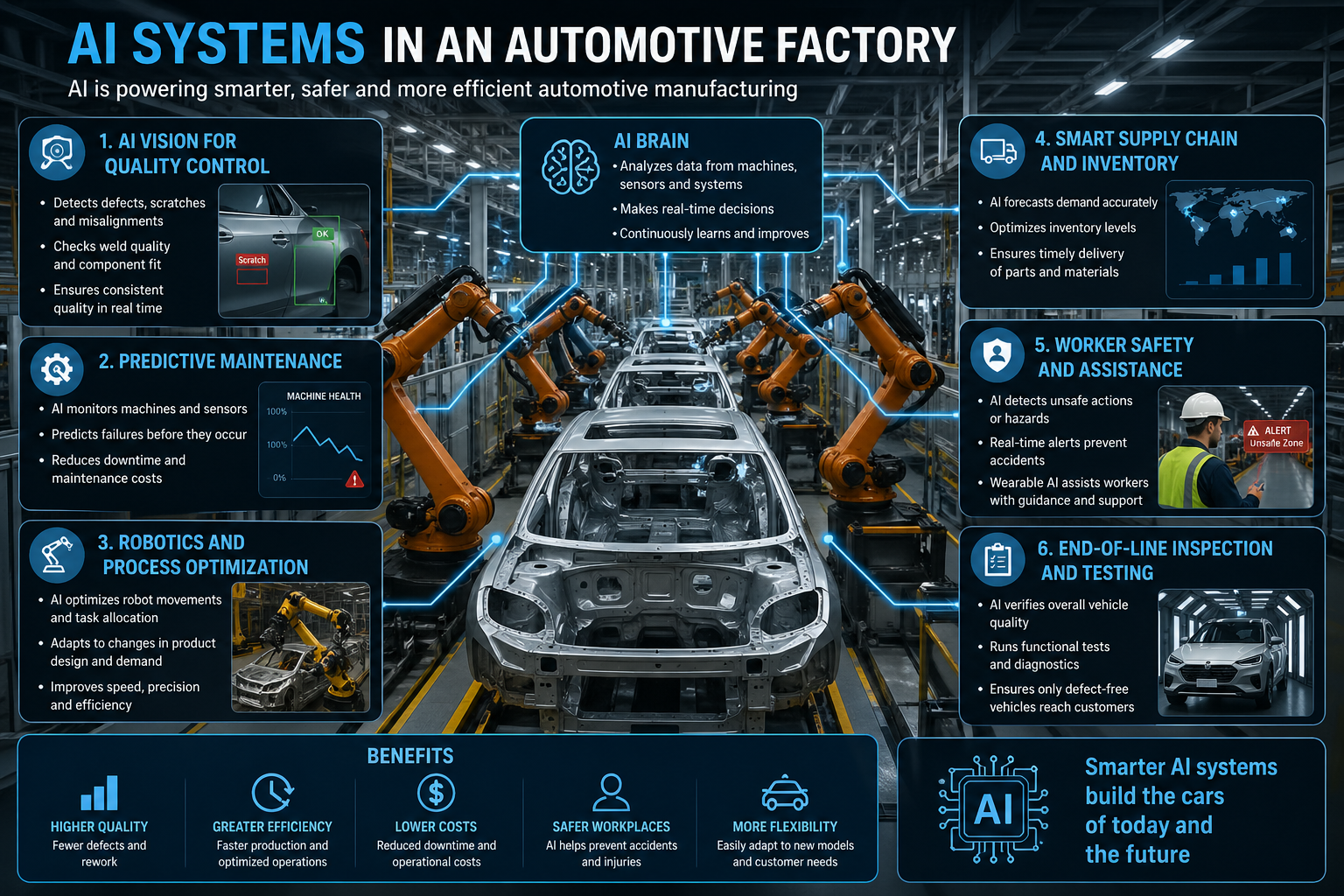
AI in a car factory – artistic impression. Image credit: Alius Noreika / AI
What AI Actually Does in a Car Factory
Artificial intelligence in car manufacturing means using machine learning, computer vision, and generative models to design, assemble, inspect, and service vehicles faster and with fewer errors. Modern automakers feed sensor data from production lines, robotic tooling, and supplier systems into AI models that make decisions in real time — adjusting welds, spotting paint flaws, predicting which parts will arrive late, and simulating new vehicles before any metal is cut.
The shift is no longer experimental. Volkswagen Group has more than 1,200 AI applications running across its brands, with hundreds more in development. Audi alone is rolling out over 100 AI use cases at its global production sites, focused on quality monitoring, efficiency, and generative AI. According to the IBM Institute for Business Value, original equipment manufacturer (OEM) executives expect AI’s share of total revenue to grow from 5% today to 9% within three years, and they project AI will lift product value by 22% and digital service value by 37% in the same window.
Generative Design and Digital Twins: Cars Built in Software First
Before a single chassis is welded, AI now does much of the heavy lifting in design. Generative design algorithms take engineering targets — weight, crash performance, aerodynamics, material cost — and produce optimized geometries that human designers refine. The result: lighter parts, less wasted material, and shorter prototype cycles.
Digital twins take this further. A digital twin is a live virtual replica of a vehicle, component, or entire production line that pulls real-world data from its physical counterpart. Engineers run thousands of crash scenarios, traffic conditions, and failure modes virtually rather than building physical prototypes for every test. Battery development is one of the clearest wins. Factorial’s Gammatron platform combines physics-based models with machine learning to simulate cell behavior in days instead of months, and partners using it have doubled cycle life in lab tests.
ZF’s TempAI demonstrates the same approach for electric powertrains. The system uses machine learning to forecast motor temperatures with over 15% greater accuracy, which unlocks roughly 6% more peak power because thermal headroom can be used more aggressively without risking damage.
Smart Assembly Lines and Robotics
On the production floor, AI-driven robotics handle precision welding, painting, and assembly tasks that demand consistency beyond human capability. The robots themselves are not new — what’s new is the layer of machine learning sitting on top of them. Algorithms continuously analyze cycle times, torque readings, and positional data to flag deviations and self-correct.
Audi’s Edge Cloud 4 Production (EC4P) is one example now running in series production. It blends conventional automation hardware with cloud computing power, reducing the equipment needed at each station and letting engineers push new functions to the line faster. The benefits are measurable: more stable operations, lower maintenance overhead, and quicker introduction of new vehicle variants on the same line.
Computer Vision for Quality Control
Quality inspection is one of the highest-impact AI deployments in car manufacturing. Cameras paired with deep learning models scan body panels, welds, paint surfaces, and electronic assemblies at line speed, catching micro-defects — hairline cracks, weld porosity, paint inclusions — that escape human eyes during fast-moving production.
This matters financially as well as operationally. Catching a defective panel before it reaches final assembly avoids rework. Catching it before the vehicle ships avoids warranty claims. AI-driven IoT sensors embedded along the line also cross-check torque values, fastener placement, and adhesive application, building a digital paper trail for every vehicle.
| Quality Control Method | What It Catches | Typical Speed |
|---|---|---|
| Human visual inspection | Visible surface defects | Limited by fatigue, slows over a shift |
| Fixed-rule machine vision | Pre-programmed defect types | Fast, but rigid |
| Deep learning vision systems | Novel and subtle defects, including micro-cracks | Real-time at line speed, improves with data |
Predictive Maintenance: Keeping the Line Running
Unplanned downtime on an assembly line costs thousands of dollars per minute. AI predictive maintenance models ingest vibration data, temperature readings, current draw, and acoustic signatures from robots, presses, and conveyors. When a pattern starts drifting toward a known failure signature, the system flags the asset for service before it breaks.
The same approach extends to dies, welding tips, and paint nozzles — consumables that historically were replaced on fixed schedules whether they needed it or not. AI lets manufacturers replace them based on actual condition, cutting both material costs and unplanned stoppages.
Supply Chain Intelligence
A modern car has roughly 30,000 parts sourced from hundreds of suppliers across multiple continents. AI handles the forecasting, routing, and disruption detection that human planners simply cannot match at scale. Machine learning models combine historical sales data, dealer inventory, weather patterns, port congestion data, and even news feeds to predict demand and spot risks days or weeks ahead of traditional methods.
When a supplier reports a delay or a port shuts down, AI systems re-route orders, suggest alternative parts, and recalibrate production schedules automatically. This kind of resilience became essential after pandemic-era semiconductor shortages and remains critical with ongoing geopolitical pressure on critical materials like lithium, cobalt, and nickel.
AI in Battery Manufacturing for EVs
Electric vehicle production has become one of the most AI-intensive corners of the industry. Battery cells are notoriously sensitive — small variations in electrode coating, electrolyte filling, or formation cycles can drastically alter performance and safety. Computer vision and machine learning monitor each step, rejecting cells that fall outside spec and feeding data back to upstream processes.
AI also guides cell chemistry decisions, balancing fast-charging capability against long-term durability. As OEMs migrate from 400-volt to 800-volt architectures, particularly in China, AI-driven design and validation tools help ensure that motors, inverters, and battery packs work reliably under the higher voltages.
Knowledge Transfer and Workforce Tools
Manufacturers are also using generative AI internally to capture institutional knowledge. Honda partnered with IBM on a generative AI solution to transfer engineering expertise from senior staff to younger engineers, cutting the time and rework that traditional documentation methods required. Similar tools across the industry summarize technical manuals, surface relevant past cases, and answer technician questions on the shop floor.
Volkswagen Group’s “WE & AI” initiative, launched in 2024, takes a complementary approach — focused on training employees to use AI confidently in their daily work and embedding it into the company’s culture rather than treating it as a tool layered on top.
Benefits at a Glance
| Area | What AI Delivers |
|---|---|
| Design | Faster iteration, lighter parts, lower material use |
| Assembly | Higher throughput, fewer defects, less downtime |
| Quality | Detection of micro-defects beyond human capability |
| Supply chain | Better demand forecasts, faster disruption response |
| Maintenance | Failures predicted before they occur |
| Energy use | Reduced consumption per vehicle, lower CO₂ |
| Workforce | Routine tasks automated, engineers focus on higher-value work |
The Real Challenges
The rollout is not frictionless. Data governance sits at the top of the list — AI models are only as good as the data feeding them, and a fragmented automotive supply chain makes clean, well-labeled data hard to come by. Standards like ISO 26262 (functional safety), WP.29 (cybersecurity for vehicles), and GDPR (data privacy) shape how data can be collected, stored, and shared.
Cybersecurity is the second pressure point. Connected factories and software-defined vehicles create far more entry points for attackers than traditional plants ever had. A breach in a manufacturing execution system could halt production across multiple plants simultaneously.
Workforce displacement is the third concern. As AI absorbs routine inspection, scheduling, and design work, manufacturers need aggressive reskilling programs to keep their workforce relevant. Toyota, for instance, follows a “privacy by design” framework and has stated it does not sell customer data, an approach increasingly common as automakers handle more sensitive driver and production information.
What Comes Next
The IBM Institute for Business Value found that 74% of automotive executives expect vehicles to be software-defined and AI-powered by 2035. Auto executives are nearly tripling R&D budgets for software and digital initiatives — from 21% to 58% by 2025. Nearly half of automotive CIOs, CTOs, and CDOs say partnerships with competitors will be essential for competitive advantage over the next three years, suggesting the industry is moving toward shared AI platforms for non-differentiating systems while reserving proprietary AI for distinctive customer experiences.
Hauke Stars, Head of IT at Volkswagen Group, framed the company’s posture this way: “Wherever we see potential, we utilize artificial intelligence in a targeted manner. Scalable, responsible and with clear industrial benefits. Our ambition: AI everywhere, in every process.”
The car factory of 2030 will look superficially similar to today’s — same robots, same conveyors, same paint booths. The difference will be invisible: a continuous layer of AI watching every weld, predicting every failure, optimizing every shipment, and feeding lessons back into the next vehicle’s design before it ever rolls off the line.
If you are interested in this topic, we suggest you check our articles:
- 6 Best AI Tools For Automotive Business Owners in 2026
- AI Solutions That Are Quietly Changing How Auto Dealerships Work
- The Role of AI in Self-Driving Cars
Sources: IBM, Volkswagen, S&P Global
Written by Alius Noreika