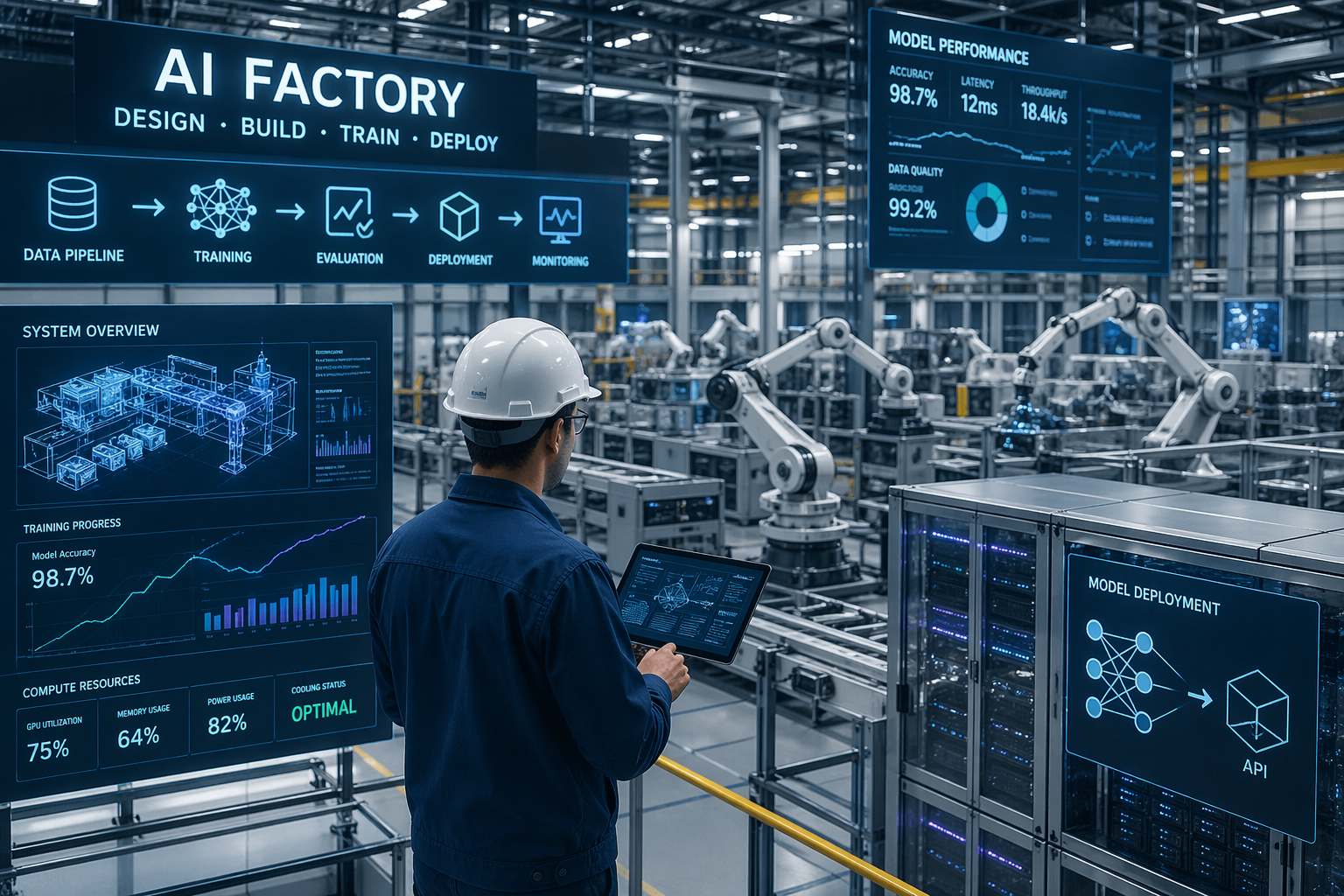
AI in manufacturing – artistic impression. Image source: Alius Noreika / AI
Key Takeaways
- An AI factory is a purpose-built computing system that turns raw data into usable intelligence – predictions, pattern recognition and process automation – at industrial scale.
- Four engineering pillars hold it together: a data pipeline, algorithm development, software infrastructure, and an experimentation platform.
- The output is measured in tokens (units of model throughput), not physical goods, and its value depends on inference performance per watt.
- Digital twins let engineers simulate the physical facility before a single server is racked.
- Sectors gaining the most right now: government and public infrastructure, automotive and robotics, healthcare and drug discovery, telecommunications, financial services, and advanced manufacturing.
- Deployment options span on-premises, cloud, and hybrid, each with different trade-offs between control, scalability and cost.
- Harvard Business School professor Karim Lakhani describes it plainly: “The AI factory, as its output, does three things: predictions, pattern recognition, and process automation.”
What is an AI Factory?
An AI factory solution is a specialized computing facility engineered to convert data into intelligence the way a traditional plant converts raw materials into finished goods. Its product is measured in tokens, the output units produced by large language models and other AI systems, and its success metric is how efficiently it generates those tokens to support decisions, automation and new applications. The engineering discipline behind it, AI factory engineering, covers the hardware stack, the software layer, the data workflows and the operational practices that keep the whole system producing intelligence reliably at scale.
The sectors set to gain the most are those that run on prediction and pattern recognition: governments building sovereign AI capacity, automotive firms training self-driving systems, healthcare companies accelerating drug discovery, telecom operators optimising networks, financial institutions running fraud detection and algorithmic trading, and manufacturers adopting smart-factory practices. Each of these domains feeds on large, continuous streams of data – exactly what an AI factory is built to process.
How the Engineering Works: The Four Core Pillars
Harvard Business School professors Karim Lakhani and Marco Iansiti, who teach AI Essentials for Business, identify four components that together form a working AI factory. The pillars are engineering concerns first and business concerns second – each requires specific technical choices that determine whether the whole system delivers value.
1. The Data Pipeline
Every AI factory begins with a semi-automated system for collecting, cleaning, integrating and securing data. Engineers call this datafication: turning messy inputs into structured tokens a model can actually learn from. Lakhani puts it bluntly in the HBS course: “As the saying goes: ‘Garbage in, garbage out.’ If your data isn’t set up in a way that enables you to learn from across your enterprise or your customers, you’re going to have garbage coming out of your AI factory.”
Amazon is a textbook example. Its pipeline ingests browsing histories and purchase behaviour at enormous scale, cleans and structures the data, and feeds models that produce personalised recommendations. Without that plumbing, the recommendation engine would be no better than a guess.
2. Algorithm Development
Data alone produces nothing. Engineers then choose and tune algorithms suited to the specific data type and business outcome. Iansiti frames the problem directly in the course: “Data by itself doesn’t do anything. You actually need to figure out which algorithm you’re going to choose.”
Tesla’s self-driving systems show this in action. Engineers select machine-learning algorithms capable of combining camera, radar and sensor inputs to produce real-time steering, braking and acceleration decisions. A different algorithm family would handle the same data poorly. Matching algorithm to goal is where engineering judgement matters most.
3. Software Infrastructure
Infrastructure is the backbone that lets the other pillars run at production scale. Providers like Neurotechnology Cloud are increasingly in demand to help companies accelerate the development and output of scalable AI solutions through AI-ready infrastructure. It covers high-performance GPUs, CPUs, high-speed interconnects, networking, storage and cooling – plus the modular, API-driven software that ties them together.
Hardware choices directly affect what’s possible. Purpose-built AI factories rely on accelerated computing to hit the performance-per-watt figures needed for modern workloads. Interconnects such as NVIDIA NVLink and NVLink Switch handle GPU-to-GPU communication, while Quantum InfiniBand and Spectrum-X Ethernet move data between nodes. Inference platforms like NVIDIA TensorRT, Dynamo and NIM microservices sit on top to push trained models into production.
Netflix illustrates why this pillar cannot be skipped. Its recommendation algorithms were strong early on, but the infrastructure could not process the volume required. Only after moving to scalable cloud infrastructure could the platform deliver accurate recommendations to millions of subscribers. As Lakhani notes: “You can have the fanciest data pipelines, the fanciest algorithms — but if your infrastructure can’t make this work, can’t do this at scale, then you run into problems.”
4. The Experimentation Platform
The final pillar is where teams test, refine and deploy models. Algorithms generate hypotheses — a new pricing rule, a churn predictor, a rerouted workflow — and the experimentation platform turns them into measurable trials. Lakhani explains that algorithms effectively say: “take action X to increase customer satisfaction, take action Y to potentially increase sales, take action Z to change the dynamics of who pays first.”
Harvard Business School professor Iavor Bojinov, who co-teaches AI for Leaders with Lakhani, emphasises the cultural side: “In organizations that encourage feedback, experimentation, and shared learning, AI adoption accelerates. In environments where habits are rigid or change feels imposed, trust erodes — and adoption slows.” Engineering an experimentation platform is partly about tooling and partly about giving teams permission to iterate.
The Engineering Layer Beneath: Inference, Automation and Digital Twins
Beyond the four pillars, three technical practices define modern AI factory engineering.
AI inference at scale. Inference — the moment a trained model generates a prediction — is the dominant workload in a live AI factory. Full-stack inference infrastructure has to deliver low latency and cost efficiency across cloud, hybrid and on-premise environments. Because newer reasoning models iterate more during inference, they demand more compute per query. Inference outputs also feed back into the system, creating a data flywheel that sharpens accuracy over time.
Automation. Hyperparameter tuning, retraining, deployment and monitoring all need to run without constant human input. Automation tools keep throughput high and make large-scale operation economically viable.
Digital twins for the facility itself. Before a facility is built, engineers now assemble a complete virtual replica covering the building, cooling, power distribution, network topology and compute layout. Teams can simulate failure scenarios, test redundancy, model airflow and validate the design collaboratively. NVIDIA’s Omniverse Blueprint is the best-known platform for this. The payoff is faster deployment, lower construction risk and better energy performance once the facility goes live.
Deployment Choices: On-Prem, Cloud, or Hybrid
Where an AI factory runs is itself an engineering decision with business consequences.
| Deployment | Strengths | Best suited for |
|---|---|---|
| On-premises | Maximum control over data, predictable latency, compliance with strict data rules | Defence, regulated finance, healthcare, sovereign AI |
| Cloud | Elastic scaling, lower upfront capital, rapid provisioning | Startups, variable workloads, early experimentation |
| Hybrid | Balances security with elasticity, flexible cost profile | Large enterprises with mixed compliance and scale needs |
Which Sectors Benefit Most
Not every industry gains equally. The biggest beneficiaries share three traits: they produce enormous data volumes, they rely on fast decisions, and they can convert better predictions into measurable value.
Government and sovereign AI. Nations are beginning to treat AI capacity the way they treat roads, power grids and telecom networks — as national infrastructure. Sovereign AI factories let governments train models on region-specific data, develop local-language systems, address public-sector challenges and reduce dependence on foreign providers. The strategic argument is straightforward: countries without AI infrastructure will import intelligence rather than produce it.
Automotive and advanced robotics. Self-driving cars, warehouse robots and humanoid systems all need high-performance training compute and low-latency inference. AI factories provide both, plus the continuous-learning loop that makes these systems safer over time. The same infrastructure then supports the manufacturing side — automated assembly, quality control via computer vision, predictive maintenance on production lines.
Healthcare and drug discovery. Generative AI is being applied to propose novel drug molecules, design treatment protocols and tailor therapies to individual patients. AI factories supply the compute to analyse genomic data, imaging archives and clinical records at a scale that was impossible a decade ago. The potential payoff is cheaper, faster, more personalised treatment.
Telecommunications. Telenor in Norway launched an AI factory specifically to accelerate AI adoption, upskill its workforce and push sustainability goals. The broader use case is familiar: optimising network performance, reducing downtime, and running customer-service applications powered by large language models.
Financial services. Banks and capital-markets firms use AI factories for transaction fraud detection, customer support automation and algorithmic trading. The combination of hardware, networking and development tooling is engineered for the latency and throughput these workloads demand.
Manufacturing. The traditional factory itself is becoming a heavy AI factory customer. IBM researchers Matthew Finio and Amanda Downie document applications ranging from predictive maintenance on assembly-line robots to digital twins of entire production lines, computer-vision quality control, generative design in aerospace and automotive, energy monitoring and AI-assisted workforce scheduling. Collaborative robots — cobots — work directly alongside human employees, handling repetitive or physically demanding tasks while humans take on creative work.
Benefits an AI Factory Delivers
| Benefit | What it produces |
|---|---|
| Revenue from raw data | Turns untapped information into decision-grade intelligence |
| Optimised AI life cycle | Streamlines ingestion, training, fine-tuning and inference in one system |
| Better performance per watt | Accelerated computing cuts energy costs on heavy workloads |
| Efficient scaling | Supports both sovereign and enterprise scale-up and scale-out |
| Secure, adaptive ecosystem | Continuous updates without rebuilding from scratch |
Engineering Challenges Worth Naming
AI factory engineering is not plug-and-play. Six problems surface repeatedly in real deployments.
Data quality is the first. Manufacturers and enterprises often discover their historical data is messy, incomplete or mislabelled. Models built on poor inputs produce poor outputs no matter how sophisticated the algorithm.
Operational reliability is the second. Some generative models still lack the precision needed in production, and engineering teams have to build guardrails around them.
Skills shortages are the third. Specialists in AI, data science and ML infrastructure remain scarce.
Cybersecurity is the fourth. More connectivity means more attack surface, and AI factories store valuable data and valuable models.
Change management is the fifth. Workers worry about job security, and adoption stalls without clear communication and retraining plans.
Finally, capital cost is the sixth. The upfront investment in GPUs, networking and facility engineering is substantial, which is why cloud and hybrid options exist.
The Direction of Travel
AI factories are shifting from experimental projects inside large tech firms to standard infrastructure for any organisation that treats intelligence as a production output. Harvard Business Review notes that they already power Google’s daily ad auctions, Uber’s ride matching, Amazon’s pricing and Walmart’s cleaning robots. The engineering playbook — four pillars, inference-first design, digital-twin planning, deployment flexibility — is becoming the template for the next decade of corporate compute.
Lakhani’s summary in AI for Leaders is the clearest description of what separates a working AI factory from a model-building exercise: “What truly makes this an AI factory is the process. It’s not about building a single model, but about creating an end-to-end system that can repeatedly turn raw data into useful predictions or insights, learn from experience, and improve over time. Just like a manufacturing plant, it’s designed for efficiency, scale, and continuous iteration.”
If you are interested in this topic, we suggest you check our articles:
- Automate your Manufacturing Business with AI
- How AI is Revolutionizing Manufacturing Efficiency & Sustainability
Sources: Nvidia, Harvard Business School, IBM
Written by Alius Noreika