Key Takeaways
- Google restructured into Alphabet Inc. on August 10, 2015, creating a holding company structure where Google became a subsidiary
- The reorganization separated Google’s core internet business (search, YouTube, Android, advertising) from experimental ventures called “Other Bets”
- Alphabet’s structure enabled expansion into industries far removed from internet services, including life sciences, robotics, autonomous vehicles, and longevity research
- The move improved financial transparency by allowing separate reporting of profitable Google operations versus cash-burning moonshot projects
- Co-founders Larry Page and Sergey Brin retained majority voting control while elevating Sundar Pichai to CEO of the slimmed-down Google
- The restructuring drew inspiration from Warren Buffett’s Berkshire Hathaway conglomerate model
- Within three years, Alphabet’s stock price had risen more than 85%, validating the reorganization financially
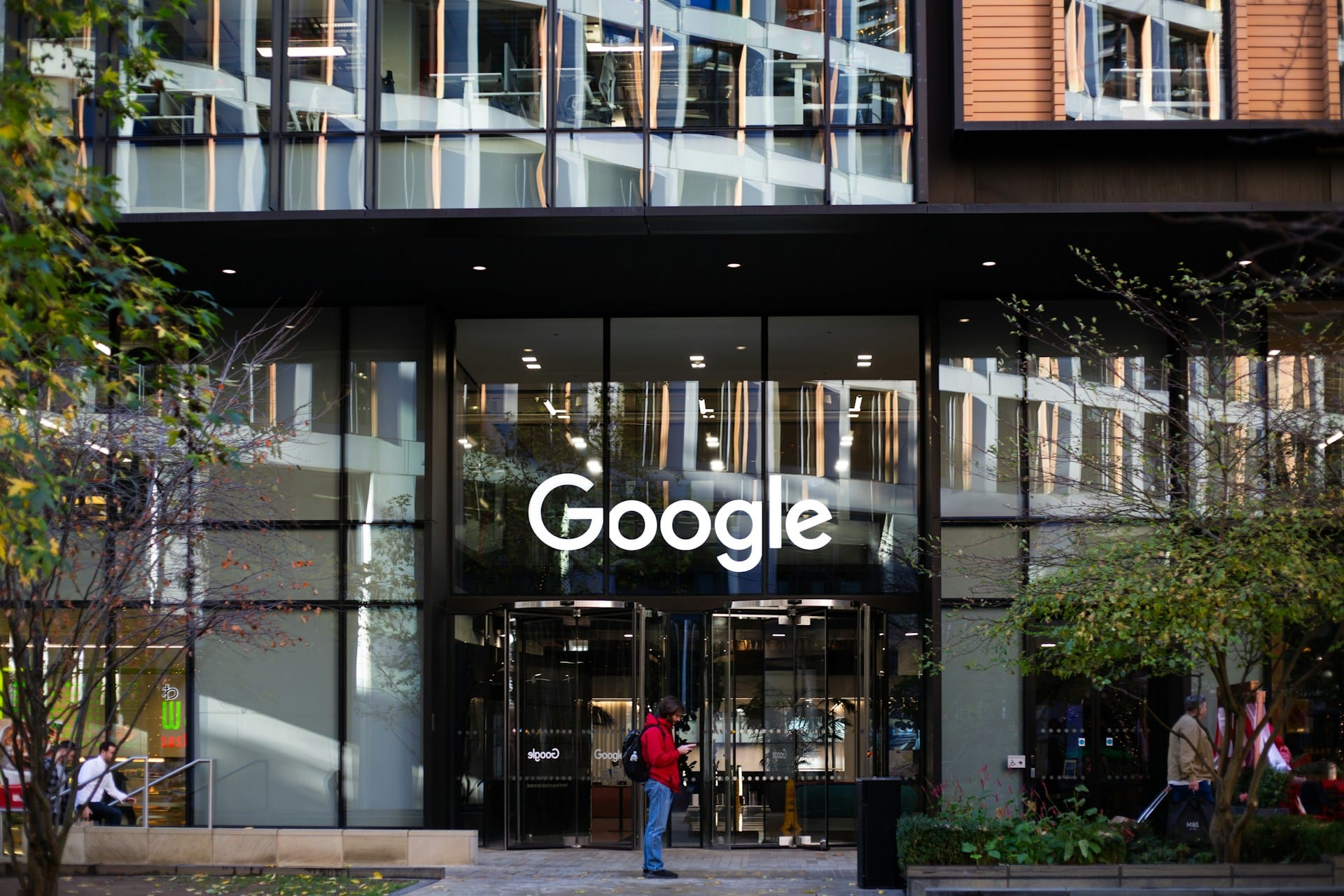
A Google office – illustrative photo. Image credit: Karollyne Videira Hubert via Unsplash, free license
The Decision Behind Creating Alphabet Inc.
Google’s co-founders Larry Page and Sergey Brin announced on August 10, 2015, that they were creating Alphabet Inc., a new holding company that would house Google alongside various other business ventures. The restructuring stemmed from a straightforward problem: Google had evolved far beyond its original mission as a search engine company, branching into areas as diverse as self-driving cars, human longevity research, smart home technology, and venture capital.
Managing such wildly different businesses under one corporate umbrella had become unwieldy, and investors were increasingly nervous about money-losing experimental projects dragging down the company’s financial performance.
The solution placed Google’s core internet operations (search, advertising, YouTube, Android, Maps, and Gmail) into a slimmed-down subsidiary, while other ventures became separate Alphabet companies. This allowed each business to operate with its own CEO, budget, and goals. As Page explained in his announcement: “Fundamentally, we believe this allows us more management scale, as we can run things independently that aren’t very related.”
What Problems Did the Old Structure Create?
Before the restructuring, Google faced several organizational challenges that made the status quo unsustainable.
- Investor Anxiety Over Financial Opacity
Wall Street had grown uncomfortable with Google’s spending patterns. The company was pouring billions into speculative projects without disclosing how much each venture was actually costing or earning. When Google’s chairman defended these “moonshots” at the 2015 shareholder meeting, it highlighted just how much explaining the company needed to do. Investors wanted visibility into whether their money was funding profitable search advertising or being burned on robot prototypes and internet-delivering balloons.
- Innovation Getting Bogged Down
The original corporate structure forced experimental projects to live by the same rules as a publicly traded company focused on quarterly earnings. Wharton adjunct finance professor David Wessels observed that the founders must have felt frustrated watching new growth businesses get “lumped in with the overall performance of the business.” Projects that needed years to mature were judged against divisions generating billions in immediate revenue.
- Talent Retention Concerns
Perhaps the most pressing catalyst was the risk of losing key executives. Reports emerged that Twitter had been pursuing Sundar Pichai as its next CEO. To keep Pichai in the fold, Google needed to offer him a title commensurate with his importance. The restructuring provided the mechanism: Pichai became CEO of Google itself, while Page moved up to run Alphabet. Similar opportunities opened for other senior leaders who could now become CEOs of their own Alphabet subsidiaries rather than remaining perpetual division heads.
How Did the Restructuring Work?

Googleplex in June 2019. Image credit: Gregory Varnum via Wikimedia, CC BY-SA 4.0 license
The mechanics of creating Alphabet involved a complex corporate maneuver. Google first created Alphabet as a wholly owned subsidiary of itself. Alphabet then created its own subsidiary, which merged with the original Google. Through this process, Google emerged as a direct subsidiary of Alphabet, with all existing Google shareholders automatically receiving equivalent Alphabet shares.
The restructuring was completed on October 2, 2015. Under Delaware corporate law, where Alphabet incorporated, this type of holding company reorganization did not require a shareholder vote.
Comparison of Google Before and After Restructuring
| Aspect | Pre-2015 Google | Post-2015 Alphabet Structure |
|---|---|---|
| Parent Company | Google Inc. | Alphabet Inc. |
| Core Internet Business | Part of Google | Google LLC (subsidiary) |
| Experimental Projects | Google X Labs | Separate Alphabet subsidiaries |
| Financial Reporting | Combined | Separated into “Google” and “Other Bets” |
| CEO of Search Business | Larry Page | Sundar Pichai |
| Holding Company CEO | N/A | Larry Page |
| Corporate Motto | “Don’t be evil” | “Do the right thing” (Alphabet) |
What Business Ventures Did Alphabet Enable?
The restructuring gave Alphabet the freedom to pursue ambitious projects without those ventures affecting Google’s brand image or financial metrics. The holding company structure created a clear separation between the cash-generating search business and what Alphabet calls its “Other Bets.”
Major Alphabet Subsidiaries Formed or Expanded After 2015
| Company | Focus Area | Status |
|---|---|---|
| Waymo | Self-driving vehicles | Operating autonomous taxi services in multiple US cities |
| Verily | Healthcare technology | Developing AI diagnostics and health monitoring tools |
| Calico | Longevity research | Researching aging and age-related diseases |
| DeepMind | Artificial intelligence | Leading AI research with applications across industries |
| Wing | Drone delivery | Operating commercial delivery services |
| X (Moonshot Factory) | Breakthrough technology research | Incubator for ambitious projects |
| Fiber | High-speed internet | Providing ultra-fast broadband in select markets |
| GV (Google Ventures) | Venture capital | Early-stage startup investments |
| CapitalG | Growth equity | Later-stage company investments |
The holding company model drew inspiration from Warren Buffett’s Berkshire Hathaway. Former Google CEO Eric Schmidt revealed in 2017 that he had encouraged Page and Brin to visit Buffett in Omaha to study how Berkshire operated as a collection of subsidiaries with strong, trusted CEOs running each business.
How Did This Affect Google’s Core Business?
The “new” Google that emerged from the restructuring remained one of the world’s largest companies. It retained search, advertising, YouTube, Android, Maps, Gmail, Chrome, and Google Cloud. These products accounted for approximately 90% of Google’s $66 billion in 2014 revenues.
Sundar Pichai took over as CEO, responsible for maintaining Google’s dominance in digital advertising while facing increasing competition from Facebook (now Meta), Apple, and emerging threats from Chinese companies like Tencent. The restructuring allowed Pichai to focus entirely on internet products without getting pulled into decisions about driverless cars or biotech research.
Google’s performance under the new structure validated the reorganization. Within three years, quarterly revenues had surged by more than $13 billion compared to the second quarter of 2015. The stock price climbed more than 85% during the same period.
Did the Restructuring Reduce Regulatory Pressure?
One underappreciated benefit of creating Alphabet involved regulatory positioning. Under the old structure, Google’s expansion into every new industry invited increased government attention. Acquiring a smart home company like Nest or developing autonomous vehicles while also dominating internet search made the company look like it was trying to control everything.
The holding company structure allowed Alphabet to present each subsidiary as a separate entity that happened to share common ownership. Nest, Calico, Waymo, and Fiber could operate in their distinct industries without automatically triggering concerns about Google’s dominance in search and advertising extending into those markets.
What Happened to the Founders’ Control?
The restructuring preserved something important to Page and Brin: their grip on decision-making power. Through Alphabet’s dual-class share structure, the two founders retained majority voting control despite not owning a majority of the stock. This arrangement prevented outside shareholders from pressuring the company to abandon long-term innovation in favor of short-term profits.
Page became Alphabet’s CEO, with Brin serving as president. Both stepped back from daily operations in December 2019, but they remain employees and the majority voters on the board of directors. Pichai added Alphabet CEO to his Google CEO title at that time.
Why the Name “Alphabet”?
The name carried multiple meanings, intentional and otherwise. The straightforward interpretation references humanity’s most important inventions while suggesting the company encompasses everything from A to Z (hence its domain: abc.xyz). The financial interpretation plays on “alpha,” the investment term meaning returns exceeding a benchmark, making Alphabet a company that bets on alpha.
The more mundane reality: Alphabet served as a deliberately generic name that could stand for anything without creating brand confusion with Google’s consumer products. Unlike Google, which carried specific associations with search and internet services, Alphabet had no existing meaning that would limit its application to any particular industry.
Notably, while Google retained its “Don’t be evil” motto, Alphabet adopted a different code of conduct centered on “Do the right thing.”
Has the Restructuring Succeeded?
Working at Google. Image credit: Google
The financial verdict has been positive. Alphabet became the world’s most valuable publicly traded company briefly in February 2016, surpassing Apple. The stock has dramatically outperformed broader market indices since the restructuring.
However, the Other Bets category continues to lose money. In 2017’s second quarter, these ventures posted a $772 million operating loss. The moonshots have not yet produced another business anywhere near the scale of Google’s advertising empire. Some projects, like the internet-providing balloon project Loon, have been discontinued entirely. Others, like Nest, were eventually folded back into Google’s hardware division.
The structure has evolved as well. Alphabet’s X lab now increasingly spins out projects as fully independent companies backed by external venture capital rather than keeping them as Alphabet subsidiaries. This approach reduces the burden on Alphabet’s books while allowing promising technologies to develop with startup-style agility.
What Does This Mean for Consumers?
Google AI mode – artistic impression. Image credit: BoliviaInteligente via Unsplash, free license
For ordinary users of Google products, the restructuring changed almost nothing. Search, Gmail, YouTube, Maps, and Android continued operating exactly as before. The main consumer-facing change involved Nest, which shifted from Google branding to Alphabet subsidiary status before eventually returning to Google’s hardware division.
The deeper impact plays out over longer timeframes. By insulating experimental projects from quarterly earnings pressure, Alphabet gave itself permission to pursue technologies that might take decades to mature. Self-driving cars, longevity research, and AI breakthroughs may eventually reach consumers precisely because they were not forced to justify themselves against the immediate profitability of search advertising.
Conclusion
Google’s 2015 restructuring into Alphabet addressed real organizational problems rather than merely rebranding for its own sake. The holding company structure separated a massive, profitable internet business from speculative ventures that needed room to grow without quarterly scrutiny. It provided transparency that satisfied investors, created CEO positions that retained talented executives, offered some insulation from regulatory concerns, and preserved founder control over long-term direction.
The restructuring acknowledged that a company cannot simultaneously optimize for current profits and breakthrough innovation within a single corporate structure. By splitting these competing priorities into distinct entities, Alphabet gave both missions better chances of success.
If you are interested in this topic, we suggest you check our articles:
- Alphabet’s AI Strategy: Pichai’s Vision and $85B Investment Plan
- 5 Biggest AI Financial Investments in 2025
- Alphabet’s $4 Trillion Journey: From Search Engine to AI Powerhouse
Sources: The Guardian, Investopedia, Knowledge at Wharton, Wikipedia, VICE
Written by Alius Noreika