Recently the artificial intelligence (AI) market and the attention of technology experts have been captured by an open-source local AI agent running directly on the user’s computer. It is currently known as OpenClaw, but within just three months it has already changed its name several times – take a closer look at this story.
Some Facts About OpenClaw
The project was created by developer Peter Steinberg as a small experiment at the end of 2025. At first it was a simple personal agent allowing AI to operate through messaging apps and perform actions on the computer. However, within only a few weeks the project became one of the fastest-spreading open-source AI tools – collecting tens of thousands of GitHub stars and attracting enormous interest from the technology community.
The main distinction of OpenClaw is that it runs locally – users themselves launch and control the model, the data, and integration with other platforms. The tool performs real tasks and, for example, can manage a calendar, send messages, or browse the web, while interaction happens simply in natural language.
Since it is an open-source model, the user can essentially code any other function the tool does not have. This means, theoretically, the platform’s customization possibilities are unlimited.
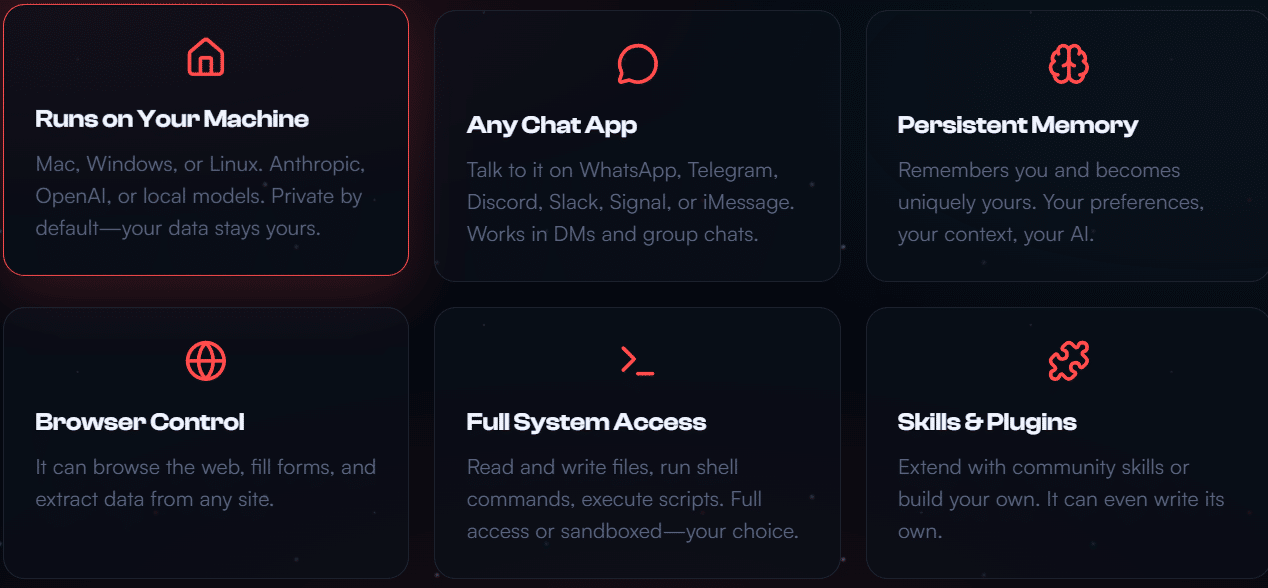
OpenClaw website features grid showing six capabilities. Image source: OpenClaw
The History Behind the OpenClaw Name
The activity described as a weekend project by Peter Steinberg originally had the name Clawd (also known elsewhere as Clawdbot). The creator himself explains and admits that it was a wordplay clearly directed at another AI model – Claude. Although the community had no objections – Anthropic, which manages Claude, did. Because the event drew legal attention due to trademark similarity to an existing product, the developer had to drop OpenClaw’s original name.
The second name was Moltbot. It came more from the Discord community initiative and refers to the shedding of an animal’s shell or skin (molt). The creator states that it described the project’s condition quite accurately, since the agent was rapidly evolving and constantly changing. However, recognizability is important for every product, in this case connections with the technological world, therefore the name had to be adjusted again.
Finally, it became what we have today – OpenClaw. These two words form the project’s identity, where Open emphasizes the open-source philosophy and community contribution, while Claw refers to the project’s origins and previous names.
Final Thoughts
Such name changes do not necessarily have to be viewed negatively, especially since they happened at the very beginning of the project. On the other hand, the transformation of these names also reflects the project’s path from an initial idea – more “experimental” than expected – to a finalized and rapidly growing product whose success already requires a strong, consistent, and clear identity.
It is worth noting that OpenClaw changes what we previously considered the capabilities of AI agents. It shows that an agent can be not only a conversation partner or task generator but also a continuously operating digital executor integrated into the everyday work environment, while keeping full control in the user’s hands.
And although it may sound humorous, the story of it shows that today AI projects can grow from an experiment into a global product faster than there is time to create their name.
If you are interested in this topic, we suggest you check our articles: