Key Takeaways
- Global Championship: ENJOY AI Global Finals represents the annual culmination of one of the world’s largest youth robotics and artificial intelligence competitions, serving participants aged 3 to 22 years old
- Record-Breaking Scale: The ENJOY AI 2024 Shanghai finals achieved a Guinness World Record with over 16,000 teams and nearly 28,500 participants from more than 60 countries
- Diverse Challenges: Competition categories span multiple age divisions through themed arenas including Cyber City (urban AI), Battle of Tribes (strategic robotics), Geometric Forest (foundational STEM), and Skyline Adventures (autonomous drones)
- Educational Impact: The event combines technical competitions with cultural exhibitions and educator forums, engaging over 1 million participants annually across five continents in 34 countries
- Innovation Focus: Through ENJOY AI, students develop critical thinking, coding expertise, engineering skills, and problem-solving abilities through hands-on challenges that simulate real-world AI applications

Image credit: ENJOY AI
Understanding ENJOY AI Global Finals
The ENJOY AI Global Finals stands as the premier annual championship organized by the Federation of Global Youth Artificial Intelligence, a United States-based non-profit organization. This event transforms youth education by providing students between ages 3 and 22 with practical exposure to artificial intelligence and robotics through competitive challenges. The competition has earned recognition as the “Olympics of AI and Robotics,” attracting participants from more than 60 countries and regions worldwide.
The finals represent the culmination of regional competitions held throughout the year across five continents. Each season begins with qualifying events including the European Open, Asian Open, African Open, and specialized regional championships, all leading to the grand finale where top-performing teams compete for international recognition.
ENJOY AI Competition Structure and Challenge Categories
Age-Specific Divisions
The championship accommodates varying skill levels through carefully structured age groups. Early Elementary School divisions introduce foundational concepts through simplified challenges, while Lower Elementary and Upper Elementary categories progressively increase complexity. Middle School and High School divisions tackle advanced programming, autonomous systems, and sophisticated engineering problems.
Themed Arena Challenges
Cyber City tests students’ understanding of urban artificial intelligence applications. Teams program robots to navigate smart city environments, addressing challenges related to traffic management, public services, and infrastructure optimization. The 2025 finals saw Vietnam dominate the Lower and Upper Elementary divisions, while Malaysia claimed the High School championship with Team 404 Not Found.
Geometric Forest engages younger participants through pattern recognition and spatial reasoning tasks. This arena emphasizes foundational STEM concepts, with Mongolia’s teams demonstrating exceptional performance in the 2025 competition. Malaysia’s Team Transformers secured the Early Elementary championship, showcasing creative approaches to geometric problem-solving.
Battle of Tribes introduces strategic elements requiring teams to balance offensive and defensive robotics capabilities. Macau’s teams excelled in this category during the 2025 finals, with Morocco’s participants demonstrating impressive tactical innovation in the Middle School division.
Skyline Adventures challenges students with autonomous drone operations involving visual recognition and aerial navigation. This advanced category demands sophisticated programming skills and precise engineering. The 2025 finals featured victories from Vietnam, Mongolia, and the United Arab Emirates across different age divisions.
Educational Impact and Skill Development in ENJOY AI
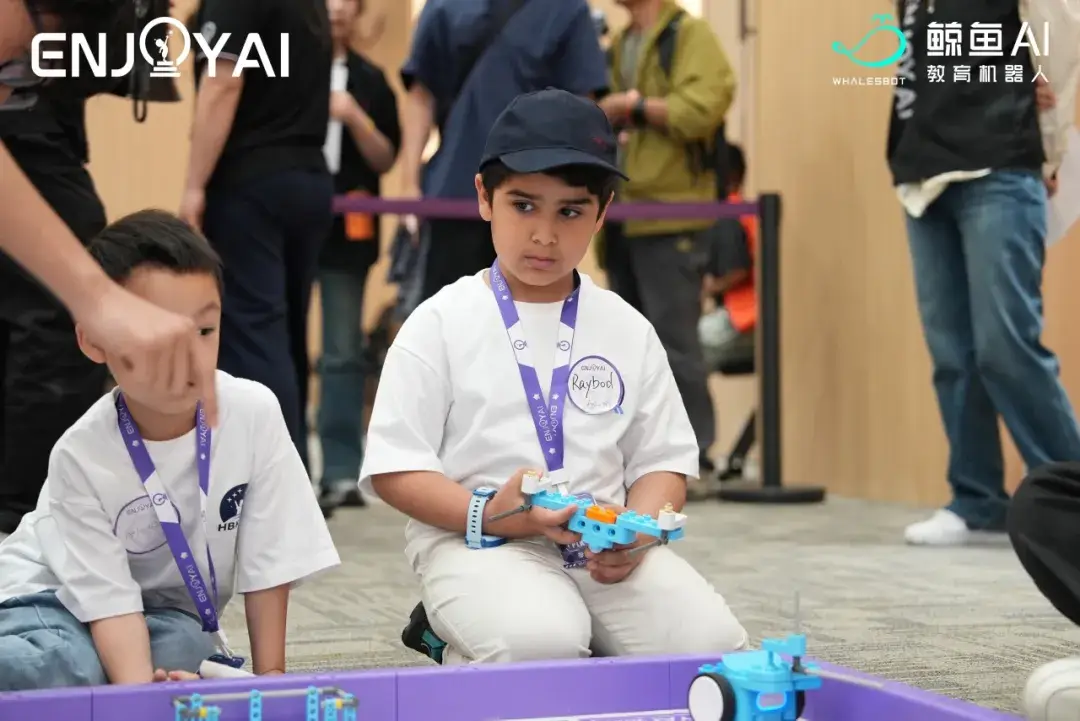
Image credit: ENJOY AI
Technical Competency Building
Participants develop concrete programming abilities through languages and platforms relevant to contemporary AI development. The competition structure requires students to master sensor integration, autonomous decision-making algorithms, and mechanical engineering principles. These technical foundations extend beyond theoretical knowledge into practical application.
Critical Thinking Enhancement
The open-ended nature of competition challenges prevents reliance on memorized solutions. Students must analyze problems from multiple angles, develop hypotheses, test approaches, and iterate based on performance feedback. This process mirrors professional engineering workflows, preparing participants for future careers in technology sectors.
Collaboration and Communication
Team-based competitions necessitate effective communication, task delegation, and conflict resolution. Students learn to articulate technical concepts to teammates with varying expertise levels, document their design processes, and present solutions to judges. These soft skills complement technical abilities, creating well-rounded innovators.
Cultural Exchange Component
Beyond technical competitions, the Global Finals incorporates a Cultural Exhibition where teams showcase their national heritage, traditions, and creative expressions. The 2025 finals recognized Malaysia for Best Design Booth and Sweden for Best Atmosphere, highlighting how the event fosters international understanding alongside technical education.
This cultural dimension addresses a critical gap in STEM education by acknowledging that innovation emerges from diverse perspectives. Participants gain exposure to different problem-solving approaches, communication styles, and cultural values that inform technology development globally.
Industry and Education Forums
The championship includes professional development opportunities for educators through structured forums and panel discussions. Topics address current trends in robotics education, successful implementation strategies, and emerging technologies. Industry representatives contribute insights on workforce needs and skill gaps, helping educators align curricula with future employment demands.
These forums facilitate knowledge transfer between regions with mature robotics programs and areas developing new initiatives. Participants share practical lessons from classroom implementation, discuss resource constraints, and explore funding mechanisms for sustained program growth.
Advancing Youth AI Education
Accessibility Initiatives
The Federation of Global Youth Artificial Intelligence prioritizes making robotics education available regardless of geographic or economic circumstances. Regional competitions reduce travel barriers while maintaining consistent challenge standards. The organization works with local partners to provide equipment access and mentor training in emerging markets.
Progressive Skill Development
The multi-season structure allows students to advance through increasingly complex challenges as they mature. Early Elementary participants who master Geometric Forest fundamentals can progress toward Cyber City and eventually tackle Skyline Adventures as high schoolers. This continuity encourages sustained engagement with STEM fields.
Real-World Application Focus
Competition themes address tangible problems facing societies worldwide. Cyber City’s urban AI challenges reflect actual smart city development priorities. Skyline Adventures’ drone programming relates to commercial applications in agriculture, logistics, and emergency services. Students recognize how their acquired skills connect to professional opportunities.
Impact on Future Innovation
The competition produces measurable outcomes in participant career trajectories and academic pursuits. Former participants have founded robotics companies, pursued engineering degrees, and contributed to AI research initiatives. The hands-on experience provides clarity about technology careers that classroom instruction alone cannot deliver.
Educational institutions implementing ENJOY AI-style robotics programs report increased student interest in advanced mathematics and computer science courses. The competitive element motivates sustained effort, while team dynamics teach resilience when facing setbacks.
2025 ENJOY AI Global Finals Outcomes
The December 2025 championship held in Wuzhen and Shanghai, China brought together thousands of students who qualified through regional competitions. Vietnamese teams demonstrated particular strength across multiple categories, securing numerous championship titles. Macau’s consistent performance in Battle of Tribes highlighted the region’s strategic robotics expertise. Malaysia’s victories in both creative design and technical challenges showcased balanced program development.
The event featured an opening ceremony emphasizing global collaboration, followed by three days of intensive competition, cultural exchange, and professional development activities. Recognition extended beyond competitive rankings to acknowledge creative booth design, cultural presentation quality, and collaborative spirit.
Looking Forward: The ENJOY AI 2026 Season
The upcoming season introduces a new theme called “Inventions Trail,” moving beyond previous maps to explore humanity’s innovation history. This thematic shift encourages students to understand technological development as an ongoing human endeavor rather than isolated achievements.
Regional qualifying events for 2026 include the African Open scheduled for Ghana, continuing the organization’s commitment to expanding participation across developing regions. These qualifiers provide essential competitive experience while building local robotics communities.
The ENJOY AI Global Finals establishes a framework where technical skill development, cultural awareness, and collaborative problem-solving converge. By engaging over one million young people annually in hands-on AI and robotics challenges, the competition creates pathways toward technology careers while fostering international understanding among future innovators. The event’s scale, educational rigor, and commitment to accessibility position it as a significant force in shaping how the next generation approaches artificial intelligence development.
If you are interested in this topic, we suggest you check our articles:
- AI Discipline of Robotics: Learn the Basics
- 5 Industries Utilizing AI Robotics
- List of Biggest Manufacturers for Humanoid Robots
Sources: ENJOY AI
Written by Alius Noreika