Key Takeaways
- Scientists at the UK Dementia Research Institute in Edinburgh use AI to test whether existing, approved drugs can be repurposed to treat MND, Parkinson’s and dementia.
- The team analyses patient data — including voice recordings and iris scans — alongside lab-grown brain cells derived from patient blood samples.
- Machine learning algorithms are trained to find drugs that flip a diseased cell signature back toward a healthy one.
- Around 1,500 drugs already exist that were approved for other conditions; repurposing skips much of the decade-plus timeline a brand-new drug needs.
- The MND-SMART trial tests several drugs at once rather than running a single treatment against a placebo.
- Other teams are pushing the same idea: MIT used generative AI to design new antibiotic compounds, and Harvard’s TxGNN model matched existing drugs to thousands of diseases.
- The field has had setbacks — a large review found Alzheimer’s drugs lecanemab and donanemab slowed decline but not enough to matter much to patients.
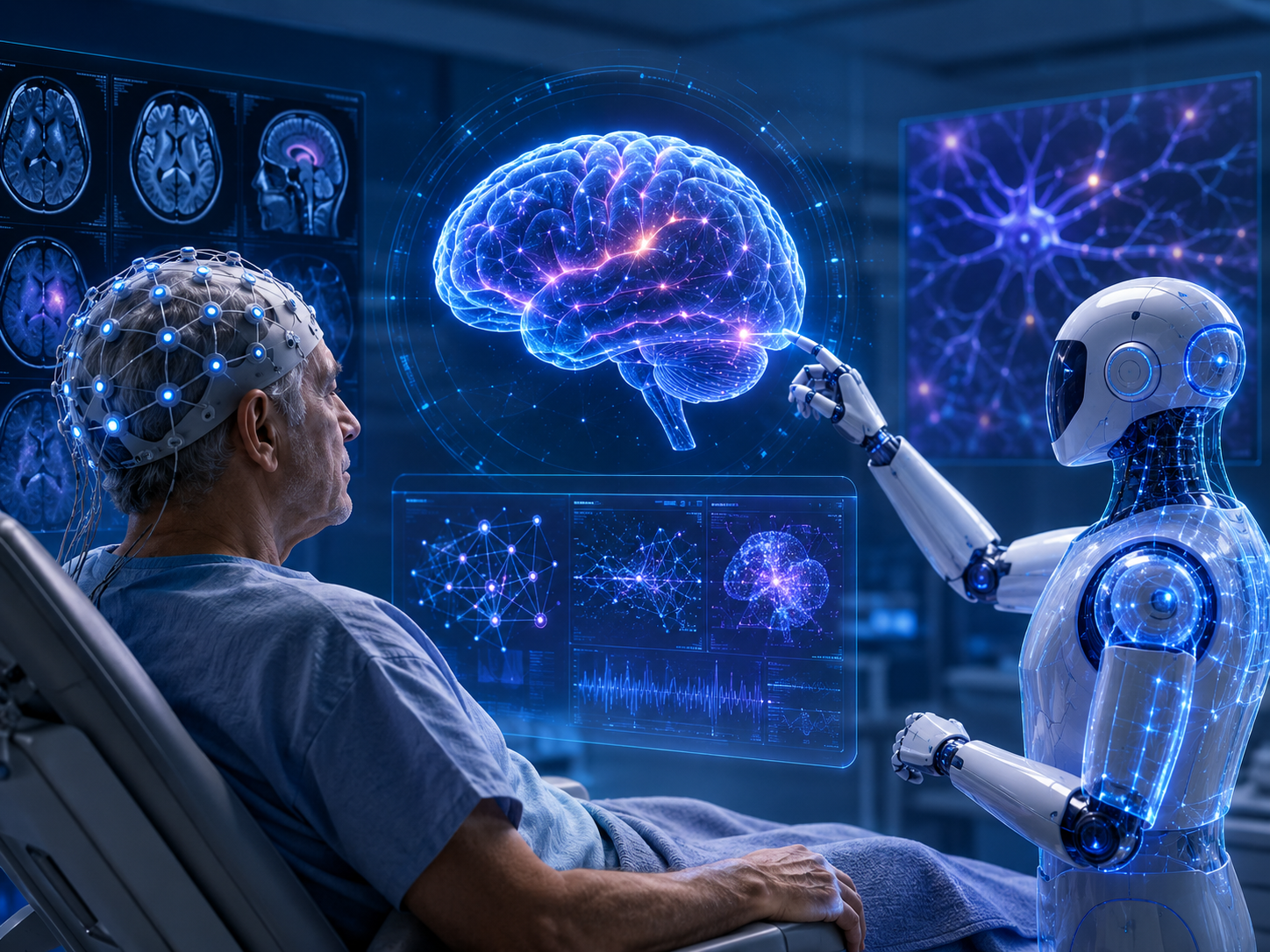
Treatment of neurological conditions using AI – artistic impression. Image credit: Alius Noreika / AI
Artificial intelligence is shortening the hunt for treatments for brain diseases such as motor neurone disease (MND), Parkinson’s and dementia by spotting existing medicines that might work on conditions they were never designed for. At the UK Dementia Research Institute in Edinburgh, scientists feed AI with patient voice recordings, iris scans and lab-grown brain cells, then let machine learning sift the data for drugs already sitting on pharmacy shelves. The aim is direct: find effective therapies in years instead of decades.
The approach is called drug repurposing, and AI makes it faster because it can read patterns across enormous datasets that no human team could process by hand. Roughly 1,500 drugs have already been developed and approved for other illnesses. Any one of them might quietly help a damaged brain — researchers just have not known which, or had a quick way to check. AI changes that math.
What Drug Repurposing Means for Brain Disease
Drug repurposing takes a medicine already cleared for one illness and tests it against another. The advantage is plain: the drug has already passed safety checks and has a known track record in people. Researchers skip the earliest and slowest parts of development and head closer to the clinic.
That matters enormously for neurological conditions, where the clock is cruel. Bringing a genuinely new drug to market can take more than ten years by some estimates. For someone with a fast-moving disease, a decade is not an abstract figure — it is longer than they have. Repurposing compresses that timeline because the foundational work is done.
The brain, though, resists shortcuts. “The brain is the most complicated organ in the body, so we’ve got to contend with the paradox of that complexity,” Professor Siddarthan Chandran, chief executive of the UK Dementia Research Institute, told the BBC. Until recently, that complexity forced scientists toward blunt, slow methods of study. “A combination of AI and new technologies mean we can now do things which would have been unbelievable when I was at medical school,” he said.
Inside the Edinburgh Lab: How the AI Pipeline Works
The Edinburgh process moves from the patient, to the dish, to the algorithm, and back to the patient. It starts with data. Clinicians gather iris scans and voice recordings from volunteers living with Parkinson’s, dementia and MND, building a database designed to catch the faintest early signs of change. AI curates and crunches this mass of information, looking for patterns that might flag trouble before symptoms harden.
The lab work runs in parallel. Researchers take blood samples from those same volunteers and coax the cells into stem cells, then grow them into clusters of brain cells called neurones. This gives the team living, patient-derived tissue to experiment on — without experimenting on the patient.
Existing drugs are then applied to many batches of those neurones using robots, conventional lab equipment and computers running specialist algorithms. The machine learning models have one job here: identify which drugs nudge a neurological “disease signature” back into a “healthy” one. When the AI flags a promising candidate, that drug can move into a clinical trial with people like the volunteers who supplied the cells in the first place.
The science behind targeting MND has grown more specific, too. Most cases involve a toxic build-up of a protein called TDP-43, along with damage driven by other cell types such as astrocytes and microglia. Because several pathways feed the disease at once, researchers increasingly suspect that combinations of drugs — not a single magic pill — will do the most good.
The Steps in Plain Order
| Stage | What Happens | Why It Matters |
|---|---|---|
| Data collection | Voice recordings, iris scans and clinical records gathered from volunteers | Builds a dataset where AI can spot early disease markers |
| Cell creation | Blood samples turned into stem cells, then grown into neurones | Provides patient-derived brain tissue for safe testing |
| Drug screening | Approved drugs tested on neurone batches via robots and algorithms | Checks many compounds far faster than manual lab work |
| AI prediction | Models identify drugs that shift diseased cells toward healthy ones | Narrows thousands of options to a handful worth trialling |
| Clinical trial | Promising candidates tested in patients, e.g. through MND-SMART | Confirms whether lab results hold up in real people |
A Smarter Kind of Trial: MND-SMART
Traditional drug trials are slow partly because of their shape: one group receives a treatment, another receives a placebo, and everyone waits. The MND-SMART trial breaks that mould by testing several drugs at the same time. It is a more efficient design, letting researchers learn about multiple candidates in a single effort rather than running them one after another.
For participants, the appeal runs deeper than mechanics. Steven Barrett OBE, diagnosed with MND a decade ago, frames his involvement as something larger than his own outcome. “For me the research is much more than taking a tablet – it’s taking a tablet with the intention of delivering outcomes, that may or may not help me but help others,” he says.
One Patient’s View: “A Bright Light”
Steven Barrett had a long, decorated career in the civil service and was planning an active retirement when he noticed a numbness in his leg. A few years later came the diagnosis: MND, a degenerative neurological condition with no cure.
He does not soften what the disease does. “MND is a horrible disease, it strips you of who you are,” he told the BBC from his home in Alloa, Scotland. “It rips any sense of future that you may feel that you had planned for yourself – all that goes.” His family, he says, did not see it coming either — he points to photographs of himself at work, at parties, at his son’s wedding.
Yet he calls the research a “bright light” of hope, for himself and for others facing MND or similar conditions. That hope is precisely what the AI work is built to deliver faster.
Beyond Edinburgh: A Wider Movement
The Edinburgh team is not working alone. Across the field, AI is being pointed at the same problem — solutions hidden inside mountains of medical data — with several notable results.
At the Massachusetts Institute of Technology, scientists used generative AI to design novel antibiotic compounds aimed at hard-to-treat infections, including drug-resistant gonorrhoea, with the broader method also relevant to conditions such as Parkinson’s. The work shows AI moving from sifting existing molecules to inventing new ones.
At Harvard, researchers built a model called TxGNN, published in Nature Medicine in 2024, that uses a graph neural network to match existing drugs to diseases. Its standout feature is “zero-shot” prediction: it can suggest candidates for a disease it was never specifically trained on, by reasoning across shared biological features. In testing, TxGNN identified potential uses for nearly 8,000 medicines across more than 17,000 diseases, many of which have no approved treatment, and it improved indication predictions by roughly 49 percent over rival methods under strict evaluation. The model is freely available, and a companion “Explainer” tool shows clinicians the reasoning trail behind each suggestion — a direct answer to the worry that AI is a black box.
| Project | Institution | What the AI Does |
|---|---|---|
| Edinburgh repurposing pipeline | UK Dementia Research Institute | Tests approved drugs on patient-derived neurones to treat MND, Parkinson’s, dementia |
| Generative antibiotic design | MIT | Designs new compounds against resistant infections and other conditions |
| TxGNN | Harvard / Kempner Institute | Matches existing drugs to over 17,000 diseases, including those with no treatment |
A Reality Check: The Field’s Setbacks
Optimism here comes with honest caveats. Two Alzheimer’s drugs once hailed as breakthroughs, lecanemab and donanemab, recently faced a sobering review. Researchers examined 17 studies involving 20,342 volunteers, all testing drugs that clear amyloid — a misfolded protein found in the diseased brain. The verdict: the drugs did slow the disease, but not by enough to make a meaningful difference to patients’ lives. The conclusion drew pushback from other scientists, a reminder that even large datasets leave room for fierce disagreement.
The lesson is not that AI-led research is futile, but that brain disease is unforgiving and progress is rarely clean. Chandran, for his part, stays firmly optimistic. He believes, as he put it to the BBC, that researchers are “at the tipping point of change” in how neurological disease is understood and treated.
Why This Matters for Patients and the NHS
Repurposed drugs carry a practical bonus beyond speed: they tend to be cheaper. Because the medicines already exist and are approved, redeploying them sidesteps much of the cost and risk of building a drug from scratch. Chandran and his team believe their work could bring affordable, effective treatments for neurological conditions sooner than the traditional pipeline would allow.
For the millions living with conditions that currently have no cure, the equation is simple. Faster, cheaper, safer-to-trial candidates mean more shots at a treatment that works — and they mean those shots arrive while there is still time to take them.
Frequently Asked Questions
How does AI help treat neurological conditions?
AI analyses large volumes of patient data and lab results to identify which existing, approved drugs might work against brain diseases such as MND, Parkinson’s and dementia. It spots patterns and predicts candidates far faster than manual research, then those candidates move into clinical trials.
What is drug repurposing?
Drug repurposing means using a medicine already approved for one illness to treat another. Because the drug has already cleared safety testing, it can reach patients much faster and at lower cost than a brand-new compound.
What is the MND-SMART trial?
MND-SMART is a clinical trial that tests several drugs at the same time, rather than running one treatment against a placebo. This design lets researchers evaluate multiple candidates more efficiently.
Can AI cure motor neurone disease?
Not yet. There is no cure for MND. AI is being used to speed up the search for treatments that could slow the disease or improve outcomes, and to find them in years rather than decades.
If you are interested in this topic, we suggest you check our articles:
- Neuromorphic Computing: Learn About AI Mimicking the Human Brain
- AI in Medical Research: Exploring Its Impact and Innovations
- The use of AI Image Recognition in Medicine
Sources: BBC News, LifeArc, Nature Medicine (TxGNN), Kempner Institute, Harvard University, A foundation model for clinician-centered drug repurposing
Written by Alius Noreika