While the global race for AI adoption dominance captures headlines, a closer examination reveals an uncomfortable truth: some of the world’s most advanced economies are falling behind in putting AI into the hands of their citizens.
New data from the second half of 2025 paints a stark picture. Despite massive investments in AI infrastructure and frontier model development, several developed nations find themselves lagging in actual usage rates, overtaken by smaller, more digitally focused economies that have moved faster to integrate these technologies into daily life.
America’s Infrastructure Paradox
The United States presents perhaps the most striking example of this disconnect. Home to OpenAI, Anthropic, and the majority of breakthrough AI models, the country ranks only 24th globally in adoption among its working-age population. Just 28.3 percent of Americans use generative AI tools regularly—a figure that trails far behind nations like the United Arab Emirates (64 percent), Singapore (60.9 percent), and even Spain (41.8 percent).
This gap underscores a fundamental lesson: creating the technology does not guarantee its widespread use. The U.S. leads in AI innovation and possesses unmatched computing infrastructure, yet it has slipped one position in global rankings during the latter half of 2025. The nation’s strength in research and development has not translated into broad public engagement with the tools emerging from its laboratories.
European Fragmentation and Hesitation
Europe faces its own AI adoption challenges, though the picture varies dramatically across the continent. While France, Spain, and Ireland have achieved adoption rates above 40 percent, placing them among global leaders, other major economies struggle to gain traction.
Germany, Europe’s largest economy, registers only 28.6 percent AI adoption—virtually identical to the United States. Italy stands at 27.8 percent, and even innovation-focused Sweden reaches just 33.3 percent. These figures suggest that economic might and technological sophistication do not automatically drive citizen engagement with AI tools.
The fragmentation becomes more pronounced when examining smaller European markets. Romania’s AI adoption rate barely exceeds 16 percent, while across the EU, only 13.5 percent of enterprises reported using AI technologies as of 2024. This uneven landscape reflects deeper structural issues: regulatory uncertainty, limited coordination across member states, and insufficient support for small and medium-sized businesses attempting to integrate these technologies.
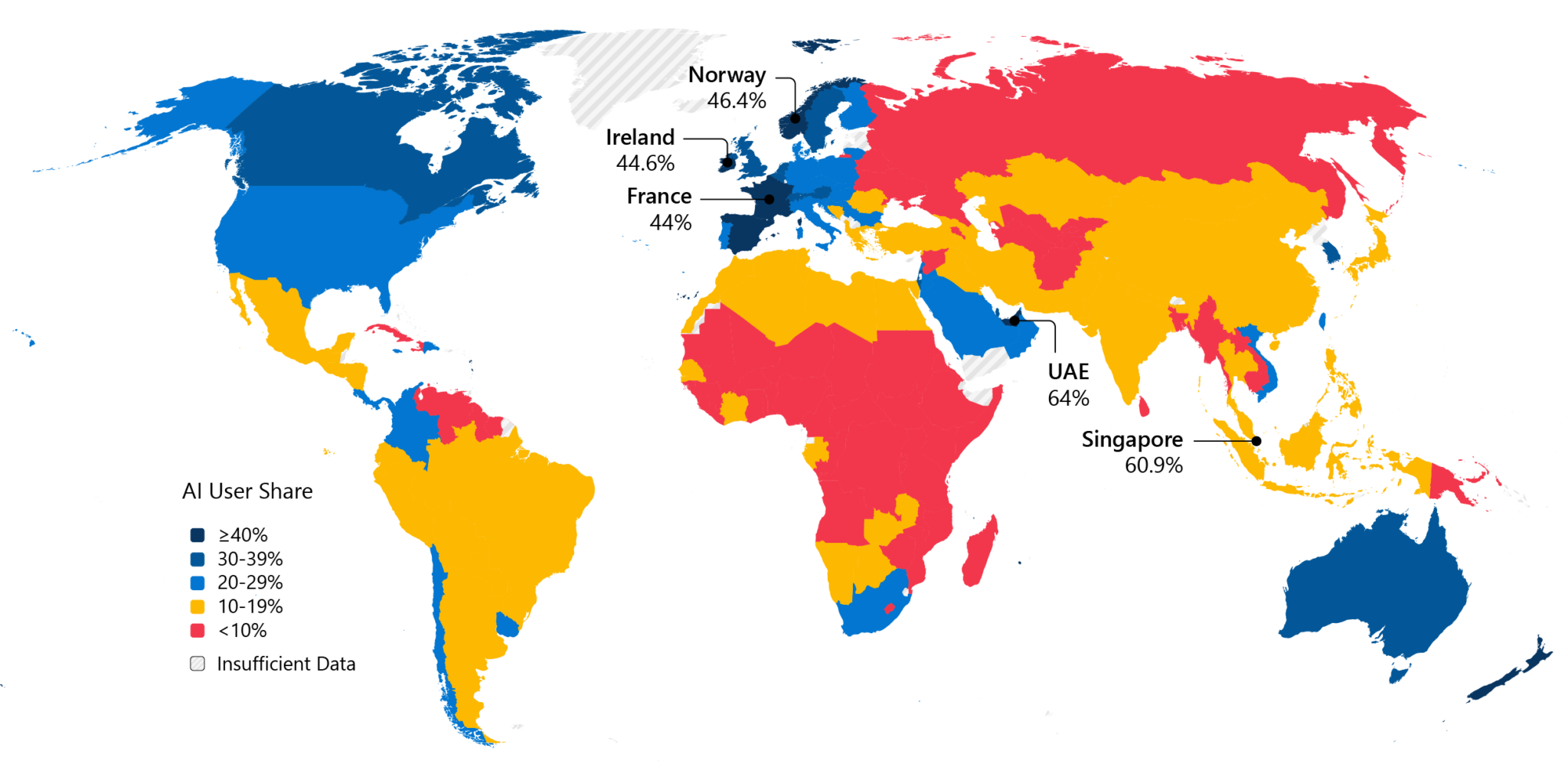
AI user share. Image source: Microsoft
Japan’s Cautious Approach
Japan’s position at 19.1 percent AI adoption reveals another dimension of developed-nation hesitation. Despite the country’s reputation for technological advancement and its substantial investments in robotics and automation, Japanese citizens have been slower to embrace generative AI than their counterparts in Vietnam (23.5 percent) or Saudi Arabia (26.2 percent).
Language barriers explain part of this lag. Until recently, large language models performed poorly in Japanese, limiting their practical utility. But the gap also reflects cultural factors and institutional inertia that make rapid technology adoption more difficult in established economies with entrenched systems and processes.
The Price of Hesitation
What explains this pattern across wealthy nations? Several factors emerge from the data. First, these countries often lack the coordinated national strategies that have propelled smaller nations forward. The UAE appointed a Minister of Artificial Intelligence in 2017—five years before ChatGPT launched—and built public familiarity and trust through steady government deployment.
Second, regulatory caution, while perhaps prudent, has slowed implementation. The European Union’s comprehensive AI Act established important guardrails but may have created compliance burdens that discourage experimentation. Third, mature economies with complex legacy systems face higher barriers to technology integration than nations building digital infrastructure from scratch.
A Widening Divide
The implications extend beyond national pride. As AI adoption in the Global North grows twice as fast as in the Global South, a similar divide is emerging among developed nations themselves. Countries that moved early on digital infrastructure, government adoption, and public education about AI capabilities have opened substantial leads.
The data from late 2025 suggests this gap is not closing. Among the ten countries with the largest increases in AI adoption, all are high-income economies that were already ahead. Success appears to breed success, while hesitation compounds into structural disadvantage.
For advanced economies watching from the middle of the global rankings, the challenge is clear: wealth and technical capacity alone will not determine who benefits from AI’s potential. Without deliberate strategies to drive AI adoption, even the world’s most developed nations risk being left behind.
You might also like:
The Race Toward Artificial General Intelligence
Sources: Microsoft, World Economic Forum