The United States still tops the global AI race, but the margin is narrowing. China has reached near-parity with American models on key performance benchmarks, while the UK, India, Singapore, and Gulf states are spending billions to close the gap.

Artificial intelligence – artistic impression. Image credit: Alius Noreika / AI
Key Takeaways
- The US attracted $471 billion in cumulative private AI investment (2013–2024), more than the rest of the world combined. In 2024 alone, US private AI investment hit $109.1 billion — nearly 12 times China’s $9.3 billion.
- China leads the world in AI patents (nearly 70% of all grants), industrial robot installations (51% of the global total), and computer vision research. China invested roughly ¥890 billion ($125 billion) across public and private channels in 2025.
- The UK ranks third globally in AI funding ($28.2 billion cumulative) and has committed £1.6 billion to a new four-year AI research strategy. Its AI market is valued at over £72 billion.
- India ranks 10th on the Global AI Index, excelling in AI talent. Its AI market is projected to grow from $21.65 billion (2024) to $257.45 billion by 2035.
- The UAE was the first country to appoint a minister for AI (2017) and is building a 5GW AI campus in Abu Dhabi. Saudi Arabia launched a $100 billion AI initiative called Project Transcendence.
- China launched the K-visa in October 2025 to attract foreign STEM talent — directly competing with the US H-1B system, which now faces a $100,000 application fee for new applicants under Trump administration policy.
- Global AI spending is forecast to reach $1.5 trillion in 2025 and exceed $2 trillion in 2026.
With worldwide AI spending forecast of $1.5 trillion in 2025 and to hit $2 trillion in 2026 (according to Gartner), the battle for AI supremacy is no longer a two-horse contest — it is a multi-front war fought across talent pipelines, visa policies, compute infrastructure, and capital flows.
The Stanford 2025 AI Index put it bluntly: “The race is tighter than ever, and no one has a clear lead.” US-based institutions still produced 40 notable AI models in 2024, compared to China’s 15 and Europe’s three. But Chinese models reached near-parity on two critical benchmarks — Massive Multitask Language Understanding (MMLU) and HumanEval — and China already dominates AI patent filings, holding nearly 70% of all global grants. Meanwhile, nations from the Middle East to Southeast Asia are entering the field with their own models and infrastructure, turning what was once a bilateral contest into a genuinely global competition.
The Talent War: Visas, Brain Drains, and a $100,000 Fee
AI progress starts with people, and the fight over who gets to employ the best researchers has become one of the most politically charged dimensions of the race.
The United States houses about 60% of the world’s most prestigious AI institutions and has attracted nearly two-thirds of elite AI researchers, according to Morgan Stanley. Higher salaries, flexible research environments, and a deep venture capital ecosystem have made American labs the default destination for top minds. But that advantage is eroding.
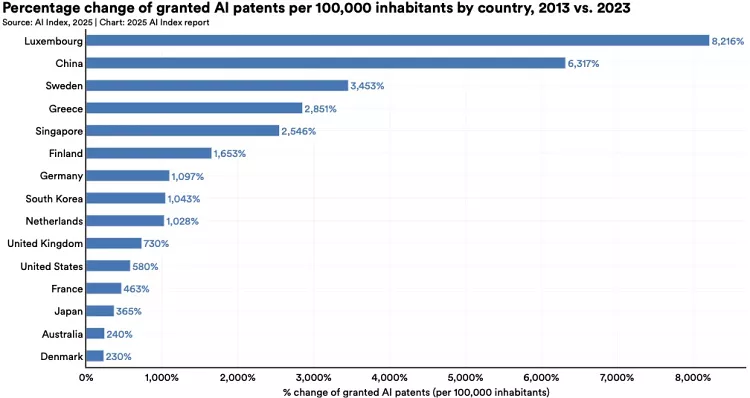
Per inhabitant, Luxembourg is leading the AI patent race Stanford HAI
Nearly half of all AI researchers ranked in the top 20% globally were born in China. The US artificial intelligence sector is so saturated with Chinese-born talent that, as one widely circulated industry joke puts it, the AI race is between two groups of Chinese — those in the US and those in China. That joke is losing its humor. In May 2025, US Secretary of State Marco Rubio announced the administration would “aggressively revoke visas for Chinese students, including those with connections to the Chinese Communist Party or studying in critical fields.” NASA subsequently banned Chinese nationals — including those with US visas — from its data, facilities, and programs.
The Trump administration also imposed a new $100,000 fee on H-1B visa applications, a move that prices out smaller companies and startups. The H-1B system was already constrained: capped at 65,000 visas per year, requiring employer sponsorship, and forcing applicants into a lottery. Laid-off workers have just 60 days to find a new sponsor or face deportation.
China is exploiting this opening. In October 2025, Beijing launched the K-visa, which allows foreign STEM professionals to enter without employer sponsorship — a sharp contrast to the US model. The visa targets young graduates and experienced researchers alike, offering flexibility on entry frequency and duration of stay. Barbara Kelemen, associate director at security intelligence firm Dragonfly, noted: “Beijing perceives the tightening of immigration policies in the U.S. as an opportunity to position itself globally as welcoming foreign talent and investment more broadly.”
Chinese tech giants are also actively recruiting from American companies. ByteDance, Alibaba, and Tencent have reportedly been offering compensation packages that exceed what Meta and other US firms pay mid-level researchers. ByteDance hired Wu Yonghui, a 17-year Google veteran who was a key researcher behind the Gemini AI models.
Still, China faces real barriers. Its less transparent political climate, internet censorship, and the language barrier deter many top-tier candidates. As Michael Feller, chief strategist at Geopolitical Strategy, put it: “The U.S. may be sabotaging itself, but it’s doing so from a far more competitive position in terms of its attractiveness to talent.” He added that the US is probably more at risk of losing H-1B applicants to other Western economies — including the UK and the EU — than to China.
| Country | Talent Strategy | Key Visa Mechanism | Notable Advantage | Key Challenge |
|---|---|---|---|---|
| United States | Market-driven, venture capital ecosystem | H-1B (capped at 65,000/year, $100K fee) | 60% of top AI institutions, highest salaries | Restrictive immigration policy, Chinese talent exodus risk |
| China | State-directed recruitment, K-visa launch | K-visa (no employer sponsorship required) | 47% of top-20% AI researchers born in China | Language barrier, political climate, internet censorship |
| United Kingdom | Global Talent Taskforce, £54M talent fund | Global Talent Visa | Third-largest AI funding globally ($28.2B) | Smaller scale than US, post-Brexit workforce uncertainty |
| India | Massive domestic STEM pipeline | — | Second-highest talent score on Global AI Index | Brain drain to US and UK, low research scores |
| UAE | Golden Visa for AI professionals | AI-specific DIFC licence, Golden Visa | First country with a minister for AI | Small population, heavy dependence on foreign talent |
The Money Race: $471 Billion vs. State-Backed Billions
No country comes close to matching the United States in private AI investment. Between 2013 and 2024, US firms raised $471 billion for AI ventures — more than the rest of the world combined ($289 billion), according to the Stanford 2025 AI Index and the US Federal Reserve. In 2024 alone, $109.1 billion flowed into American AI companies. The four largest US tech firms (spanning online search, social media, software, and e-commerce) spend almost six times what their Chinese counterparts invest.
The biggest single commitment is the Stargate Plan — a $500 billion collaboration between OpenAI, Oracle, Japan’s SoftBank, and the UAE’s MGX to build AI infrastructure across the US. It is the largest AI infrastructure investment announced to date.
China takes a different approach. While its private AI investment has declined from a peak of $16 billion in 2018 to around $9.3 billion in 2024, the state fills the gap. China’s National Venture Capital Guidance Fund channels approximately $138 billion into strategic “hard tech” sectors including AI and semiconductors. Provincial governments and state-owned enterprises operate dozens of additional co-investment funds. In 2025, total Chinese AI spending across public and private sources reached roughly $125 billion (¥890 billion).
The UK sits third with $28.2 billion in cumulative private AI investment and a freshly announced £1.6 billion UKRI research strategy (2026–2030). France attracted Europe’s biggest AI funding deal in 2024, with Mistral AI securing $616 million. Germany’s Helsing landed €464 million, the continent’s second-largest AI investment.
In the Gulf, Saudi Arabia’s Project Transcendence commits $100 billion to AI infrastructure, data centers, and startups. The UAE’s G42 launched a $10 billion government-backed AI fund in 2023, and Abu Dhabi is developing a 5GW AI campus. India, though still smaller in absolute investment, is one of the fastest-growing AI markets, projected to expand from $21.65 billion in 2024 to $257.45 billion by 2035.
| Country/Region | Cumulative Private AI Investment (2013–2024) | 2024 Private AI Investment | Notable State/Sovereign Commitments |
|---|---|---|---|
| United States | $471 billion | $109.1 billion | $500B Stargate Plan |
| China | $119.3 billion | $9.3 billion | ~$138B National VC Guidance Fund |
| United Kingdom | $28.2 billion | $4.5 billion | £1.6B UKRI AI strategy (2026–2030) |
| Canada | $15 billion | — | $1.7B government AI package |
| Israel | $15 billion | — | Military/academic R&D pipeline |
| Saudi Arabia | — | — | $100B Project Transcendence |
| UAE | $3.7 billion | — | $10B G42 fund, 5GW AI campus |
| India | — | — | AI market projected $257B by 2035 |
Compute Power and the Chip Bottleneck
AI models are only as powerful as the hardware that trains them. The US holds half the world’s total AI compute capacity — 39.7 million petaflops as of mid-2025. It also hosts over 60% of global data center capacity, a share forecast to grow to 65% by the end of the decade (Morgan Stanley).
China, despite having 46% (230) of the world’s AI data clusters, ranks seventh in total AI compute at just 400,000 petaflops — a consequence of US export bans on Nvidia and AMD’s most advanced chips. Both the US and China depend on Taiwan’s TSMC, which produces over 60% of the world’s semiconductors and nearly 90% of the advanced chips required for AI.
China is investing heavily to close this gap. Huawei and other domestic firms are building alternative AI chips, and researchers are optimizing algorithms to run efficiently on less powerful hardware — a form of innovation born from constraint. DeepSeek demonstrated this in January 2025 when it launched a high-performance large language model reportedly built at a fraction of the cost of American equivalents, though it relied partly on Nvidia chips stockpiled before the export ban.
The Gulf states have quietly become a third pole. The UAE and Saudi Arabia hold a combined 30.3 million petaflops of AI compute, built largely by US firms on the condition that both nations severed ties with Chinese competitors. This positions the Gulf as a strategic US-aligned compute hub, with implications for which countries can actually access the infrastructure needed to train frontier models.
Model Performance: Near-Parity on Paper, Divergence in Practice
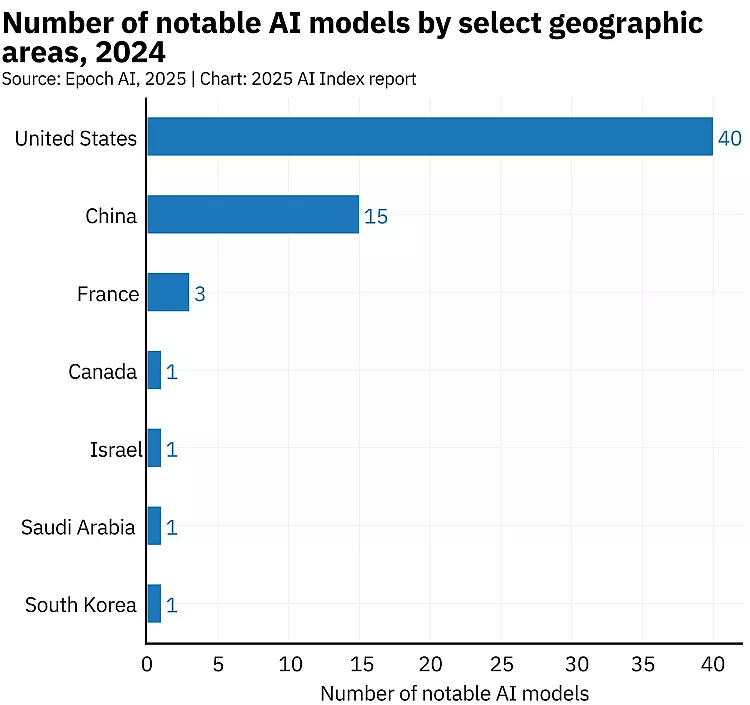
Number of notable AI models by country. Image credit: Stanford HAI
US-based labs still produce the most notable AI models. OpenAI led with seven models in 2024, followed by Google (six) and China’s Alibaba (four). France’s Mistral AI ranked eighth with three models.
But raw model count tells only part of the story. On MMLU (knowledge and problem-solving) and HumanEval (code generation), Chinese models have reached near-parity with American ones. DeepSeek’s R1 model ranked closest to OpenAI and Google’s models on multiple benchmarks. In open-source AI, Chinese models now lead globally: Alibaba’s Qwen has surpassed Meta’s Llama in user preference, global downloads, and developer adoption.
China also dominates computer vision research. At the 2025 International Conference on Computer Vision (ICCV) in Hawaii, half of all paper authors were affiliated with Chinese institutions — far ahead of the US at 17%.
That said, the US retains a decisive edge in compute access and capital. Sean Kenji Starrs of King’s College London pointed out that the US boasts all of the world’s top ten AI firms by market value and 37 of the top 50. Nvidia alone reached a $5 trillion valuation in late 2025. China has just four firms in the top 50 — the same number as Israel.
The University Pipeline: Who Produces the Next Generation
The competition to train AI researchers begins in universities. The US has MIT, Stanford, and Carnegie Mellon — often called the birthplace of AI. Oxford ranks fourth globally for data science and AI. China now produces more PhDs in the sciences than any other country, feeding a deep domestic talent pool.
China’s Ministry of Education launched a national AI curriculum in spring 2025, embedding AI instruction from primary school through university. Shanghai’s Lin-gang Special Area offers AI researchers rent-free startup spaces for up to three years and is building 3,000 subsidized talent apartments.
India excels in producing sheer volume of STEM graduates and ranks second globally on the Global AI Index talent sub-pillar. The UK has 5,800 AI companies and a network of research institutions drawing international talent. The UAE, recognizing its small domestic workforce, has built the Mohamed bin Zayed University of AI (MBZUAI) — the world’s first graduate-level AI research university — and uses Golden Visa schemes to attract foreign researchers.
Beyond the US and China: The New AI Contenders
The AI race is no longer a bilateral affair. Singapore tops the intensity rankings, punching far above its weight with the highest per capita AI spending globally. South Korea scores third-best for AI development and is a major semiconductor production hub. France anchors Europe’s ambitions, backed by €109 billion in private commitments announced in early 2025.
Seven EU nations are building dedicated AI factories — supercomputer-powered research hubs designed to accelerate model training and deployment. Germany’s HammerHAI in Stuttgart, Italy’s IT4LIA in Bologna, and Luxembourg’s L-AI facility are among the first.
In the Gulf, the UAE and Saudi Arabia are converting oil wealth into AI infrastructure at a pace no other region can match. Abu Dhabi’s planned AI campus aims to create a self-sustaining ecosystem of research, talent, and startups. Dubai targets 25% autonomous journeys by 2030.
The Tortoise Media Global AI Index — which scores 83 countries across investment, innovation, and implementation — places the US at 100, China at 54, Singapore at 32, the UK at 30, and France at 28. India sits at 24, Israel and Canada at 26, and the UAE at 17.
Who Actually Wins?
Nvidia CEO Jensen Huang told a London AI summit in late 2025 that “China is going to win the AI race,” citing its energy superiority, research talent, and the risk that US chip export bans will galvanize Beijing to close the technology gap. He later softened his stance, saying America could still prevail.
The evidence suggests a more complicated picture. The US dominates in private investment, top-tier firms, compute power, and frontier model development. China leads in patents, computer vision research, open-source models, industrial robot deployment, and state-coordinated investment. The UK, India, the Gulf states, and parts of Europe are each carving out specialized niches — from the UK’s AI drug discovery to India’s fintech AI to the UAE’s smart city deployments.
As Greg Slabaugh, Professor of Computer Vision and AI at Queen Mary University of London, argued: more data, more talent, and more coordinated investment create a self-accelerating loop for China. But as Sean Kenji Starrs of King’s College London countered, compute access and capital spending remain decisive — and the US advantage here is measured in orders of magnitude.
The $1 trillion question may not have a single answer. AI leadership is fragmenting across multiple layers — talent, models, infrastructure, chips, regulation, and deployment — and different nations lead in different areas. The country that wins will likely be the one that combines the most of these advantages, or the one that prevents its rivals from doing the same.
If you are interested in this topic, we suggest you check our articles:
- How Competitive is the GenAI Model Race?
- The Race Toward Artificial General Intelligence
- The AI Adoption Gap: Wealthy Nations Struggling to Keep Pace
Sources: Euronews, Morgan Stanley, Independent, LoveMoney
Written by Alius Noreika