Key Takeaways
- Walt Disney Imagineering‘s free-roaming Olaf robot appeared live alongside NVIDIA CEO Jensen Huang during the GTC 2026 keynote in San Jose on March 16.
- The 35-inch, 33-pound robot walks, talks, and balances independently — a departure from traditional fixed animatronics.
- Olaf runs on NVIDIA’s Newton physics engine, built by Disney Research, Google DeepMind, and NVIDIA, now open-sourced through the Linux Foundation.
- Disney’s custom Kamino simulator trained 100,000 virtual Olafs in two days using a single NVIDIA RTX 4090 GPU.
- Olaf will debut for park guests at Disneyland Paris’s World of Frozen on March 29, performing on a moving boat in the lagoon.
- Deep reinforcement learning taught the robot to balance on an unstable surface in a matter of hours.
- Disney plans to extend the technology to more characters across its parks and cruise ships worldwide.
Disney’s beloved Frozen snowman walked onto one of the world’s most prominent technology stages on March 16, 2026. During NVIDIA CEO Jensen Huang’s keynote at the annual GTC conference in San Jose, a 2.5-foot-tall robotic Olaf — complete with stick arms, a carrot nose, and white felt-like covering — joined Huang on stage, moving freely, responding to conversation, and drawing the attention of thousands of AI developers, researchers, and industry leaders in the audience.
The robot is the product of a three-way collaboration between Walt Disney Imagineering, NVIDIA, and Google DeepMind. Unlike any Disney animatronic before it, this Olaf walks autonomously, navigates its environment, and interacts with people around it. The demonstration was not a concept preview — it was a public showing of a finished system heading to Disneyland Paris on March 29, where it will greet guests inside the brand-new World of Frozen land.
How the Olaf Robot Works: Newton, Kamino, and Deep Reinforcement Learning
Olaf’s movement is powered by the Newton physics engine, a GPU-accelerated, open-source simulation platform co-developed by Disney Research, Google DeepMind, and NVIDIA. Newton is built on NVIDIA’s Warp framework and the OpenUSD standard. It supports multiple physics solvers and enables complex contact-rich robot behaviors — walking on uneven terrain, manipulating objects, and maintaining balance under dynamic conditions.
“It was because of physics, using this Newton solver, that runs on top of Nvidia Warp, that we jointly developed with Disney and DeepMind, that made it possible for you to be able to adapt to the physical world,” Huang told the robotic snowman on stage.
Disney built its own simulator layer on top of Newton called Kamino, a GPU-accelerated physics solver designed for complex mechanical systems. Kamino runs thousands of parallel training environments on a single GPU, including structurally different robots in each environment. Engineers trained 100,000 virtual Olaf instances in just two days using a single NVIDIA RTX 4090 GPU. That training covered standing, walking, heat management, and noise reduction.
Kyle Laughlin, SVP of Research & Development and Technology & Engineering at Walt Disney Imagineering, described the specific challenges the team faced. “He is such a unique character — he is made of snow, moves in non-physical ways, and he has snowball feet,” Laughlin said. “Olaf will be debuting at World of Frozen as part of the daily Celebration in Arendelle show, which takes place on a boat in the lagoon. This meant he had to learn to balance on an unstable surface. Through deep reinforcement learning, in just a matter of hours, he earned his sea legs.”
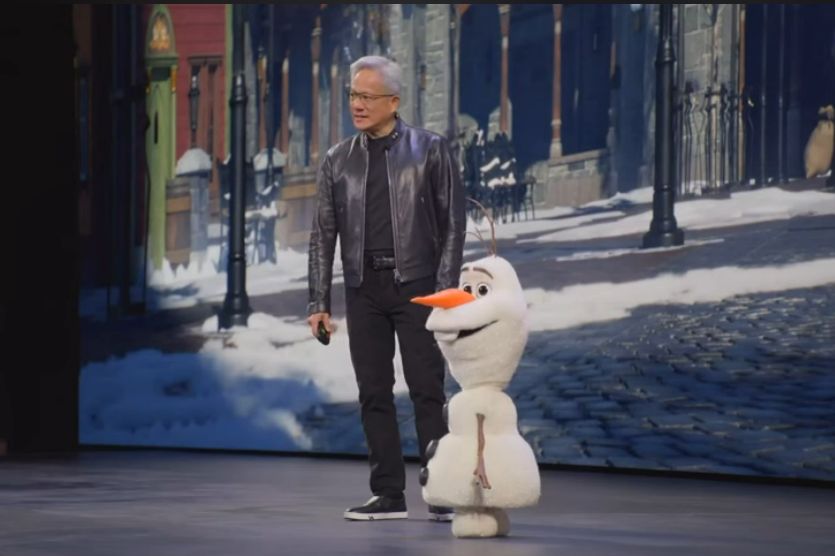
Nvidia’s Jensen Huang and Olaf the robot. (YouTube screenshot)
Physical Specifications and Onboard Systems
The robotic Olaf stands 35 inches tall and weighs 33 pounds. It carries onboard NVIDIA chips and is teleoperated via a Steam Deck controller. Walt Disney Animation Studios provided character animation data so the robot’s gait would match Olaf’s recognizable shuffling walk from the films. Reinforcement learning allowed Disney engineers to train the robot’s policies for movement, building on techniques previously applied to the BDX droids used in Disney parks.
| Specification | Detail |
|---|---|
| Height | 35 inches (approximately 2.5 feet) |
| Weight | 33 pounds |
| Physics Engine | NVIDIA Newton (open-source, GPU-accelerated) |
| Custom Simulator | Kamino (built on NVIDIA Warp) |
| Training Scale | 100,000 virtual instances in 2 days on one RTX 4090 |
| Control Method | Teleoperated via Steam Deck |
| Onboard Compute | NVIDIA chips (model unspecified) |
| Collaborators | Disney Research, Google DeepMind, NVIDIA |
| Open-Source Host | Linux Foundation |
Where Guests Will See Olaf First
The GTC demo was a prelude to a real deployment. Olaf will debut at World of Frozen in Disneyland Paris on March 29, 2026, performing in the daily Celebration in Arendelle show aboard a boat in the lagoon. Hong Kong Disneyland will follow with limited-time appearances. Disney has not yet confirmed a timeline for U.S. park deployments, but Huang suggested during his keynote that Newton-enabled robots could appear in American Disney parks as well.
Notably, guests at the Disneyland Paris debut should not expect extended one-on-one interaction time with the robot. Disney has indicated the character will perform as part of a structured show rather than roaming freely among visitors — at least initially.
Newton Goes Open-Source Under the Linux Foundation
Newton is not a proprietary Disney tool. The engine was donated to the Linux Foundation in September 2025 as a fully open-source project. This means any robotics researcher or developer can access the same GPU-accelerated physics simulation platform used to train Olaf.
Moritz Bächer, Director of Disney Research Lab Zurich, presented a session at GTC titled “Disney’s Robotic Characters: From the Screen to Reality via Physical AI.” He also joined a panel discussion on March 19 alongside representatives from NVIDIA, Google DeepMind, and robotics company Skild, focused specifically on the Newton engine.
“Newton’s architecture has made it possible for us to create Kamino, a simulator that unlocks the potential of reinforcement learning for robotic systems of unmatched complexity,” Bächer said.
Broader Ambitions: Beyond Olaf
Disney’s plans extend well past a single snowman. The Kamino simulator is designed to handle structurally different robots, not just Olaf-shaped ones. Laughlin confirmed that the team is working on more emotive, expressive, and surprising characters for parks and cruise ships worldwide. The BDX droids already in Disney parks use the same Newton-based training pipeline, learning to navigate complex environments through the same reinforcement learning approach.
NVIDIA framed the Olaf partnership within a much larger physical AI push. At GTC 2026, the company also announced Isaac Lab 3.0 (in early access), GR00T N1.7 robot foundation models with commercial licensing, a preview of GR00T N2 — which reportedly succeeds at new tasks more than twice as often as leading vision-language action models — and the Cosmos 3 world model for generalized robot intelligence. More than two million robots globally now use NVIDIA’s Omniverse and Isaac frameworks.
“Physical AI has arrived — every industrial company will become a robotics company,” Huang said. “NVIDIA’s full-stack platform — spanning computing, open models and software frameworks — is the foundation for the robotics industry.”
What This Means for Theme Park Robotics
Fixed animatronics have been a Disney signature for decades, from the Hall of Presidents to Pirates of the Caribbean. Olaf marks a departure: a character that walks, balances, and moves through a space without tracks, rails, or fixed mounting points. The combination of onboard compute, reinforcement-learned movement policies, and teleoperation gives Disney a system that can place recognizable characters in fluid, unscripted-looking environments.
Laughlin emphasized the speed gains the new training pipeline delivers. “The speed at which we’re able to create new characters — and get them in front of our guests — is unprecedented,” he said. That speed matters commercially. Faster character development means Disney can populate new lands and attractions with interactive figures more quickly, potentially reducing the gap between a film’s release and its physical presence in a park.
For the moment, Olaf remains the flagship. When he steps onto that boat in the Disneyland Paris lagoon on March 29, he will be the first free-roaming Disney robot character to perform live for a public audience — trained not by human puppeteers fine-tuning every joint, but by 100,000 simulated copies of himself learning to walk in a virtual world.
If you are interested in this topic, we suggest you check our articles:
- How Advanced Are AI Humanoid Robots?
- 5 Industries Utilizing AI Robotics
- List of Biggest Manufacturers for Humanoid Robots
Sources: Forbes
Written by Alius Noreika