Key Takeaways
- By revenue, Nvidia’s most successful product is its data centre GPU line — the Hopper H100 and its Blackwell successors — which generated $193.7 billion in fiscal 2026 alone.
- Data centre sales grew from $15.0 billion in fiscal 2023 to $47.5 billion in fiscal 2024, $115.2 billion in fiscal 2025 and $193.7 billion in fiscal 2026.
- In the second quarter of fiscal 2027, data centre products accounted for $89.0 billion of $96.2 billion in total revenue — 93% of the company.
- Blackwell posted $11.0 billion of revenue in its first full quarter, which Nvidia called the fastest product ramp in its history.
- GeForce remains the longest-lived franchise, launched in 1999 and still generating $16.0 billion in fiscal 2026, but it is now under 8% of revenue.
- CUDA, released in 2006, is the product that made the rest possible; Nvidia funded it for roughly a decade before it paid off.
- Nvidia became the first public company worth $5 trillion on 29 October 2025, on the strength of data centre demand.
- Longevity tells a different story from revenue: the RTX 3060 spent years as the most common GPU on Steam before a laptop chip took the top spot in June 2026.
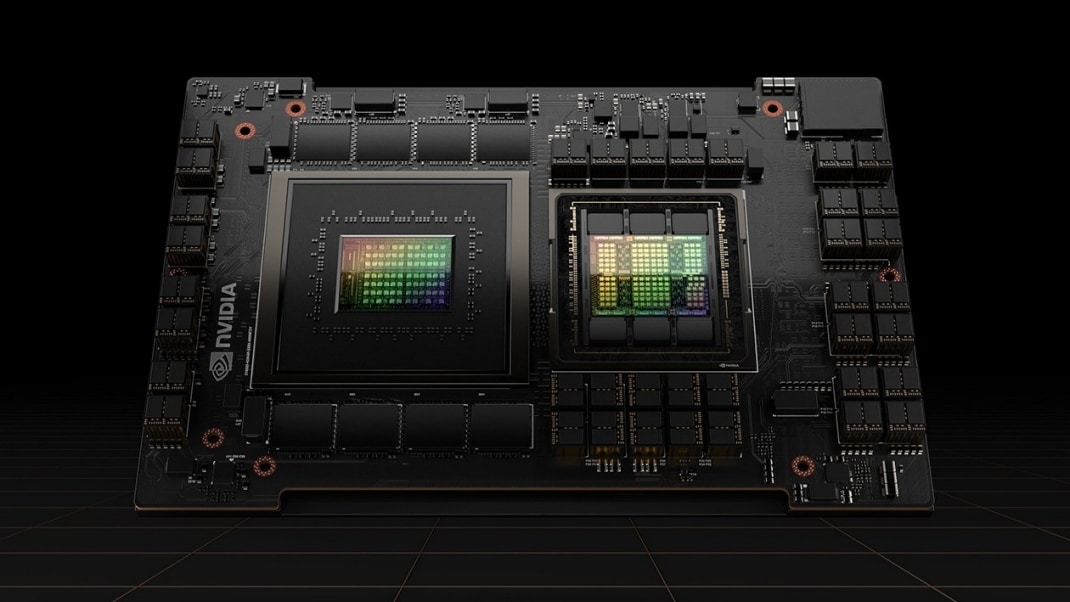
NVIDIA H100 GPU. Image source: NVIDIA
Nvidia’s most successful product is its data centre GPU line. In fiscal 2026 that single category brought in $193.7 billion of the company’s $215.9 billion total, and by the second quarter of fiscal 2027 it accounted for $89.0 billion out of $96.2 billion — 93 cents of every dollar. No other product Nvidia has shipped in thirty years comes within an order of magnitude.
The more interesting answer sits underneath that one. CUDA, the parallel computing platform Nvidia released in 2006 and gave away for free, is what turned a graphics chip into the default machine for training neural networks. It generates no direct revenue and appears in no segment table, yet without it the H100 would have been one accelerator among several rather than the industry standard. Revenue names the winner; CUDA explains the win.
The Revenue Answer: Data Centre GPUs
The growth curve is the clearest evidence. Nvidia’s data centre business was a respectable but unremarkable line item until generative AI arrived, and then it went vertical.
| Fiscal year | Total revenue | Data centre revenue | Data centre growth |
|---|---|---|---|
| FY2023 | $27.0 billion | $15.0 billion | — |
| FY2024 | $60.9 billion | $47.5 billion | +217% |
| FY2025 | $130.5 billion | $115.2 billion | +142% |
| FY2026 | $215.9 billion | $193.7 billion | +68% |
| Q2 FY2027 (quarter) | $96.2 billion | $89.0 billion | +117% year over year |
Two products drove most of that. The H100, built on the Hopper architecture, became the unit of account for AI capacity between 2023 and 2025 — clusters were described by how many H100s they held, and shortage of them set the pace of the entire industry. Blackwell replaced it and did so faster than anything Nvidia had launched before, contributing $11.0 billion in its first full quarter, which the company’s finance chief described as the fastest product ramp in its history. The Blackwell server platform then became the reference design for AI data centres worldwide.
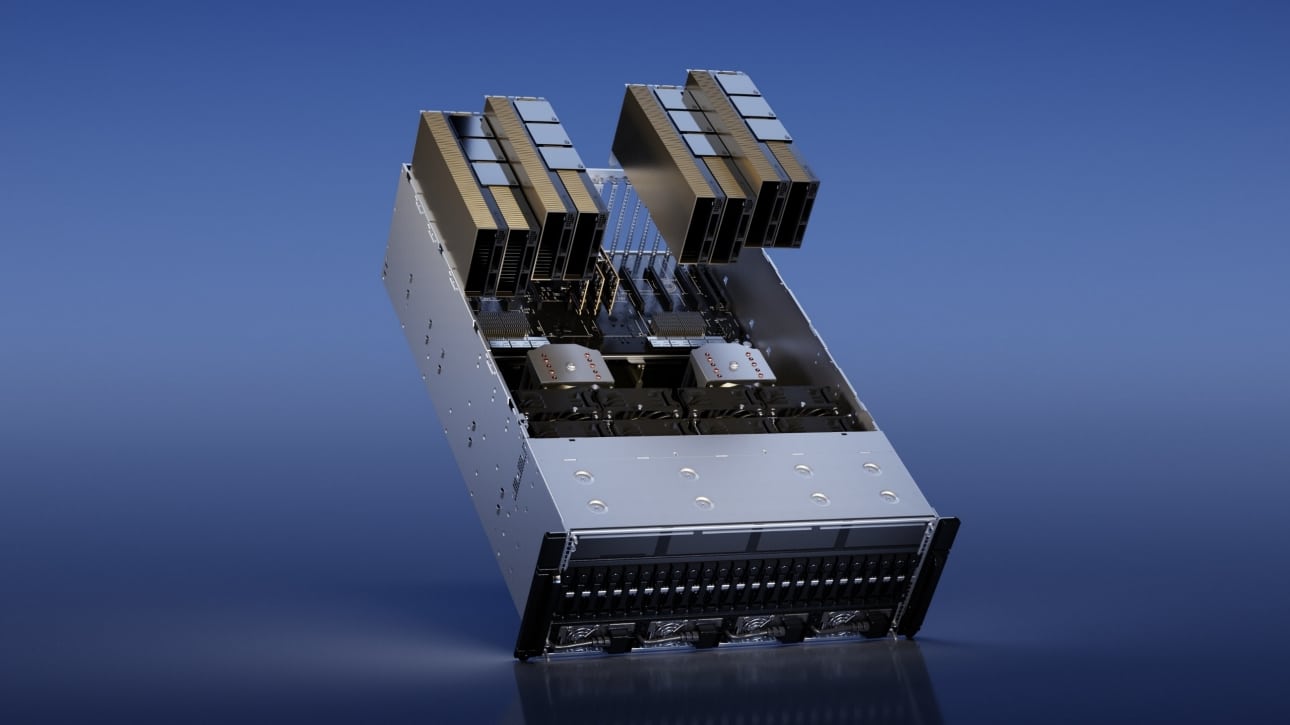
NVIDIA H100 GPU. Image source: NVIDIA
Why CUDA Is the Product That Mattered Most
Nvidia shipped CUDA in 2006 and embedded it in every graphics processor it made, at considerable cost and with no near-term return. The company spent roughly a decade funding the platform before it produced meaningful profit. Ian Buck, Nvidia’s vice president for hyperscale and HPC, described the core insight this way: “The most important thing about CUDA was the C programming language…let the program run on 10,000 cores for just the part where it really mattered.”
That decision built a software estate — more than a thousand CUDA-X libraries across C, Python, Fortran and Java — that competitors have to replicate before they can compete on silicon at all. Jensen Huang has described the resulting dynamic as a flywheel: “It’s taken us 20 years to build up hundreds of millions of GPUs and computing systems…This combination of dynamics helps the Nvidia architecture expand.”
The practical effect is switching cost. A rival accelerator can match a Blackwell part on paper and still lose the order, because the customer’s models, kernels and tooling assume CUDA. Every discussion of AI infrastructure components eventually arrives at that dependency.
GeForce: The Longest Run, Not the Biggest Number
GeForce launched in 1999 with the GeForce 256, which Nvidia marketed as the world’s first GPU. It has shipped continuously for more than a quarter of a century, funded the research that produced everything else, and built the manufacturing scale that made data centre parts affordable to develop.
It is also still a substantial business in absolute terms — $16.0 billion in fiscal 2026, up 41% year over year. But it now represents under 8% of company revenue, and Nvidia has reorganised its reporting so that consumer and edge products sit together in a $7.2 billion quarterly line. Judged by durability, brand recognition and install base, GeForce is the company’s most successful product. Judged by money, it is not close.
Install base is where GeForce still leads on a metric nobody else can match. The RTX 3060 held the top position in the Steam hardware survey for years after its release, and only in June 2026 did a laptop part, the RTX 4060 Laptop GPU, take first place — the first time a mobile chip led the chart. Hundreds of millions of gamers running Nvidia hardware is the base from which every developer relationship starts.
Comparing the Candidates
| Product | Case for it | Case against it |
|---|---|---|
| Data centre GPUs (H100, Blackwell) | $193.7 billion in FY2026; 93% of current revenue; drove a $5 trillion valuation | Concentrated in a young market with heavy customer overlap |
| CUDA | Created the moat; enabled every subsequent win; 20 years of compounding | Generates no direct revenue of its own |
| GeForce | 27 years of continuous shipping; largest install base; funded the R&D | Under 8% of revenue and shrinking as a share |
| DGX systems | Turned chips into complete supercomputers; established the rack as the unit of sale | Volume small relative to component sales |
| Automotive and robotics platforms | $2.3 billion in FY2026, up 39%; long design-in cycles | Still around 1% of revenue |
The Shift From Chips to Systems
One reason the data centre answer holds is that Nvidia stopped selling chips and started selling machines. DGX systems packaged GPUs, networking and software into a supported unit, and the NVL72 rack extended that to an entire cabinet operating as a single accelerator. Networking, acquired with Mellanox, became a record-setting business in its own right.
That packaging is what lets Nvidia capture more value per GPU than it could as a component vendor, and it now extends down to the desk with products such as DGX Spark and DGX Station. The pattern repeats upward too, with Blackwell Ultra and Vera Rubin arriving as full platform generations rather than individual parts.
What Could Change the Answer
Three things would rewrite this ranking. Custom inference silicon from Nvidia’s largest customers erodes the highest-volume workload, since serving models is a narrower problem than training them and easier to build a dedicated chip for. Memory cost inflation is already pushing Nvidia’s gross margin from 75.0% toward a forecast trough of 71–72%, which changes the profit picture even if unit volume holds. And the automotive and robotics platforms, currently around 1% of revenue, have the longest runway of anything in the portfolio — partnerships such as the GM and Nvidia collaboration on vehicles and manufacturing take years to reach volume but tend to persist once designed in.
For now the ledger is unambiguous. The data centre GPU is the most commercially successful product Nvidia has ever sold, by a margin that grows every quarter. CUDA is the reason it happened, GeForce is the reason CUDA existed, and each of those answers is correct depending on which question is being asked.
If you are interested in this topic, we suggest you check our articles:
- NVIDIA Blackwell Server: Specs, Power and Capabilities
- Nvidia’s Blackwell Ultra GB300 and Vera Rubin
- Nvidia’s DGX Spark and DGX Station: Desktop AI Supercomputing
- GM and Nvidia Partnership: Automotive AI and Manufacturing
- AI Infrastructure: Essential Components in Modern ML Systems
Sources: Nvidia FY2026 results, Nvidia FY2025 CFO commentary, Nvidia FY2024 results, Nvidia Q2 FY2027 press release, Computer Weekly, TechCrunch
Written by Alius Noreika