Key Takeaways
- Moonshot AI is a Beijing large-model company founded in March 2023 by Yang Zhilin, Zhou Xinyu and Wu Yuxin, all Tsinghua University schoolmates.
- Its consumer product is Kimi, an assistant launched in October 2023 that built its early reputation on long-context reading.
- The company raised roughly $2 billion in May 2026 at a post-money valuation near $20 billion, led by Meituan’s investment arm, with state-backed China Mobile among the participants.
- Reported disclosed fundraising across recent rounds totals close to $3.9 billion, and the company is said to be discussing a further round valuing it near $30 billion.
- Kimi’s annualised recurring revenue reportedly moved from about $100 million in early March 2026 to more than $200 million by the end of April.
- Flagship model Kimi K3 launched on 16 July 2026 with 2.8 trillion total parameters, 104 billion active per token and a context window of roughly 1.05 million tokens.
- K3 open weights shipped on 26–27 July 2026 under a custom licence rather than a permissive one, spanning 96 shards and about 1.56TB.
- Alibaba is reported to be the largest outside shareholder; Tencent was an early backer. The company is weighing a Hong Kong listing.

Kimi K3 art. Image credit: Moonshot AI
Moonshot AI is the Beijing laboratory that turned a long-context chatbot into one of the world’s most-used open-weight model families — and, in the space of roughly six months, saw its private valuation multiply roughly fivefold to about $20 billion. Its name in Chinese, 月之暗面, translates as “the dark side of the moon,” a nod to founder Yang Zhilin’s favourite Pink Floyd record; the company was incorporated on the album’s fiftieth anniversary.
The commercial answer to what Moonshot actually is: a foundation-model company that sells a consumer assistant called Kimi, sells API access to that assistant’s underlying models, and gives the weights away afterwards. That last decision, taken in mid-2025 after a bruising year, is what rebuilt the business.
Founding and the Long-Context Bet
Yang Zhilin trained at Tsinghua University and Carnegie Mellon, with research stints at Google Brain and Meta AI, before founding Moonshot in March 2023 alongside two university contemporaries. He has described his objective as building foundation models toward artificial general intelligence, with three staged milestones: long context length, a multimodal world model, and a scalable general architecture capable of improving itself without human input.
The first milestone came quickly. Six months after founding, Moonshot shipped the Kimi app — at the time the first commercially available assistant able to accept roughly 200,000 Chinese characters in a single input. Capacity later expanded to two million characters, and that single feature made Kimi one of China’s most-used AI services through 2024, with more than 36 million monthly active users by the end of that year. Valuation followed: about $300 million at launch, roughly $2.5 billion by February 2024 after a raise exceeding $1 billion.
The DeepSeek Squeeze and the Open-Weight Pivot
2025 went badly. DeepSeek’s R1 release in January of that year reset expectations for what a Chinese lab could deliver at what price, and Kimi’s consumer standing eroded. Moonshot had been spending heavily on advertising while a rival grew organically to tens of millions of daily users. By February 2025 Kimi had cut its marketing budget sharply. The competitive pressure that DeepSeek applied across the industry hit its domestic peers hardest of all.
The response was a strategy change rather than a product tweak. In July 2025 Moonshot released Kimi K2, a one-trillion-parameter open-weight Mixture-of-Experts model, and topped Hugging Face downloads on launch day. Kimi K2 Thinking followed in November 2025, scoring 44.9% on Humanity’s Last Exam with tools enabled — ahead of the reported figures for GPT-5 at high reasoning and Claude Sonnet 4.5 Thinking on that particular test. Reports circulated of a $4.6 million training cost, though Yang has since said that number is not official and that research and experimentation make the true figure hard to pin down.
The bet worked. By spring 2026, Kimi K2.6 had become the second most-used large language model on OpenRouter, the routing platform many developers use to compare providers.
Funding Timeline and Ownership
| Date | Event | Reported valuation |
|---|---|---|
| March 2023 | Company incorporated in Beijing | ~$300 million |
| February 2024 | Raise exceeding $1 billion (Alibaba, Sequoia China, Xiaohongshu) | ~$2.5 billion |
| December 2025 | $500 million Series C led by IDG Capital, with Alibaba and Tencent | ~$4.3 billion |
| January 2026 | Round extension reported | ~$4.8 billion |
| Early 2026 | $700 million raise | ~$10 billion |
| May 2026 | ~$2 billion led by Meituan’s Long-Z, with China Mobile and Tsinghua Capital | ~$20 billion |
| Mid-2026 | Further round reported in discussion | ~$30 billion (unconfirmed) |
Two features of the May 2026 round stand out. First, the lead investor was a food-delivery and services platform’s venture arm rather than a traditional technology fund. Second, China Mobile’s participation brought a state-backed telecoms operator onto the register, carrying implications for domestic distribution and infrastructure access. CITIC Private Equity Funds also took part.
Moonshot does not publish audited financials. Valuation and revenue figures come from press reporting rather than filings, and should be read with that in mind.
Kimi K3: The Largest Open Model Yet Released
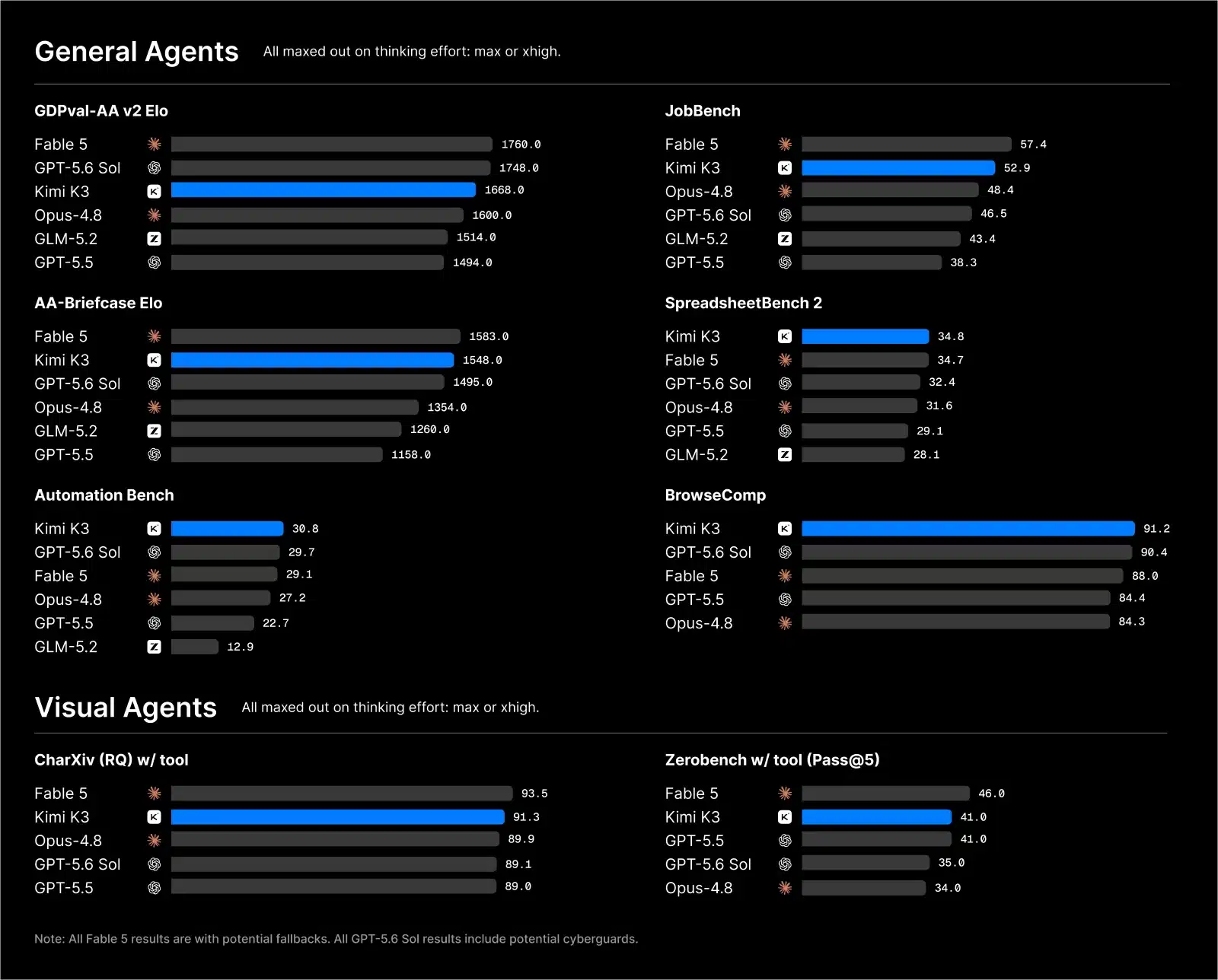
Kimi K3 general AI agents benchmark. Image credit: Moonshot AI
K3 arrived on 16 July 2026, timed just ahead of the World Artificial Intelligence Conference in Shanghai. Moonshot describes it as the first open 3T-class model — 2.8 trillion total parameters, of which only 16 of 896 experts fire on any given token, roughly 1.8% of the pool, activating about 104 billion parameters. The architecture uses what the company calls Stable LatentMoE alongside Kimi Delta Attention and attention residuals, with quantisation-aware training in MXFP4 and MXFP8 formats and a claimed 2.5x scaling efficiency improvement over K2.
Moonshot’s own assessment placed K3 behind Claude Fable 5 and GPT-5.6 Sol on overall performance while ahead of every other model in its evaluation suite, including Claude Opus 4.8 and GPT-5.5, on coding and agentic tasks. Independent signals were strong on launch day: first place on Arena’s Frontend Code leaderboard at 1,679 Elo in blind developer matchups, ahead of Fable 5, and a fourth-place overall ranking from Artificial Analysis. The company also reported 91.2 on BrowseComp, 88.3 on Terminal Bench 2.1 and 93.5 on GPQA-Diamond.
Pricing is where K3 breaks from the Chinese playbook. At $3 per million input tokens, $0.30 on cached input and $15 per million output tokens, it is the most expensive model any Chinese lab has shipped — matching the headline rate of Claude Sonnet 5. Moonshot is no longer competing purely on price. That shift places it in a different bracket to the low-cost tier and closer to the frontier vendors whose generational model comparisons readers usually study for capability rather than cost per call.
Weights arrived on 26 July, a day ahead of the promised deadline, at roughly 1.56TB across 96 shards — but under a custom Kimi K3 licence rather than the modified MIT terms that covered the K2 line. Moonshot recommends production deployment on supernode configurations of 64 or more accelerators and has not published a minimum viable GPU setup.
Products, Controversy and What Comes Next
Beyond the core chatbot, Moonshot ships Kimi Work, Kimi Code, Kimi Researcher, Kimi Agent, Kimi Audio and the Kimina Prover theorem-proving system. Kimi Code has found real traction among developers; Cursor used an earlier Kimi model in building Composer 2. Domestic subscription tiers run from about 5.2 yuan for four days to 399 yuan for a year of priority access.
The company is not without disputes. In November 2025, GSR Ventures and other institutions initiated arbitration in Hong Kong over the relationship between Moonshot and Yang’s earlier venture. And in July 2026, White House OSTP Director Michael Kratsios publicly accused Moonshot of running an internal distillation platform targeting Claude Fable 5 using restricted Nvidia chips routed through Thailand — an allegation the company has not conceded.
A Hong Kong listing is under consideration. Moonshot has held preliminary talks with Goldman Sachs and CICC, with a float reportedly sized near $1 billion, though no timeline is confirmed and the company may stay private. Yang told staff in late 2025 that recent rounds had already exceeded what most listed companies raise through IPOs and placements, leaving little urgency. If that changes, Moonshot would join a public-market moment that already includes Anthropic’s own confidential IPO filing, and 2026 would become the year frontier labs on both sides of the Pacific finally answered to public shareholders.
If you are interested in this topic, we suggest you check our articles:
- DeepSeek: Chinese AI Firm Disrupting the Global Industry
- How Does DeepSeek Truly Compare to ChatGPT?
- Anthropic Files for IPO: How Will It Compare to AI Players?
- Claude Opus 4.6 vs 4.7 vs 4.8: Which Model Wins?
- xAI vs OpenAI vs Anthropic: Who Wins in 2026?
Sources: TechCrunch, The Next Web, Tom’s Hardware, Wikipedia, South China Morning Post via Yahoo Finance, OpenRouter, MIT Technology Review
Written by Alius Noreika