Key Takeaways
- The “5x cheaper” claim is roughly true on a per-task basis, but not on any single per-token rate.
- Grok 4.5 lists at $2 per million input tokens and $6 per million output tokens; Claude Opus 4.8 lists at $5 input and $25 output.
- On raw rates, Grok 4.5 is 2.5x cheaper on input and about 4.2x cheaper on output — not a flat 5x.
- Measured per completed task, the gap widens: about $0.31 per Intelligence Index task for Grok 4.5 versus roughly $1.80 for Opus 4.8, close to a 6x difference.
- The multiplier comes mostly from token efficiency: Grok 4.5 uses around 4.2x fewer output tokens than Opus 4.8 on SWE-Bench Pro tasks.
- Opus 4.8’s caching, batch API and effort controls narrow the real-world gap for many workloads.
- Cheaper does not mean better: Opus 4.8 leads on the hardest coding and accuracy-critical work.
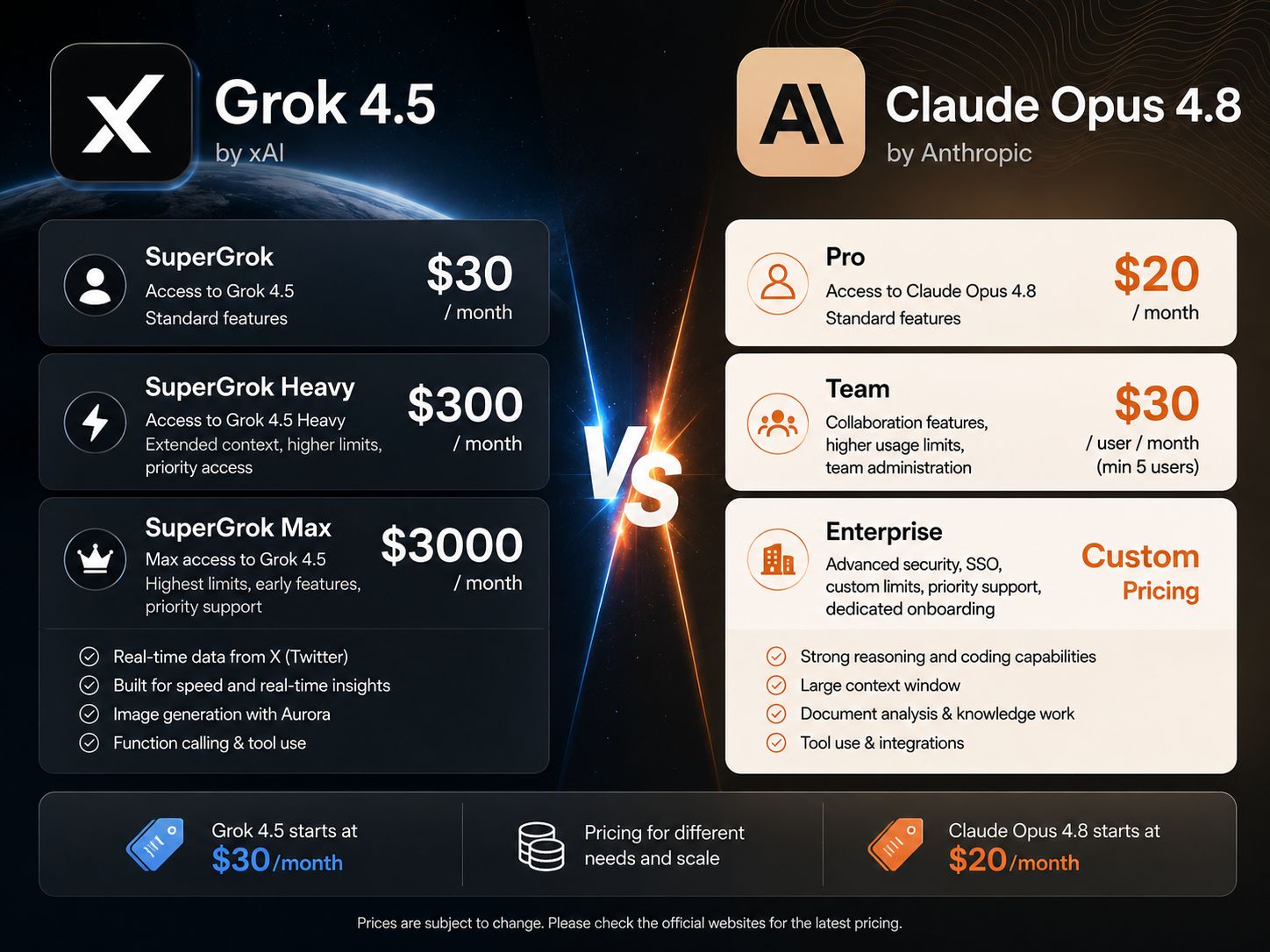
Grok 4.5 versus Claude Opus 4.8 pricing – artistic impression. Image credit: Alius Noreika / AI
Grok 4.5 is close to five times cheaper than Claude Opus 4.8 when you measure the cost of finishing a whole task, but the “5x” figure does not hold on the sticker rates alone. On published per-token pricing, Grok 4.5 is 2.5x cheaper on input and about 4.2x cheaper on output. The reason the effective gap grows toward five or six times is that Grok 4.5 needs far fewer tokens to complete the same job, so the savings compound across an agentic run.
Put simply: if you compare list prices token for token, the honest number is roughly two-and-a-half to four times, depending on the input-to-output mix. If you compare the money spent to actually solve a standardised task, independent testing from Artificial Analysis puts Grok 4.5 at about $0.31 per Intelligence Index task against roughly $1.80 for Opus 4.8 — very close to a 6x difference. “5x cheaper” sits neatly in the middle of those two measures, which is why the claim keeps circulating.
The List Prices, Side by Side
Both models publish standard per-million-token pricing. Grok 4.5 charges $2 for input and $6 for output, with cached input reads at $0.50. Claude Opus 4.8 has held $5 input and $25 output since the Opus 4.5 generation, with cache-hit reads dropping to $0.50 and a batch API halving both figures. The math on the raw rates is straightforward and it is not a clean 5x.
| Cost measure | Grok 4.5 | Claude Opus 4.8 | Opus ÷ Grok |
|---|---|---|---|
| Input, per million tokens | $2 | $5 | 2.5x |
| Output, per million tokens | $6 | $25 | ~4.2x |
| Cached input read, per million | $0.50 | $0.50 | 1x |
| Cost per Intelligence Index task | $0.31 | ~$1.80 | ~6x |
| Avg tokens per coding-agent task | ~1.9M | ~7–8M (SWE-Bench Pro) | ~4.2x fewer |
Why the Per-Task Gap Beats the Per-Token Gap
Output tokens drive most agentic bills, and this is where Grok 4.5 pulls ahead twice over. It charges less per output token, and it produces fewer of them. On SWE-Bench Pro tasks, xAI reports Grok 4.5 using about 4.2 times fewer output tokens than Opus 4.8 at maximum effort. Multiply a lower rate by a smaller token count and the effective saving on a finished task climbs well past the headline rate difference. That compounding is the whole reason the “5x” number feels right in practice even though no single line on the price sheet says five.
The lesson mirrors a point we make in our 2026 AI subscription price comparison: token rates only tell part of the cost story once reasoning, retries and tool calls enter the bill. Two models with identical sticker prices can cost very different amounts to run a real workload.
Where Opus 4.8 Claws Back the Difference
Opus 4.8 is not defenceless on cost. Prompt caching drops repeated input to $0.50 per million, the batch API cuts both directions in half, and effort controls let teams dial reasoning down for simpler jobs. For workloads that replay a large system prompt or run asynchronously, those levers move the real bill more than the headline rate does. Our breakdown of Claude Opus 4.6 vs 4.7 vs 4.8 walks through how the effort dial changes the true cost per task.
Cheaper Is Only Half the Question
Price without quality is a false economy, and here the two models diverge. Opus 4.8 leads on SWE-Bench Pro and on accuracy-critical work, and it ships with a detailed system card. Grok 4.5 trades roughly 15 to 25 Intelligence Index points and a real gap on the hardest coding tasks for its lower cost, and it carries a doubled hallucination rate versus its predecessor.
For high-volume, checkable agentic work, the savings are worth it. For unsupervised, high-stakes tasks, the cheaper model can cost more once you count the errors. The wider trade-off between price and capability is something we explore in our 2026 vibe-coding tier list, and the strategic reasons behind xAI’s low-cost pitch are explained in our coverage of the SpaceX and xAI merger.
The Bottom Line
Is Grok 4.5 five times cheaper than Claude Opus? On completed-task cost, yes — the effective gap runs about five to six times. On raw per-token rates, no — it is closer to two-and-a-half times on input and four times on output. The “5x” shorthand is a fair blended approximation of a real, large advantage, driven as much by Grok 4.5’s token efficiency as by its lower price sheet.
Pricing is anchored to published list rates as of late July 2026 and to Artificial Analysis per-task testing from July 9–10, 2026. Rates and discounts change; this is informational, not procurement advice.
If you are interested in this topic, we suggest you check our articles:
- 2026 AI Subscription Prices: Gemini vs ChatGPT vs Claude
- Claude Opus 4.6 vs 4.7 vs 4.8: Which Model Wins?
- xAI vs OpenAI vs Anthropic: Which AI Lab Wins in 2026?
- Best AI LLM for Vibe Coding: Complete 2026 Tier List
- ChatGPT-5 vs Grok 4: Who Wins?
Sources: AI Tools Review, Spheron, Apidog, The Decoder
Written by Alius Noreika