Most content is still consumed on autopilot. People scan a blog, skim a landing page, and close the tab without clicking anything. Interactive quizzes break that pattern by turning your content into a short, personal experience where visitors answer a few questions and get a result that feels written just for them, not for “everyone.”
When you treat quizzes in content marketing as a funnel, you can see exactly where people get interested, where they drop off, and where they finally convert. That visibility lets you improve your content with real data instead of guesswork and turn quizzes into a repeatable growth channel instead of a one-time campaign.

Content marketing – artistic impression. Image credit: Nick Morrison via Unsplash, free license
This guide explains what interactive quizzes are, why they matter, how they work step by step, which types perform best, what metrics to watch, and the trusted tools you can use to build and optimize your own quiz strategy.
Key Highlights
|
What Are Interactive Quizzes?
An interactive quiz is a guided experience where visitors answer a short series of questions and receive a personalized result, score, or recommendation. Instead of only reading, they participate in the content.
At a basic level, a quiz has three parts:
- A hook that promises a clear benefit, such as a score, type, or plan
- A small set of focused questions
- A results screen that explains what the answers mean and what to do next
Behind the scenes, each answer is tied to a score, category, or logic rule. The quiz tool combines these to decide which result a person should see.
Interactive quizzes can be purely educational, purely entertaining, or tightly connected to your product. The strongest results usually come when the topic matches a real decision or doubt your audience already has, such as “Which approach is right for me” or “How ready are we for this change?”
Why Interactive Quizzes Matter for Content Marketing
A good quiz can change the role of your content from a one-way message to a two-way conversation. Even small improvements in how many people start, finish, and convert inside the quiz can produce a clear impact on leads, pipeline, and sales.
There are four main reasons they matter:
1. They Lift Engagement
Quizzes demand action. Clicking, choosing, and moving forward keep people on the page longer and focus their attention on the topic. This usually leads to higher time on page and deeper scroll activity than static articles.
2. They Attract Better Fit Visitors
People who commit to several questions about a specific problem are often more serious about solving it. This helps you filter out casual readers and focus on those who actually want help.
3. They Generate Structured Data
Every answer is a piece of first-party data. Over time, you learn what people struggle with, how prepared they feel, and what they want next. That data can refine your messaging, offers, and even product roadmap.
4. They Bring Content and Lead Generation Together
Instead of separate assets for education and lead capture, a quiz combines both. People learn something about themselves, and you gain permission to continue the conversation.
How Interactive Quizzes Work
Most interactive quizzes follow a simple flow. Understanding this flow makes it easier to create a quiz.
1. Awareness – People First See the Quiz
This is where visitors discover your quiz for the first time. It could be a banner on a blog, a callout in the middle of an article, a social post, an email, or a paid ad. The title and short description need to make the benefit clear in just a few words.
2. Consideration – They Decide to Start
Once people land on the quiz page, they decide whether to click the start button. This is where layout, design, and clarity matter. A clean page with a short intro, simple instructions, and a visible button usually works best. Your goal is to remove doubts like “How long will this take?” or “Is this relevant for me?”
3. Participation – They Answer Questions
This is the core of the experience. People move from one question to the next. Good quizzes:
- Keep questions short and specific.
- Avoid trick or confusing wording.
- Use consistent answer formats wherever possible.
On screen, progress indicators and simple navigation help people feel in control.
4. Gate – You Ask for Details
Many marketing quizzes ask for an email address or other details before or after the results. You can:
- Place the form before the results to capture more leads.
- Place the form after results for fewer, more committed leads.
Short forms with clear explanations of value usually convert better than long forms that ask for everything at once.
5. Result – You Deliver the Outcome
The result screen is where the payoff happens. It should:
- Explain what the result means in simple language.
- Highlight a key insight or shift in perspective.
- Recommend one clear next step and possibly a secondary one.
This can be a link to a guide, a product page, a demo, a webinar, or a consultation.
Types of Interactive Quizzes
There are many ways to group quizzes, but most high-performing ones fall into a few familiar types.
1. Personality and Profile Quizzes
These quizzes place people into types or profiles.
Example: “What Kind of Remote Manager Are You?”
You map answer patterns to a set of profiles. Each profile has its own description and advice. These quizzes work well at the awareness stage because they feel fun and personal and are easy to share.
2. Product Recommendation Quizzes
These quizzes help visitors choose among many options.
Example: “Find the Right Learning Plan for Your Team in 7 Questions”
Questions explore company size, goals, budget, and preferred style. The result narrows down the best plan or bundle and links directly to relevant pages. This format is powerful for e-commerce and SaaS where choice overload is a real problem.
3. Knowledge and Readiness Quizzes
These quizzes measure how much someone knows or how prepared they feel.
Example: “How Ready Is Your Organization for ISO Certification?”
The result can be a score, level, or maturity stage. You can then recommend resources, timelines, or services that match their stage. This works well in B2B and compliance-focused fields.
4. Pain and Priority Quizzes
These quizzes surface the main problems people face and order them.
Example: “What Is Your Biggest Content Bottleneck Right Now?”
Based on answers, you point to the top one or two issues that need attention and suggest specific solutions. This helps both the visitor and your sales team focus on what really matters.
5. ROI and Cost Quizzes
These quizzes estimate potential gains or losses.
Example: “How Much Revenue Are You Losing Due to Slow Follow-Up?”
They turn vague ideas into approximate numbers, which often makes a business case more compelling. These quizzes are useful for late-stage content that needs to justify change.
How Interactive Quizzes Improve Content Marketing Results
When you build quizzes with a clear purpose, they can support each step of your content funnel.
1. Better Conversion From Existing Traffic
You do not need a huge traffic spike to see value. A quiz that converts even a small percentage of visitors into leads can outperform typical gated PDFs or static forms. People have already invested time in answering questions, so sharing an email to see or save results feels fair.
2. Stronger Segmentation and Personalization
Every answer can map to a segment. For example, you might classify people as beginner, intermediate, or advanced, or tag them by industry or company size. This makes it easier to send follow-up content that speaks directly to their context instead of sending the same nurture sequence to everyone.
3. More Insightful Sales and Success Conversations
When quiz data is sent to your CRM or help desk, your teams see more than just a name and email. They see interests, scores, and self-reported challenges. That context makes calls smoother and lets teams suggest more relevant next steps.
4. Continuous Ideas for New Content
Patterns in quiz answers reveal common questions and misconceptions. If many people score low in one area or choose the same option, that is a signal to create more content on that topic. Over time, this turns quizzes into a quiet research engine for your editorial calendar.
Real Example of a Brand Using an Interactive Quiz Successfully
One of the clearest proofs that interactive quizzes can drive massive engagement comes from Red Lobster’s social campaigns. Their quiz, “What Endless Shrimp Flavor Are You?”, turned a simple promotion into a viral moment on Facebook.
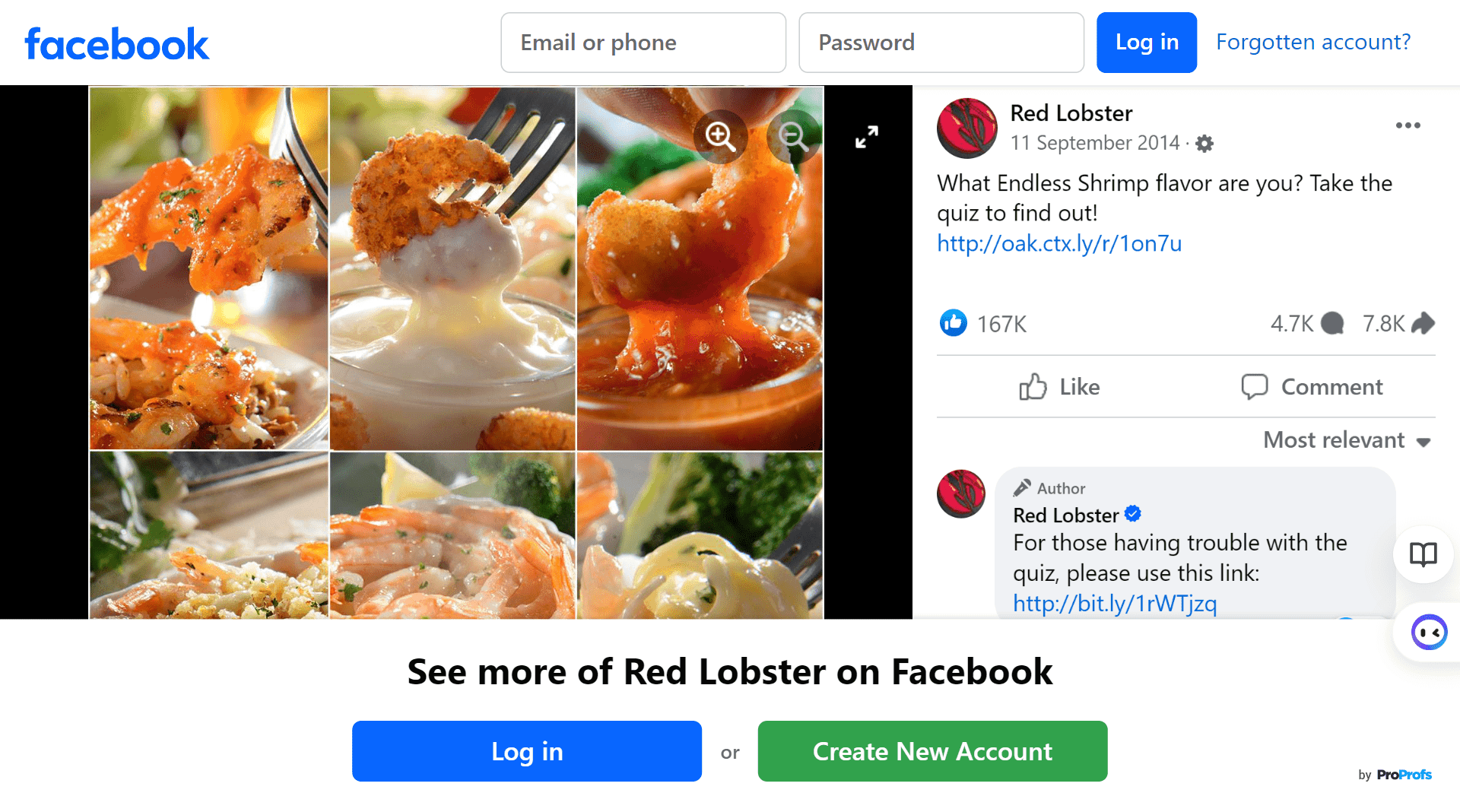
Here is what the quiz achieved:
- Over 167,000 likes on the post
- Around 7,800 shares
- Nearly 80,000 likes on the very first day alone
For a light, personality-style quiz built around one menu item, those numbers are huge. The format worked because it was fun, low effort, and tightly connected to a popular offer that fans already loved. People could get a playful “flavor” identity in seconds, tag friends, and share their results without overthinking it.
From a “quizzes in content marketing” perspective, this example highlights three important points:
- Tie your quiz to a specific, timely campaign or offer.
- Use a simple, curiosity-driven hook that makes people want to click.
- Design results that are easy to share and talk about with friends.
Going viral on Facebook is never guaranteed, and it is certainly not easy. But Red Lobster’s quiz shows the upside when everything clicks: a simple interactive quiz can push your brand into thousands of feeds in a single day and create buzz that traditional posts rarely match.
Best Tools to Create Interactive Quizzes
You do not need to write code to build and manage quizzes today. Here are five reliable tools that support interactive quizzes for marketing and training, along with short, accurate descriptions.
1. ProProfs Quiz Maker
ProProfs Quiz Maker lets you create graded and personality quizzes with 20+ question types, including highly interactive formats such as hotspot, drag & drop, video response, and sequencing. You can start from scratch, use a large library of ready-to-use questions and templates, or create a quiz in seconds with AI.
Automated grading, instant feedback, detailed reports, and integrations with tools like Salesforce and Mailchimp make it suitable for both training and lead generation.
2. Typeform
Typeform lets you create conversational quizzes with one question per screen and a strong visual style. It includes quiz templates, scoring, and outcome quizzes, so you can assign points to answers and show different endings based on total scores.
Because of its design, Typeform works well when you want your quiz to feel light and engaging while still collecting structured data and sending it on to other systems.
3. Interact
Interact focuses on quizzes for lead generation. It provides quiz templates, a visual builder, and strong integrations with email and CRM platforms so that leads can be tagged and segmented by result automatically.
Many creators and small businesses use Interact to grow email lists with personality and product match quizzes that plug directly into tools like HubSpot and ConvertKit.
4. Outgrow
Outgrow is an interactive content platform for marketers that supports quizzes, calculators, surveys, chatbots, and product recommendations without coding.
It is designed for conversion-focused experiences, with templates, analytics, and integrations that help turn interactions into qualified leads. If you want quizzes plus other interactive formats in one place, Outgrow can work as a central platform.
5. LeadQuizzes
LeadQuizzes specializes in quizzes built to capture leads and learn about audiences. It offers templates, a drag-and-drop editor, analytics, and new AI-powered options for creating quizzes and forms that support lead generation, event registration, and data collection.
LeadQuizzes is often used by marketing teams that want a focused quiz builder tied closely to their campaigns and landing pages.
Conclusion: Make Interactive Quizzes Part of Your Content Habit
Interactive quizzes are more than just a fun addition to your content—they’re a powerful tool for attracting, engaging, and qualifying leads in a way that leaves a lasting impression. When you understand the quiz funnel, track key metrics, and continuously refine the experience, you can reduce drop-offs, enhance lead quality, and gain deeper insights into your audience with every response.
If you already create blogs, guides, or ebooks, adding interactive quizzes is the next logical step. These quizzes should be a natural extension of your content, answering real questions your audience is asking. Rather than treating them as one-off experiments, integrate them as core assets alongside other formats.
Over time, these small but meaningful interactive experiences will breathe new life into your content strategy, making it more personal, dynamic, and impactful for both you and your readers.