Key Takeaways
- AI-enabling goods — semiconductors, servers and telecoms equipment — accounted for almost half of global trade growth in 2025 while making up only one-sixth of merchandise trade.
- Their share of world trade rose from about 13% in 2023 to nearly 17% by the end of 2025, growing 21.9% year on year.
- The WTO projects AI could raise global trade by 34–37% and global GDP by 12–13% by 2040, depending on how widely the technology and supporting policy spread.
- Machine translation raised exports on eBay by 10.9% between affected country pairs — an effect one researcher likened to “making the world 26 percent smaller.”
- Asia contributed 71% of merchandise trade growth in 2025, concentrating the gains geographically.
- The IMF forecast 3.3% global growth for 2026, with AI investment offsetting trade headwinds, while flagging an AI valuation correction as a downside risk.
- Bound tariffs on AI-enabling goods reach as high as 45% in some low-income economies, raising the cost of catching up.
- UNCTAD projects the AI market will reach $4.8 trillion by 2033, roughly the size of Germany’s economy.
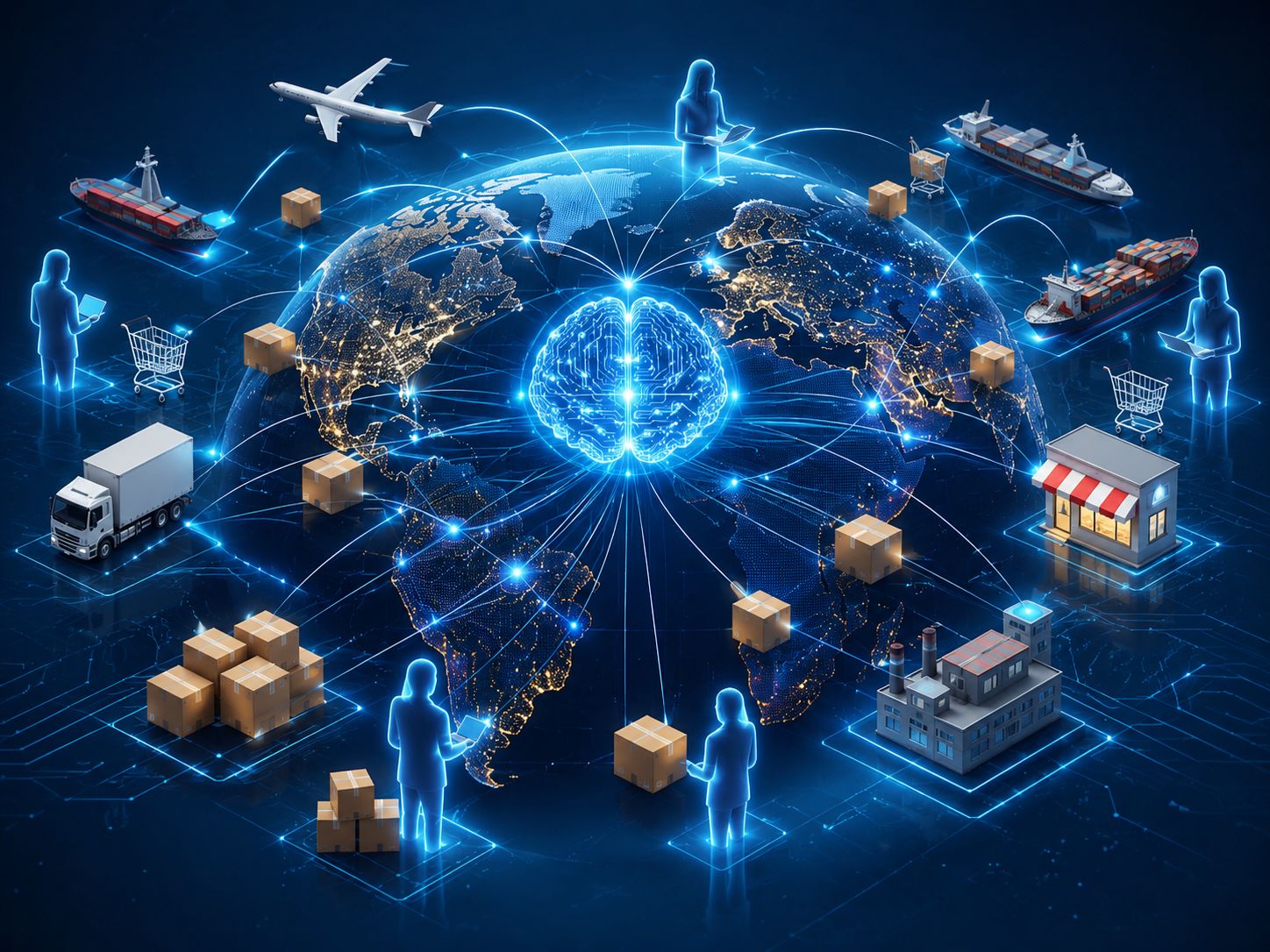
AI in cross-border commerce – artistic impression. Image source: Alius Noreika / AI
AI is changing international business in three measurable ways. It has become a major traded good in its own right, with AI-enabling hardware driving nearly half of world trade growth in 2025. It cuts the fixed costs that keep smaller firms out of foreign markets — translation, compliance paperwork, customer support in unfamiliar time zones. And it concentrates advantage, because the countries and companies that already had capital, electricity and data are the ones capturing most of the gain.
The scale is not speculative. The World Trade Organization’s modelling suggests AI could lift global trade by 34–37% and global GDP by 12–13% by 2040, but those figures assume broad adoption and policy that keeps markets open. The same report notes that access to AI-enabling goods remains uneven and that some low-income economies maintain bound tariffs of up to 45% on exactly the equipment they would need. The technology’s effect on international business is therefore a question of distribution as much as magnitude.
AI Hardware Has Become a Trade Category of Its Own
Something unusual happened to the composition of world trade in 2025. Semiconductors, servers, networking gear, raw silicon and specialty gases grew 21.9% year on year and contributed close to half of total merchandise trade expansion, despite representing roughly one-sixth of trade by value. Their share of world trade climbed from about 13% in 2023 to nearly 17% two years later.
Overall merchandise trade volume grew 4.6% in 2025. The WTO’s March 2026 outlook put 2026 baseline growth at 1.9% and 2027 at 2.6%, with the slowdown attributed partly to the unwinding of earlier import frontloading and partly to conflict-driven energy and transport costs. AI investment is the counterweight in both years.
| Indicator | Figure | Period |
|---|---|---|
| World merchandise trade volume growth | 4.6% | 2025 |
| Forecast trade growth | 1.9% / 2.6% | 2026 / 2027 |
| AI-enabling goods growth | 21.9% | 2025 |
| AI goods share of world trade | ~13% to ~17% | 2023 to end-2025 |
| Asia’s share of trade growth | 71% | 2025 |
| Projected AI market size | $4.8 trillion | By 2033 |
Concentration is the striking part. Asia supplied 71% of merchandise trade growth, led by China, Singapore, Chinese Taipei and Thailand — the economies that make and assemble the hardware. The upstream inputs are narrower still, as set out in this survey of the materials required for AI chip production, which is why export restrictions on a handful of substances can move global trade figures.
Lower Costs of Selling Across Borders
The best evidence for AI’s effect on trade friction predates the current wave. When eBay upgraded its machine translation system, exports rose 10.9% between the country pairs affected. Item titles in Spanish saw human acceptance rates improve from 82% to 90%, and trade increased 1.06% for each additional translated word in a listing title. Erik Brynjolfsson, one of the study’s authors, described the impact as “making the world 26 percent smaller, in terms of its impact on the goods that we studied.”
That study isolated one variable — translation quality — on one platform, and still produced an effect comparable to a meaningful tariff cut. Current language models handle not just product listings but contracts, support tickets, regulatory filings and marketing copy, in dozens of languages, at a cost per word that rounds to zero. For a mid-sized exporter, the practical result is that entering a second or third market no longer requires hiring a local team before the first sale.
Customer service follows the same pattern. Round-the-clock support in the buyer’s language used to require offshore call centres and a payroll commitment made before demand existed. It now scales with volume, which removes one of the standard reasons smaller firms stay domestic.
Supply Chains, Logistics and Demand Planning
Cross-border supply chains generate exactly the kind of noisy, high-volume data that machine learning handles well. Demand forecasting across multiple markets, container routing, customs classification, supplier risk scoring and inventory positioning all improved measurably where firms invested in them. The WTO reports that 90% of firms already using AI see tangible benefits in trade-related operations.
Logistics gains are quiet but compounding. Better forecasting reduces safety stock, which frees working capital; better routing reduces demurrage; automated tariff classification reduces both delay and misdeclaration penalties. None of these produce a headline, and together they change the economics of operating a multi-country business. The sectors feeling this first are catalogued in this look at the industries most impacted by AI automation.
Compliance and Regulatory Work
International business carries a permanent compliance burden: sanctions screening, know-your-customer checks, product standards that differ by jurisdiction, environmental reporting, transfer pricing documentation. This work is language-heavy, rule-based and expensive, which makes it well suited to automation and also raises the stakes when automation fails.
Firms that deploy AI here typically use it to draft and triage rather than decide — flagging the shipments that need a human review, producing first-draft filings, and mapping one country’s product requirements onto another’s. The pattern of AI agents working across formerly separate business systems is most visible in exactly this kind of cross-functional paperwork.
The Macroeconomic Picture
The IMF forecast global growth of 3.3% for 2026, crediting AI investment with offsetting the drag from trade tensions. That is an unusual position for a single technology to occupy in a global outlook, and the Fund paired it with an explicit warning: a sharp correction in AI valuations would remove a meaningful share of that growth.
The long-run projections are larger and more conditional. The WTO’s 34–37% trade uplift and 12–13% GDP gain by 2040 both assume that adoption spreads beyond the current leaders and that policy does not fragment the market. WTO Deputy Director-General Johanna Hill framed the opportunity carefully: “AI could be a bright spot for trade in an increasingly complex trading environment – it offers new opportunities to reduce trade costs, boost productivity, and expand participation in global markets.”
Who Gets Left Behind
UNCTAD projects the AI market will reach $4.8 trillion by 2033 while warning that participation is narrow. Research spending, model development and compute capacity cluster in a small number of countries, and the infrastructure needed to use AI — reliable electricity, data centre capacity, skilled staff — is unevenly distributed.
Tariffs make the gap self-reinforcing. Bound tariff rates on AI-enabling goods run as high as 45% in some low-income economies, so the countries with the least AI capacity face the highest cost to import the equipment that would build it. Cheaper models help at the margin, and the arrival of low-cost alternatives — examined in this comparison of whether cheap Chinese AI models can rival OpenAI and Anthropic — lowers the software barrier even where the hardware barrier stays high. Investment patterns by region are mapped in this overview of leading AI investment countries by continent.
New Frictions AI Has Created
The technology has generated its own trade barriers. Export controls on advanced chips have effectively closed markets: Nvidia reported that less than 1% of its second-quarter fiscal 2027 data centre revenue shipped to Chinese customers, and its forward guidance assumes none at all. That is a multi-billion-dollar market removed by policy rather than competition.
Data localisation rules complicate any cross-border AI deployment, since models trained or served in one jurisdiction may not lawfully process another’s data. Divergent AI regulation adds a second layer: the EU AI Act, sectoral US rules and various national frameworks impose different documentation and oversight duties on the same system. For multinational firms, compliance cost now scales with the number of jurisdictions rather than the number of products.
| Friction | Effect on international business |
|---|---|
| Semiconductor export controls | Closes specific markets; forces regional supply chain duplication |
| Data localisation requirements | Limits centralised model training and shared customer data |
| Divergent AI regulation | Multiplies documentation and audit obligations per jurisdiction |
| High tariffs on AI hardware | Raises adoption cost in the economies furthest behind |
| Electricity and data centre capacity | Determines where AI-intensive operations can physically locate |
What This Means for Companies Trading Across Borders
The competitive question has shifted. Five years ago the advantage went to firms with the lowest labour cost in a given function; increasingly it goes to firms that can operate in more markets without adding proportional overhead. Translation, support, compliance drafting and demand planning are the four functions where that leverage is already provable.
Three constraints deserve attention before the technology does. Data location determines what is legally possible. Electricity and compute availability determine where AI-intensive operations can sit. And the regulatory calendar — the EU AI Act’s phased obligations in particular — determines what documentation must exist before deployment rather than after. Firms that work through those first tend to move faster afterwards, which is the practical argument in this guide to how businesses should approach AI integration in 2026.
The headline projections describe a favourable case. The 34–37% trade gain arrives only if adoption widens beyond the economies currently capturing it, and the 2025 figures — Asia at 71% of trade growth, tariffs of up to 45% on AI goods in the poorest markets — show how far that is from automatic.
If you are interested in this topic, we suggest you check our articles:
- 2026 Leading AI Investment Countries by Continent
- How Should Businesses Approach AI Integration in 2026
- Industries Most Impacted by AI Automation
- Essential Materials for AI Chip Production & Manufacturing
- Can Cheap Chinese AI Models Rival OpenAI and Anthropic?
Sources: WTO World Trade Report 2025, WTO March 2026 trade outlook, Global Trade Review, UNCTAD, MIT News (eBay machine translation study), Management Science, IMF World Economic Outlook coverage, Nvidia Q2 FY2027 press release
Written by Alius Noreika