Key Takeaways
- AWS has been Formula 1’s official cloud provider since 2018, processing over 1.1 million telemetry data points per second from 300+ sensors on each car during races
- F1 Insights powered by AWS delivers 22+ real-time broadcast graphics explaining race strategy, car performance, and driver battles to fans worldwide
- AWS-powered CFD simulations helped design the 2022 F1 car, reducing downforce loss from 50% to 15%, resulting in 30% more overtakes on track
- F1’s global fanbase grew from 500 million to over 826 million between 2017 and 2024, with AWS infrastructure supporting audience expansion
- The partnership has helped F1 reach 6.5 million annual race attendees and 107.6 million social media followers
- AWS reduced simulation time by 80% (from 60 hours to 12 hours) and cut computing costs by 30% using Graviton2 processors
- F1 TV streaming operates at peak speeds of 6 terabits per second, powered by AWS cloud infrastructure
AWS Turns Raw Racing Data Into Fan-Friendly Storytelling

2025 Japan GP – McLaren – Lando Norris – FP1. Image credit: Liauzh via Wikimedia, CC BY 4.0 license
Amazon Web Services has helped Formula 1 grow from a technical sport that often confused casual viewers into an accessible entertainment experience with record-breaking global engagement. Since the partnership began in 2018, AWS has processed billions of data points each race weekend and converted them into broadcast graphics that explain what is happening and what will happen next. F1’s global audience expanded from 500 million fans in 2017 to 826.5 million in 2024, representing a 12% year-over-year increase in recent seasons.
The AWS-F1 partnership operates on two fronts. First, real-time machine learning models analyze live race telemetry and produce predictive graphics for TV broadcasts. Second, high-performance cloud computing enables aerodynamic simulations that made physical racing closer and more exciting. The 2024 Austrian Grand Prix qualifying session demonstrated this closeness when just 0.798 seconds separated the fastest car from the slowest across all 20 competitors—the tightest qualifying spread in F1 history.
Real-Time Analytics: How AWS Processes 1.1 Million Data Points Per Second
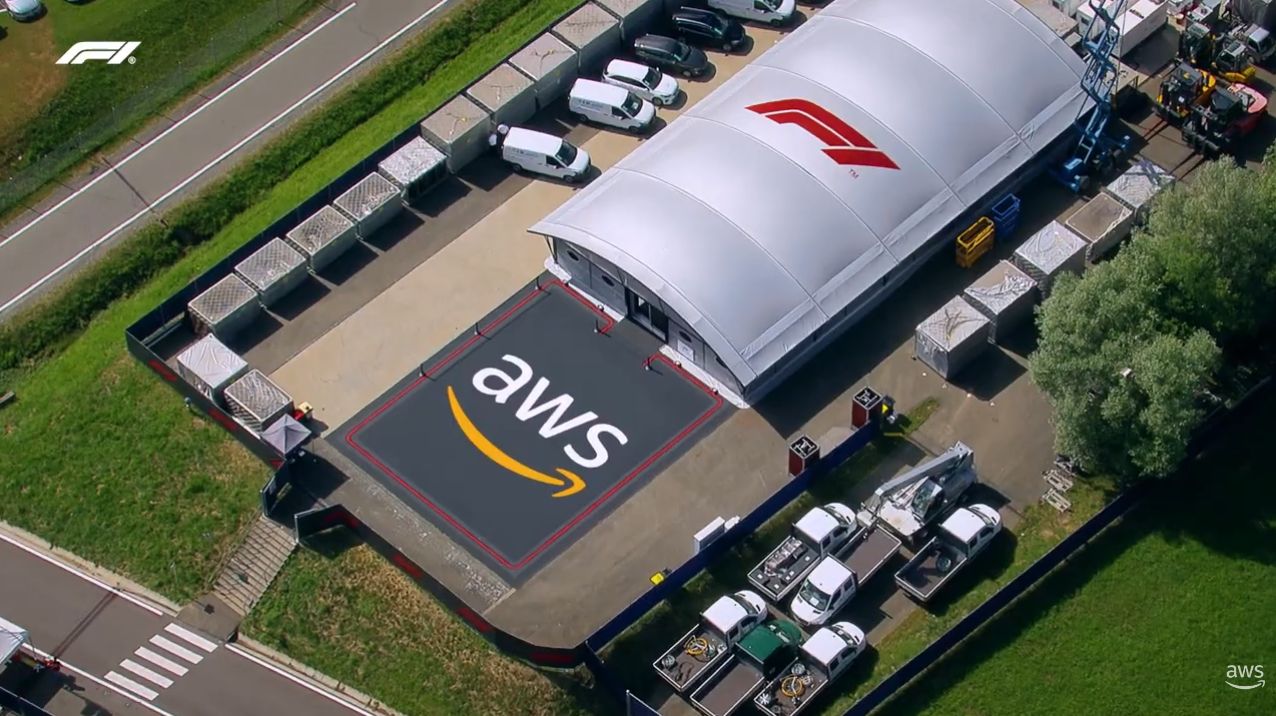
Image credit: Amazon AWS
Each F1 car carries more than 300 sensors measuring speed, tire wear, fuel consumption, engine performance, brake pressure, and dozens of other variables. During a race, these sensors generate 1.1 million data points per second. AWS collects this information alongside readings from 20+ trackside weather stations monitoring temperature, humidity, and wind conditions.
All this data travels over dual 10-gigabit fiber connections from the Event Technical Center at each circuit to F1’s Media & Technical Center at Biggin Hill in England. From there, dedicated AWS Direct Connect links push the information into the cloud, where machine learning models trained on 65+ years of historical race data process incoming streams and generate predictions.
The processing pipeline uses Amazon SageMaker for model development and training, Amazon Kinesis for real-time data streaming, and AWS Lambda for serverless computation. This architecture allows F1 to analyze race performance metrics in milliseconds and deploy insights to global broadcasts before the action they describe becomes irrelevant.
“F1 can now deliver more data-driven insights that help to educate and entertain fans—from timing and telemetry data captured by hundreds of sensors on each F1 car, relayed real time to AWS compared to historical data stored on Amazon Simple Storage Service,” said Neil Ralph, AWS Principal Sports Partnership Manager.
F1 Insights: 22 Broadcast Graphics That Explain Racing Strategy
F1 Insights powered by AWS launched with seven graphics in 2020 and has expanded to 22+ real-time statistics that appear during live broadcasts. Each insight addresses a specific aspect of racing that casual viewers might miss or find confusing.
- Battle Forecast predicts how many laps remain before a chasing car reaches striking distance for an overtake. The system combines track history, projected driver pace, tire compound data, and weather conditions to display countdown predictions during on-track battles. Broadcasters receive advance notice of likely overtakes, allowing commentators to direct viewer attention before the action happens.
- Predicted Pit Stop Strategy calculates optimal tire and race strategies during the first lap, showing viewers when drivers should enter the pits. This graphic creates anticipation regardless of whether the viewer understands F1 strategy.
- Alternative Strategy debuted at the 2023 United States Grand Prix and shows how races might have ended if teams made different decisions. The simulation incorporates timing, race pace, tire degradation, weather conditions, and track conditions to generate hypothetical outcomes.
- Car Performance Scores break down driver abilities across seven metrics: Qualifying Pace, Race Starts, Race Lap 1, Race Pace, Tyre Management, Driver Pit Stop Skill, and Overtaking. Each metric uses a normalized 0-10 scale that allows direct comparisons between drivers.
- Track Pulse uses generative AI to help the broadcast team identify unfolding stories during live sessions. The serverless data pipeline consolidates multiple information streams to surface live driver battles, championship implications, speed records, and developing narratives that production crews can highlight.
Additional graphics include Time Lost (showing the cost of driver errors), Pitlane Performance (analyzing complete pit stop sequences), Undercut Threat (predicting overtakes from pit strategy), Close to the Wall (measuring proximity at dangerous corners), and Car Exploitation (showing when drivers push beyond theoretical limits).
StatBot: Generative AI Mining 74 Years of Racing History
Ahead of the 2024 British Grand Prix, AWS and F1 launched StatBot, a generative AI tool that queries F1’s complete historical database dating back to 1950. The tool allows broadcast analysts to ask natural language questions and receive answers in seconds rather than the minutes or hours previously required.
An example query—”When was the last time a rookie won a race?”—previously required a human operator to analyze historic results, filter all winners, and cross-reference each winner’s career status at the time of their victories. StatBot performs this analysis automatically and returns the answer (Lewis Hamilton at the 2007 Canadian GP) within moments.
“You want the answer to that question as quickly as possible, so you can get it on the broadcast while it is still editorially relevant,” said Neil Ralph. “With StatBot, what we’ve done is augment F1’s human capability. Using natural language prompts with generative AI allows F1 to get answers back from the historic data repository far quicker than previously possible.”
StatBot’s development continues toward real-time operation, where the system will generate statistics relating to events occurring live on the track, including position changes, crashes, and overtakes as they happen.
How AWS Simulations Made Racing 30% More Exciting
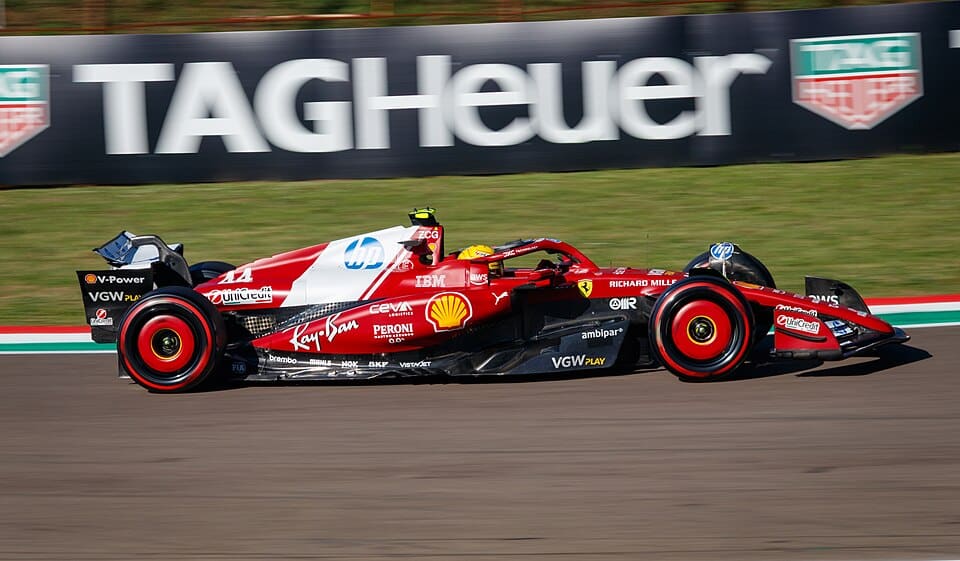
FIA F1 Imola 2025 No. 44 Hamilton. Image credit: Jen_ross83 via Wikimedia, CC BY 4.0 license
Before 2022, F1 cars lost up to 50% of their downforce when racing one car length behind another vehicle. Turbulent air wake from the leading car disrupted the aerodynamic grip of following drivers, making overtaking extremely difficult. Fans regularly heard drivers complain on team radio about inability to get close enough to attempt passes.
F1 used AWS high-performance computing to address this problem. The aerodynamics team ran over 5,000 single- and multi-car Computational Fluid Dynamics (CFD) simulations over six months, generating 550 million data points modeling how cars interact in close proximity. These simulations would have been impossible with on-premises computing resources.
“This project with AWS was one of the most revolutionary in the history of Formula 1 aerodynamics,” said Pat Symonds, then Chief Technical Officer of Formula 1. “Nobody designs a car to come in second, but for this CFD project we were looking at how cars perform in the wake of another, as opposed to running in clean air.”
AWS reduced average simulation time from 60 hours to 12 hours—an 80% improvement. Using AWS Graviton2-powered EC2 instances cut computing costs by 30%. F1 originally planned 20-30 simulations weekly but scaled to 80-90 simulations with AWS resources.
The resulting 2022 car regulations reduced downforce loss from 50% to 15% at one car length separation. This dramatic reduction allowed chasing drivers to maintain grip and attempt overtakes. Racing has featured 30% more on-track passes since the new regulations took effect.
| Metric | Before AWS (Pre-2022) | After AWS (2022+) |
|---|---|---|
| Downforce loss at 1 car length | 50% | 15% |
| Simulation time per run | 60 hours | 12 hours |
| Simulations per week | 20-30 | 80-90 |
| Cost reduction | — | 30% |
| On-track overtakes | Baseline | +30% |
Fan Database Growth: From 1 Million to 826 Million
In 2017, F1 had 500 million fans worldwide but fewer than 1 million in its direct database. The organization had operated primarily as a business-to-business entity, licensing broadcast rights rather than engaging consumers directly. Liberty Media’s acquisition in 2017 and the subsequent AWS partnership changed this approach.
F1 built its Fan Personalisation Programme (FPP) using AWS infrastructure and Salesforce’s Data Cloud. The system unifies data from F1 TV, F1 Fantasy, F1 Sim Racing, merchandise purchases, and over 100 other internal and external sources into a centralized data lake.
“Our previous solution took 24–48 hours to stitch data together,” said Raul Alexis, Commercial Partnerships at F1. “So the data was often outdated before we could even think about segmenting and bringing it to life through an activation channel.”
The AWS-powered platform processes fan data in near real-time, enabling personalized communications including AI-written newsletters with dynamic content based on specific customer segments. By 2024, F1’s global fanbase reached 826.5 million, with 42% female representation (up from 32% in 2018) and one-third of fans under 35.
Broadcasting Infrastructure: 6 Terabits Per Second Streaming
F1 TV delivers 20+ simultaneous live feeds including onboard cameras, trackside angles, aerial shots, and commentary tracks. AWS powers this streaming operation with peak throughput reaching 6 terabits per second during major race events.
During the COVID-19 pandemic, F1 shifted to remote broadcast operations using Amazon WorkSpaces and AWS Direct Connect, maintaining production quality while reducing on-site personnel requirements. This infrastructure allowed the sport to continue during restricted conditions and has become part of standard operations.
Track Pulse, built on AWS serverless architecture, provides real-time dashboards for commentators and analysts. The system processes continuous data streams and presents relevant narratives that production teams can feature during broadcasts.
Measurable Results: Attendance and Engagement Records
The AWS partnership coincides with F1’s strongest period of commercial and audience growth:
| Year | Global Fanbase | Race Attendance | Social Media Followers |
|---|---|---|---|
| 2018 | 500M | 4.0M | Baseline |
| 2022 | 650M | 5.7M | 71M |
| 2023 | 700M | 6.0M | 80M |
| 2024 | 826.5M | 6.5M | 96M |
| 2025 (mid-season) | 850M+ | 3.9M (14 races) | 107.6M |
The 2024 British Grand Prix drew 480,000 attendees and 22.4 million UK television viewers—the most-watched European race in British history. The Miami Grand Prix attracted 3.1 million American viewers, setting a US viewership record. Live race viewership in the United States has grown 23% compared to the 2024 season average.
F1’s database of identified fans grew 20 times between 2017 and 2023. Social media followers in the United States increased 445% since 2018. F1 TV subscriptions rose 14% year-over-year in 2024.
Technical Architecture: The AWS Services Behind F1
F1’s AWS implementation uses multiple services working together:
Amazon SageMaker handles machine learning model development, training, and deployment for all F1 Insights graphics. Data scientists train models on historical data and deploy them for real-time inference.
Amazon Kinesis collects and processes real-time data streams from cars and trackside equipment, enabling sub-second latency between events and broadcast graphics.
Amazon S3 stores 65+ years of historical race data and serves as the primary data lake for fan information.
Amazon EC2 (including C5n and Graviton2-based C6g instances) runs CFD simulations for car design and powers production workloads.
AWS Lambda provides serverless compute for real-time analytics without provisioning dedicated servers.
AWS Direct Connect delivers dedicated fiber connections between F1 facilities and AWS regions with consistent throughput and redundancy.
AWS ParallelCluster orchestrates high-performance computing clusters running the OpenFOAM CFD framework.
“The speed at which our AWS deployments went from experimental to race critical was surprising,” said Chris Roberts, F1 Director of IT. “AWS has quickly become ingrained in our race DNA. We can go live with new features that are adding value for fans quickly.”
Interactive Fan Experiences Beyond Broadcast Graphics
AWS and F1 continue developing tools that let fans participate actively rather than watch passively. Real-Time Race Track allows fans to design custom circuits and simulate race strategies. These generative AI experiences aim to convert casual viewers into engaged participants.
The 2025 Global F1 Fan Survey found that 90% of surveyed fans feel emotionally invested in race outcomes and 61% engage with F1 content daily. Among US Gen Z respondents, 70% interact with F1 content daily through streaming video and social media.
F1’s approach uses AWS infrastructure to support these engagement patterns. The sport now targets 1 billion fans by 2027, relying on personalized digital experiences to reach audiences who may never attend a race in person—currently over 99% of the fanbase.
Sustainability Applications
AWS data analytics and machine learning also address F1’s environmental goals. Algorithms optimize generator placement at race circuits, reducing fuel consumption and emissions. The partnership supports F1’s Sustainability Task Force, which aims to make the sport carbon neutral.
By moving CFD simulations to cloud computing, F1 reduced its computational energy footprint compared to maintaining dedicated on-premises supercomputing clusters. The elastic nature of cloud resources means computing power scales with actual needs rather than maintaining peak capacity continuously.
If you are interested in this topic, we suggest you check our articles:
- AI Coding Assistants Are Getting Smarter. But Which One Actually Helps You Code?
- Which European Countries Have the Most Data Centers?
- Tech Giants vs Startups: Who’s Driving Innovation in 2025?
- Amazon AWS vs Microsoft Copilot: Which AI Assistant Delivers More Value?
Sources: Amazon AWS, Forrester, Emmanuel Olawale via Medium, Amazon UK, Technology Magazine
Written by Alius Noreika