Key Takeaways
- Ambient clinical AI scribes like Abridge and Suki auto-generate doctor’s notes in real time, cutting documentation time that currently runs 2–3 hours for every hour of patient care.
- Computer-vision triage tools flag critical findings on X-rays and CT scans within seconds, pushing urgent cases to the top of a radiologist’s worklist.
- AI sepsis-prediction models such as UCSD’s COMPOSER analyze vitals and lab data to catch sepsis before symptoms fully appear, reducing false alarms and mortality.
- Generative AI drug discovery platforms condense years-long compound design into months, speeding therapies for rare diseases and fast-mutating pathogens.
- Edge AI wearables process health data — glucose, ECG — directly on the device, enabling instant alerts without needing a cloud connection.
- Agentic AI handles multi-step hospital tasks like scheduling, pre-op coordination, and follow-up care without human hand-holding.
- AI-driven prior-authorization agents converse with insurers by voice, slashing manual paperwork and reducing payment denials.
- Virtual nursing agents contact patients after discharge to check symptoms, give instructions, and manage prescriptions — 24 hours a day.
- Synthetic patient-data generators let researchers train AI models without touching real records, sidestepping HIPAA concerns entirely.
- AI-powered digital pathology platforms act as a second expert on tissue samples, boosting accuracy in cancer screening.
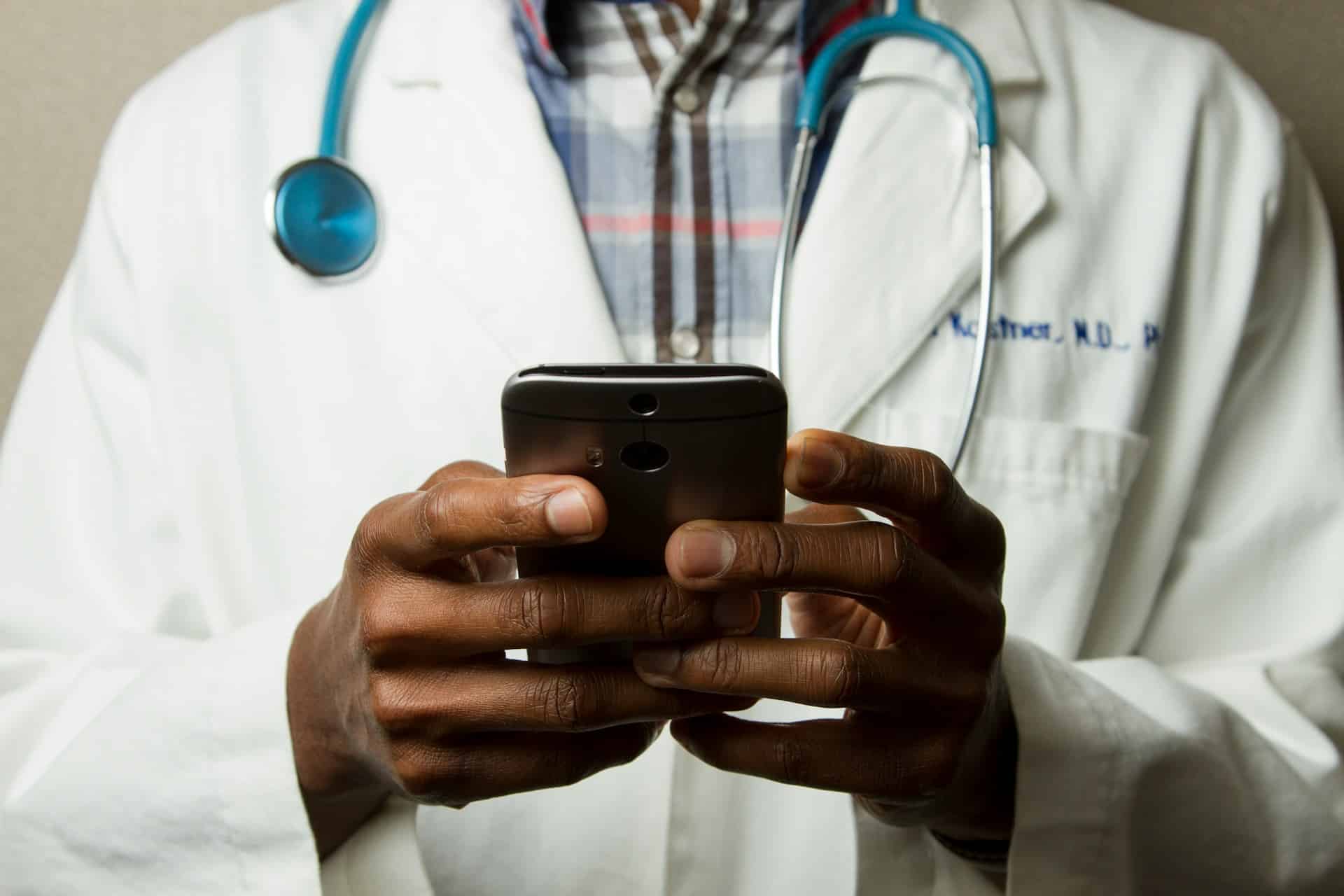
Doctor using a smartphone. Image credit: NCI via Unsplash, free license
Artificial intelligence in healthcare has moved past its proof-of-concept phase. In 2026, hospitals, clinics, and pharmaceutical companies are deploying AI systems that function as active clinical and operational partners — not just passive automation. These tools now handle documentation, flag life-threatening imaging findings, predict sepsis, accelerate drug development, and manage complex scheduling across entire hospital networks. The medical AI market, projected to exceed $45 billion by 2026, has made the technology a daily presence in care delivery.
The problems AI addresses in healthcare are specific and measurable: physicians spend 2–3 hours on documentation for every hour of patient interaction; urgent-care doctors miss broken bones in up to 10% of cases; traditional drug discovery takes a decade and billions of dollars per approved compound. Each of the ten solutions below targets one of these concrete pressure points, with tools either already deployed or entering clinical use right now.
Clinical and Diagnostic AI Solutions
| AI Solution | Primary Problem Addressed | Example Tools |
|---|---|---|
| Ambient Clinical Documentation | Physician burnout from excessive note-taking | Abridge, Suki, Nuance DAX Copilot |
| Imaging Triage (Computer Vision) | Missed critical findings, diagnostic delays | Aidoc, Qure.ai qXR, Viz.ai |
| Sepsis Prediction | Alert fatigue, late sepsis detection | UCSD COMPOSER |
| Drug Discovery | Decade-long, billion-dollar development cycles | Exscientia, Insilico Medicine, Atomwise |
| Digital Pathology | Inconsistent cancer tissue analysis | PathAI |
| Agentic Workflow AI | Multi-step scheduling and coordination bottlenecks | AWS Healthcare Agents, Epic, Oracle |
| Prior Authorization | Manual insurance paperwork, payment denials | HeyRevia |
| Edge AI Wearables | Delayed chronic disease alerts, cloud dependency | CGM devices, on-device ECG monitors |
| Virtual Nursing Agents | Post-discharge gaps, readmission risk | Huma, Woebot, Wysa |
| Synthetic Data Generation | Privacy barriers to AI model training | Generative data platforms |
1. Ambient Clinical Documentation: AI Scribes That Listen and Write
Ambient clinical documentation has become healthcare AI’s first breakout commercial category. Systems from companies like Abridge, Suki, and Microsoft’s Nuance DAX Copilot listen to patient-physician conversations and automatically draft comprehensive progress notes in real time. The technology directly addresses the documentation crisis: the average physician completes charts for hours after clinical shifts, and the workload is cited as a primary driver of burnout and early retirement across the profession.
The ambient scribe segment generated roughly $600 million in revenue in 2025, a 2.4x year-over-year increase, according to industry investment trackers. Major electronic health record vendors like Epic now build ambient capabilities as native, integrated features rather than bolt-on tools. At HIMSS 2026 — one of the industry’s largest health IT conferences — Oracle unveiled its own documentation agent covering 30 medical specialties, while Amazon, Google, and Microsoft each introduced competing AI assistants for clinical note generation.
Accuracy remains a concern. A report found that OpenAI’s Whisper, used by many hospitals to summarize patient meetings, occasionally hallucinated portions of transcriptions. Still, healthcare executives broadly see ambient scribes as the fastest path to measurable return on AI investment, with industry leaders calling for documentation tools that are transparent about data sources and assumptions.
2. Imaging Triage and Detection With Computer Vision
AI-powered computer-vision tools now scan X-rays, CT scans, and MRIs in the background, flagging critical issues and pushing them to the top of a radiologist’s worklist. Platforms like Aidoc, Qure.ai’s qXR, and Viz.ai use deep-learning algorithms to detect conditions including intracranial hemorrhages, lung nodules, and tumors — often faster and with fewer misses than manual review alone.
The clinical stakes are high. Studies estimate radiological errors occur in 3–5% of cases on a day-to-day basis, with higher rates reported in targeted reviews. Urgent-care doctors miss fractures in up to 10% of cases, while X-ray technicians face both shortages and overload. The UK’s National Institute for Health and Care Excellence (NICE) has evaluated AI-assisted fracture detection as safe, reliable, and capable of reducing follow-up appointments.
A separate AI system trained on 800 brain scans of stroke patients and tested on 2,000 more proved twice as accurate as professionals at identifying stroke characteristics and estimating when the stroke occurred — critical information for treatment eligibility. As Dr. Paul Bentley, a consultant neurologist, explained: “For the majority of strokes caused by a blood clot, if a patient is within 4.5 hours of the stroke happening, he or she is eligible for both medical and surgical treatments.”
AI epilepsy-detection tools have also demonstrated value: one study found that an AI model trained on MRI scans of over 1,100 adults and children spotted 64% of brain lesions that radiologists had missed. Lead researcher Dr. Konrad Wagstyl described the challenge: “It’s like finding one character on five pages of solid black text.”
3. Real-Time Sepsis Prediction
Sepsis kills hundreds of thousands of patients annually, and early detection is the single most important factor in survival. Traditional alert systems tend to over-trigger, flooding clinicians with false alarms and causing “alert fatigue” — a state where staff begin ignoring warnings altogether.
AI models like UCSD’s COMPOSER approach the problem differently. They analyze continuous streams of patient data — vitals, lab results, and electronic health records — to identify sepsis patterns before symptoms fully manifest. The result is fewer false positives, more targeted alerts, and, crucially, lower mortality rates. Hospitals across the United States are now integrating predictive analytics of this type to identify patients at risk for sepsis, falls, or readmissions, enabling earlier interventions.
4. Generative AI in Drug Discovery
Pharmaceutical drug development has long been one of the slowest, most expensive processes in science — often a decade from concept to approval, with billions spent per successful compound. AI platforms from Exscientia, Insilico Medicine, and Atomwise are compressing that timeline by simulating molecular interactions, predicting binding affinities, and screening candidate compounds computationally before they enter a laboratory.
DeepMind’s AlphaFold set a precedent by accurately predicting three-dimensional protein structures from amino acid sequences. Understanding protein shape is essential to designing drugs that interact precisely with biological targets, and AlphaFold’s accuracy is regularly described as competitive with experimental methods. AI is also optimizing clinical trial design — analyzing patient data, identifying suitable populations, and predicting potential complications before enrollment begins. Industry estimates suggest AI can reduce drug development time and cost by 30–50%.
5. AI-Powered Digital Pathology
Pathology — the microscopic examination of tissue samples — remains a field where consistency matters as much as accuracy. AI platforms like PathAI function as a second expert, using computer vision to identify cancer cells in tissue slides with a level of consistency that the human eye cannot sustain over long hours and heavy caseloads.
These systems are particularly valuable in complex cancer screening, where subtle cellular abnormalities can determine staging, treatment plans, and prognosis. By flagging suspicious regions and confirming findings, digital pathology tools reduce inter-observer variability — the documented tendency for different pathologists to reach different conclusions from the same sample.
Operational and Patient-Care AI Solutions
6. Agentic AI for Hospital Workflow Automation
The newest generation of AI in healthcare operations goes well beyond passive chatbots. “Agentic” AI systems autonomously execute multi-step tasks: scheduling complex procedures, arranging pre-operative testing, coordinating follow-up appointments, and routing patients through administrative steps without human hand-holding at each stage.
Amazon Web Services released a new agent platform in March 2026 designed specifically for healthcare administrative tasks like scheduling and documentation. BCG experts predict that agentic AI will significantly boost both care quality and operational throughput across hospital systems this year. The challenge, as raised at HIMSS 2026, is validation: with agents from Epic, Google, Microsoft, and Oracle entering clinical environments simultaneously, experts caution that many products have not been sufficiently tested with real patients.
| Workflow Task | Traditional Approach | Agentic AI Approach |
|---|---|---|
| Procedure scheduling | Manual phone calls, multi-step coordination | Autonomous booking across departments |
| Pre-op testing | Staff-initiated orders, patient follow-up | Auto-generated orders, patient reminders |
| Follow-up care | Nurse-led outreach, paper checklists | Automated calls, symptom checks, escalations |
| Insurance verification | Hold times, manual data entry | Voice-based AI conversations with insurers |
7. Automated Prior Authorization
Prior authorization — the process of getting insurer approval before delivering certain treatments — consumes enormous staff time and frequently results in payment denials. AI agents like HeyRevia use voice interaction and natural language processing to converse directly with insurance companies, verify patient benefits, and submit authorization requests.
These systems eliminate hold times, reduce manual data entry, and track denials in real time. For healthcare organizations struggling with administrative costs — nurses currently spend 15–20 minutes of every hour on administrative tasks — automated prior authorization is one of the most immediately impactful AI deployments available.
8. Edge AI for Chronic Disease Monitoring
Edge AI refers to processing that happens directly on a wearable device rather than in a remote data center. For chronic conditions like diabetes, heart disease, and hypertension, this matters: edge-enabled wearables track blood glucose, ECG patterns, and blood pressure continuously, detecting anomalies and sending alerts to healthcare teams in real time — even without an internet connection.
Continuous glucose monitoring (CGM) systems already provide real-time data on glucose levels throughout the day. AI uses these readings to adjust treatment plans dynamically, enabling more precise insulin dosing based on an individual’s unique patterns. The broader goal is a proactive model of chronic disease management: rather than reacting to symptoms during office visits, AI enables constant, personalized monitoring that catches deterioration early.
9. Virtual Nursing and Digital Triage Agents
AI-powered virtual nursing agents contact patients after hospital discharge to deliver post-care instructions, check on symptoms, manage prescription refills, and escalate concerns to clinical staff. These systems operate around the clock, bridging the gap in care during the vulnerable period after a patient leaves the hospital.
The impact is measurable. A World Economic Forum case study on digital patient platform Huma found it reduced readmission rates by 30% and cut the time clinicians spent reviewing each patient by up to 40%. Mental health chatbots like Woebot and Wysa extend the concept further, offering cognitive behavioral therapy principles, mood tracking, and coping strategies outside office hours. A Woebot study found 65% of app usage occurred outside normal clinical hours, with peak engagement between 5 and 10 p.m.
A US study also found that while standard large language models (ChatGPT, Claude, Gemini) provided clinicians with relevant, evidence-based medical answers only 2–10% of the time, a retrieval-augmented generation (RAG) system called ChatRWD produced useful responses 58% of the time — suggesting that purpose-built clinical AI far outperforms general-purpose models.
10. Synthetic Data Generation for AI Training
Training AI models in healthcare requires massive datasets, but real patient records are scarce, sensitive, and tightly regulated under laws like HIPAA. Synthetic data generation uses generative AI to create realistic but entirely artificial patient records — lab values, imaging patterns, demographic profiles — that preserve statistical validity without exposing any real individual’s information.
This approach solves two problems at once. Researchers and AI developers can train and validate models without navigating lengthy data-access agreements or risking privacy breaches. And underrepresented patient populations — groups with rare diseases or those historically excluded from clinical studies — can be “generated” in synthetic form, improving model fairness and reducing bias in the tools that ultimately guide clinical decisions.
What Comes Next: Emerging AI Healthcare Trends
Three trends are gaining traction beyond the ten solutions above. Virtual hospitals are expanding telemedicine into full remote-care facilities, where specialists manage treatment in regional clinics or directly in patient homes. Digital twins — patient-level computational models — allow clinicians to simulate treatment paths in oncology and cardiology before applying them to the actual patient. And shadow AI governance is becoming an urgent priority: as staff adopt AI tools outside official oversight, health systems are establishing “AI safe zones” and formal compliance policies to manage risk.
With 4.5 billion people currently lacking access to essential healthcare services and a global health worker shortage of 11 million projected by 2030, these technologies are not incremental improvements. They address structural deficits that no amount of hiring or traditional investment can fill on its own. The organizations moving fastest — those pairing AI deployment with rigorous validation, transparent governance, and clinical expertise — will set the standard for the next decade of healthcare delivery.
If you are interested in this topic, we suggest you check our articles:
- AI is Transforming the Healthcare Sector – It Can Even Discharge Patients from Hospitals
- AI in Healthcare: 8 Use Cases Making a Positive Impact
- The Role of AI in Maternal Healthcare
Sources: Sanjay Barot on Medium, World Economic Forum, Oxford Training Centre, MTU,
Written by Alius Noreika