Key Takeaways
- Adaptive Learning Systems: AI analyzes individual pilot performance data to create personalized training programs that address specific weaknesses and optimize learning efficiency
- Real-Time Performance Monitoring: Machine learning algorithms provide instant feedback during simulator sessions, allowing pilots to correct errors immediately rather than waiting for post-flight debriefing
- Enhanced Cognitive Skills: AI-powered tools improve decision-making capabilities by simulating complex, real-world scenarios that traditional training methods cannot replicate cost-effectively
- Safety Analytics: Predictive algorithms identify potential risks before they occur by analyzing flight data from millions of previous flights, enabling proactive safety measures
- Cost Reduction: Virtual reality and AI-driven simulators reduce training expenses by up to 40% while maintaining or improving training quality through 24/7 accessibility
- Evidence-Based Training: Data-driven insights replace standardized procedural testing, focusing on actual operational threats and individual pilot competency profiles
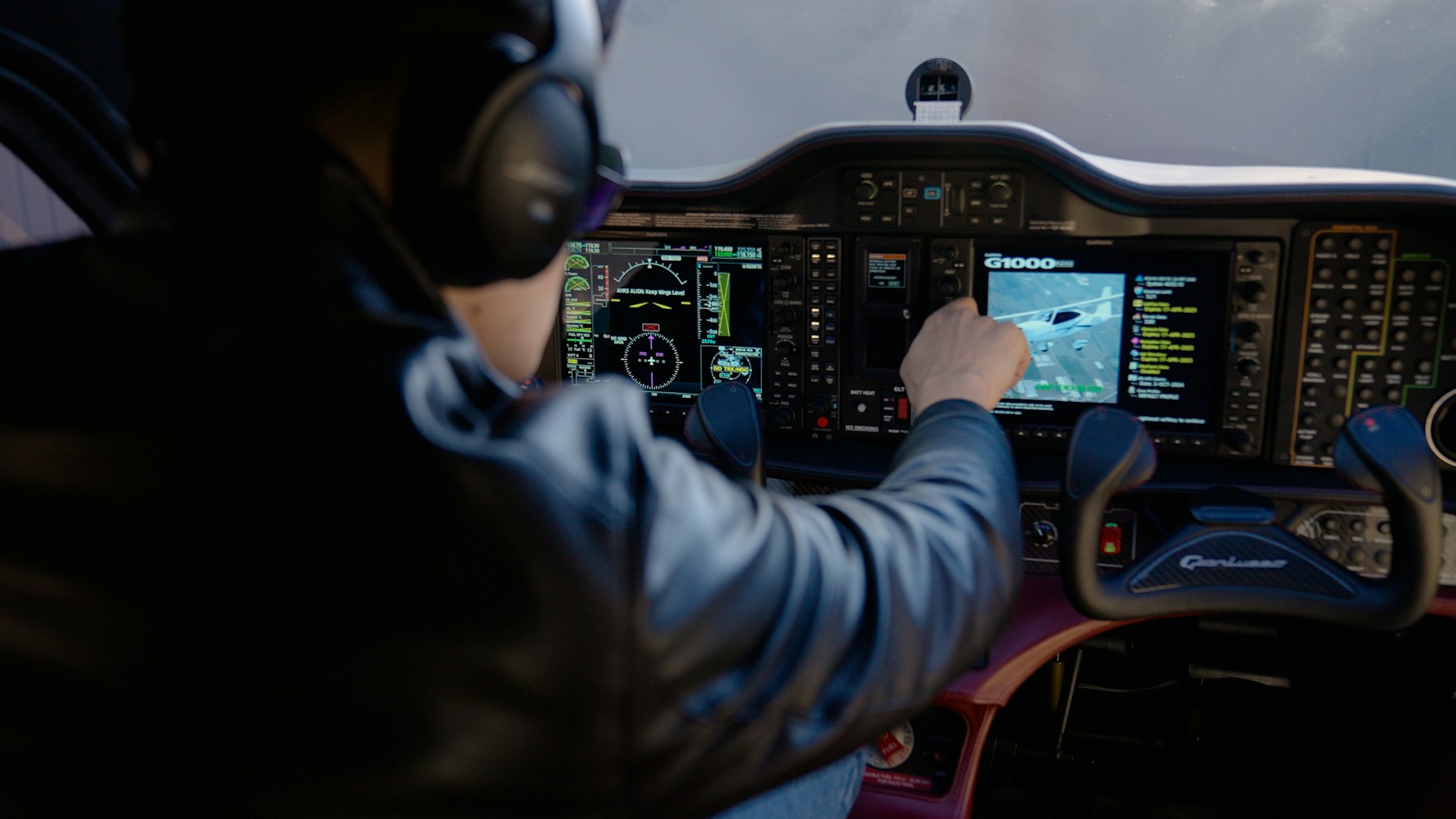
A pilot in an aircraft cockpit. Image credit: Horizon Flights via Unsplash, free license
Artificial intelligence has fundamentally changed how aviation prepares pilots for the cockpit. Modern AI systems analyze performance data from training sessions, identify skill gaps, and automatically adjust difficulty levels to match each pilot’s learning pace. This technology addresses longstanding limitations in traditional flight training, including high costs, limited access to realistic scenarios, and inability to provide immediate, objective feedback during complex maneuvers.
The integration spans the entire training lifecycle, from curriculum design to final competency assessment. Major training organizations now use AI to generate scenario scripts, develop targeted tests, monitor real-time eye movements, and provide actionable performance insights across global training networks. This shift from instructor-dependent evaluation to data-enhanced coaching represents the most significant evolution in pilot education since flight simulators became mandatory.
Intelligent Simulation Environments
Flight simulators equipped with AI capabilities now respond dynamically to trainee actions rather than following predetermined scripts. These systems recognize pilot behaviors, modify challenge levels automatically, and deliver personalized feedback without human intervention.
CAE trains over 150,000 pilots annually across 240 facilities using AI-enhanced platforms. Their Rise system combines simulator telemetry with eye-tracking data, giving instructors real-time visibility into trainee performance while the technology automatically captures subtle performance metrics. This allows instructors to focus on critical crew behaviors rather than manual data recording.
The technology evaluates multiple performance dimensions simultaneously. During a training session, AI monitors instrument scanning patterns, control inputs, communication protocols, and decision timing. It compares these actions against optimal benchmarks derived from expert pilot data and immediately flags deviations requiring attention.
Axis Flight Simulation has embedded AI into simulators, VR products, and web-based training modules. Their debriefing system delivers instant verbal performance evaluations, eliminating the traditional delay between training and feedback. The AI watches pilot actions during simulator sessions, compares them to standard training benchmarks, and provides immediate coaching—even through spoken guidance.
Christian Theuermann from Axis Flight Simulation says that this approach offers objective training based on data-driven results. The technology enables instructors to concentrate on coaching rather than administrative tasks, producing automated reports that replace manual note-taking during sessions. Pilots receive standardized assessments regardless of which instructor oversees their training, addressing regulatory concerns about evaluation consistency.
Personalized Learning Pathways
An aircraft pilot. Image credit: Horizon Flights via Unsplash, free license
AI analyzes data from training events to assess pilot performance and identify weaknesses, enabling customized learning experiences impossible with traditional group instruction methods. The technology tailors training programs to maximize learning efficiency for individual pilots.
Christopher Ranganathan, CAE’s chief learning officer for commercial aviation training, says AI supports evidence-based training methodology. This data-driven approach prioritizes real-world threats and errors over procedural testing. AI proves essential in tailoring programs not only to aircraft types but to individual pilot profiles.
CAE projects a future training mix driven 70% by baseline aircraft generation training topics, 20% by AI-generated insights about the crew, and 10% by AI analysis of individual pilot capabilities. This granular personalization ensures each pilot spends training time on areas requiring the most development.
Machine learning algorithms examine flight data monitoring information, identifying opportunities to improve adherence to standard operating procedures. Acron Aviation’s Astra application uses advanced flight data analytics to provide pilots with crucial insights before and after each flight through its iOS safety module. The system measures pilot performance against other crew members in their fleet, with recommendations built on machine learning models trained on 45 million flights.
Research confirms that personalized approaches yield measurable improvements. Studies using eye-tracking technology and PC-based Aviation Training Devices showed that gaze-based training with feedback significantly improved novice pilots’ situation awareness and flight performance across most scenarios. Training that follows the mistakes-mitigation-mastery approach, combined with AI analysis, accelerates competency development.
Real-Time Cognitive Enhancement
AI technologies monitor and enhance pilot cognitive processes during training, addressing mental workload management, attention allocation, and decision-making under pressure. These systems detect subtle changes in cognitive state that human instructors cannot observe directly.
- Electroencephalography (EEG) research demonstrates AI’s capability to recognize pilot mental states with 96% accuracy. Convolutional neural networks trained on brain activity data successfully identify channelized attention, diverted attention, startle responses, and normal states during simulated flights. This enables training systems to adjust difficulty when pilots show signs of cognitive overload or insufficient engagement.
- Heart rate variability analysis combined with machine learning provides another avenue for cognitive monitoring. Advanced algorithms detect mental workload levels during real flight operations, allowing training programs to optimize challenge progression. Studies show that arousal positively influences performance in easier tasks, while higher mental workload negatively impacts performance in medium and difficult scenarios.
- AI-driven debriefing tools automatically examine simulator sessions and identify missed callouts, unstable approaches, or checklist deviations. Flight schools and training facilities test these systems to reduce the learning curve while enhancing safety outcomes. The technology processes vast amounts of performance data instantly, spotting patterns human observers might miss over multiple sessions.
- Research using transcranial direct current stimulation combined with EEG monitoring revealed that targeted brain stimulation during simulator training increased midline-frontal theta activity, improving working memory and flight performance consistency. These findings demonstrate potential for AI systems to optimize not just training content but the neurological processes underlying skill acquisition.
Advanced Performance Analytics
AI enables comprehensive performance tracking across training programs, providing insights that drive continuous improvement. Systems analyze data from various training events to help assess pilot competency and identify development areas with precision traditional methods cannot achieve.
- Flight Operation Performance Evaluation Systems use Quick Access Recorder (QAR) data to assess pilot performance objectively. These platforms evaluate flight operations, issue warnings, and suggest specific training improvements. The technology enhances flight risk monitoring by analyzing pilot performance trends over time, offering quantitative risk assessment based on statistical models.
- Enhanced collaborative filtering models incorporate user difference factors to improve recommendation accuracy for pilots’ core competency behavior indicators. These systems refine similarity calculations, outperforming traditional methods in reducing prediction errors while increasing accuracy, recall, and diversity in training recommendations.
- Two-dimensional competency models validated using real flight training data achieve 84% accuracy in matching instructor ratings. The Assessment Score Measurement Form and competency assessment matrix link behavioral indicators to competency-based training requirements. This approach improves training effectiveness, aligns evaluations with real-world skills, and supports data-driven decision-making in flight training programs.
- Tools like Acron Aviation’s efficiency module delivers comprehensive monitoring of fuel consumption, wear-and-tear indicators, and performance metrics through intuitive dashboards. This enables fleet-wide oversight for management teams while driving performance improvements in the flight deck through targeted feedback.
Safety Risk Mitigation
Predictive analytics powered by AI identify potential safety risks before they manifest in actual flight operations. This proactive approach marks a departure from reactive safety management that responds only after incidents occur.
- Machine learning models analyze flight trajectory data to predict potential deviations and hazardous situations during training. These systems employ stacked neural networks for scalable approximation and adaptive prediction, demonstrating strong performance on flight training data. Accurate trajectory prediction supports automatic flight maneuver evaluation and flight operations quality assurance initiatives.
- Holographic modeling combined with risk filtering, rating, and management theory creates risk identification frameworks specifically designed for flight training. These approaches accurately identify critical risk factors, offering scientific, objective methods for improving risk prevention and control. Beginner pilots particularly benefit, as they face significant operational risks and limited risk management skills early in training.
- AI-based fatigue detection systems address one of aviation’s persistent safety challenges. Machine learning models achieve 95% accuracy in classifying pilot fatigue states by analyzing physiological and performance data. While subjective fatigue ratings and psychomotor vigilance tests show limitations, integrated AI systems successfully detect cognitive impairment that might compromise flight safety.
- Research on spatial disorientation—a leading cause of fatal aviation accidents—benefits from enhanced motion simulators incorporating realistic illusions. AI-enhanced training for pitch-up scenarios, graveyard spirals, runway width illusions, and motion decoupling improves pilot ability to recognize and counter disorientation during actual flight operations.
Evidence-Based Training Implementation
AI supports the aviation industry’s shift toward evidence-based training, which prioritizes data-driven insights over standardized procedural testing. This methodology focuses on real-world threats and operational challenges rather than abstract evaluation criteria.
The technology analyzes operational data to identify actual risk patterns in flight operations. Training scenarios then emphasize situations pilots will likely encounter rather than hypothetical emergencies. AI systems continuously update training priorities as operational data reveals emerging threats or changing risk profiles.
CAE’s implementation across the Analysis, Design, Development, Implementation, and Evaluation cycle demonstrates comprehensive integration. AI generates training scripts, develops appropriate tests for learning objectives, ensures all regulatory requirements appear in curricula, and provides actionable insights from pilot and instructor performance across training centers. This feedback loops into continuous improvement processes.
Competency-based training frameworks rely on AI to assess whether pilots demonstrate required skills rather than simply completing training hours. Machine learning models evaluate complex competency indicators that resist simple pass-fail classification. The technology recognizes nuanced performance variations that indicate developing expertise or persistent weaknesses requiring intervention.
Flight Simulation Training Devices integrated with augmented reality show particular promise. Survey data from 197 pilots indicates strong support for these technologies, particularly for emergency training and solo flight debriefing. Pilots value self-paced learning enabled by AI systems that provide expert-level feedback without requiring instructor availability.
Virtual and Augmented Reality Integration
A training airplane. Image credit: Max Nüstedt via Unsplash, free license
AI enhances immersive training technologies, creating more effective learning environments while reducing costs associated with full-flight simulator time. Virtual reality platforms combined with machine learning algorithms provide 24/7 training access without the scheduling constraints of traditional simulator facilities.
Axis plans to expand offerings through mixed reality, combining physical hardware with VR environments to increase immersion and improve muscle memory development. The AI engine behind these systems runs on gaming platforms, making deployment lightweight and accessible without major hardware upgrades. This advantage proved especially valuable during the COVID-19 pandemic when traditional training facilities faced access restrictions.
Multimodal augmented reality applications for training pilots in Visual Flight Rules traffic procedures demonstrate no negative training effects compared to traditional simulator training. AR trainees perform as well as control groups while showing improved scanning patterns and reduced fear of failure. Gender differences emerge in AR feature preferences, with variations in voice interaction and visual display preferences informing customized interface design.
Research comparing 2D and 3D displays in learning complex tasks shows higher cognitive load for 2D presentations, especially for difficult procedures. Stereoscopic 3D technology reduces cognitive strain, particularly for individuals with lower spatial abilities. These findings support expanded application of 3D virtual environments in pilot training, where spatial awareness proves critical.
Studies using EEG measurements confirm that 3D VR environments demand more cognitive and sensory resources than 2D alternatives, but this increased engagement correlates with improved learning outcomes. The immersive nature of 3D VR environments better prepares pilots for actual flight conditions where spatial orientation and three-dimensional thinking prove essential.
Regulatory and Implementation Challenges
Despite proven benefits, AI integration into pilot training faces significant hurdles. Regulatory frameworks developed for traditional training methods require updating to accommodate data-driven, automated assessment systems.
Lee Woodward from Skyborne Airline Academy, which trains pilots in the United States, United Kingdom, and India, acknowledged the industry has considerable distance to cover. Safety factors require careful consideration before full AI integration becomes standard practice. Skyborne currently trials AI platforms offline in parallel with normal practices and protocols before operational deployment.
The certification and revalidation of pilot competencies presents particular complexity. These highly regulated processes, overseen by aviation authorities and carried out by authorized examiners, maintain rigorous requirements ensuring standardization, fairness, and safety. For AI to play formal roles in certification, extensive safeguards would prove essential, including algorithmic transparency, data integrity protections, human oversight mechanisms, and alignment with international aviation standards.
Industry-wide confidence in AI’s ability to make high-stakes decisions impartially and without bias remains under development. Concerns about algorithmic bias, where AI systems might disadvantage certain pilot populations based on training data patterns, require systematic research and mitigation strategies.
Data privacy considerations complicate AI implementation. Training systems collect detailed performance data, biometric measurements, and potentially sensitive health information. Regulatory frameworks must balance the safety benefits of comprehensive data collection against individual privacy rights and data security requirements.
Technical limitations include demands for high-fidelity simulation that accurately represents aircraft systems, environmental conditions, and emergency scenarios. AI reliability in safety-critical applications requires extensive validation. Systems must perform consistently across diverse operational conditions without failures that could compromise training effectiveness or pilot confidence.
Economic Impact and Accessibility
AI-driven training solutions offer substantial cost reductions while maintaining or improving training quality. Traditional full-flight simulator training costs between $400 and $800 per hour, limiting access for many aspiring pilots and smaller training organizations.
Virtual reality systems combined with AI feedback mechanisms reduce training expenses by up to 40% according to industry analyses. Pilots can train at home or in low-cost environments, saving time and money while receiving feedback comparable to full-flight simulator sessions. This accessibility democratizes pilot training, removing financial barriers that previously limited aviation career opportunities.
The technology enables more efficient use of expensive simulator resources. AI handles routine performance monitoring and initial feedback, allowing human instructors to focus on complex skill development and mentoring. Training centers can increase student throughput without proportionally expanding instructor staff or facility capacity.
Continuous training access represents another economic advantage. Traditional simulators require scheduling days or weeks in advance, limiting training frequency especially for part-time students. AI-powered systems provide immediate access, allowing pilots to train during optimal learning windows and maintain skill currency more effectively.
Airlines benefit from reduced training duration without compromising competency standards. Accelerated, personalized learning pathways enabled by AI allow pilots to reach operational proficiency faster. This shortens the time-to-productivity for new hires while reducing training costs absorbed by airlines.
Future Development Trajectories
The aviation industry anticipates single-pilot cargo operations by the late 2020s, with commercial passenger flights potentially following around 2030. This operational shift requires advanced automation and interface technologies, with AI playing central roles in both aircraft systems and pilot training.
Traditional multi-crew apprenticeship training will become obsolete, necessitating complete training redesign. Extended Reality technologies including VR, AR, and mixed reality offer immersive, risk-free training environments that develop skills for managing advanced autonomous systems alongside traditional piloting competencies.
Intelligent Pilot Advisory Systems represent emerging applications. These AI-driven decision-support platforms provide real-time mission monitoring, integrate pre-flight briefing information, and offer operational recommendations during normal flight operations. User-centered development involving pilots, data scientists, and human-artificial intelligence teaming experts ensures these systems enhance rather than complicate pilot workflows.
Research into collaborative AI systems emphasizes human-AI interaction optimization. The goal involves creating partnerships where AI handles data processing, pattern recognition, and routine monitoring while pilots maintain strategic decision-making authority and ultimate operational control. This division of cognitive labor could reduce pilot workload while improving safety outcomes.
Neurological insights gradually form the basis for next-generation training development. The Mirror Neuron system, which links perception and action in the brain, offers potential for enhancing flight training effectiveness. Tracking expertise development through brain activity measurements could enable more precise training progression and customized skill development strategies.
Ethical Considerations and Trust
Pilot acceptance of AI systems significantly affects implementation success. Trust in automated training assessment and feedback systems develops gradually through demonstrated reliability, transparency, and alignment with pilot experience.
Algorithmic transparency addresses concerns about “black box” AI decisions. Pilots need to understand how systems evaluate their performance and generate recommendations. Explainable AI approaches that show reasoning behind assessments help build confidence in automated evaluation systems.
Bias mitigation remains critical. Training data used to develop AI models must represent diverse pilot populations to avoid perpetuating historical biases. Regular audits of AI system outputs ensure fair treatment across demographic groups and prevent systematic disadvantages for any pilot category.
If you are interested in this topic, we suggest you check our articles:
- How AI is Transforming Our Lives: 20 Best Everyday AI Applications
- Can You Use GenAI Models Without Ever Needing a Subscription?
Sources: Aerospace Global News, Airline Pilot Central, Abner Flores et al. on ResearchGate.
Written by Alius Noreika