
Launching a new application usually involves stitching together multiple tools, frameworks, and workflows before anything usable exists. Even early prototypes often require design work, backend setup, basic infrastructure, and time from developers or contractors. The promise behind tools like Famous.ai is that this entire process can be compressed into a single interaction.
To understand whether that promise holds up, this review looks at Famous.ai not as a concept, but as a working system. Instead of evaluating features in isolation, the focus here is practical behavior: what happens when you describe an app in plain language and let the platform handle execution.
What Famous.ai Is Designed to Do
Famous.ai is an AI-driven app creation platform that turns natural language prompts into fully functional software. From a single description, the system generates a complete application, including a frontend interface, backend logic, data handling, and deployment-ready structure.
This is not a code assistant or design helper. Famous.ai operates autonomously, interpreting intent, planning the system, and assembling all required components into a working product. The goal is not partial output or drafts, but finished software that can be interacted with immediately.
From Prompt to Application
The entry point into Famous.ai is deliberately simple. Users describe what they want to build using plain language, including the type of app, its users, and the core functionality. This prompt acts as the specification.
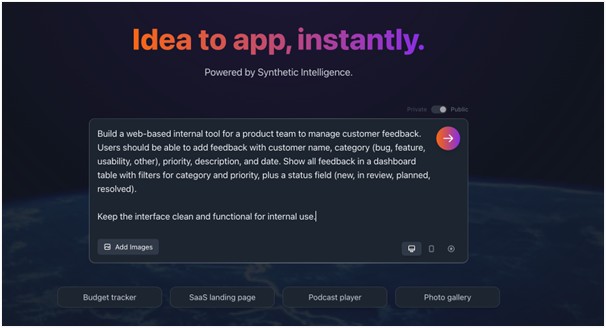
Unlike many AI tools that stop at content or code snippets, Famous.ai treats the prompt as the starting point for a full system build. Once submitted, the platform begins planning how the application should function, what data structures are required, and how the interface should be assembled.
What Happens During the Build
One of the more revealing aspects of Famous.ai is that it exposes its build process in real time. As the system works, it displays internal status updates that reflect planning and execution steps rather than surface-level generation.
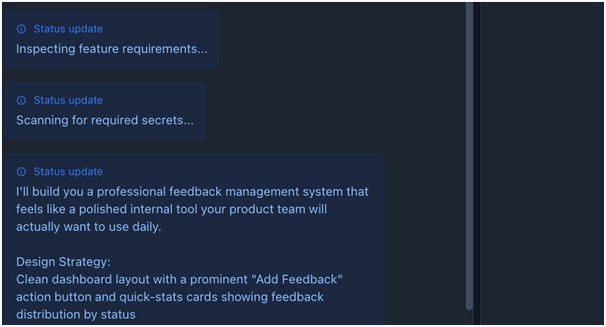
These messages show that Famous.ai is not simply generating a UI template. It is making decisions about features, dependencies, and configuration before moving into implementation. This reinforces the idea that the platform behaves more like an autonomous builder than a reactive assistant.
The process is largely hands-off. Users are not required to approve individual steps or manually select components. Once the prompt is submitted, the system proceeds through planning and execution on its own.
The Resulting Output
Once the build completes, the result is a usable application rather than a visual mockup. Interfaces load with real data structures, navigation works, and interactions behave as expected for the described app type.

In this case, the output resembles a polished internal tool, complete with structured layouts and functional components. This is significant because it demonstrates that Famous.ai can produce software that teams can realistically use, test, and iterate on without additional setup.
Common Use Cases in Practice
Based on how Famous.ai behaves, several practical use cases stand out.
Early-Stage MVPs
Founders and small teams can move from idea to working product without assembling a traditional development stack. This allows faster validation and user feedback before committing resources to custom development.
Internal Tools and Dashboards
Operational apps, admin panels, and workflow tools can be generated quickly, reducing the need for developers to spend time on non-customer-facing software.
Concept Exploration
Teams can test different product ideas or feature directions by generating multiple versions of an app, observing how they function, and refining the concept before moving forward.
In all of these scenarios, the value comes from speed and completeness rather than fine-grained control.
Where Famous.ai Shows Its Strengths
The most obvious strength of Famous.ai is execution speed. Building functional software from a single prompt dramatically shortens the path from idea to reality.
Another advantage is accessibility. Because interaction happens through natural language, the platform is usable by people without technical backgrounds. Iteration also happens through prompts, allowing changes without touching code.
Finally, the system’s autonomy reduces coordination overhead. There is no need to move between design tools, backend frameworks, and deployment pipelines. Famous.ai handles these internally.
Where Famous.ai Makes the Most Sense
The same autonomy that makes Famous.ai fast can also be limiting for certain users. Developers who want precise control over architecture, performance optimizations, or custom infrastructure may find the abstraction too restrictive.
Prompt quality also matters. While the system handles execution, unclear or vague descriptions can lead to outputs that fail to meet expectations. Users still need to articulate their intent carefully to get optimal results.
Famous.ai is best viewed as a way to accelerate creation, not a replacement for deeply customized engineering work.
How Famous.ai Fits Into the Broader Landscape
Within the growing ecosystem of AI creation tools, Famous.ai sits at the far end of the autonomy spectrum. It does not assist with parts of the workflow. It attempts to own the entire workflow.
This makes it particularly relevant for teams that value speed, experimentation, and reduced complexity. It is less about incremental productivity gains and more about collapsing the build process into a single interaction.
Final Thoughts
Famous.ai offers a clear proposition: describe what you want, and receive working software. In practice, the platform largely delivers on that promise. The applications it generates are functional, coherent, and immediately usable, which sets it apart from tools that focus on partial outputs.
For founders, teams, and creators looking to move quickly from idea to execution, Famous.ai provides a compelling shortcut. For those who require deep customization or infrastructure-level control, it may serve better as an exploration or prototyping layer rather than a final solution.
As a practical system rather than a concept, Famous.ai demonstrates how far autonomous software creation has progressed, and where it already makes sense to apply it.