A Promise Deferred
Apple’s “Apple Intelligence” announcement in 2024 was supposed to mark a turning point. A redesigned Siri, finally able to handle multi-step requests across apps, was the headline feature. Yet more than a year later, those capabilities remain absent, pushed to at least 2026. Instead of excitement, the rollout has left behind frustration. Longtime Siri users remain disappointed, and industry observers question why Apple chose to promote features that were not ready for delivery.
The Agentic AI Dilemma
The difficulty highlights the challenge of building so-called “agentic AI,” systems designed not just to answer questions but to perform tasks like booking flights, sending emails, or managing schedules. These tools are powerful but inconsistent, often working correctly only 70 to 80 percent of the time. For creative tasks, a margin of error may be acceptable. For personal assistance—where a missed flight or a wrong purchase can have real-world consequences—it is not. Apple’s caution reflects this tension, but its delay risks looking like indecision rather than prudence.
Privacy at a Cost
One reason Apple is lagging is its commitment to on-device processing. Unlike Google or Microsoft, which lean on massive data centers, Apple insists that its AI features work largely without cloud access. The advantage is stronger privacy protection. The drawback is clear: Apple’s AI systems are less capable than rivals. Even basic features such as email summaries and notification management have struggled to impress. For a company whose brand is built on delivering seamless experiences, the gap is jarring.
Cracks in the Culture
Apple’s struggles are also a cultural story. Under Steve Jobs and early Tim Cook, Apple earned credibility by shipping products that were both polished and punctual. That consistency built a sense of inevitability around Apple launches. Now, the delays to Apple Intelligence raise questions about leadership and internal processes. Critics note that what Apple presented at its developer conference last year amounted to a concept video rather than a functioning demo—an unusual step for a company that once prided itself on understated delivery. The credibility gap may be harder to fix than any single technical issue.
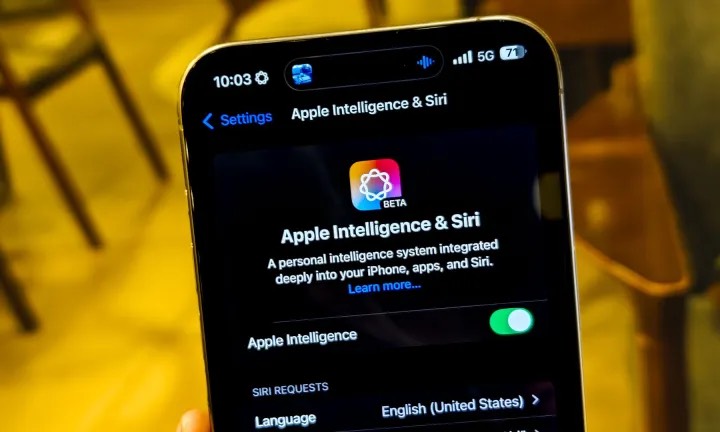
Image source: Digitaltrends
Competitors Press Ahead
While Apple hesitates, its rivals are moving quickly. Google has integrated its Gemini assistant directly into Android, giving users the ability to generate lists, control apps, and search across services in natural language. Microsoft has embedded AI deeply into Office and Windows. Even Amazon, long criticized for Alexa’s stagnation, has introduced an upgraded assistant. Meanwhile, OpenAI’s partnership with former Apple design chief Jony Ive signals that the next generation of AI hardware may not come from Cupertino at all.
A Market That Still Buys Time
Despite these challenges, Apple is not in immediate peril. The iPhone remains a dominant product, with billions of users worldwide and an ecosystem that keeps customers loyal. Revenue from Apple’s services business continues to grow, and its balance sheet is unmatched. Analysts suggest that Apple has roughly a year and a half to deliver a compelling AI strategy before customer loyalty begins to erode. History shows that Apple has often succeeded not by being first, but by being better.
The Clock Is Ticking
Still, time is not infinite. The rapid pace of AI development means that gaps widen quickly. Features that felt cutting-edge in 2023 already look dated in 2025. Apple’s opportunity lies in marrying AI’s creativity with the precision of traditional computing, wrapped in the design and reliability that have long been its trademarks. But execution is everything. Apple has weathered storms before, but this one may be different. Its problem is not only technical—it is reputational. And in a world where trust is as important as innovation, the company can ill afford many more missteps.
Sources: Wisconsin School of Business, CNBC, Y Net Global, Pocket-lint