Quick answer — key facts at a glance:
- Yes. Modern military drones increasingly run artificial intelligence, but most are not fully autonomous. As of 2025, the majority of military drones and robots still require human approval before engaging a target.
- AI handles specific jobs: target recognition, object tracking, navigation in GPS-denied zones, footage analysis, and swarm coordination — not unsupervised killing.
- Onboard (“edge”) AI lets drones think locally when communications are jammed, using compact processors that combine CPUs, GPUs, and neural accelerators.
- Combat in Ukraine accelerated everything: Russia’s Lancet loitering munitions gained an AI targeting module built on Nvidia’s Jetson platform, while Ukraine fields AI that automates roughly 99% of human labor in some intelligence tasks.
- Western militaries enforce a “human in the loop” rule. The Pentagon’s targeting projects disqualify any solution that removes human decision-making.
- The Pentagon’s autonomous-warfare budget is set to leap from $226 million to a proposed $54 billion in 2027 — a sign of how central this technology has become.
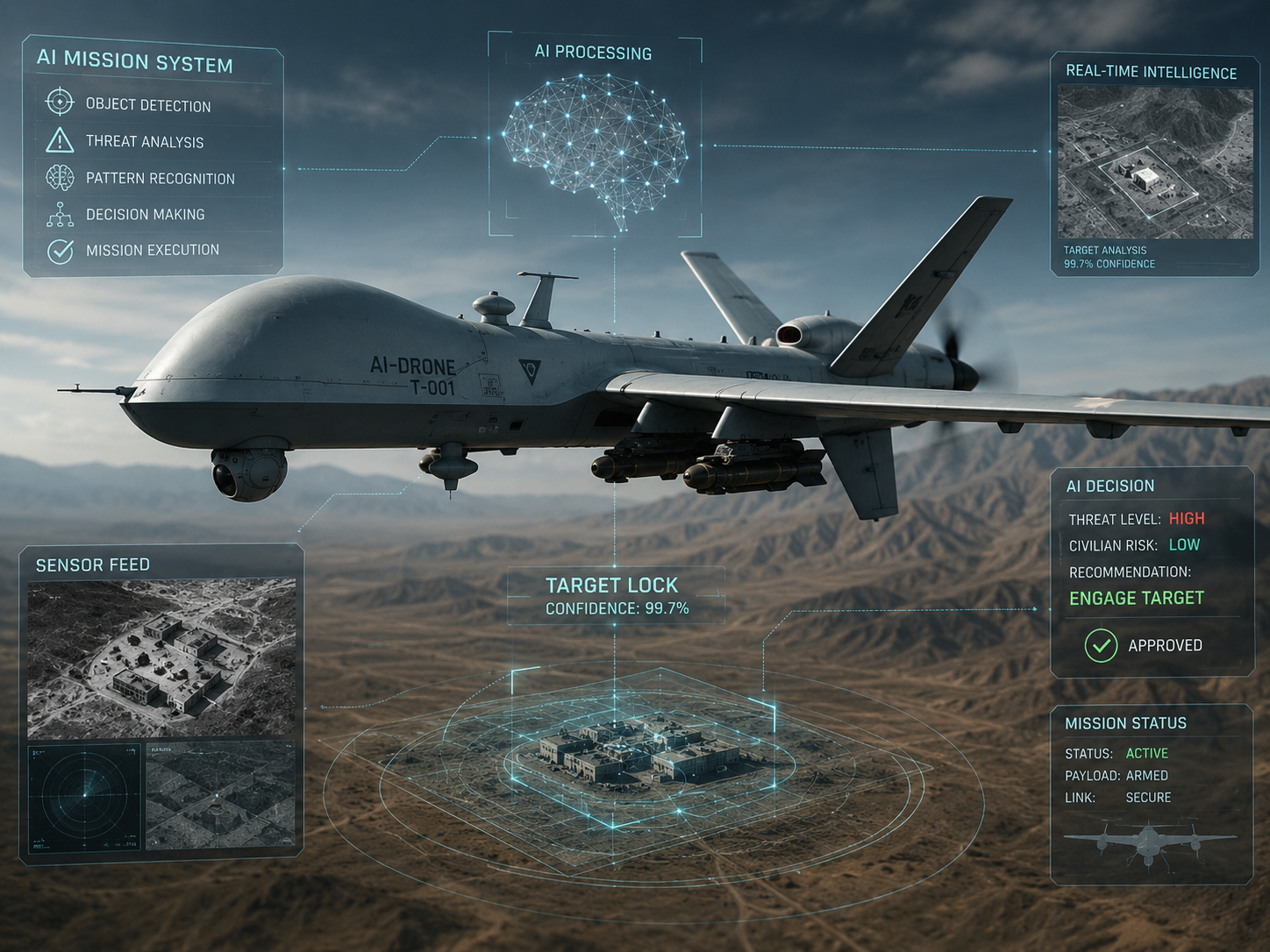
A military drone with AI functionality – artistic impression. Image credit: Alius Noreika / AI
The Short Answer: AI Powers Today’s Military Drones
Military drones use AI technology, and that use is growing fast. But the popular image of a self-deciding “killer robot” misreads where the field actually stands. Artificial intelligence in current drones works as a force multiplier for narrow functions — spotting a tank under camouflage, holding a target lock through evasive movement, flying without a satellite signal — rather than as an independent commander choosing whom to strike.
The crucial distinction is between automated and autonomous. According to CSIS analysis of Ukraine’s battlefield, AI now strongly enhances drone footage analysis, target recognition and tracking, and autonomous navigation, with AI replacing up to 99 percent of human labor in tasks like extracting intelligence from sound and text. Yet a Wikipedia survey of the field notes that as of 2025, most military drones and robots are not truly autonomous. AI does the perception and the heavy lifting; a person almost always confirms the kill.
What AI Actually Does Inside a Military Drone
Computer Vision and Target Recognition
The single biggest contribution of AI is sight. Computer-vision models trained to recognize vehicles, equipment, and personnel let a drone identify and follow a target on its own. CSIS reports that handing target recognition to onboard automatic target recognition (ATR) systems lets drones lock onto objects up to 2 km away, and that recognition ranges have stretched from roughly 300 meters to an average of 1 km in combat, reaching 2 km in ideal conditions. The same software counters decoys and camouflage that fool the human eye.
This matters for a practical reason: fatigue. As CSIS explains, automating object identification eases the burden on frontline operators worn down by stress, exhaustion, and uneven skill levels.
Onboard “Edge” AI for Jammed Battlefields
Early drones depended on a constant link to a pilot and a live video feed. Modern combat broke that model. As the International Data and Governance Authority’s analysis puts it, communications are disrupted, GPS is unreliable, and human decision cycles are often too slow — conditions that expose the limits of any system tied to a remote operator or cloud server.
The fix is putting the intelligence on the aircraft itself. Compact AI accelerators — modules that fuse CPUs, GPUs, and dedicated neural processing units for fast inference — now let drones perceive, prioritize, and decide locally when the connection is degraded or denied. The IDGA notes that future systems will blend multiple senses: a drone might spot a vehicle visually, confirm it acoustically, and match it against known radio-frequency signatures, layering inputs to cut false positives. Critically, this processing has to happen on the drone, because streaming raw multi-sensor data off-platform is rarely feasible in a contested area.
Navigation Without GPS
Jamming is now standard practice. Drawing lessons from the Russia-Ukraine war, the Pentagon wants drone swarms that can navigate and communicate in GPS-denied and electronic-warfare environments using visual or inertial navigation and resilient communication links. Lithuania’s Granta GA-10FPV-AI is a concrete example: it carries AI for autonomous flight even where GPS is unavailable or being jammed, with vertical take-off and landing for tight spaces.
Swarm Coordination
AI also lets many drones act as one. On January 23, 2026, a broadcast from the PLA’s National University of Defence Technology showed a single soldier directing a formation of 200 autonomous drones. The technical challenge — letting a small number of operators command a far larger fleet — sits at the center of two DARPA efforts, including one named Decentralized Artificial Intelligence through Controlled Emergence, aimed at helping robots form teams and run missions together.
How Autonomous Are They Really? The Three Loops
Defense scholars describe autonomy as a continuum, sorted by how much a human stays involved. Research summarized by TRENDS and the University of Washington’s Jackson School lays out three categories:
| Level | What it means | Example |
|---|---|---|
| Human-in-the-loop | A person must approve or start every targeting and engagement decision | Russia’s Marker ground robot; Project Maven |
| Human-on-the-loop | The system acts on its own, but a person monitors and can intervene | Many defensive systems |
| Human-out-of-the-loop | The system selects and engages independently | The category that drives most ethical and legal alarm |
Real systems often blur these lines. As one analysis featured by Yahoo News observed, drones can be flown by a human remotely and then switched to autonomous mode once a target is identified, specifically to defeat jamming. Going from that to AI that finds the target by itself is mostly a software problem — and one already being solved in the civilian sector.
A widely cited case shows how easily reporting distorts this. A UN report suggested Turkey’s Kargu-2 loitering munition may have autonomously attacked forces in Libya in 2020. But the UN panel could not corroborate the autonomous-mode claim, and the manufacturer, STM, clarified that the system uses AI-enabled computer vision to identify and track targets while still requiring a human operator to engage them.
Real Systems in Service Right Now
Several platforms illustrate where AI sits inside today’s fleets:
| System | Country / Maker | AI capability |
|---|---|---|
| Lancet loitering munition | Russia | AI targeting module on Nvidia Jetson; processes camera imagery locally, runs object recognition without a remote link, selects from pre-set target categories |
| Project Maven | United States | Fuses data from drones, satellites, and sensors to flag potential targets for human analysts |
| Lumberjack | Northrop Grumman (US Army test) | Demonstrated autonomous missions and AI-driven adaptive targeting |
| Receptor AI | Quantum Systems (Ukraine) | Software enabling autonomous target recognition, trained on Ukrainian datasets |
| GA-10FPV-AI | Granta Autonomy (Lithuania) | Autonomous flight in GPS-denied, jammed conditions |
Russia’s Lancet shows how far “narrow” AI already reaches. The drones, credited with more than 4,000 strikes on Ukrainian hardware since July 2022, now process imagery on board, recognize objects without phoning home, relay targeting data to one another about armored-vehicle concentrations, and engage in coordinated sequences.
Why the Pentagon Is Spending Billions
The funding numbers reveal the strategic stakes. The budget of the Defense Autonomous Working Group — the lead Pentagon office for drone warfare — would jump from $226 million this year to $54 billion under the 2027 spending proposal. Under the Replicator initiative, the U.S. military set out to field thousands of autonomous systems across multiple domains within 18 to 24 months.
The driver is China’s manufacturing scale. At the 2024 Zhuhai Airshow, Chinese defense maker Norinco unveiled an entire brigade of armored vehicles and drones run by AI, and the Pentagon is reportedly worried it cannot match the speed or scale of China’s autonomous-weapons production. Europe is responding too: in March 2026 the European Commission proposed AGILE, a fast-track funding tool meant to push AI decision-making systems, autonomous platforms, and drones from development into the hands of armed forces within one to three years.
The Ethics Question: Where Do the Guardrails Go?
The faster AI advances, the louder the debate over accountability. In 2025, Austria and a group of 30 co-sponsoring states put forward a UN General Assembly resolution arguing that AI and autonomy in weapons raise serious humanitarian, legal, security, technological, and ethical challenges by undermining the human role in the use of armed force.
Western policy leans hard on human control. The Pentagon frames its approach as “responsible AI” designed to keep a person in the loop so that systems are used in lawful, ethical, responsible, and accountable ways. That principle has teeth: in a 2026 Defense Innovation Unit project to build AI that helps troops shoot down hostile drones, the solicitation required a human in the loop and warned that non-compliance with the Department of Defense’s AI Ethical Principles would result in immediate disqualification.
Ukraine offers a candid view of the present limit. Deputy Defense Minister Yuriy Myronenko has stated that while fully autonomous weapons systems do not yet exist, Ukraine has “partially implemented it in some devices.” That single sentence captures the honest answer to the headline question — AI is deeply embedded in military drones today, full machine autonomy is not yet here, and the line between the two is exactly where the world’s hardest defense decisions now sit.
If you are interested in this topic, we suggest you check our articles:
- AI in Ocean Depths: Mapping the Invisible
- The $1 Trillion Question: Which Country Will Win the Global AI Race?
- Object Detection Models
- Choosing The Right Image Recognition Model for Your Project
- The Evolution of Object Detection
Sources: Vision of Humanity, Defense One, DefenseScoop, CSIS, IDGA, CEPA, Defense News, TRENDS Research, Euronews, Wikipedia – Lethal autonomous weapon, Wikipedia – Project Maven, Wikipedia – Granta GA-10FPV-AI
Written by Alius Noreika