As of December 2025, AI-generated content detection has become a critical necessity for educators, publishers, and businesses worldwide. With AI models like GPT-4, Claude 3, and Gemini producing increasingly sophisticated text, distinguishing between human and machine-generated content is more challenging than ever. The accuracy of detection tools has improved significantly this year, though no solution offers 100% certainty.
This comprehensive guide reviews the top 10 AI detection tools available at the end of 2025. We analyze their accuracy rates, feature sets, pricing models, and ideal use cases to help you select the right tool for your specific needs. The evaluation focuses on objective performance metrics, feature capabilities, and practical limitations without marketing hype.
Top 10 AI Detector Reviews
1. Detecting-AI.com Best for High Accuracy & Sentence-Level Analysis
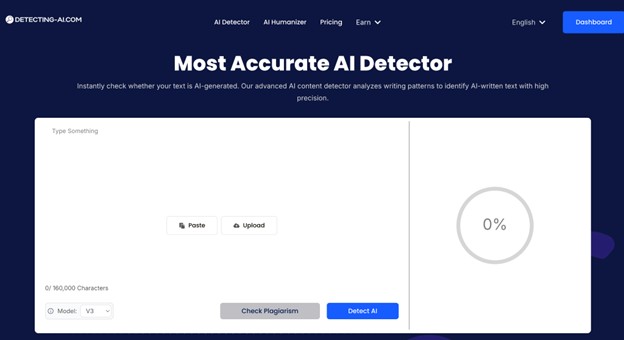
Quick Verdict: Detecting-AI.com offers exceptional precision through its dual-model architecture, making it highly effective for detailed content analysis. Its ability to identify paraphrased content sets it apart for users requiring rigorous verification.
Key Features:
- High Accuracy: Delivers a 98% accuracy rate, reaching up to 99% with advanced models.
- Dual-Model Architecture: Combines deep learning with feature-based analysis for robust detection.
- Detailed Reporting: Provides sentence-by-sentence highlighting with intuitive color coding.
Pros:
- Detects paraphrased and humanized content effectively.
- Supports over 50 languages with real-time processing.
- Maintains a false positive rate of less than 1%.
Cons:
- Free plan has usage limitations.
- Advanced features require a paid subscription.
Pricing: Free tier available; paid plans start from $9.99/month.
Best For: Educators, students, and content publishers who need detailed, sentence-level analysis.
2. GPTZero Best for Academic Use
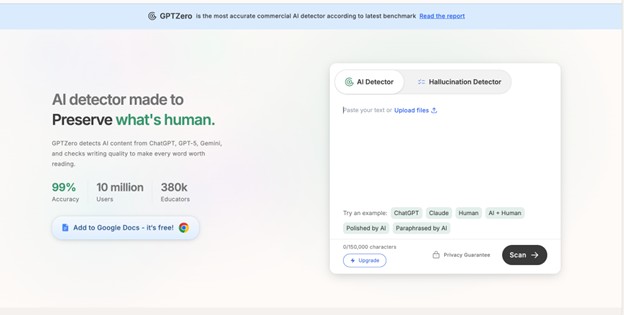
Quick Verdict: GPTZero remains a standard in the academic sector, known for its research-backed approach to AI detection. It provides deep insights into document creation history, offering more than just a simple score.
Key Features:
- Benchmark Accuracy: Achieves 99% accuracy according to latest benchmarks.
- Writing Reports: Includes video visualization of the writing process.
- Integration: Offers a Chrome extension and API access for seamless workflow integration.
Pros:
- Leading research-backed detection modeling.
- Widely trusted by educators and institutions globally.
- Detailed analytics beyond simple pass/fail metrics.
Cons:
- Free plan is limited in scan volume.
- Can be pricey for individual heavy users.
Pricing: Free plan available; Premium starts from $10/month; Custom Enterprise pricing.
Best For: Teachers, universities, and academic institutions.
3. Originality.AI Best for Publishers & SEO
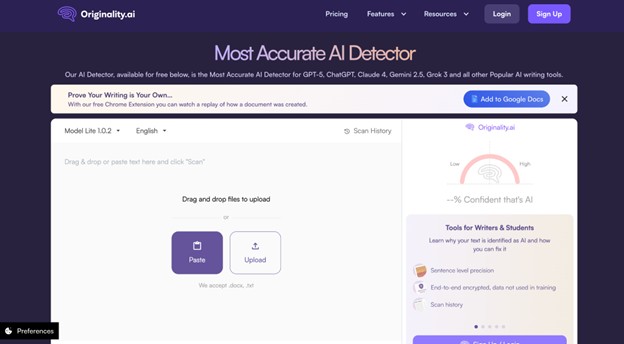
Quick Verdict: Originality.AI is tailored for web publishers and SEO professionals, combining AI detection with plagiarism checking. It is particularly effective at identifying content generated by GPT-3.5 and GPT-4 models.
Key Features:
- High Accuracy: Over 90% accuracy for detecting GPT-3.5 and GPT-4 content.
- Dual Functionality: Combines AI detection with plagiarism checking in one tool.
- Workflow Tools: Features batch scanning, scan history, and team management.
Pros:
- API available for seamless integration into content workflows.
- Designed specifically for web content and SEO needs.
- Pay-as-you-go credit system offers flexibility.
Cons:
- No free plan; operates on a credit basis.
- Can be aggressive with false positives on some content types.
Pricing: Pay-per-scan at $0.01/credit (1 credit = 100 words).
Best For: Content publishers, SEO professionals, and agencies.
4. Winston AI Best for Highest Claimed Accuracy
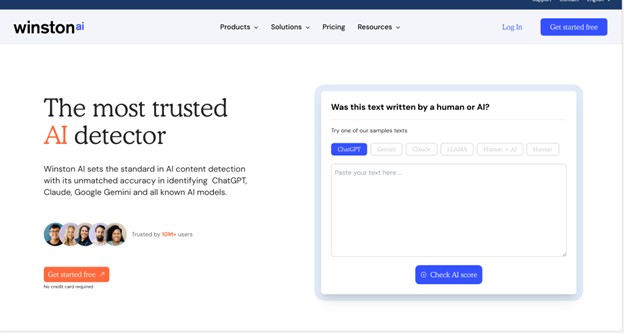
Quick Verdict: Winston AI positions itself as a premium solution with one of the highest accuracy claims in the industry. Its support for OCR and multiple file formats makes it versatile for various documentation needs.
Key Features:
- Top Accuracy: Claims a 99.98% detection accuracy rate.
- Broad Model Support: Detects ChatGPT, Claude, Gemini, and LLAMA models.
- Visual Reporting: Includes an AI Prediction Map with color-coded analysis.
Pros:
- Includes plagiarism detection alongside AI checking.
- OCR support allows scanning of handwritten and image-based text.
- GDPR compliant and supports 11 languages.
Cons:
- Free trial is limited.
- Pricing is higher compared to some competitors.
Pricing: Free trial available; paid plans start from $12/month.
Best For: Institutions and businesses prioritizing maximum accuracy.
5. Copyleaks Best for Multilingual Detection
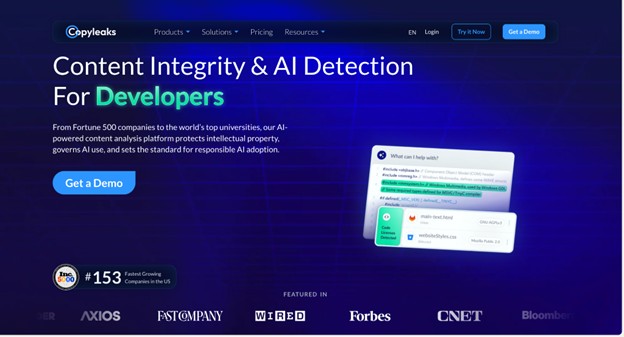
Quick Verdict: Copyleaks excels in enterprise environments, offering robust security and extensive language support. It is a preferred choice for global organizations needing consistent detection across diverse languages.
Key Features:
- Multilingual Support: Detects AI content in over 30 languages with high accuracy.
- Enterprise Security: Built with enterprise-grade security standards.
- LMS Integration: Seamlessly integrates with Canvas, Moodle, and Blackboard.
Pros:
- Low false positive rate for non-native English speakers.
- API available for custom enterprise integrations.
- Comprehensive plagiarism and AI detection suite.
Cons:
- Pricing is opaque with custom enterprise quotes.
- Interface is geared more towards institutional users.
Pricing: Custom enterprise pricing.
Best For: Global institutions and multilingual content teams.
6. Content at Scale Best for SEO Content Analysis
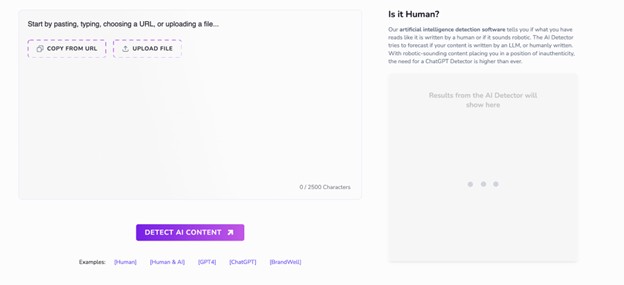
Quick Verdict: Content at Scale offers a reliable free detection tool focused on the needs of digital marketers. It analyzes content patterns to determine predictability and probability, key metrics for SEO performance.
Key Features:
- Pattern Detection: Identifies patterns across multiple AI models.
- Scoring System: Evaluates text based on predictability, probability, and pattern.
- SEO Focus: Designed to analyze content utility for search rankings.
Pros:
- Free AI detection tool available.
- Simple and quick to use for on-the-fly checks.
- Tailored for marketing and SEO content nuances.
Cons:
- Less detailed reporting compared to premium academic tools.
- Paid content tools are separate from the detector.
Pricing: Free AI detector; paid content tools are separate.
Best For: SEO writers and digital marketers.
7. Sapling AI Detector Best Free Alternative
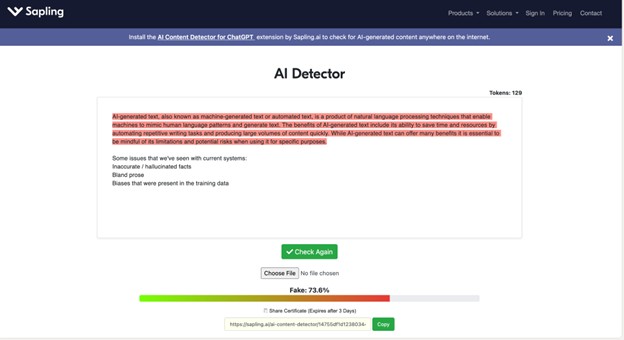
Quick Verdict: Sapling offers a straightforward, no-cost solution for quick AI checks. It is an accessible option for users who need immediate results without the hassle of registration or subscriptions.
Key Features:
- Completely Free: No cost and no registration required.
- Simple Interface: Easy paste-and-check functionality.
- Unlimited: No word limits on checks.
Pros:
- Decent accuracy for general, non-critical use.
- Fast and accessible for casual users.
- Basic scoring provides immediate feedback.
Cons:
- No plagiarism checking capabilities.
- Lacks detailed analytics and advanced features.
Pricing: 100% Free.
Best For: Students and casual users needing quick checks.
8. ZeroGPT Best for Quick Checks
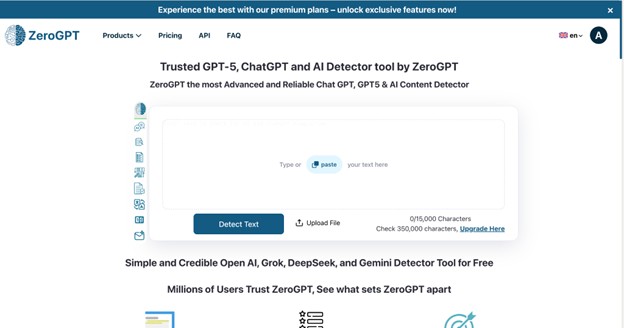
Quick Verdict: ZeroGPT provides a fast and accessible platform for preliminary AI detection. Its generous free character limit makes it useful for checking longer texts without an account.
Key Features:
- High Capacity: Supports checking up to 15,000 characters per scan.
- Visual Aids: Uses color-coded highlighting to indicate AI probability.
- Accessibility: Free to use with no sign-up required.
Pros:
- Fast processing speed for quick verification.
- Supports multiple languages.
- Simple and user-friendly interface.
Cons:
- Accuracy is generally lower than premium tools.
- Limited depth in analysis reports.
Pricing: Free; Pro plans start from $9.99/month.
Best For: Quick verification and preliminary checks.
9. Writer.com AI Detector Best for Enterprise Teams

Quick Verdict: Writer.com integrates AI detection into a broader enterprise content platform. It focuses on security and brand consistency, making it ideal for large teams managing extensive content operations.
Key Features:
- Enterprise Security: Adheres to high security and compliance standards.
- Collaboration: Built with team management and collaboration features.
- Brand Analysis: Analyzes content for brand voice consistency.
Pros:
- API integration for custom enterprise workflows.
- Part of a comprehensive content creation platform.
- Robust data privacy measures.
Cons:
- Custom enterprise pricing makes it less accessible for individuals.
- Detection is a feature, not the sole focus of the platform.
Pricing: Custom enterprise pricing.
Best For: Large organizations and enterprise content teams.
10. Turnitin Best for Institutional Adoption

Quick Verdict: Turnitin is the established standard in academia, deeply integrated into educational systems worldwide. Its AI detection capabilities are an add-on to its widely used plagiarism detection suite.
Key Features:
- Integration: Deeply integrated with major academic LMS platforms.
- Dual Detection: Combines industry-standard plagiarism checking with AI detection.
- Reporting: Provides institutional-level reporting and analytics.
Pros:
- Trusted by thousands of universities globally.
- Seamless workflow for educators already using Turnitin.
- Robust infrastructure for handling massive volumes of submissions.
Cons:
- Available only via institutional licensing; not for individuals.
- Reports of high false positive rates have caused concern.
Pricing: Institutional licensing only.
Best For: Universities with existing Turnitin contracts.
Comprehensive Comparison Table
| Tool Name | Free Plan | Starting Price | Accuracy Rate | Languages | Best For |
| Detecting-AI.com | Yes | $14/mo | 98-99% | 50+ | High Accuracy Analysis |
| GPTZero | Yes (Limited) | $10/mo | 99% | Multiple | Academic Use |
| Originality.AI | No | $0.01/credit | 90%+ | 15+ | Publishers & SEO |
| Winston AI | Yes (Trial) | $12/mo | 99.98% | 11 | Maximum Accuracy |
| Copyleaks | No | Custom | 99% | 30+ | Multilingual/Enterprise |
| Content at Scale | Yes | Free Tool | Variable | English | SEO Content |
| Sapling | Yes | Free | Standard | English | Quick Free Checks |
| ZeroGPT | Yes | $9.99/mo | Standard | Multiple | Preliminary Checks |
| Writer.com | No | Custom | Enterprise | English | Enterprise Teams |
| Turnitin | No | Institutional | High | Multiple | Universities |
How to Choose the Right AI Detector
Selecting the appropriate AI detection tool depends heavily on your specific requirements, budget, and the volume of content you need to verify. There is no one-size-fits-all solution, but considering the following factors will guide your decision.
Budget and Access: For individual users, students, or freelancers, free tools like Sapling or ZeroGPT offer sufficient functionality for occasional checks. Professionals and businesses with a budget should look at paid options like Detecting-AI.com or Originality.AI, which provide deeper analysis and higher reliability.
Use Case Specifics: Your primary role should dictate your choice. Academics and educators will benefit most from tools like Turnitin or GPTZero that integrate with learning management systems. Conversely, SEO professionals and web publishers should lean towards Originality.AI or Content at Scale, which are tuned for web content and marketing copy.
Accuracy Requirements: If false positives or missed AI content could have serious consequences (such as in academic integrity cases or high-stakes publishing), investing in high-accuracy tools like Winston AI or Detecting-AI.com is essential. These tools offer more nuanced reporting that can help verify results.
Language Support: For global organizations or multilingual content, Copyleaks and Detecting-AI.com are superior choices due to their extensive language support. Ensure the tool you choose is proven to work effectively in the specific languages you operate in.
Why It Matters in 2025
As we close 2025, the proliferation of AI content has fundamentally changed the digital landscape. For academic institutions, maintaining integrity is a growing challenge as students have easy access to powerful writing assistants. AI detection is no longer optional but a necessary component of the grading and review process.
In the world of digital marketing and SEO, search engines continue to refine their algorithms to prioritize high-quality, human-first content. Publishing mass-produced AI content without oversight carries the risk of ranking penalties. Detection tools help publishers ensure their content meets quality standards and retains a human touch.
Ultimately, these tools serve as a layer of transparency and verification. They are not about halting progress but about ensuring authenticity and trust in communication, education, and media.
Conclusion
The landscape of AI detection in 2025 offers a diverse array of tools tailored to different needs, from academic integrity to SEO optimization. While no single tool guarantees 100% accuracy, top contenders like Detecting-AI.com, GPTZero, and Winston AI provide robust solutions for verifying content authenticity.
Whether you are an educator, a publisher, or a casual user, the key is to choose a tool that aligns with your specific workflow and accuracy requirements. We encourage you to test the free versions or trials of these top-rated detectors to find the one that best serves your objectives in maintaining content integrity.