TL;DR:
- Under Buffett, Berkshire first bought Alphabet in late 2025, holding about 17.8 million shares — a position worth roughly $4.3–5.6 billion and long called one of his “biggest misses.”
- In Q1 2026, new CEO Greg Abel tripled that stake to nearly 58 million shares, worth about $16.6–17 billion, vaulting Alphabet into Berkshire’s top holdings.
- The buy was not about cheapness alone; it was a bet on an underpriced AI moat, funded by Berkshire’s ~$397 billion cash pile.
- Alphabet’s Q1 2026 results backed the thesis: revenue up 22% to $110 billion, EPS of $5.11 (nearly double consensus), and Google Cloud up 63% with backlog near $460 billion.
- Abel paired the Alphabet buy with an aggressive cleanup — exiting 16 positions, including Visa, Mastercard, Amazon, and UnitedHealth — shrinking the portfolio from 40 names to 26.
- The wider market split on the same trade: Bill Ackman’s Pershing Square sold most of its Alphabet to buy Microsoft, while Bridgewater bought alongside Berkshire.
- Key lessons: conviction can override a famous regret, value can mean a quality business at a fair price, and a 13F is a lagging snapshot, not a live signal.
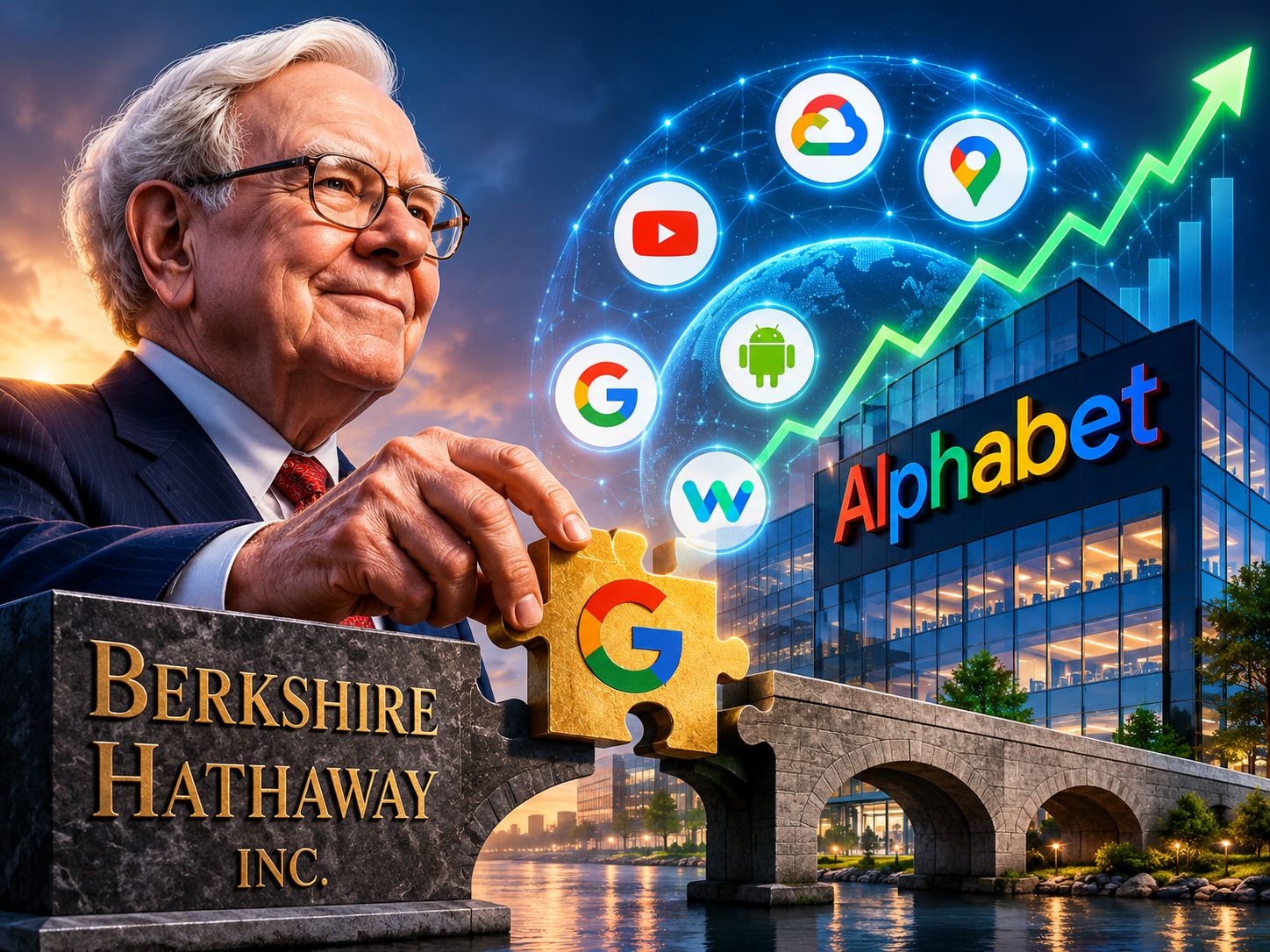
Berkshire Hathaway investment in Alphabet – artistic impression. Image credit: Alius Noreika / AI
Berkshire Hathaway’s bet on Alphabet teaches one lesson above all: the firm finally acted on a mistake it had admitted for years, and it did so with conviction at the moment a “value” label and an AI growth story lined up. Warren Buffett and the late Charlie Munger had long called missing Google one of their biggest errors – Munger said they “just sat there sucking our thumbs.”
Late in 2025, under Buffett, Berkshire bought in for the first time, taking roughly 17.8 million shares. Then in the first quarter of 2026, his successor Greg Abel tripled the position to nearly 58 million shares, worth about $17 billion, turning a long-standing regret into one of Berkshire’s largest holdings.
The deeper takeaway is about how the decision was framed. Most of Berkshire’s other Q1 2026 buys, Delta, Lennar, Macy’s, were classic discounted, beaten-down names. Alphabet was the exception. Abel and Buffett bought it not because it was cheap in the traditional sense but for what they appear to see as an unpriced moat in AI and cloud, at a price the market still treated with suspicion. That distinction – paying a fair price for an exceptional business rather than a low price for an average one – is the thread running through everything the move signals.
From “biggest miss” to top-five holding
The timeline matters. The first Alphabet purchase came on Buffett’s watch and was relatively measured. The transformation happened in the quarter that ended March 31, 2026 – Abel’s first full quarter as CEO after taking over on January 1. Berkshire’s Alphabet share count rose from about 17.85 million at year-end 2025 to nearly 58 million by the end of March, a 224% increase in roughly three months. The position jumped from around $5.6 billion to roughly $17 billion and now ranks among Berkshire’s largest disclosed equity holdings, behind a still-untouched Apple stake of about 228 million shares worth roughly $58 billion.
That Apple detail is its own lesson. For nearly two years under previous management, Berkshire had been trimming Apple. Abel left it alone — a signal of continuity in conviction even as he reshaped the rest of the book. The Alphabet buy extended Berkshire’s comfort with big tech to a second name, a notable shift for a chairman who long avoided technology because, in his words, he could not predict the long-term winners well enough.
| Metric | Year-end 2025 (Buffett) | Q1 2026 (Abel) |
|---|---|---|
| Alphabet shares held | ~17.85 million | ~57.8 million |
| Approximate value | ~$5.6 billion | ~$16.6–17 billion |
| Quarter-over-quarter change | — | +224% |
| Portfolio rank | Smaller position | Top-five holding |
| Total positions held | ~40 | 26 |
The numbers that justified the conviction
Alphabet’s Q1 2026 earnings gave the thesis hard support. Total revenue grew 22% year-over-year to $110 billion, the fastest pace in over two years. Net income rose 81% to $62.6 billion, and earnings per share hit $5.11 – nearly double the $2.63 consensus.
The standout was Google Cloud: revenue grew 63% to exceed $20 billion for the first time, with operating margin expanding and backlog nearly doubling quarter-on-quarter to over $460 billion in contracted future revenue.
CEO Sundar Pichai said the company’s AI investments and full-stack approach were “lighting up every part of the business,” noting that Google’s first-party models were processing more than 16 billion tokens per minute via direct API. Tellingly, Alphabet said the only thing holding Cloud back was capacity, not demand – Pichai stated the company was “compute constrained in the near term” and that revenue would have been higher with more capacity.
For a value investor, a business turning away revenue because it cannot build data centers fast enough, while still expanding margins, is a rare combination of growth and durability.
The bet beneath the bet: an AI infrastructure moat
The Alphabet purchase is, at its core, a wager on AI infrastructure economics. Berkshire is betting that Alphabet’s enormous 2026 capital expenditure – guided to $180–190 billion, up from an earlier $175–185 billion range — translates into durable cloud market share and a defensible position in AI. That is a striking amount of spending for Berkshire to underwrite, roughly six times Google’s capex of just a few years earlier, and the company has signaled 2027 spending will rise further still.
The lesson here is about what “moat” means in the AI era. Berkshire has always sought businesses with strong competitive advantages and a “share of mind.” Alphabet offers both through Search and YouTube, but the new element is full-stack AI: custom TPUs, the Gemini model family, and a cloud platform whose enterprise AI revenue grew nearly 800% year-over-year.
Buying that at a forward earnings multiple below the broader S&P 500 is the value discipline applied to a growth asset – the bet is that the market is mispricing a moat, not that the stock is simply cheap.
The cleanup that came with it
The Alphabet move did not happen in isolation. Abel’s first quarter was among Berkshire’s busiest ever for trading. He exited 16 positions entirely – including Visa, Mastercard, UnitedHealth, Amazon, Domino’s Pizza, and Charter Communications – and slashed Constellation Brands by 95%, shrinking the portfolio from 40 names to 26. He also restarted Berkshire’s buyback program, which Buffett had paused through all of 2025.
The exits carry their own lesson. Visa and Mastercard are exceptional businesses; selling them was not a verdict on quality but on price. In an expensive market, Abel chose to leave positions where the margin of safety had eroded and concentrate capital where he saw mispriced opportunity.
The result is a leaner, more concentrated book – the same investment philosophy of demanding value and holding conviction, executed faster and with a sharper hand. Berkshire ended March with about $397 billion in cash, so this was reallocation by choice, not necessity.
Wall Street split on the same stock
One of the most instructive parts of the episode is that the so-called smart money divided itself over the identical question. In the same window Berkshire tripled down on Alphabet, Bill Ackman’s Pershing Square liquidated more than 95% of its Alphabet stake and moved into Microsoft. Ray Dalio’s Bridgewater bought heavily alongside Berkshire.
Both sides are betting on AI infrastructure; they disagree on who captures the economics. Berkshire’s wager is that Alphabet’s capex converts into durable cloud share at a price the market still doubts. Ackman’s is that Microsoft’s enterprise distribution turns AI workloads into recurring revenue faster than anyone else.
The honest lesson for an ordinary investor is that copying either trade without understanding its thesis is the wrong instinct – conviction is only useful when it is your own.
What the Alphabet bet actually teaches
Several durable lessons emerge. First, a famous regret is not a permanent verdict; Berkshire revisited Google once the business and the price aligned, showing that discipline includes the willingness to correct course. Second, “value” does not require a low headline number – a high-quality compounder at a fair multiple can be the value play, especially when the moat is underpriced.
Third, leadership transitions can preserve philosophy while changing execution; Abel kept Buffett’s principles and moved with more speed and concentration.
Finally, there is a practical caution. A 13F filing is a lagging indicator – it reflects positions as of March 31, disclosed up to 45 days later, and Berkshire never comments on its trades.
By the time the public sees the move, the price has changed, and the rationale is inferred, not confirmed. The right response to any star investor’s disclosed trade is to do your own research and decide whether the thesis fits your own goals and risk tolerance – which is, fittingly, the most Buffett-shaped lesson of all.
If you are interested in this topic, we suggest you check our articles:
- What Is Required for a Premium AI Infrastructure System?
- How Much Electrical Power Does AI Require?
- European Countries With the Most Data Centers 2026
- 2026 AI Subscription Prices: Gemini vs ChatGPT vs Claude
- Which LLM Is Best? Claude vs ChatGPT vs Gemini Comparison
Sources: Fortune, Yahoo Finance / Fortune (13F), TheStreet, Yahoo Finance (Motley Fool), Alphabet 8-K (SEC), CNBC, INDmoney, Crypto Briefing
Written by Alius Noreika