Key Takeaways
- Alphabet Inc. crossed the $4 trillion market capitalization threshold on January 12, 2026, joining only Nvidia in this elite valuation territory
- The company’s stock surged 65% during 2025, marking its strongest annual performance since 2009
- Apple announced a multi-year partnership worth approximately $1 billion annually to integrate Google’s Gemini AI into Siri
- Gemini 3 scored 91.9% on GPQA Diamond benchmark and topped the LMArena Leaderboard with 1501 Elo
- Google Cloud revenue jumped 34% year-over-year to $15.2 billion in Q3 2025
- Warren Buffett’s Berkshire Hathaway disclosed a $4.3 billion stake in Alphabet during Q3 2025
- A favorable September 2025 antitrust ruling allowed Alphabet to retain its Chrome browser
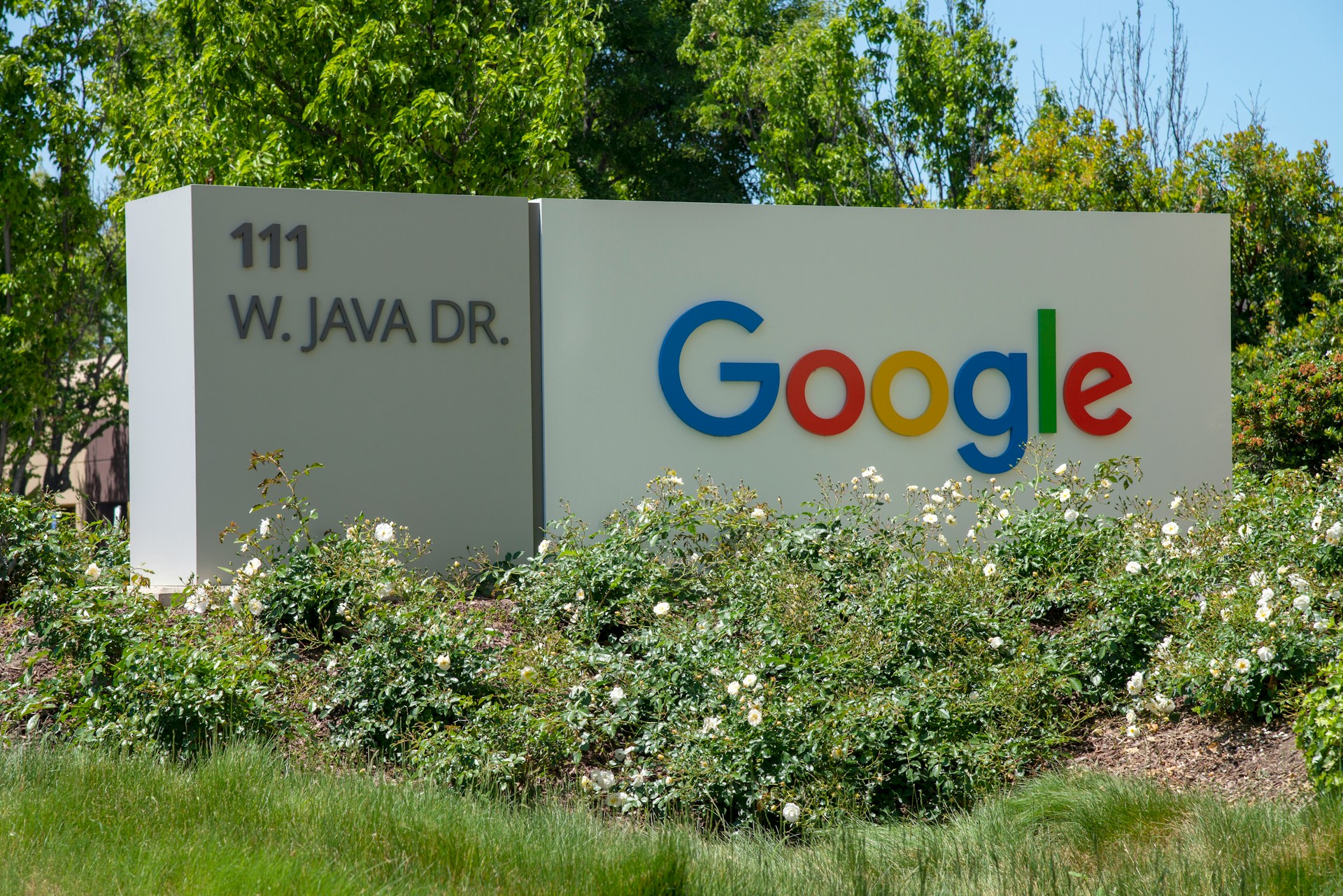
Google in Sunnyvale, CA, at West Java Drive. Image credit: Greg Bulla via Unsplash, free license
Alphabet Inc. achieved a market capitalization exceeding $4 trillion on January 12, 2026, becoming only the fourth company in history to reach this valuation milestone. The Google parent company now trails only Nvidia in global market value, having overtaken Apple for the first time since 2019. This achievement caps a remarkable turnaround for a company that faced existential questions following ChatGPT’s launch in late 2022.
The journey from search engine leader to AI-native powerhouse took Alphabet through four distinct market cap milestones over six years. Each crossing point tells a different story about the company’s evolution and the shifting priorities of technology investors.
Market Cap Milestones: A Decade of Growth
Alphabet’s path to $4 trillion followed a clear trajectory, though the pace accelerated dramatically in recent years.
| Milestone | Date | Key Catalyst | Time Between Milestones |
|---|---|---|---|
| $1 trillion | January 16, 2020 | Cloud expansion, advertising stability | First entry |
| $2 trillion | April 26, 2024 | First-ever dividend, $70B buyback | 4 years, 3 months |
| $3 trillion | September 15, 2025 | Favorable antitrust ruling, AI optimism | 17 months |
| $4 trillion | January 12, 2026 | Gemini 3 launch, Apple partnership | 4 months |
What took four years between the first two milestones compressed to just four months for the final trillion-dollar jump.
Gemini 3: The Technical Breakthrough That Changed Everything
Google launched Gemini 3 Pro on November 18, 2025, and the AI community responded with unusual enthusiasm. The model achieved scores that established new benchmarks across reasoning, coding, and multimodal understanding.
The numbers tell a compelling story. Gemini 3 Pro recorded 91.9% on GPQA Diamond, a test designed to measure PhD-level reasoning. It reached 37.5% on Humanity’s Last Exam without tool assistance—a benchmark specifically created to stump AI systems. On the LMArena Leaderboard, it achieved a breakthrough Elo score of 1501, surpassing all competitors.
Beyond raw benchmarks, Gemini 3 introduced “Deep Think” mode, which pushes the model further on complex problems. In this mode, accuracy on Humanity’s Last Exam rises to 41%. The model also achieved 78% on SWE-bench verified for coding tasks, placing it among the top performers for autonomous software development.
OpenAI CEO Sam Altman acknowledged the competitive pressure publicly. “I expect the vibes out there to be rough for a bit,” he said following Gemini 3’s launch. The comment underscored how Google had closed the gap that opened after ChatGPT’s debut.
Google followed Gemini 3 Pro with Gemini 3 Flash on December 17, 2025—a faster, cheaper model that now serves as the default in the Gemini app. The Flash version matches Gemini 3 Pro’s reasoning capabilities while processing queries more efficiently, making advanced AI accessible to a broader user base.
The Apple Partnership: A Vote of Confidence
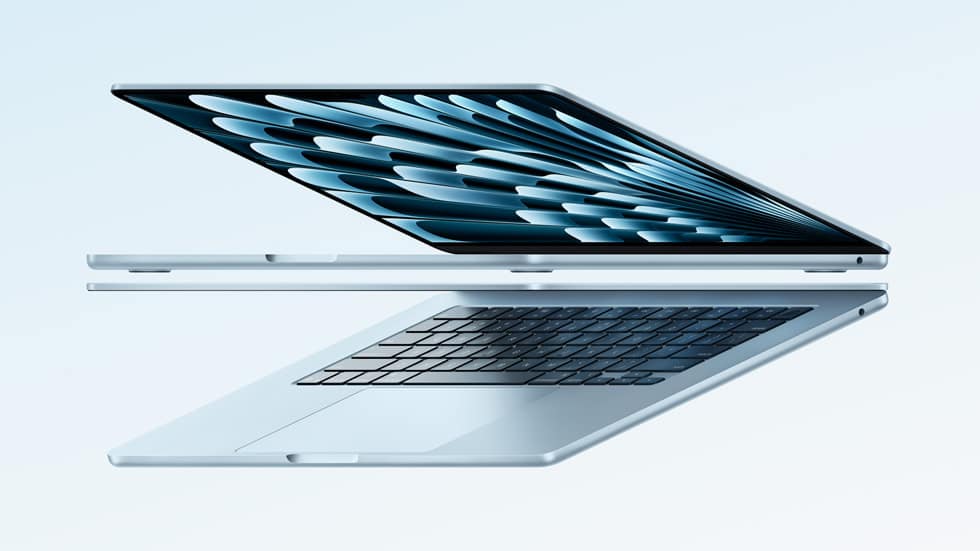
Apple MacBook Air M4
Apple’s January 13, 2026 announcement that it would use Gemini to power the next generation of Siri sent Alphabet shares climbing. The multi-year collaboration, reportedly valued at approximately $1 billion annually, positions Google as the primary AI engine for billions of Apple devices.
“After careful evaluation, Apple determined that Google’s AI technology provides the most capable foundation for Apple Foundation Models and is excited about the innovative new experiences it will unlock for Apple users,” the companies stated jointly.
The deal carries strategic importance beyond revenue. Apple had previously worked with OpenAI for certain AI features, making the Gemini selection a clear endorsement of Google’s technical superiority. For Alphabet, the partnership provides distribution across Apple’s ecosystem—iPhones, iPads, Macs—creating a moat that competitors cannot easily breach.
Danni Hewson, head of financial analysis at AJ Bell, noted that Google is handling competition effectively “despite concerns that many of the last decade’s disrupters might become this decade’s disrupted. Alphabet is consistently making smart innovations which should keep them relevant for years to come.”
Cloud Computing: The Profit Engine
Google Cloud has transformed from a money-losing growth project into a genuine profit contributor. The division posted $15.2 billion in revenue for Q3 2025, representing 34% year-over-year growth that outpaced both Amazon Web Services and Microsoft Azure on a percentage basis.
The cloud business benefits from several converging factors. Enterprise customers increasingly require AI capabilities, and Google’s Tensor Processing Units (TPUs) offer an alternative to Nvidia’s GPUs for training and inference workloads. In November 2024, Alphabet unveiled Ironwood, the seventh generation of its custom AI chips, which competes directly with Nvidia’s offerings for certain applications.
Anthropic, the AI company behind Claude, uses up to 1 million of Google’s specialized AI chips through a cloud arrangement. This partnership demonstrates that even competing AI labs recognize the value of Google’s hardware infrastructure.
Ben Barringer, head of technology research at Quilter Cheviot, described the current situation: “Alphabet is very much a ‘sum of the parts’ story, with a number of businesses at the forefront of their sector. If it can stabilise revenues from search advertising and YouTube and keep up the momentum in the Cloud business, then, yes, it can keep up momentum.”
Regulatory Clarity Removes Uncertainty
Alphabet’s stock received a significant boost in September 2025 when Judge Amit Mehta delivered his antitrust remedies ruling. The Department of Justice had sought aggressive structural changes, including a forced sale of Chrome browser and potential divestiture of Android. The court rejected these proposals.
Judge Mehta ordered behavioral remedies instead: ending exclusive default search agreements and sharing certain search data with competitors. However, Google can continue paying device makers for default placement, provided agreements don’t exceed one year and aren’t conditioned on exclusivity.
The ruling acknowledged that AI competition had already altered the market dynamics the court was addressing. “These companies already are in a better position, both financially and technologically, to compete with Google than any traditional search engine,” Mehta wrote, referring to AI-powered challengers like OpenAI and Perplexity.
Alphabet’s stock jumped 8% on the ruling, adding tens of billions to its market cap in a single session. Investors interpreted the outcome as validation that Google’s core business model would survive intact.
The Quantum Computing Wild Card
Google AI mode – artistic impression. Image credit: BoliviaInteligente via Unsplash, free license
On December 10, 2024, Alphabet unveiled its Willow quantum computing chip, triggering a 6% stock surge—the largest single-day gain since April of that year. The chip completed a benchmark computation in under five minutes that would require the world’s fastest supercomputer approximately 10^25 years (ten septillion years).
Hartmut Neven, founder of Google Quantum AI, noted that Willow addresses a challenge that has plagued the field for nearly three decades: error correction. The chip can reduce errors exponentially as it scales up, a property essential for building commercially viable quantum computers.
While practical applications remain years away, Willow positions Alphabet at the frontier of a technology with transformative potential across pharmaceuticals, cryptography, materials science, and financial modeling. CEO Sundar Pichai stated that Willow is “an important step in our journey to build a useful quantum computer with practical applications in areas like drug discovery, fusion energy, battery design and more.”
Buffett’s Endorsement
Warren Buffett’s Berkshire Hathaway disclosed a $4.3 billion stake in Alphabet during Q3 2025—a surprising move from an investor known for avoiding technology stocks. The position, acquired at an average price of approximately $209 per share, has already generated substantial returns as shares climbed above $330.
The investment carried extra weight given Buffett’s historical reluctance toward high-growth tech names. He previously admitted to “blowing it” by not buying Google earlier, even though his Geico insurance unit was an early Google advertising customer.
“I had seen the product work, and I knew the kind of margins [they had],” Buffett said in 2018. “I didn’t know enough about technology to know whether this really was the one that would stop the competitive race.”
His eventual purchase suggests the uncertainty has resolved in Google’s favor.
Revenue Diversification Strengthens the Foundation
Alphabet’s business now spans multiple high-performing segments beyond search advertising.
| Division | Q3 2025 Revenue | YoY Growth |
|---|---|---|
| Google Search & Other | $105B (H1 2025) | 11% |
| YouTube Advertising | $10.26B | 15% |
| Google Cloud | $15.2B | 34% |
| Other Bets (Waymo, Verily, etc.) | Growing | Variable |
YouTube continues expanding its advertising revenue while subscription services add recurring income. Waymo, the autonomous vehicle division, plans to expand ride-hailing services to ten additional international cities by the end of 2026, potentially transforming from research project to revenue contributor.
The 2024 full-year revenue reached $350 billion with net income of $100.12 billion—the company’s first time crossing the $100 billion profit threshold.
Looking Forward
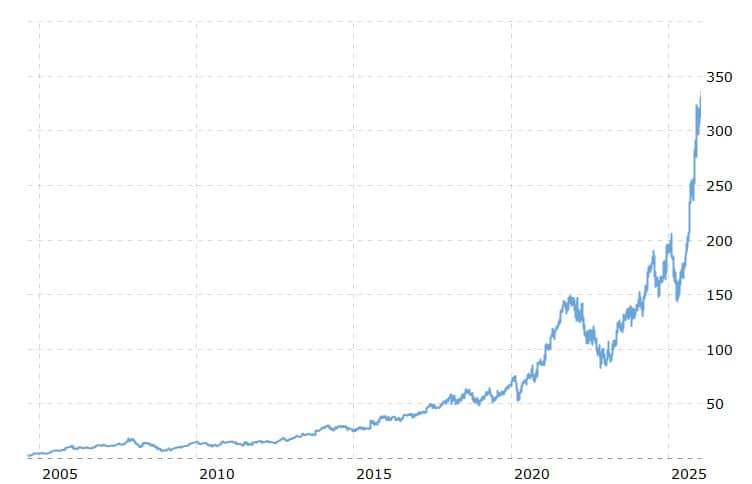
Alphabet – 22 Year Stock Price History | GOOGL. Source: Macrotrends
Analysts project continued momentum. Citi named Google a top internet pick for 2026, noting that 70% of Google Cloud customers use its AI products. Mad Money host Jim Cramer offered a specific target: “I think Alphabet goes straight shot to $400.”
The company faces challenges. AI-generated content must remain trustworthy and accurate—the “hallucination” problem that plagued early models requires ongoing vigilance. Energy costs for running AI at scale continue climbing. And competitors at OpenAI, Microsoft, Meta, and Anthropic continue iterating rapidly.
Alphabet’s Q4 2025 earnings call, scheduled for February 4, 2026, will provide investors with updated metrics on Gemini adoption, cloud growth trajectories, and the early impact of the Apple partnership.
The path from $4 trillion to $5 trillion may prove shorter than anyone expected. Sarah Kunst, an angel fund investor, captured the optimistic case: “If you look at Alphabet as Tesla (robotics, AI self-driving cars) meets OpenAI, on top of their core businesses, it’s way undervalued.”
Whether that assessment proves accurate depends on execution. But Alphabet has demonstrated that a company written off as a potential victim of AI disruption can instead become one of its primary beneficiaries.
If you are interested in this topic, we suggest you check our articles:
- Alphabet’s AI Strategy: Pichai’s Vision and $85B Investment Plan
- 5 Biggest AI Financial Investments in 2025
Sources: The Wall Street Journal, Euronews, Wikipedia, Macrotrends
Written by Alius Noreika