Key Takeaways
- Wineries using AI-driven irrigation systems report water savings of up to 30%, while maintaining or improving grape quality.
- AI-powered disease detection apps, built on image-processing pipelines and TensorFlow models, allow growers to identify vine diseases early and reduce pesticide use by 50–77% in documented cases.
- Real-time fermentation monitoring powered by machine learning tracks temperature, sugar levels, and yeast activity across entire winery operations, reducing batch-to-batch variation.
- Optical sorting machines enhanced with AI now assess grape color, shape, and quality at accuracy rates reaching 90%.
- Automated robotic harvesters cut labor costs by up to 40% while picking grapes at peak ripeness.
- AI-powered fraud detection systems — including partnerships between Italy’s State Mint and Microsoft — let consumers verify Prosecco authenticity by scanning a bottle label.
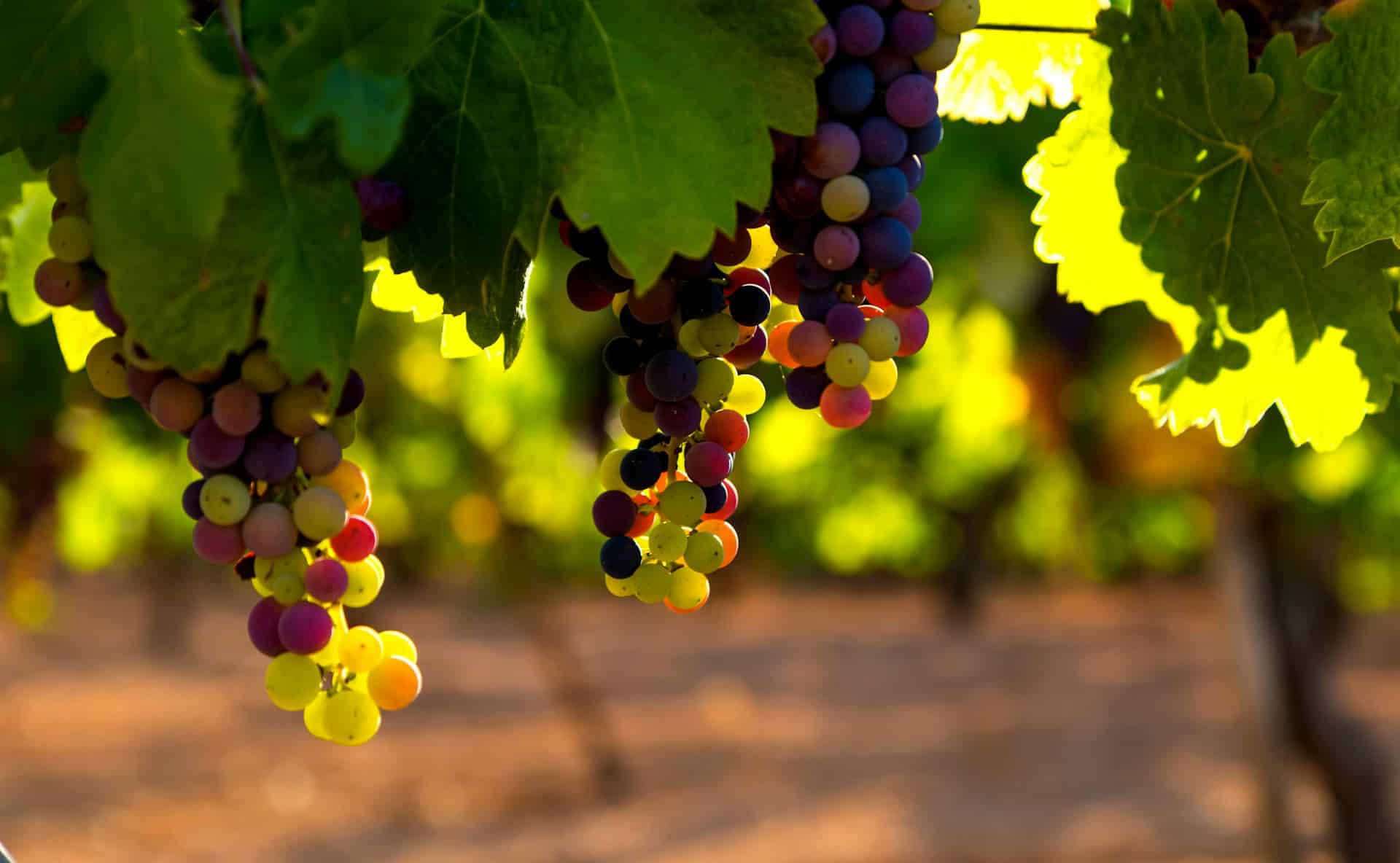
Grapes in a vineyard. Image credit: Jose Alfonso Sierra via Unsplash, free license
Machine learning is now embedded in every stage of winemaking, from the moment a sensor reads soil moisture in a vineyard row to the instant a robotic arm rejects a flawed bottle on a packaging line. Wineries across California, France, Germany, Italy, New Zealand, and Spain are deploying AI tools to analyze soil composition, time irrigation precisely, monitor fermentation in real time, and predict harvest quality weeks before a single grape is picked. The result: higher yields, lower resource waste, and more consistent wines — vintage after vintage.
This is not a story about technology replacing the winemaker. Every producer interviewed for this article made the same point: AI handles data processing and pattern recognition at a scale no human can match, but the creative, sensory, and emotional dimensions of wine remain firmly human territory. “Artificial intelligence does not replace human intelligence — it enhances it. The emotions of wine remain the domain of people,” says Emanuele Nardi, oenologist at Tenute del Cerro in Montepulciano, Italy. What AI does is free winemakers to spend their time on the decisions that matter most.
How AI Reads the Vineyard: Soil Analysis and Vine Health Monitoring
Traditional vineyard management depended on walking the rows, inspecting leaves, testing soil by hand, and relying on accumulated experience. AI-powered monitoring compresses that process and dramatically expands its scope.
At California’s Château Montelena, digital vine monitoring uses technology adapted from facial recognition software. Vineyard managers capture images of vines on their smartphones, and algorithms analyze leaf angles, correlating them with sun exposure and water stress in real time. Subtle shifts invisible to the naked eye — a slight droop, a color change at the leaf margin — trigger early alerts.
In Germany, developers Maria-Theresa Licka and Mario Schweikert built a mobile application that detects vine diseases using a trained image-processing pipeline. “In order to recognise patterns correctly, we created an image-processing pipeline, at the end of which is a TensorFlow model,” Schweikert explains. The app also maps the geographic spread of infections, enabling growers to treat specific zones rather than blanket-spraying entire vineyards. The payoff: less copper and chemical buildup in soils, and lower input costs.
Drones add another layer of precision. Unmanned aerial vehicles equipped with multispectral and hyperspectral cameras fly over vineyards and capture data invisible to the human eye — early-stage plant stress, nutrient deficiencies, pest damage patterns. AI algorithms trained on extensive labeled image datasets then distinguish healthy vines from those affected by threats like grapevine moths, phylloxera, or Flavescence dorée. Research conducted in southern France using UAV multispectral imagery demonstrated effective detection of both Flavescence dorée and grapevine trunk diseases across seven vineyards and five grape cultivars.
A vineyard in Spain reported a 40% reduction in pesticide use after integrating drones into its pest management strategy, while maintaining crop health and yield.
| AI Vineyard Application | Technology Used | Documented Outcome |
|---|---|---|
| Vine health monitoring | Smartphone imaging, facial-recognition algorithms | Early detection of water stress and leaf-angle changes |
| Disease detection | TensorFlow model, image-processing pipeline | Targeted treatment zones, reduced pesticide use |
| Pest surveillance | Drones with multispectral cameras, computer vision | 40% pesticide reduction (Spain case study) |
| Nutrient mapping | UAV multispectral remote sensing, ML regression models | Accurate prediction of N, P, K content in grape leaves |
Smart Irrigation: AI-Powered Water Management
Water is the most contested resource in viticulture, especially in drought-prone regions like California, southern Europe, and parts of Australia. AI-powered predictive models now analyze soil moisture levels, weather forecasts, vine stress indicators, and historical data to calculate exactly where and when to irrigate.
Lumo, a technology company based in Santa Rosa, California, works with growers using advanced sensor networks and data-driven irrigation scheduling. Estates using these systems have reported water savings of up to 30%.
At Clos du Val in Napa Valley, viticulturist Ryan Decker describes the precision involved: “A flow meter is incorporated into each valve that is capable of delivering irrigation sets by volume, rather than by duration.” Delivering water by volume rather than time eliminates the guesswork that leads to over- or under-watering, directly improving fruit quality.
Research backs up these field results. A study in New Zealand demonstrated that a multi-agent irrigation management system maximized water sharing within a farming community by estimating needs based on crop type, farm size, and real-time sensor data. An Italian vineyard implementing AI-driven irrigation cut water usage by 20% without sacrificing grape quality. In Portugal, the SIMDualKc model improved water use efficiency in Mediterranean vineyards under scarcity conditions.
AI also handles nutrient management alongside irrigation. Machine learning algorithms analyze soil data, leaf tissue samples, and environmental conditions to recommend precise fertilizer application rates and timings for different vineyard zones. A study in China combined UAV multispectral remote sensing with ML to predict nitrogen, phosphorus, and potassium content in grape leaves — enabling growers to correct deficiencies before they become visible.
Inside the Winery: Fermentation Monitoring and Quality Control
Once grapes arrive at the winery, AI’s role intensifies. Fermentation is where chemistry, biology, and timing converge — and where small deviations can ruin an entire batch.
Real-Time Fermentation Tracking
Moët Hennessy was among the earliest wine producers to invest in data-driven winemaking, launching data acquisition projects as early as 2000. Marc Brévot, R&D director at the company’s Robert-Jean de Vogüé Research Centre, notes that data now underpins the company’s approach to fermentation, helping assess grape quality and optimize harvest timing through detailed monitoring of grape maturation. A real-time fermentation monitoring system operates across all Moët & Chandon wineries, tracking temperature and fermentation activity with precision.
Modern AI fermentation systems go further. Smart sensors embedded in fermentation tanks measure temperature, sugar levels, pH, oxygen exposure, and yeast metabolism continuously. Machine learning models process this data and flag anomalies — an unexpected temperature spike, sluggish yeast activity, rising volatile acidity — before the human palate or nose would detect them. Automated alerts can go directly to a winemaker’s phone, and in standardized procedures, the system can trigger corrective interventions (like activating tank cooling) without human involvement.
Research published in Applied Sciences outlines how AI integrates multiple fermentation variables into a single monitoring platform. Neural networks trained on historical batch data recognize patterns that predict successful fermentations, and flag deviations in real time. Support Vector Machines have been used to detect abnormal fermentations early by analyzing density, brix, acidity, and yeast assimilable nitrogen simultaneously.
The Digital Twin Concept
Some winemakers are exploring digital twins — virtual simulations of their fermentation tanks where they can test adjustments (temperature changes, nutrient additions, timing shifts) without touching the actual wine. These models learn from each completed vintage, improving their predictive accuracy over time.
Optical Sorting and Robotics
At Tenute del Cerro in Montepulciano, a next-generation AI-powered optical sorter assesses each grape’s color, shape, and overall quality, separating healthy berries from defective ones at up to 90% accuracy. Optical sorting technology has existed since the late 1990s, but AI has pushed its precision to a new level.
At Château de Sours in Bordeaux’s Entre-deux-Mers, four autonomous, laser-guided robots — the only system of their kind globally — transport grapes from sorting to fermentation vats at up to ten tonnes per hour. Sébastien Jacquey, the estate’s GM, is candid about the challenges: “It’s a powerful technology, but being among the first to use it comes with its challenges. Because it relies on sensors, and we are working with juices that are sticky and highly pigmented, the sensors can become disrupted and need to be monitored closely.”
| Winery Stage | AI Application | Key Benefit |
|---|---|---|
| Harvest timing | Predictive maturation models | Grapes picked at peak ripeness |
| Grape sorting | Optical sorters with AI vision | 90% accuracy in quality assessment |
| Fermentation | Real-time sensor + ML monitoring | Early anomaly detection, reduced batch variation |
| Bottling | Machine vision inspection systems | Defect detection in bottles, labels, fill levels |
| Logistics | Laser-guided autonomous robots | Up to 10 tonnes/hour grape transport |
Bottling, Labels, and the Last Mile of Quality
AI-driven machine vision systems inspect every bottle on the packaging line, checking for cracks, fill-level inconsistencies, and label alignment. These systems learn from historical data, improving their defect-detection accuracy over time. Studies report that AI-powered inspection has achieved mean average precision of 99.5% for object detection on production lines. Integration with robotic arms allows automatic removal of faulty bottles without stopping the line, boosting throughput by as much as 25% in documented cases.
Fraud Detection and Consumer Trust
Wine fraud is a multi-billion-dollar global problem, and Prosecco is one of the most frequently counterfeited wines in the world. An AI-powered authentication system developed in partnership with Microsoft and Italy’s State Mint lets consumers scan a bottle’s label to instantly verify its authenticity and access production details.
On the consumer-facing side, Tastry — a US-based platform — analyzes the chemical composition of wine to build flavor and aroma profiles from millions of data points, bypassing traditional tasting descriptors. It then matches these profiles to individual consumer preferences, predicting which wines a person is most likely to enjoy. For producers and retailers, this translates to more precise product development and targeted marketing.
Blockchain technology is adding another layer of trust. When combined with AI and IoT sensor data, blockchain creates a tamper-proof, verifiable record of a bottle’s journey from vineyard to shelf. Consumers scan a QR code and see everything: vineyard practices, fermentation conditions, storage temperatures, transport history. Cantina Volpone in Italy became the first winery to implement blockchain traceability, and research shows consumers are willing to pay more for wines with verifiable provenance.
What Stands in the Way
AI adoption in wine is accelerating, but real obstacles remain. High upfront costs for sensors, drones, and software platforms put advanced systems out of reach for many small producers. Data literacy gaps mean vineyard managers sometimes lack the skills to interpret AI-generated recommendations. And many AI models operate as “black boxes” — making it hard for winemakers to understand why a system made a particular recommendation, which erodes trust.
There is also a cultural dimension. Winemaking is deeply traditional, and some producers are skeptical of delegating any decisions to algorithms. The most successful implementations tend to start small — perhaps a few sensors in select fermentation tanks, or a pilot drone survey over one vineyard block — and scale up as teams build confidence and see measurable results.
Where AI in Wine Goes Next
The trajectory is clear: AI will become more embedded, more affordable, and more accessible. Emerging directions include advanced sensory analysis tools that can predict a wine’s flavor profile from chemical data before blending is complete, AI-driven development of grape varieties resistant to climate change and disease, and tighter integration between vineyard IoT networks, winery automation, and global supply chain platforms.
The winemakers who thrive will be those who treat AI as a partner — handling the data-heavy, pattern-recognition work at scale — while keeping human judgment, creativity, and sensory expertise at the center of every bottle.
If you are interested in this topic, we suggest you check our articles:
- AI in Hospitality: A Match Made in Heaven
- 10 Big Improvements AI Has Made to Farming
- Computer Vision Applications in Agriculture
Sources: IWC, London Wine Fair, Ralph Dangelmaier, MDPI
Written by Alius Noreika