Key Takeaways
- AI drowning prevention systems analyze live video from pool cameras, detect distressed swimmers, and send smartwatch alerts to lifeguards within seconds — already operating in 120+ Australian public pools alone.
- Lynxight, an Israeli AI firm, runs its platform across 16 countries and enables lifeguard response up to six times faster than unaided observation.
- Coral Detection Systems (Coral Smart Pool) offers the MYLO device with underwater and above-pool cameras for residential pools, trained on hundreds of hours of real distress footage since 2018.
- The global drowning detection AI market reached an estimated $486.5 million in 2024 and is projected to grow at 12.3% CAGR through 2034.
- The World Health Organization reports approximately 236,000 drowning deaths per year globally; children under five face the highest mortality rate regardless of gender.
- ASTM International published the first-ever standard (ASTM F3698-24) for computer-vision drowning detection in residential pools in 2024.
- Open-water AI systems like SightBit use camera feeds to predict rip currents and track hundreds of swimmers simultaneously at beaches in the US, Israel, UAE, Australia, and Brazil.
- The LAIF system, developed in Spain, brings 365-day AI surveillance to beaches near Barcelona, detecting medical emergencies such as cardiac events that produce no visible drowning behavior.
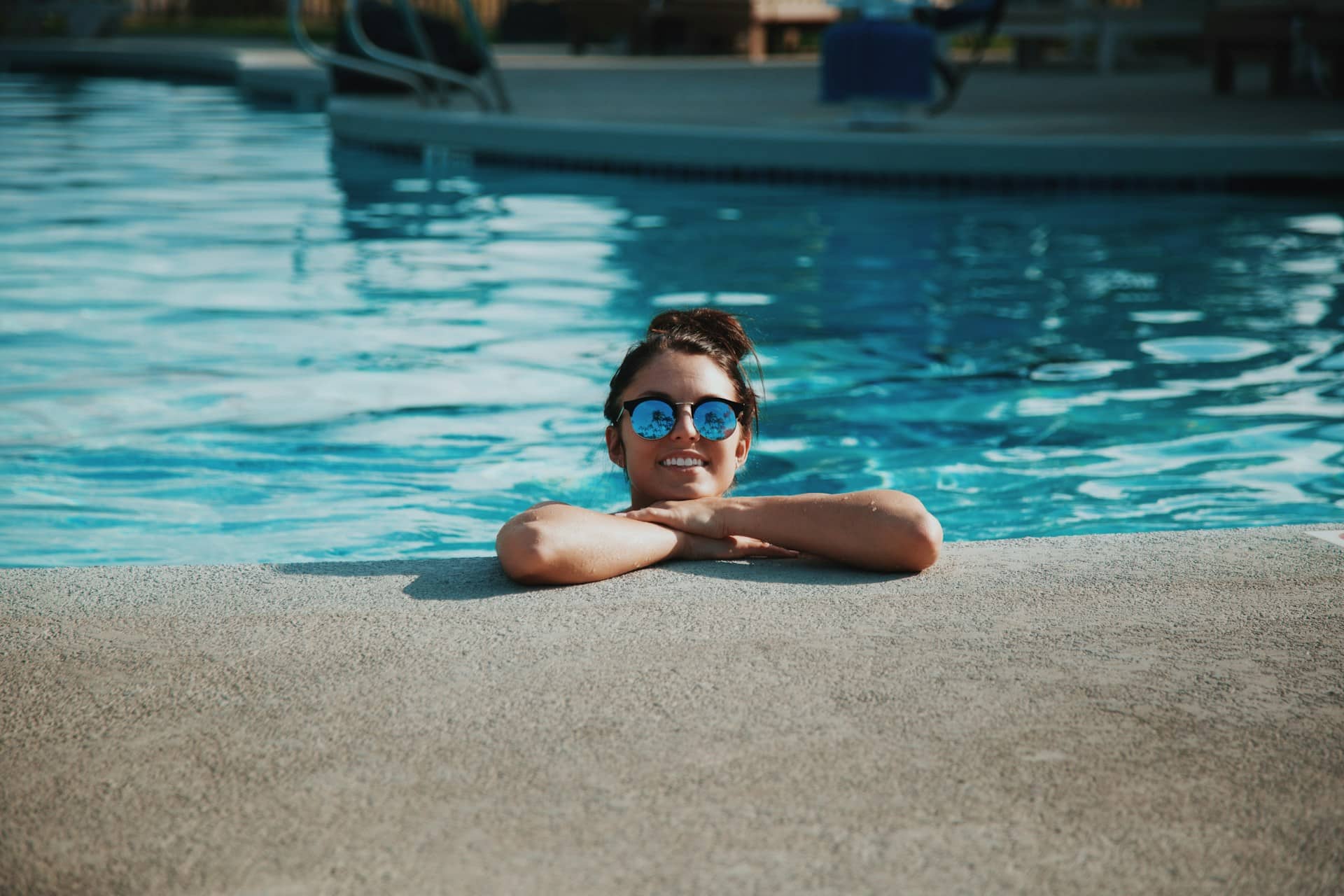
A woman in a swimming pool. Image credit: Conner Baker via Unsplash, free license
Drowning kills approximately 236,000 people each year, according to the World Health Organization. It ranks as the third leading cause of unintentional injury death worldwide and claims more children under five than almost any other preventable hazard. These deaths occur quickly and silently — nothing like the dramatic arm-waving depicted in films. Lifeguards, no matter how vigilant, struggle against water glare, blind spots, crowd density, and the simple limits of human attention.
Machine learning is now filling those gaps. Across pools, water parks, and open beaches in more than 16 countries, AI-powered camera systems watch swimmers in real time, recognize distress patterns invisible to the human eye, and push instant alerts to lifeguards’ smartwatches. The technology does not replace trained staff. It gives them what one Australian facilities coordinator described as “eyes in the back of their head.”
How AI Drowning Prevention Systems Work
Most AI-based pool safety platforms share a common architecture. Cameras — mounted overhead, on pool walls, or underwater — feed continuous video to computer vision software. Deep learning algorithms, often built on convolutional neural networks (CNNs) and object detection frameworks like YOLO (You Only Look Once), process each frame to track every person in the water. The software learns what normal swimming looks like: strokes, kicks, floating, playing. It also learns the signatures of trouble — prolonged submersion, sudden cessation of movement, erratic limb motion, or a body drifting motionless near the bottom.
When the system flags a potential drowning event, it generates an alert. That alert typically arrives on a lifeguard’s smartwatch within seconds, often accompanied by the swimmer’s location and a live image. Some platforms also trigger poolside alarms, flashing lights, and notifications to management consoles.
The critical advantage over traditional CCTV is interpretation. Standard security cameras record footage; they do not analyze it. AI adds a layer of continuous, tireless behavioral analysis that compensates for the visual challenges lifeguards face every shift — refraction distorting underwater views, sun glare bouncing off the surface, overlapping swimmers obscuring sightlines, and the sheer cognitive load of watching dozens of people at once.
Lynxight: The System Operating in 120 Australian Pools
Lynxight, founded in 2018 in Yokne’am Illit, Israel, has become one of the most widely deployed AI drowning prevention platforms in the world. The company’s software transforms standard CCTV cameras into intelligent monitoring tools by layering AI analytics on top of existing infrastructure. This approach eliminates the need for expensive underwater cameras at commercial facilities.
The system tracks multiple swimmers simultaneously across pools of different sizes. Deep learning algorithms classify swimmer behavior in real time and send tiered alerts — from elevated-attention warnings to emergency notifications — directly to lifeguards’ smartwatches and workstation screens. Royal Life Saving Australia (RLSA) entered a strategic collaboration with Lynxight in 2024, and the platform now runs across more than 120 public pools in Australia, including facilities managed by BlueFit, one of the country’s major aquatic operators.
Duncan Hutton, recreational facilities operations coordinator for the City of Stirling in Perth, has used Lynxight at the Stirling Leisure-Inglewood pool for over a year. “It gives them eyes in the back of their head,” he said. “This system is really a superpower and additional tool for our lifeguards — we’re not replacing anyone. You still need the lifeguard to actually respond to the incident.”
Real Rescues Enabled by AI Alerts
The Stirling pool system has already proved its value in a live emergency. Hutton described a scenario where a lifeguard received a smartwatch alert about a swimmer in distress. A member of the public reached the swimmer first, but the AI notification meant the lifeguard arrived seconds later with a full team response organized almost immediately.
An even more striking case occurred at a Sydney pool. RLSA’s RJ Houston recounted an incident where someone became trapped underneath a boom — a moveable bulkhead in the water. “The system alerted the lifeguard twice — the first time [they] had a look and they couldn’t see anyone and they walked away,” Houston said. The AI, analyzing multiple overhead camera angles, triggered a second alert. The lifeguard returned, located the submerged person, and pulled them out. “That’s an example where the human limitation of what we can see through refraction, through glare, through line of sight barriers are significant in these environments,” Houston explained.
Reducing Lifeguard Stress
RLSA research conducted in partnership with Lynxight has found measurable psychological benefits for lifeguards using the system. “We’re already finding from our research that lifeguards are finding that it’s easing their stress,” Houston said. “They have what we call chronic unease, where they come into work, and they’re constantly in a state of elevated stress because of the risk that someone could drown on that shift. And so having this extra layer of support, we’re already seeing … that lifeguards are feeling more confident, pool managers are feeling more confident, everyone is sleeping a little bit better at night the night before a shift.”
RLSA has developed a dedicated training program to accompany the technology rollout, specifically designed to prevent complacency and skill degradation among lifeguards who might otherwise begin deferring too much to the AI.
Coral Detection Systems: Underwater AI for Home Pools
While Lynxight targets commercial and public facilities, Israeli company Coral Detection Systems (now operating as Coral Smart Pool) has focused on residential pool safety since its founding in 2014. The company’s origin traces back to a personal tragedy: co-founder Eyal Golan created the business in memory of Coral Sheri, an 11-year-old who drowned alongside a friend in a private swimming pool in Savyon, Israel.
Coral’s flagship product, MYLO, uses both above-pool and underwater cameras — a setup the company claims is unique among residential pool safety devices. The device monitors the pool around the clock, using computer vision and proprietary AI algorithms to distinguish between normal activity and drowning risk. When MYLO detects danger, it triggers poolside alarms, an in-home alarm unit, and smartphone push notifications with real-time images.
The AI behind MYLO has been trained on hundreds of hours of real-world water distress footage and simulated drowning scenarios since 2018. The system identifies two primary drowning categories: incidents where a child or non-swimmer enters the pool unnoticed, and distress events that develop while someone is already swimming. That second category is what separates AI-powered systems from traditional pool alarms, which can only detect unauthorized entry.
In 2024, ASTM International published ASTM F3698-24, the first global standard specification for computer-vision drowning detection systems in residential pools. Coral Smart Pool has positioned MYLO as a benchmark product under this new standard.
The Broader Market: Key AI Drowning Prevention Companies
The AI drowning detection market has attracted a growing number of specialized firms, each approaching the problem from slightly different technological angles.
| Company | Founded | Headquarters | Primary Focus | Key Technology |
|---|---|---|---|---|
| Lynxight | 2018 | Yokne’am Illit, Israel | Commercial/public pools | AI overlay on existing CCTV; smartwatch alerts |
| Coral Smart Pool | 2014 | Haifa, Israel | Residential pools | Underwater + above-pool cameras (MYLO) |
| AngelEye | 2006 | Glendale, CA / Italy | Public pools, water parks | Patented underwater LED-camera units; 3D modeling |
| SwimEye | — | Stavanger, Norway | Public pools | Underwater camera with OpenPose body recognition |
| SightBit | 2018 | Israel | Beaches, open water | Camera-based rip current prediction; CNN object detection |
| LAIF (CIMNE) | — | Barcelona, Spain | Beaches, pools | Privacy-focused live streaming; 365-day monitoring |
| Poseidon | — | USA | Public pools | Dual camera system (wall + overhead); 10-second alarm trigger |
AngelEye, founded in Italy and now operating from both Europe and the US, takes a hardware-heavy approach. Its patented underwater cameras double as LED pool lights, making installation straightforward in facilities that already have underwater lighting fixtures. The software produces alarms within 10 seconds and delivers the swimmer’s exact position and a live image to lifeguards via smartwatch. AngelEye’s system follows ISO 20380:2017 guidelines for drowning detection and has been deployed extensively across European schools, municipalities, and water parks. Belgium’s LAGO group, which operates nine aquatic centers, uses AngelEye SplashDown across its facilities.
Norway’s SwimEye places cameras underwater and transmits captured images to a computer system running the OpenPose algorithm for human pose estimation. The software monitors body postures and flags struggling movements. When a swimmer appears to be in danger at the bottom of the pool, SwimEye triggers a yellow alert state; if the situation persists, it escalates to a red alarm sent directly to lifeguards.
AI on the Beach: Open-Water Monitoring
Pool environments are relatively controlled — clear water, known dimensions, fixed camera positions. Open water presents a much harder problem. Waves, currents, weather changes, vast distances, and unpredictable crowd distribution make beach monitoring exponentially more complex.
SightBit, founded in 2018 by graduates of Israel’s Ben-Gurion University, built its platform specifically for open-water environments. The system uses off-the-shelf cameras paired with deep learning algorithms trained on tens of thousands of beach images processed on NVIDIA GPUs. SightBit’s software can differentiate between children and adults, track swimmers across wide stretches of coastline, and detect dangerous rip currents using optical flow algorithms that calculate the acceleration vectors of water movement at the pixel level.
SightBit is now operational in the US, Canada, Australia, Israel, the UAE, and Brazil. The Israel Nature and Parks Authority deployed the system at Palmachim National Park, making it one of the first AI-monitored “smart beaches.” The platform provides a dashboard accessible on monitors, smartphones, and smartwatches, where lifeguards see real-time alerts — flashing boxes around individuals or hazards — and can click to zoom into specific incidents.
LAIF: Year-Round Beach Surveillance from Barcelona
LAIF, developed through collaboration between CIMNE (International Centre for Numerical Methods in Engineering) and Pro-activa Serveis Aquàtics with support from Catalonia’s ACCIÓ agency, takes a different approach to open-water AI. Currently in pilot operation at Castelldefels Beach near Barcelona, LAIF uses strategically positioned cameras to analyze swimmer behavior patterns and water conditions through continuous real-time processing.
A distinguishing feature of LAIF is its privacy-first design: cameras stream live video without recording, processing frames in real time and discarding them. The system can also detect medical emergencies — cardiac events, seizures — that produce atypical movement patterns rather than classic drowning behavior. LAIF is designed for autonomous operation using renewable energy sources, making it deployable in remote coastal areas where permanent lifeguard presence is not economically feasible. A second pilot at a Barcelona swimming pool launched in autumn 2025.
Wearables and Drones: Expanding the AI Safety Net
AI drowning prevention is not limited to fixed camera systems. Wearable technology and autonomous drones are adding new layers of protection, particularly for open-water swimmers.
Companies like Garmin and Suunto continue developing smartwatches and swim trackers that interpret biometric data — heart rate, body temperature, cardiac rhythm — using AI pattern recognition. Experimental platforms such as SAFER and Drowning Detection Systems (DDS) are being tested in Europe and the US, combining biometric monitoring with GPS location data to alert emergency services automatically when a swimmer shows signs of distress.
Drones equipped with AI image recognition offer another tool. They can scan for swimmers in trouble faster than rescue boats, cover areas beyond a lifeguard tower’s line of sight, and potentially drop flotation devices to people in danger before human rescuers arrive. SightBit has signaled interest in connecting its AI platform to rescue drones as a next-generation response capability.
Research from Taiwan’s National Health Research Institutes has explored wearable wristband devices that monitor blood pressure and heartbeat via Arduino microcontrollers, triggering inflatable safety airbags when drowning behavior is detected — similar in principle to automotive crash airbags. While these remain largely experimental, they demonstrate how embedded systems, IoT connectivity, and AI pattern analysis are converging around water safety.
The Over-Reliance Question
Not everyone views AI pool monitoring without reservations. Professor Paul Salmon of Australia’s University of the Sunshine Coast called the technology one of the “more positive uses of AI” but raised concerns about long-term consequences.
“I think there needs to be careful thought about how we manage some of those associated emergent risks as people increasingly use the technology,” he said. “So, you know, how are we going to prevent over-reliance on the technology? How are we going to prevent skill degradation in lifeguards, in detecting people who are drowning in a pool?”
The concern is not theoretical. In open-water contexts, the fear is that AI-driven safety devices could create a false sense of security, encouraging swimmers to venture out alone or into remote areas while trusting a gadget to summon help if something goes wrong. If the signal drops, the battery dies, or coverage is unavailable, technology cannot substitute for basic water safety principles.
Royal Life Saving Australia acknowledges this tension directly. The organization says it is committed to ensuring “appropriate systems in place so complacency doesn’t set in” and has built a national training program specifically to counterbalance the risk of skill erosion among lifeguards working alongside AI.
Market Growth and Regulatory Momentum
The drowning detection AI market is expanding rapidly. Industry estimates placed the global market at approximately $486.5 million in 2024, with projections reaching $1.55 billion by 2034 at a compound annual growth rate of 12.3%. North America accounts for about 38% of market revenue, followed by Europe at roughly 29% and Asia-Pacific at 25%.
Some European countries have begun mandating intelligent drowning prevention systems for public swimming facilities above certain capacity thresholds. The publication of ASTM F3698-24 in 2024 — the first residential pool AI detection standard — is likely to accelerate adoption in the US market as well. In April 2025, Fluidra, a global pool equipment manufacturer, invested in Lynxight, further mainstreaming the technology within the existing pool industry supply chain.
Australia’s trajectory suggests what broader adoption could look like. From initial trials at a handful of facilities, AI pool monitoring expanded to more than 120 public pools in under two years. RJ Houston of RLSA expects the technology to become the norm across Australian aquatic facilities, and the pattern of expansion is being replicated across Europe, the Middle East, and North America.
What AI Cannot Do in the Water
AI excels at continuous, tireless observation and rapid pattern matching across multiple camera feeds simultaneously. It can see through glare, compensate for refraction, and monitor dozens of swimmers at once — tasks that push human cognition to its limits. But there are clear boundaries.
No AI system can physically rescue a swimmer. Every platform currently deployed is designed to reduce detection time and accelerate human response, not replace it. The technology also struggles in certain conditions: extreme crowd density where swimmers overlap extensively, turbid or heavily churned water in wave pools and surf zones, and environments where camera angles or lighting create persistent blind spots.
For open-water swimming, the technology remains most effective in monitored beach zones with camera infrastructure. A solo swimmer in a remote lake or offshore ocean environment is still largely beyond the reach of today’s AI surveillance, unless wearing a biometric device connected to emergency networks — and those systems remain early-stage.
As endurance swimmer and journalist Ben Hooper put it, AI “may never feel the calm weightlessness of swimming beneath a blood red sky.” Its purpose in the water is different: to watch, to learn, and to ensure more people get to experience those moments safely. The magic of swimming remains human. The job of keeping swimmers alive is increasingly shared with machines that never blink.
If you are interested in this topic, we suggest you check our articles:
- AI in Cybersecurity: How It Works to Increase Our Safety
- How AI is Improving the Quality of Pilot Training
- Managing AI risk in day-to-day decision-making
Sources: ABC News, CIMNE, PubMed, The European
Written by Alius Noreika