The meeting point of artificial intelligence (AI) and architecture is beginning to reshape the way we imagine, design, and manage cities. No longer limited to experimental prototypes, AI tools are entering professional practice, helping architects and urban planners test structural ideas, evaluate environmental impacts, and even forecast the social life of neighborhoods. The promise of this technology is not only efficiency but a deeper capacity to model and respond to the complex challenges that define urban life in the 21st century.
Smart Cities and Urban Morphology
In the realm of AI architecture, one of the most striking examples comes from researchers at Tsinghua University in China. Their AI-based system was tasked with producing design layouts aligned with the “15-minute city” model, an urban concept that emphasizes local access to schools, green spaces, and services. Trained on data from human-created plans, the system produced layouts that were judged equal to—or in some cases superior to—those made by experienced planners. The work took seconds rather than weeks, underscoring how AI smart city models may change the pace of urban design.
Private companies are also moving in this direction. Singapore-based Digital Blue Foam has developed Urban Insights, a platform that compiles data from open sources to allow teams to generate and compare design scenarios. Collaborations with urban theorists and universities ensure that these digital tools are rooted in practical and scientific frameworks. Their appeal lies in agility: the ability to test multiple outcomes without committing significant resources before the first brick is laid. AI smart city models can greatly influence urban planning by boosting efficiency.
Another approach, known as “digital twins”, creates virtual replicas of entire cities. These living simulations allow planners to test new developments, transportation networks, or climate strategies while observing their effects in real time. Wellington, New Zealand, and Shanghai are among the cities already deploying such systems, offering a glimpse of how AI might guide long-term growth without guesswork.
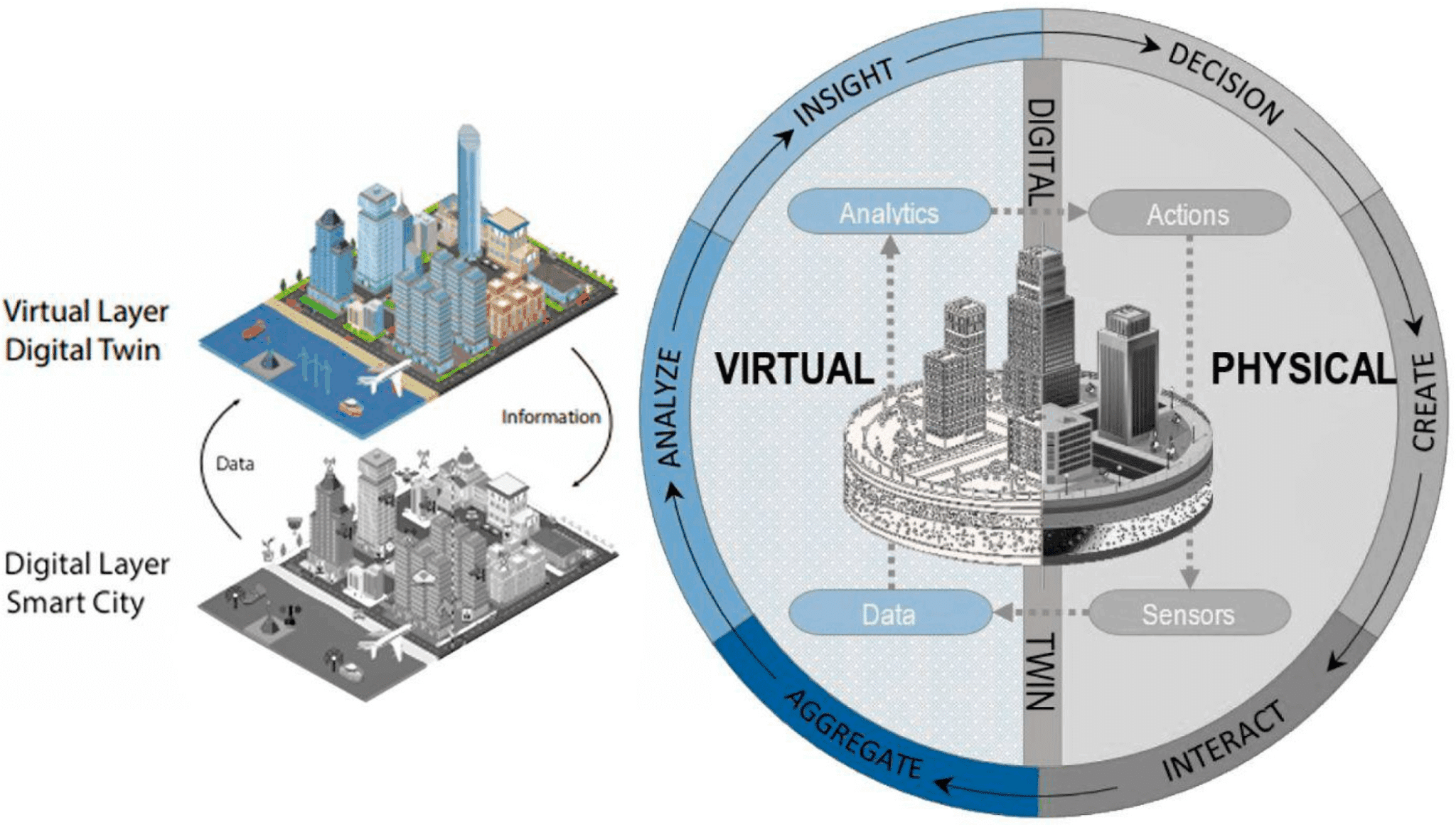
Digital twin. Image source: Mdpi
Climate Adaptation and Resilience
As the effects of climate change grow harder to ignore, AI tools are also being used to strengthen resilience. Google’s Tree Canopy tool, for example, merges AI with aerial imagery to map shade coverage in urban neighborhoods. The data helps municipalities address heat vulnerability, guiding tree planting in areas most at risk during summer heat waves.
Researchers at IBM are taking this further by quantifying carbon storage within urban trees. By analyzing species type, geometry, and foliage density, they have calculated that Manhattan’s trees store roughly 52,000 tons of carbon. This information is more than an academic exercise: it shapes strategies for integrating vegetation into dense city centers where environmental gains must be balanced against space and cost.
Infrastructure and Housing
AI’s capacity to process aerial imagery and detect irregularities has also been applied to pressing social issues. In Colombia, the National Planning Department piloted a project that combined AI-driven mapping with urban diagnostics to locate informal settlements. Algorithms correctly identified areas later confirmed by human experts with an 85 percent overlap. From this came MAIIA, an open-source software tool designed to help cities map housing needs and inform policy decisions with greater speed and precision.
Community and Participation
AI is not only about technical optimization; it can also serve as a bridge between planners and residents. Tools using virtual or augmented reality allow communities to visualize proposed changes to their neighborhoods and give feedback before construction begins. Elsewhere, AI systems monitor traffic flow, suggest safer walking routes, or evaluate public lighting—everyday elements of urban life that influence a community’s sense of security and accessibility.
The Architectural Profession at a Crossroads
The Royal Institute of British Architects (RIBA) recently reported that 41 percent of practices in the U.K. are already experimenting with AI tools. Many firms use them for visualization, concept design, or drafting client reports. Larger firms with research budgets are training algorithms on their own design archives, aiming to streamline workflows while retaining stylistic identity.
Yet questions remain. Data privacy, accountability, and authorship are unresolved issues, as is the concern over whether AI might deskill certain aspects of practice. For now, AI is best viewed as a decision-support system—powerful in its ability to surface patterns and possibilities but not yet a replacement for human judgment.
Looking Ahead
The integration of AI in urban planning and architecture is neither straightforward nor uniform. Progress depends on reliable data, strong governance, and inclusive collaboration between technologists, policymakers, and citizens. If these conditions are met, AI smart city models could help cities balance efficiency with livability, offering new ways to address climate adaptation, housing pressures, and community engagement.
In the end, the future of AI in architecture is less about replacing human expertise and more about extending it. As practices test tools for smart infrastructure, design ideation, and structural analysis, the emerging question is not whether AI will reshape our cities, but how deliberately and responsibly it will be used to do so.
Sources: Archdaily, Architecture