Key Takeaways
- American Airlines’ Smart Gating system at Dallas Fort Worth reduced aircraft taxi times by 20% and completes gate assignments in 10 minutes instead of four hours.
- Zurich-based Assaia has deployed AI turnaround monitoring at roughly 1,500 gates worldwide, helping Alaska Airlines cut turn times by 12% at Seattle-Tacoma.
- AI-powered CT scanners create 3D images of carry-on bags, eliminating the need to remove laptops and liquids — the EU mandated phased adoption by 2025.
- Queenstown Airport uses LiDAR-based passenger flow tracking across five departure zones, monitoring congestion without capturing personal data.
- Lufthansa Industry Solutions reports that quantum-optimized gate assignment simulations reduced average passenger transit times by nearly 50% compared to real-world data.
- Global passenger traffic is forecast to reach 10.2 billion in 2026, intensifying pressure on airport infrastructure.
- Biometric facial recognition systems at Dubai International Airport can clear immigration in seconds, while TSA has installed over 1,016 CT scanners at 278 U.S. airports.
- AI-driven turnaround platforms save airlines approximately $100 per minute on each aircraft turn.

Passenger at an airport – illustrative photo. Image credit: Jeshoots via Unsplash, free license
Airports around the world are deploying artificial intelligence to attack the problem that frustrates passengers most: waiting. From gate allocation and security checkpoints to baggage tracking and delay prediction, machine learning systems are producing measurable reductions in queue times at facilities handling billions of travelers per year. With global air passenger traffic projected to hit 10.2 billion in 2026, according to Airport Council International data, the pressure on legacy infrastructure has pushed AI from experimental pilot programs into core operations.
The results are already quantifiable. American Airlines’ Smart Gating platform assigns gates in 10 minutes — a task that previously took staff four hours using a legacy computer system. Alaska Airlines trimmed turn times by 12% at Seattle-Tacoma through AI camera analytics. And CT scanners with AI-driven threat detection are eliminating the security checkpoint ritual of unpacking laptops and liquids, cutting screening queue times at airports across the EU and the United States.
Smart Gate Allocation: From 570 Billion Possibilities to 10-Minute Decisions
Gate allocation sits at the heart of airport efficiency, yet the process has remained surprisingly manual. An AeroCloud survey of senior airport executives found that 40% still relied on Excel and Word documents to manage airport operations, including gate assignments.
The math explains why the task is so difficult. “With 15 gates and 10 airplanes, there are more than 570 billion possibilities,” says Dr. Joseph Doetsch, quantum computing lead at Lufthansa Industry Solutions. Factors include carrier lounge proximity, connecting passenger volumes, aircraft type, runway assignment, ground staffing, and the scheduled movements of every other aircraft on the tarmac. Budget carriers may opt for cheaper remote stands, while airlines with frequent connections demand gates that minimize transfer times.
Traditionally, schedules are set up to a year in advance, then revised at one month, one week, and finally on the day of departure. Delayed flights trigger last-minute reassignments that cascade through the entire gate plan.
American Airlines tackled this directly. In 2024, the airline introduced Smart Gating at Dallas Fort Worth International Airport, its largest hub. The machine learning system ingests real-time flight data to assign each arriving aircraft to the nearest available gate with the shortest taxi distance. “Traditionally, our team members manually assigned gates using a legacy computer system. At Dallas Fort Worth International Airport, our largest hub, this process took around four hours to complete,” an American Airlines spokesperson said. The automated system completes the task in 10 minutes, shortening taxi times by 20% and saving approximately 1.4 million gallons of jet fuel annually.
Quantum Computing and the Next Step in Gate Optimization
Lufthansa Industry Solutions is exploring quantum computing to push gate optimization further. Classical computers struggle with combinatorial problems of this scale — calculation times grow disproportionately as the number of variables increases. Quantum algorithms use the properties of qubits to evaluate vast solution spaces simultaneously.
“Quantum algorithms will allow optimally assigning gates, and other resources, even in large airports and travel networks. These algorithms will be able to respond to changing external factors with updated optimal solutions in real time,” Dr. Doetsch says.
Early simulations are promising. “In our first trials, our optimised solutions could reduce average transit times for passengers by almost 50% compared to the corresponding real-world data,” he adds. Lufthansa is currently evaluating which quantum computing hardware will best suit operational deployment.
George Richardson, co-founder of airport management firm AeroCloud, sees these technologies as essential to avoid costly physical expansion. “Capacity is a big issue for many airports, and even if they wanted to introduce new carriers or destinations, physical expansion acts as a blocker. They need to make the optimum use of their current resources.”
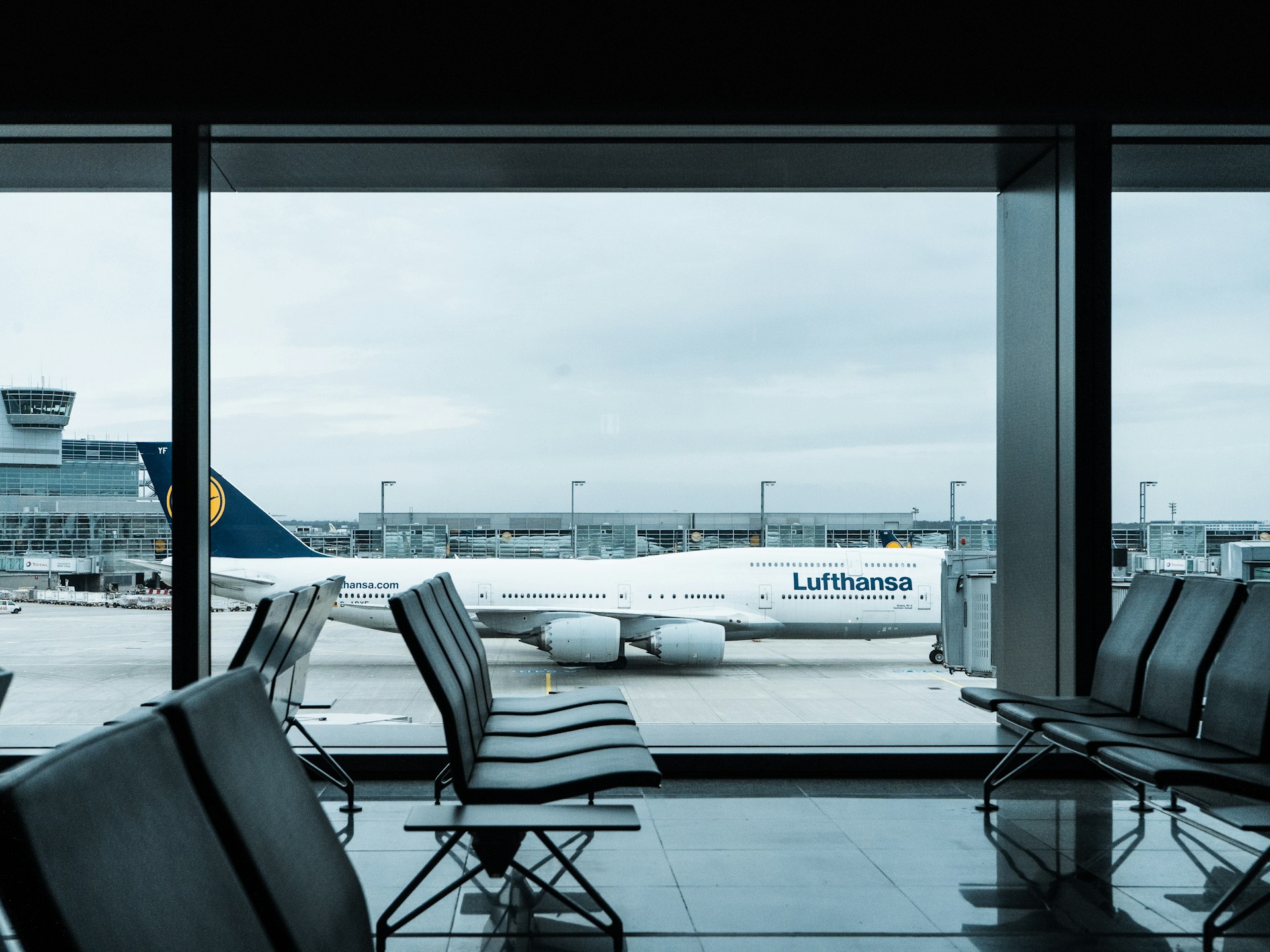
A Lufthansa airplane seen through an airport windows. Image credit: Dennis Gecaj via Unsplash, free license
AI-Powered Turnaround Monitoring: Cameras That Track Every Ramp Task
The time an aircraft spends at a gate between arrival and departure — known as turn time — directly affects airline punctuality, fuel costs, and passenger satisfaction. Three technology companies now dominate the emerging market for AI-driven turnaround monitoring: Zurich-based Assaia, Miami-based Synaptic Aviation, and Royal Schiphol Group (owner of Amsterdam Schiphol Airport).
| Company | Gates Deployed | Key Metric | Airport/Airline |
|---|---|---|---|
| Assaia | ~1,500 worldwide | 12% reduction in turn times | Alaska Airlines, Seattle-Tacoma |
| Synaptic Aviation | ~1,000 worldwide | 75% fewer gate-wait delays | Spirit Airlines |
| Royal Schiphol Group | Schiphol Airport | 25% fewer last-minute gate changes | Amsterdam Schiphol |
These platforms repurpose existing gate cameras. AI object-detection algorithms monitor and timestamp dozens of individual ramp tasks — fueling, catering, cleaning, baggage loading — and compare actual progress against the optimal turnaround schedule. Synaptic Aviation’s system recognizes 32 distinct ramp objects, from belt loaders to power systems, converting camera feeds into real-time data streams analyzed by machine learning.
“We know when things are meant to happen. We know when the catering truck should arrive if you want to have a perfect turnaround,” says Sal Salman, Synaptic Aviation’s president and chief technology officer.
When a task falls behind, the system estimates how late the departure will be and flags the delay in real time. By combining turnaround estimates with incoming aircraft arrival data, airlines can reassign gates proactively and release aircraft waiting on the airfield with greater precision. At Seattle-Tacoma, the Assaia tool produced a 17% reduction in excess hold time for arriving aircraft.
Tim Toerber, Assaia’s president of the Americas, puts a price on the efficiency gains: approximately $100 saved per minute on each turn. “You can only manage what you measure,” he said at the Future Travel Experience conference in September 2025. “Now that we’re measuring all of these activities, airlines can manage this to a more nominal value so they can reduce the overall turn time.”
Airlines also use the stored data to identify which portions of turnarounds are most frequently delayed, set performance-based contracts with ground-handling contractors, and hold ramp crews accountable. Breeze CEO David Neeleman noted his interest in the technology for safety oversight: “You have a lot of inexperienced people with high turnover on ground crews, and you have to keep them accountable. It’s not just recording, but it’s also logging everything that happens, so you can flag outliers.”
Not all analysts are convinced. Aviation industry analyst Bob Mann of R.W. Mann & Co. called such tools “expensive Band-Aids,” arguing that deeper improvements would come from better flow management — coordinating operations from pushback at one airport to arrival at the next. “That’s more deterministic,” Mann said. “The problem is when everybody needs a fuel truck, everybody needs a fuel truck. There are only so many fuel trucks. There are only so many catering trucks.”
Security Screening: CT Scanners and AI Threat Detection
The security checkpoint has long been the single greatest source of airport delays for passengers. Two technologies are converging to change that: computed tomography (CT) scanners and AI-driven threat detection algorithms.
CT scanners generate 3D images of carry-on luggage, allowing security operators to inspect bags from every angle. The practical benefit for travelers is immediate — passengers no longer need to remove laptops, liquids, or electronics from their bags. Automated object-recognition software flags potential threats, reducing false alarms and the need for manual bag searches.
The TSA has installed over 1,016 CT scanners at 278 U.S. airports as of 2025, covering roughly 35% of its long-term deployment target. The EU set a 2025 deadline for mandatory CT scanner implementation. In Milan, CT scanners halved waiting times and doubled passenger throughput during trials. Hong Kong achieved a 50% efficiency increase in its own testing.
AI adds another layer. Companies like BigBear.ai have partnered with scanner manufacturers such as Analogic to integrate AI-powered threat detection directly into CT screening workflows. The algorithms process images in real time, distinguishing harmless items from prohibited objects with fewer false positives than human-only screening. ScanTech AI, a Nasdaq-listed company, has developed fixed-gantry CT screening with proprietary machine learning that automatically locates and identifies threat materials.
Biometric facial recognition is accelerating the check-in and boarding process at the other end of the terminal. Dubai International Airport launched an AI-powered passenger corridor that scans and verifies identities in seconds. In Europe, Zurich Airport deployed the EU Entry/Exit System in November 2025, using biometric facial capture with self-service kiosks so travelers can enter identity data in advance. TSA, in partnership with CLEAR, began piloting biometric eGates at Atlanta, Washington D.C., and Seattle-Tacoma airports in August 2025.
Passenger Flow Management: Predicting Congestion Before It Forms
AI analytics platforms are shifting airports from reactive crowd management to predictive operations. By analyzing flight schedules, booking data, historical traffic patterns, and real-time security wait times, these systems forecast bottlenecks at checkpoints, immigration desks, and boarding gates before congestion develops.
Queenstown Airport in New Zealand offers a privacy-conscious model. The airport deployed an AI-powered LiDAR system across five departure areas. Instead of cameras, LiDAR sensors build anonymized 3D “point clouds” that represent passengers as dots rather than faces. The system provides real-time data on queue performance, occupancy levels, and predicted congestion — all without capturing identifiable images. Airport staff can respond proactively, opening new screening lanes or redirecting passengers before queues form.
Copenhagen Optimization’s Better Airport platform takes a data-integration approach, combining passenger forecasting, baggage volume predictions, and resource scheduling across the entire terminal workflow from check-in to baggage reclaim.
For travelers, AI-powered airport apps are becoming digital guides. Applications can deliver real-time gate updates, estimated walking times, and the fastest routes to destinations within the terminal. Dallas/Fort Worth Airport has explored AI-powered digital concierges that answer passenger questions by voice in multiple languages.
AI also generates revenue for airports. By analyzing traveler preferences and real-time location data (through systems like Real-Time Location Systems — RTLS), airports can deliver targeted retail and dining promotions. Passengers who spend less time in queues have more time in shops and lounges, and personalized offers increase the likelihood of purchases — directly boosting non-aeronautical revenue.
Predictive Delay Management and Operations Behind the Scenes
AI excels at processing the massive data streams that determine whether flights depart on time. Systems analyze weather patterns, air traffic data, historical flight records, and ground operations to forecast disruptions and provide airlines with advance warning.
Royal Schiphol Group’s in-house AI platform uses predictive modeling to reduce last-minute gate changes by 25%, producing an overall on-time performance improvement of 1 percentage point — a meaningful gain at one of Europe’s busiest airports.
Behind the terminal walls, AI handles predictive maintenance for critical infrastructure. Escalators, baggage carousels, people movers, and jet bridges are monitored for signs of impending failure. Airports using drones paired with computer-vision systems can detect foreign object debris on runways and alert ground crews before it damages aircraft engines.
Energy management is another target. AI systems adjust heating, cooling, and lighting in terminal buildings based on real-time passenger density, cutting energy consumption during low-traffic periods and scaling up before peak-hour surges.
The Infrastructure Question: Why On-Premise Computing Matters
Many airport AI applications demand processing speeds that cloud computing alone cannot deliver. Facial recognition at a checkpoint, real-time threat detection from surveillance feeds, and instant turnaround alerts all require sub-second response times. Sending data to a remote cloud server and waiting for a response introduces latency that can create bottlenecks or compromise safety.
| Factor | On-Premise/Edge Computing | Cloud Computing |
|---|---|---|
| Latency | Sub-second processing at the source | Network transit adds delay |
| Data sovereignty | Meets strict GDPR and aviation data residency rules | Requires careful jurisdiction management |
| Resilience | Operates during network outages | Dependent on external connectivity |
| High-volume data cost | Processes locally, sends only insights to cloud | Continuous upload of surveillance/IoT feeds is expensive |
| Scalability | Hardware investment required | Flexible and on-demand |
Airport data — biometric scans, surveillance footage, operational control feeds — is highly sensitive and subject to strict regulatory compliance requirements. Processing this data on-premise gives airports greater control over security and helps meet data sovereignty mandates under regulations like GDPR. For applications generating massive data volumes, such as continuous video surveillance or IoT sensor networks, local edge processing filters and aggregates information before sending only relevant insights to the cloud.
What Comes Next
The smart airport systems market is projected to reach $14.91 billion by 2030, growing at a compound annual growth rate of 13.1%, according to Next Move Strategy Consulting. The airport systems market more broadly is forecast to expand from $32.28 billion in 2024 to $50.27 billion by 2030.
Airlines and airports that have not adopted AI-first strategies will find it increasingly difficult to manage rising passenger volumes with legacy tools. The transition from experimental pilots to full operational deployment is accelerating across every layer of airport operations — from the moment a passenger enters the terminal to the second an aircraft pushes back from the gate.
The technology is not about replacing human workers. AI handles routine, data-intensive tasks so that airport staff can focus on complex decision-making and direct passenger service. The airport of 2026 is a partnership between trained personnel and intelligent systems, each handling what they do best.
If you are interested in this topic, we suggest you check our articles:
- AI in the Travel Industry: A Shake-up in Tourism
- Autonomous Ride-Hailing: The Collaboration Between Waymo and Uber
- 10 of the Best AI Applications in Hospitality
Sources: BBC, Cisco, Global Aerospace, Travel Weekly
Written by Alius Noreika