Key Takeaways
- Four AI giants lead the field: Google and IBM on superconducting qubits, Microsoft on topological qubits, and Amazon on error-correcting cat qubits.
- IBM is the scale and ecosystem leader, running the largest quantum cloud, the Qiskit software stack, and a detailed roadmap toward a fault-tolerant machine by 2029.
- Google set the research pace: its Willow chip showed below-threshold error correction, and in October 2025 its Quantum Echoes result claimed the first verifiable quantum advantage, about 13,000 times faster than a top supercomputer on a specific task.
- Microsoft is making the highest-risk, highest-reward bet with Majorana 1, the first processor built on topological qubits.
- Amazon’s Ocelot prototype uses cat qubits to cut error-correction overhead by up to 90%, aiming to make quantum another AWS cloud service.
- Nvidia leads the connective layer with its CUDA-Q software, positioning its GPUs to bridge classical and quantum systems whoever wins the hardware.
- Practical, broad quantum advantage is still years away; most experts place useful, fault-tolerant systems around 2029 to the early 2030s.
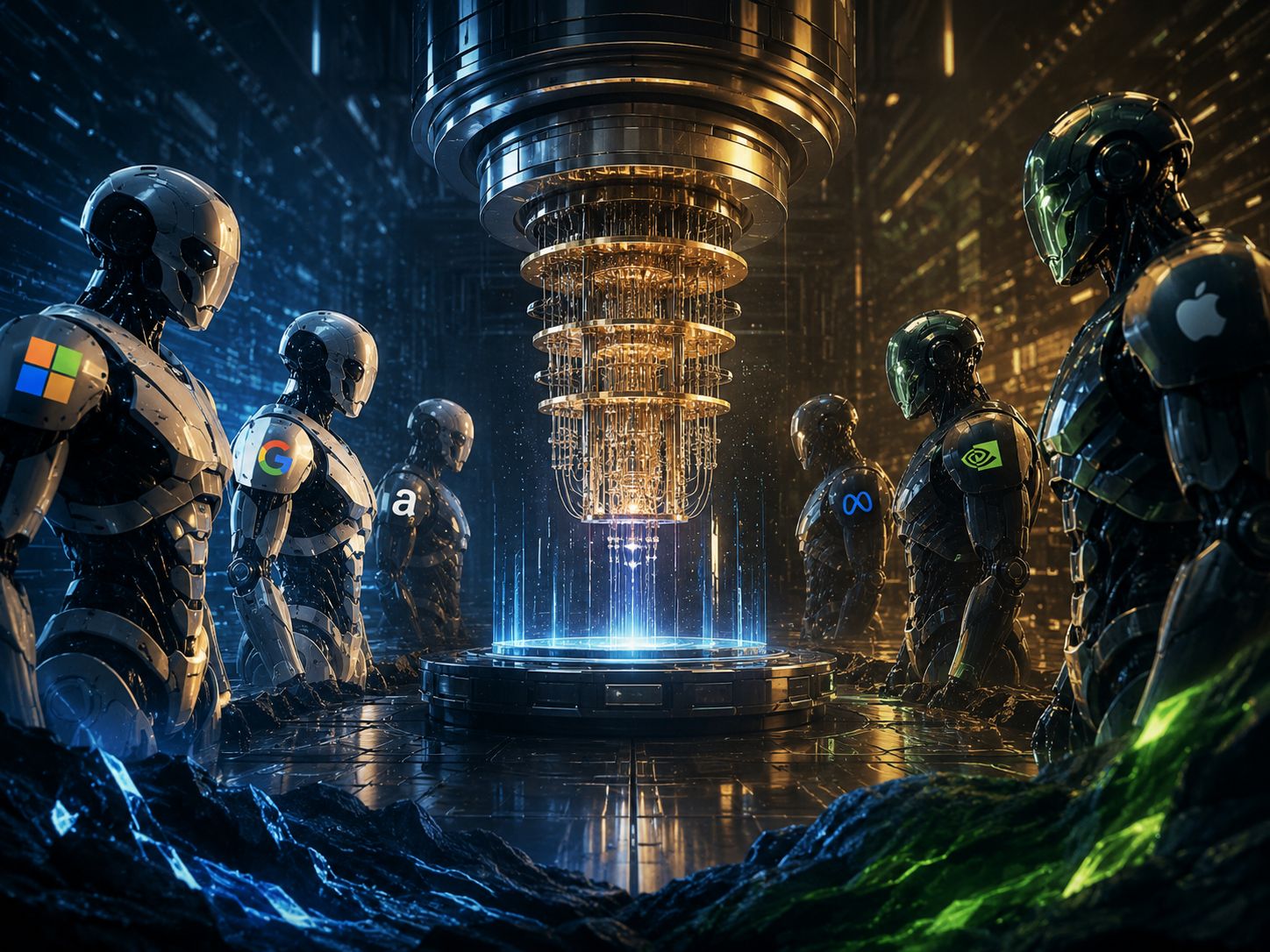
AI giants competing in quantum computing – artistic impression. Image credit: Alius Noreika / AI
The AI giants leading on quantum computing are Google, IBM, Microsoft and Amazon, with Nvidia sitting one layer down as the company that connects quantum machines to classical ones. Each has shipped a real, physical processor built on a distinct architecture, and each treats quantum as the natural extension of the compute empire it already runs for artificial intelligence. IBM leads on scale and ecosystem, Google on error-correction science, Microsoft on an exotic new qubit, and Amazon on folding quantum into its cloud.
None of them has a commercially useful, general-purpose quantum computer yet, and that matters for reading the headlines correctly. The recent milestones are genuine scientific progress on narrow problems, not the arrival of machines that break encryption or replace GPUs. The race is over who reaches fault tolerance first, and the credible timelines run from 2029 into the early 2030s. This convergence of AI and quantum is one we examine in our piece on where AI meets quantum computing.
IBM: The Scale and Ecosystem Leader
IBM runs the largest fleet of superconducting processors and the most-used quantum cloud, anchored by the open-source Qiskit stack and the IBM Quantum Network of hundreds of partners. Its late-2025 Nighthawk processor uses 120 qubits and 218 tunable couplers in a square lattice, allowing circuits roughly 30% more complex than the earlier Heron family and up to 5,000 two-qubit gates per job. Alongside it, the experimental Loon chip validates the components needed for fault tolerance on a single die. IBM’s roadmap is unusually specific: quantum advantage in a useful computation targeted for the end of 2026, rising gate counts through 2028, and a large fault-tolerant machine called Starling by 2029.
Google: The Research Frontier
Google Quantum AI sets much of the field’s research agenda. Its Willow processor was the first to show error rates falling as a surface-code patch grows — the below-threshold milestone that decades of theory had demanded. Then, on October 22, 2025, the team reported the first verifiable quantum advantage on real hardware: its 105-qubit Willow chip ran the Quantum Echoes algorithm about 13,000 times faster than a leading supercomputer on a specific problem, and, crucially, the result could be checked on a second quantum device. Google frames this as an early step with genuine scientific value in chemistry and materials, not a finished commercial product.
Microsoft: The Boldest Architecture Bet
Microsoft is chasing a different physics entirely. Its Majorana 1 processor, introduced in early 2025, is built on topological qubits made from Majorana quasiparticles and a novel material the company calls a topoconductor. The appeal is inherent stability: information encoded in the global properties of the system resists the noise that plagues ordinary qubits. The risk is that the approach is the least mature of the four. If topological qubits reach viability, Azure could leapfrog rivals on reliability; if they do not, the bet costs years. Microsoft pairs the hardware bet with Azure Quantum, a multi-hardware cloud platform that already offers partners’ machines.
Amazon: Quantum as a Cloud Service
Amazon’s Ocelot, developed at its quantum center at Caltech, is a proof-of-principle chip that combines cat qubits and transmon qubits to build error correction into the design rather than bolting it on afterward. Amazon says the approach cuts error-correction overhead by up to 90% and could shorten the path to scalable machines. The strategic logic is pure AWS: quantum becomes another service inside Braket, with Amazon controlling both the marketplace and, increasingly, the hardware beneath it — the same playbook it ran for classical cloud.
| Company | Flagship chip | Qubit approach | Standout milestone |
|---|---|---|---|
| IBM | Nighthawk / Loon | Superconducting transmon | Largest quantum cloud; 2029 fault-tolerance target |
| Willow | Superconducting transmon | Below-threshold error correction; verifiable quantum advantage | |
| Microsoft | Majorana 1 | Topological (Majorana) | First topological quantum processor |
| Amazon | Ocelot | Cat + transmon qubits | Error-correction overhead cut up to 90% |
| Nvidia | CUDA-Q (software) | Hybrid classical-quantum | Bridges GPUs to quantum hardware |
Nvidia: The Connective Tissue
Nvidia does not build qubits, but it may benefit whoever wins. Its CUDA-Q software links GPUs to quantum processors in a hybrid model, where classical accelerators handle the heavy pre- and post-processing around a quantum core. Because most useful near-term quantum work is hybrid, Nvidia’s hardware and tooling sit in the middle of nearly every serious effort — an echo of how its GPUs became the default substrate for AI. The company’s broader compute ambitions are covered in our look at Nvidia’s Blackwell Ultra and Vera Rubin platforms.
Why the Giants Are All In
The pull is the same one that drives their AI investments: whoever controls the next computing substrate controls the cloud economy built on top of it. Quantum promises breakthroughs in drug discovery, materials science, logistics and optimization that classical machines struggle with, and the same energy pressures now shaping AI make more efficient computing paradigms attractive — a theme we cover in our article on how much electrical power AI requires. For now, quantum and AI advance in parallel, with the giants racing to own both.
How to Read the Race in 2026
Rank the leaders by what you value. For enterprise readiness and ecosystem, IBM is the safest bet. For raw experimental achievement, Google is unmatched. For a high-upside architectural gamble, Microsoft. For cloud integration, Amazon. And for the connective software that all of them rely on, Nvidia.
Broad, practical quantum advantage remains years out, so the meaningful contest is over who reaches reliable, error-corrected machines first — and on current roadmaps, that verdict lands around the end of the decade. For a sense of how today’s models handle technical tasks in the meantime, see our comparison of which LLM best answers user queries.
Milestones are related to announcements from late 2024 through mid-2026. Quantum timelines shift as new results arrive, and claims of “advantage” apply to narrow problems rather than general computing. This is informational, not investment advice.
If you are interested in this topic, we suggest you check our articles:
- AI Meets Quantum Computing: Revolutionary Tech Convergence
- Nvidia’s Blackwell Ultra GB300 and Vera Rubin
- How Much Electrical Power Does AI Require?
- Which LLM Is Best? 2025 Comparison Guide
- xAI vs OpenAI vs Anthropic: Which AI Lab Wins in 2026?
Sources: Quantum Zeitgeist, TechDogs, The Quantum Bull, Quantum Security Defence, Advisor Perspectives, IBM roadmap coverage
Written by Alius Noreika