Key Takeaways
- Gamification supplies the raw behavioural data — timing, risk-taking, error correction, persistence — and AI turns that data into a ranked shortlist.
- Recruiting is the highest-adoption AI function inside HR at 27%, according to SHRM’s survey of 1,722 HR professionals conducted in December 2025.
- The same survey found 54% of organisations have not adopted AI in HR at all and have no plans to, so this remains a minority practice.
- A meta-analysis of 44 studies and 6,139 adults found game-related assessments correlate with traditional cognitive ability tests at r = 0.30, rising to r = 0.45 when corrected for unreliability.
- That correlation is moderate, which means games measure something related to cognitive ability but not identical to it.
- New York City’s Local Law 144 requires annual bias audits, published summaries and candidate notice — but a state audit found the city took no enforcement action and missed most likely violations.
- EU rules for high-risk recruitment AI were pushed from 2 August 2026 to 2 December 2027 by the Digital Omnibus, while transparency duties under Article 50 still began in August 2026.
- Adaptive difficulty is the newest use: the AI changes the game in real time based on how the candidate is performing.
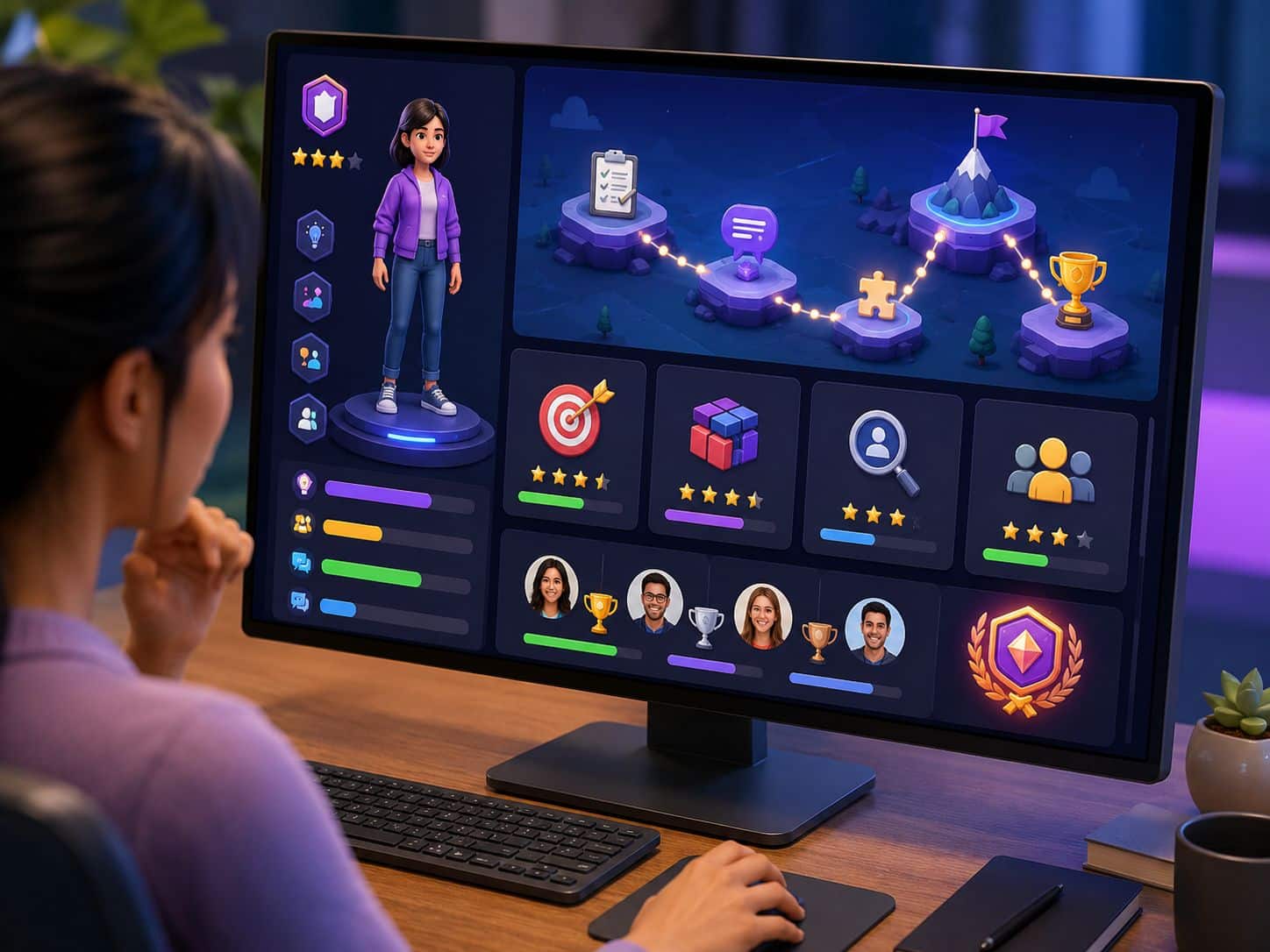
Gamified candidate assessment in recruitment – artistic impression. Image source Alius Noreika / AI
In modern recruitment, gamification and AI perform two halves of one job. The game collects behaviour that a CV cannot show — how quickly someone adjusts after a mistake, whether they gamble or hedge under time pressure, how they allocate attention when the rules change midway. The AI reads thousands of those micro-decisions, compares them against patterns drawn from existing high performers, and produces a score or a ranking. Neither half is useful alone: a game without analysis is entertainment, and an algorithm without behavioural input is just keyword matching on a résumé.
Three specific pairings dominate. AI scores game output against a role-specific model, which is the mainstream use. AI adjusts difficulty during play, presenting harder scenarios when a candidate performs well so the assessment finds their ceiling rather than their pass mark. And AI generates immediate feedback, which changes gamified assessment from a filter the candidate endures into something they get value from whether or not they are hired.
What Gamified Assessment Actually Measures
The games themselves are short, abstract and deliberately unfamiliar. A candidate might inflate balloons for points while deciding when to bank them, sort shapes under changing rules, or manage a fictional inventory against a countdown. Because almost nobody has practised these tasks, prior exposure matters less than it does with conventional aptitude tests.
What the platform records is not the score. It is the trace: reaction latency, consistency across trials, response to negative feedback, willingness to take risk after a loss, and how strategy changes when the environment shifts. Those traces map onto constructs that occupational psychologists have measured for decades — processing speed, working memory, risk tolerance, learning agility — but they are captured passively rather than through self-report.
| Game mechanic | Behaviour captured | What the AI does with it |
|---|---|---|
| Timed decision tasks | Processing speed, accuracy trade-off | Benchmarks against role-specific performance profiles |
| Risk and reward choices | Risk appetite, loss response | Flags fit for sales, trading or compliance-heavy roles |
| Rule-change scenarios | Learning agility, adaptability | Predicts performance in fast-changing teams |
| Job simulations | Domain judgement, prioritisation | Scores decisions against expert-rated answers |
| Coding challenges | Technical skill, debugging approach | Evaluates correctness, efficiency and process, not just output |
Who Is Doing This in Practice
Marriott International built a virtual hotel management simulation that tests industry knowledge and problem-solving in a setting candidates recognise. Domino’s used an interactive pizza-making app and made offers based on performance. British intelligence recruiters have used code-cracking puzzles to surface people who think clearly under pressure, reaching candidates who would never have applied through a job board.
Unilever’s graduate programme is the most-studied example, pairing behavioural games with recorded digital interviews and a final assessment centre. The company has reported large reductions in time-to-hire — from months to weeks — along with a broader applicant pool, though these are employer-published figures rather than independently audited results. The wider shift is described in more depth in this guide to how the AI hiring process changes talent acquisition.
Does the Evidence Support It?
Partly, and the honest answer is more useful than the marketing one. A 2024 meta-analysis pooling 52 independent samples from 44 studies, covering 807 correlation coefficients and 6,139 adult participants, found that game-related assessments correlate with traditional cognitive ability measures at r = 0.30, with a 95% confidence interval of 0.26 to 0.34. Corrected for measurement unreliability, that rises to r = 0.45.
The relationship strengthened when multiple ability tests were used (r = 0.39 versus r = 0.28 for a single test) and when multiple game indicators were combined (r = 0.38 versus r = 0.29). The authors’ conclusion is the important part: the effect size “raises questions about whether GRAs and traditional measures capture the same aspects of cognitive ability or if GRAs also measure other constructs beyond cognitive ability.”
Read plainly, games are measuring something real and partly overlapping with cognitive ability. Whether the non-overlapping portion is job-relevant signal or noise is unresolved, which argues for using gamified scores as one input among several rather than as a gate.
The Bias Argument Runs Both Ways
Supporters argue that abstract games strip out the proxies that carry bias in conventional screening — university name, employer prestige, the polish of a professionally written CV — and that scoring is applied identically to every candidate.
Critics point out that a system trained on the behaviour of current high performers will reproduce whatever selection pattern produced them. There are also access questions that have nothing to do with the algorithm: device quality, internet stability, and gaming familiarity all affect performance on a timed interactive task. Candidates with certain disabilities may be disadvantaged by mechanics that assume fine motor control or fast visual processing, which makes accessible alternatives a legal necessity rather than a courtesy. Some of the same tension appears in work on how AI systems address attention bias for compliance.
How Widely Is This Actually Used?
Less than the vendor material suggests. SHRM surveyed 1,722 HR professionals between 5 and 23 December 2025 and found recruiting to be the leading AI use case inside HR, at 27% adoption — ahead of HR technology management at 21% and learning and development at 17%. At the same time, 54% of organisations reported no AI adoption in HR and no plans to start.
Executive expectation runs far ahead of practice: 92% of chief human resources officers anticipate more AI integration in the workforce and 87% expect more within HR processes. Governance has not kept pace. Only 25% of organisations with an AI policy considered it clear and future-proof, 54% found their policies too restrictive and too tied to specific current tools, and 23% found them too vague to guide behaviour.
The Rules Employers Must Follow
| Rule | What it requires | Status |
|---|---|---|
| NYC Local Law 144 | Annual bias audit of automated employment decision tools, published summary, candidate notice | In force since July 2023; enforcement weak |
| EU AI Act, Annex III (recruitment) | Risk management, data governance, human oversight, technical documentation | Deferred from 2 August 2026 to 2 December 2027 |
| EU AI Act, Article 50 | Disclose to people that they are interacting with an AI system | Applies from 2 August 2026 |
The New York experience is instructive. A New York State Comptroller audit published on 2 December 2025, covering July 2023 to June 2025, found the city’s Department of Consumer and Worker Protection received just two complaints in two years. The department reviewed 32 companies and identified one instance of non-compliance; an independent review of the same 32 companies found at least 17 potential violations. No enforcement actions were documented. Employers should not read light enforcement as permission — the audit’s recommendations point toward proactive compliance checks rather than complaint-driven ones.
In Europe, the Digital Omnibus agreed on 6 May 2026 and confirmed by member state representatives on 13 May moved high-risk obligations for recruitment tools from 2 August 2026 to 2 December 2027. That is extra preparation time, not an exemption, and the transparency duty to tell candidates they are dealing with an AI system began on the original August date regardless.
The Newest Problem: Candidates Have AI Too
Assessment design now has to account for applicants who use their own tools. Text-based screening questions are trivially answerable by a language model, which is one reason interactive assessment has gained ground — it is harder to outsource a timed behavioural game than a written response. Vendors have responded with device fingerprinting, response-pattern anomaly detection and adaptive item selection so that no two candidates see an identical sequence.
The result is an arms race that pushes assessment toward live, adaptive and simulation-based formats. Candidates, meanwhile, have their own growing toolkit, as covered in this look at AI-powered tools that help people secure a job faster.
Deploying It Without Creating Problems
Four practices separate defensible deployments from risky ones. Validate locally rather than accepting a vendor’s general validity claim — run the assessment against your own performance data before it gates anyone. Keep a human decision point, so the system ranks and a person decides. Publish the bias audit whether or not the jurisdiction requires it, because candidates increasingly ask. And offer an alternative route for anyone who cannot complete an interactive assessment, documented before the first complaint arrives rather than after.
Used this way, gamified assessment scored by AI is a useful early-funnel instrument: fast, consistent, and better than CV screening at finding capable people with unusual backgrounds. Used as a single automated gate, it inherits every weakness of the data it was trained on. The distinction is a design choice, not a property of the technology — the same balance that runs through building human-centred HR systems and through workforce platforms such as privacy-focused hiring tools.
If you are interested in this topic, we suggest you check our articles:
- AI Hiring Process: Guide to Recruitment Automation
- How AI Can Help Build More Human-Centered HR Systems
- Zeligate AI Workforce Management: Privacy-Focused Hiring Tool
- How AI Systems Address Attention Bias for Full Compliance
- Secure a Job Faster: AI-Powered Tools That Work
Sources: Journal of Intelligence meta-analysis, SHRM 2026 survey analysis, New York State Comptroller audit, NYC Department of Consumer and Worker Protection, Gibson Dunn on the EU AI Act Digital Omnibus, Game-related assessments for personnel selection: a systematic review
Written by Alius Noreika