Key Takeaways
- The largest hurdle is not total volume but location: roughly two-thirds of data centres built since 2022 sit in water-stressed regions, according to Bloomberg analysis cited by the Environmental Law Institute.
- Direct US data centre water consumption tripled from about 21.2 billion litres in 2014 to 66 billion litres in 2023.
- Indirect water use is far larger: generating the 176 TWh those facilities consumed in 2023 took roughly 800 billion litres.
- Data centres still account for under 1% of total US water consumption, which is why siting, permits and disclosure — not national scarcity — drive the conflict.
- Evaporative cooling loses about 80% of its water to the air; dry and closed-loop systems cut that to near zero but raise electricity use by roughly 1–1.5% of output.
- ITIF counted more than $130 billion in delayed or abandoned projects in the first quarter of 2026 alone, with water among the stated reasons.
- Google replenished 7.7 billion gallons in 2025, about 78% of the freshwater it consumed, against a 120% target for 2030.
- Microsoft’s next-generation designs remove evaporation entirely by sealing the cooling loop, and Nvidia’s Rubin systems run liquid loops warm enough to reject heat without evaporating water.
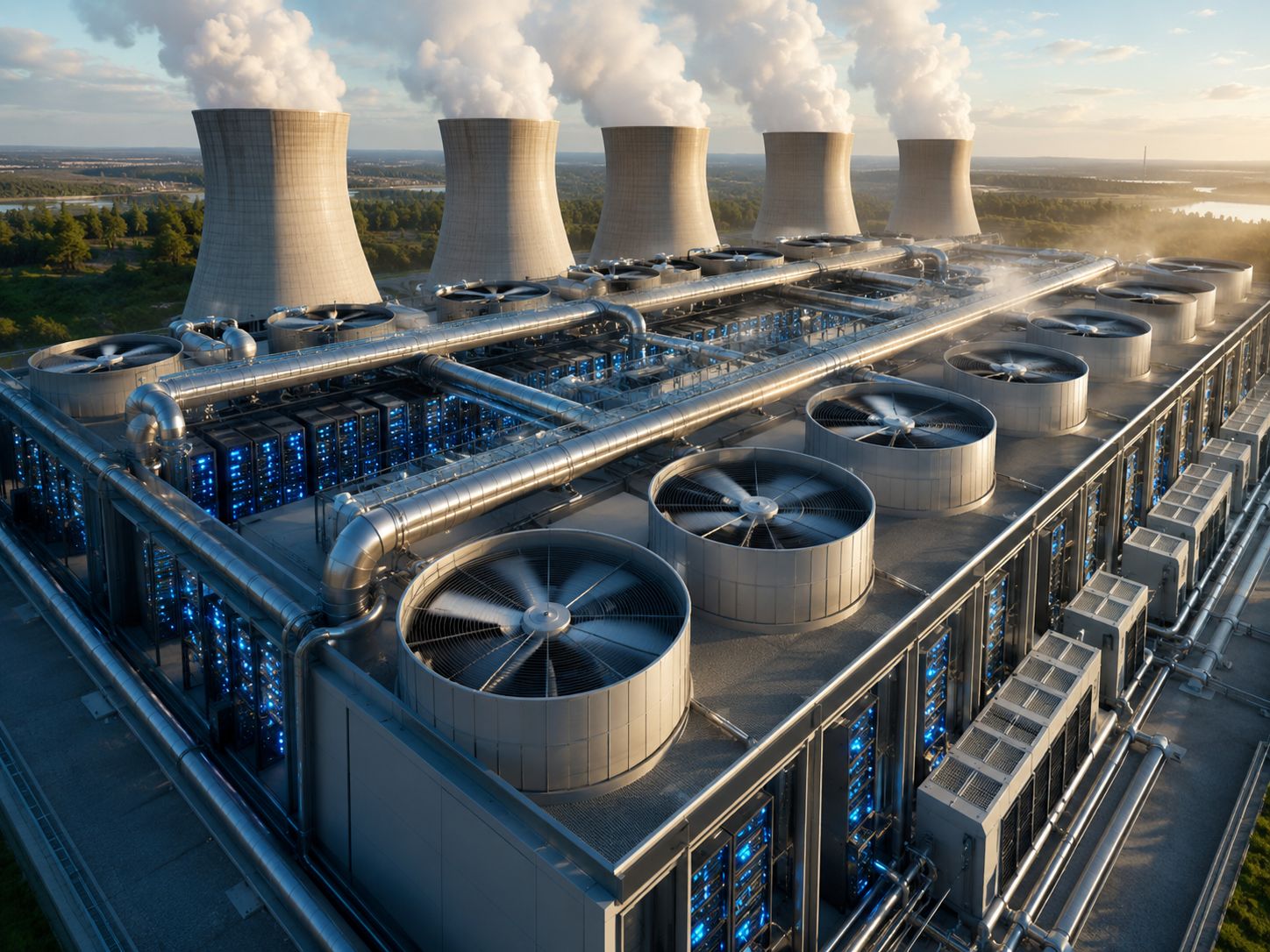
AI data centre cooling towers – artistic impression. Image credit: Alius Noreika / AI
The biggest hurdles facing AI data centres and water are geographic and procedural, not physical scarcity. Operators can already build facilities that consume almost no water for cooling. What they cannot easily do is put those facilities where power is cheap, land is available and the local aquifer is under strain, then persuade a county board that the numbers add up. Water has become the fastest way for a community to say no to a project it does not want.
The second hurdle is arithmetic that almost nobody outside the industry can check. There is no mandatory, standardised water reporting for data centres in the United States or the European Union. Companies publish different metrics on different schedules, so a resident who wants to know how many litres a proposed campus will draw from their supply usually cannot find out before the permit is signed. That gap, more than any cooling tower, is what stalls projects.
How Much Water Do AI Data Centres Actually Use?
Direct consumption is measurable and rising fast. The Environmental Law Institute puts US data centre water use at roughly 21.2 billion litres in 2014 and 66 billion litres in 2023 — a threefold increase in nine years, driven by both facility count and rack density. The Information Technology and Innovation Foundation reaches the same place from the other direction, citing 17.4 billion gallons of direct cooling water in 2023.
Indirect use dwarfs it. Producing the electricity for those buildings consumed around 800 billion litres, because thermoelectric and hydroelectric generation evaporate water at every step. ITIF estimates the indirect figure at roughly twelve times the direct one. Where the power comes from therefore matters more than the cooling tower: water intensity ranges from 2.1 gallons per kilowatt-hour in the hydro-heavy Pacific Northwest down to 0.13 gallons per kilowatt-hour in solar-heavy California.
Set against national totals, the sector remains small — under 1% of US water consumption. That figure is accurate and, on its own, useless to the farmer three miles from a new campus. Water is a local resource, and a single hyperscale site can draw as much as a small town.
| Measure | Figure | Source year |
|---|---|---|
| US direct data centre water consumption | 66 billion litres | 2023 |
| US indirect water consumption via electricity | ~800 billion litres | 2023 |
| Share of total US water consumption | Under 1% | 2023 |
| Data centres built since 2022 in water-stressed areas | ~two-thirds | 2022–2025 |
| Global data centre electricity demand | 485 TWh, rising to ~950 TWh by 2030 | 2025 / 2030 forecast |
Hurdle One: Building Where the Water Is Already Spoken For
Developers chase cheap power, fibre routes and tax abatements. Those things cluster in the American Southwest, west Texas, parts of Spain and Chile — places where water rights were allocated decades ago and are now contested. The Imperial Valley case shows what happens next. Imperial Valley Computer Manufacturing asked the Imperial Irrigation District for about 880 acre-feet a year — roughly 260 million gallons, or 750,000 gallons a day for cooling. The district rejected the application in May 2026, and the developer sued the following month seeking access to Colorado River supply. The company had earlier stated the site would rely on recycled municipal wastewater, promising that “it does not touch a single drop of the Colorado River,” until talks with nearby cities failed.
Europe has a milder version of the same problem, concentrated around a handful of hubs. The concentration of capacity in European countries with the most data centres means Dublin, Amsterdam and Frankfurt now negotiate water and grid access together rather than separately.
Hurdle Two: Nobody Agrees on the Numbers
Water Usage Effectiveness exists as a metric, but reporting it is voluntary, and definitions of withdrawal versus consumption vary between operators. Some firms report site water only; others include the water embedded in their electricity. Some report at country level, which hides the one campus sitting in a drought zone.
The New York-style solution — mandatory disclosure with standardised metrics for facilities above a threshold — is what ITIF recommends to states, alongside watershed-based review that sets performance standards instead of naming specific technologies. More than 200 state bills addressing data centres were introduced in 2025, and over 40 became law, so the direction of travel is clear even if the wording is not yet consistent.
Hurdle Three: Saving Water Costs Electricity
Every cooling choice trades one resource for another. Evaporative cooling is cheap on power and expensive on water, losing roughly 80% of what it draws to the atmosphere. Dry cooling cuts water use by about 90% but consumes 1–1.5% of the facility’s output and degrades above about 80°F ambient — exactly the conditions found in the hot, sunny regions where developers want to build. Closed-loop liquid systems and immersion cooling remove water from the equation almost entirely, at higher capital cost.
Because AI racks now dissipate far more heat than the air-cooled generation they replaced, the old evaporative approach is losing on technical grounds anyway. That shift is one reason AI’s electrical power demand has become the headline constraint while water quietly moves to the design stage rather than the operating stage.
| Cooling method | Water use | Energy penalty | Fit for AI racks |
|---|---|---|---|
| Evaporative / cooling towers | High (~80% evaporated) | Low | Struggles with modern chip heat |
| Dry (air-cooled chillers) | ~90% lower | 1–1.5% of output | Weak above ~80°F ambient |
| Rear-door heat exchangers | Moderate | Moderate | Good retrofit option |
| Direct-to-chip liquid | Near zero | Moderate | Standard for GB300-class systems |
| Two-phase immersion | Near zero | Higher capital cost | Fluid supply chain constraints |
Hurdle Four: Permits, Politics and Cancelled Projects
Water objections now carry real financial weight. ITIF counted over $130 billion in delayed or abandoned data centre projects in the first quarter of 2026, with water access among the reasons given. Brookings has argued that blanket local moratoriums are a poor substitute for proper oversight, because they stop good projects along with bad ones and give operators no incentive to design better. Yet moratoriums keep passing, because they are the only lever a county has when disclosure is voluntary and state law is silent.
Operators who publish credible numbers early tend to fare better. Those who arrive with a non-disclosure agreement and a code name tend to lose the room.
Hurdle Five: The Buildings That Already Exist
New designs solve the problem going forward. The installed base does not. Facilities commissioned between 2018 and 2024 were built around evaporative cooling and cannot be converted to closed-loop operation without substantial rework of the mechanical plant. Many sit in exactly the warm, dry regions now under pressure. Retrofitting them is slower and costlier than building new, which means water consumption from the existing fleet will decline gradually rather than sharply.
What Is Already Working
Microsoft’s next-generation datacentre design seals the cooling loop so that water is charged once during construction and then circulated continuously, removing evaporative losses from ongoing operation. Nvidia’s Rubin-generation systems are specified for liquid loops running as warm as 113°F, which allows heat rejection to ambient air without evaporating anything. Chip-level approaches are moving in the same direction, and microfluidic cooling that stops AI chips overheating pushes the coolant into channels etched close to the silicon, cutting the volume of fluid the whole building needs to move.
Replenishment programmes cover part of the remaining gap. Google reported returning 7.7 billion gallons to watersheds in 2025, roughly 78% of the freshwater it consumed, while working toward a 120% replenishment target by 2030 — a target set while its electricity demand grew 37% in a single year. Reclaimed and non-potable water sourcing does the rest, and several operators now treat municipal wastewater on site rather than competing for drinking water.
These measures belong to a wider pattern of sustainable AI moving from pledges to engineering, where the resource question is answered in the design review rather than the press release.
What to Watch Next
Three things will decide whether water remains a brake on AI construction. First, whether states converge on a single disclosure standard, so communities can compare proposals instead of guessing. Second, whether closed-loop and direct-to-chip cooling become the default for every new build rather than the flagship exception. Third, whether power procurement shifts toward generation with low water intensity, since the indirect footprint is the larger number by an order of magnitude.
The engineering answer is largely settled. Planning the surrounding AI infrastructure stack around water from the first site survey, rather than the final permit hearing, is the part the industry has yet to make routine.
If you are interested in this topic, we suggest you check our articles:
- How Much Electrical Power Does AI Require?
- Microsoft Microfluidic Cooling Stops AI Chip Overheating
- European Countries With the Most Data Centers 2026
- 10 Real Examples of Sustainable AI Transforming Planet
- AI Infrastructure: Essential Components in Modern ML Systems
Sources: Environmental Law Institute, ITIF, IEA, Google 2026 Environmental Report, Microsoft Cloud Blog, KPBS, Data Center Dynamics
Written by Alius Noreika