
Starting production before the use case and approval path are settled can turn a promising demo into expensive rework. Early in a branded voice workflow, create a shortlist of AI voices; judge every option using the same performance brief. Wait to work on full scripts until you’ve written down who decides.
However impressive the sample, you still need to check commercial release permission and usage limits. Before sign-off, check what evidence the software team needs, separately from your advertising producer’s requirements. Who’s the final approver? Put that person’s authority and the intended release date in a signed use-case brief.
Build an approval workflow for AI voices

Step 1: Define the use case and release environment
Write down where you’ll use the voice before choosing it. Note how long the voice will run, which territories it will cover, and the channel and audience. Don’t treat software that generates new lines after launch as a fixed advertising recording.
Your use-case brief should establish whether delivery is static batch rendering or dynamic real-time synthesis. Specify the exact deployment (an onboarding module for UK employees, for instance), access scope (public vs. internal prototype), update frequency, and target environment constraints such as latency caps, telephony codecs, and failover fallbacks.
Step 2: Set performance and risk criteria
Define tone through a reference line and set an acceptable pace. Mark names that must be pronounced consistently. Document prohibited uses and changes requiring renewed approval, such as a new distribution channel.
NIST’s Generative Artificial Intelligence Profile provides a risk-management reference, not certification or a legal requirement. Use a risk register to record foreseeable misuse and affected users, along with proposed controls and a named monitoring owner for each issue.
Step 3: Choose the voice with a controlled audition
Use one short audition script when shortlisting AI voices; it lets reviewers compare like with like. In addition to standard copy, deliberately structure the audition passage around known neural synthesis failure points: insert a difficult proper noun, specialized domain terminology, and contextual heteronyms or homographs (words spelled identically whose pronunciations shift with grammatical context, such as read/read, record/record, live/live, or lead/lead). Include ambiguous numeric formats (e.g., distinguishing phone digits, calendar years, and currency).
Ensure voice-casting guidelines explicitly prohibit “soundalike” prompt engineering targeting unauthorized celebrity or public-figure voices. Have reviewers score clarity and audience fit separately. Keep the chosen sample, score sheet, and accepted reading of tested edge cases together with the decision date.
Prepare and test the production script
Step 4: Convert written copy into spoken copy
When you read screen copy aloud, the dense wording is easier to catch. Break up long sentences, spelling out abbreviations that have more than one reading. For each number, write the words listeners should hear. If “two and a half” won’t do, spell out the decimal version as “version two point five”. Keep pronunciation directions structured using standard phonetic references—such as International Phonetic Alphabet (IPA) annotations or Speech Synthesis Markup Language (SSML) tags—separate from the spoken text.

Reference engine synthesis controls to understand how pacing, stability, and pronunciation settings influence a test render.
Keep one canonical script with a version number, not competing copies. Keep comments and pronunciation notes beside the approved copy; don’t scatter them across email threads or disconnected documents. The designated editor should resolve each wording request in that document before another test render. For dynamic deployments, establish approved prompt boundaries and guardrail lexicons alongside the script.
Step 5: Run a limited test before full production
Before you render the full script, start with a representative sample. Test the opening alongside specialist vocabulary, and include a sentence with instructional or emotional emphasis. Beyond short snippets, run a multi-minute passage (3 to 5 continuous minutes) through an auditory fatigue check: listen through the actual playback hardware (such as office headsets or mobile speakers) to evaluate cadence monotony, unnatural breath loop artifacts, and listener exhaustion over sustained runtimes.
“Sounds unnatural” doesn’t count as a correction request. “Pause after the product name at 00:18” gives a timestamp; ask for that kind of direction. Once approved, each reading gets locked in the pronunciation record.
Retest the corrected lines in the surrounding passage. Listeners hear the next instruction differently when you change a pause. Attach the accepted test file to its canonical script version.
Control licensing, review and final release
Step 6: Record consent and permitted use
Retain written permission covering intended media and territory. For custom voice clones, secure explicit right-of-publicity releases from voice talent; for library voices, document vendor licensing terms. Explicitly define whether the voice model or generated outputs may be used to train or fine-tune third-party AI models. Record the license term, jurisdiction, editing boundaries, and whether permission includes automated real-time generation.
For enterprise and unreleased scripts, audit vendor telemetry and prompt-logging policies: verify Zero Data Retention (ZDR) agreements or confidential enterprise terms to prevent internal copy and synthesized outputs from persisting on vendor servers.
Establish channel-specific AI disclosure placement criteria to satisfy statutory mandates (such as EU AI Act Article 50 transparency rules for synthetic content and interactive systems, as well as regional commercial bot and deepfake disclosure laws). Document how disclosure will physically execute across channels:
- Interactive agents (IVR/voicebots): Spoken pre-roll disclosure at the start of the interaction (e.g., “This automated call uses an AI-generated assistant”).
- Standalone audio/podcasts: Spoken audio credits/bumper disclaimers, clear episode-note text labeling, and embedded machine-readable provenance metadata (C2PA).
- Audiovisual/e-learning: On-screen persistent UI badges, title cards, or captions alongside the player interface.
FTC’s November 2023 voice-cloning challenge identified harms from malicious voice cloning, including fraud and biometric data misuse. Protect consent records with access controls and explicit limits on their reuse. Check who can generate speech under the recorded permission.
Step 7: Consolidate stakeholder review
Send one review package stating when the decision’s due. Include the locked script and test audio, and route feedback through one coordinator. Judge creative delivery at the appropriate gate without mixing in technical playback checks.
| Review gate | Decision owner | Evidence required | Release condition
|
|---|---|---|---|
| Language | Editor or localization lead | Locked script and pronunciation record | No unresolved wording errors |
| Audio performance | Creative lead | Timestamped test render | Delivery matches the approved brief |
| Technical delivery | Product or production lead | Acoustic validation report (sample rate, bit depth, LUFS integrated loudness specs, peak levels, absence of synthetic phasing/artifacts) and runtime stress test | Audio masters pass engineering specs and environment playback checks |
| Rights and consent | Authorized legal or procurement reviewer | License, talent consent, AI-disclosure copy, and vendor SLA verifying pinned/immutable model checkpoint access | Intended use falls within written permission, mandatory consumer disclosure copy is signed off, and model-drift protections are verified |
| Final release | Named project approver | Completed approval record | All required gates have sign-off |
Step 8: Assemble the release package
An AI voice project is ready for release when the team has approved the locked script and final audio, confirmed permitted use, completed technical testing, and recorded the named final approver’s decision. A convincing voice sample doesn’t make the release package ready. Record the outcome against the approved master file.
- Final script accompanied by the phonetic/SSML pronunciation record (and prompt guardrails, if dynamic)
- Approved audio masters with embedded provenance metadata (C2PA manifest) and watermarks meeting target delivery specifications
- Applicable consent, likeness release, signed channel-placement disclosure records, and non-training licensing agreements
- Engine configuration manifest specifying immutable/pinned model checkpoint IDs (preventing silent cloud engine updates), API version, temperature, stability, and generation seed
- Archived baseline WAV stems for acoustic drift benchmarking during subsequent releases
- Operational fallback and resilience protocol (specifying automated routing to pre-rendered static audio stems, alternate TTS provider endpoints, or human agent handoff when runtime latency caps are breached or vendor APIs fail)
- Recorded technical test results
- Dated sign-off from the stakeholders
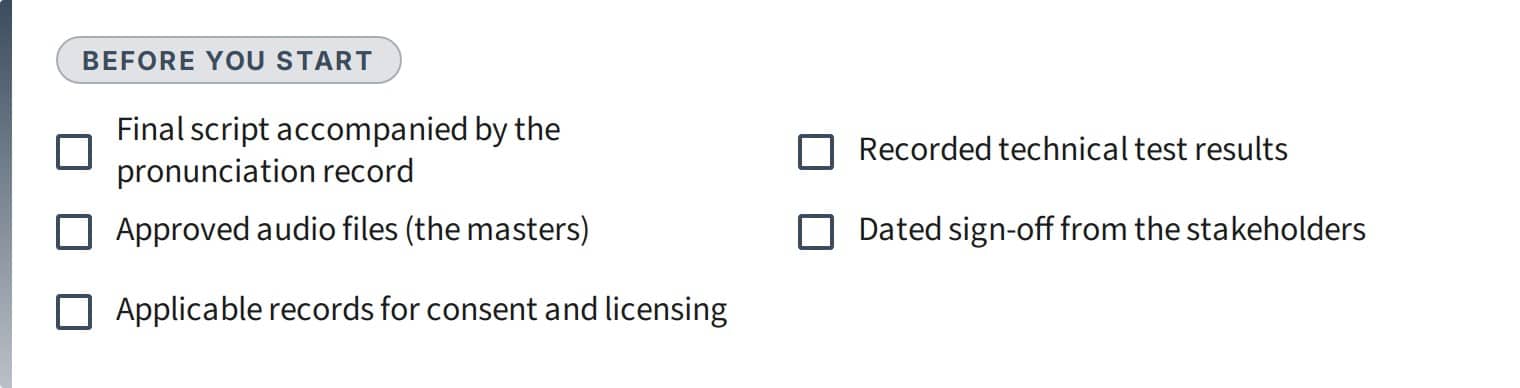
Release package checklist
Store the package under a stable project identifier (ONBOARD-UK-014, for example) alongside the pinned engine manifest, fallback protocol, and baseline stems so subsequent patch renders preserve original timbre, cadence, resilience, and regulatory compliance.
Fix workflow failures before they reach production
Scripts keep changing
Without a script-lock point, late wording gets through without approval. Require each request to cite the canonical version and name its requester. If wording changes, don’t keep it quiet. State in the version’s change record whether copy revised after script lock needs another render and fresh approval.
No one knows who can approve
Collecting opinions doesn’t give anyone permission to release. Testing must wait until you’ve assigned an owner to every gate and named the final approver. Another round of general feedback won’t settle it when people disagree over who decides. So ask the coordinator to send the disputed point directly to the relevant gate owner.
Pronunciation changes between files
Difficult terms need a shared pronunciation record with phonetic guidance or an approved audio reference. Test new terminology before you render complete modules. Date every correction, and mark the replaced direction as obsolete. If a name changes, identify affected files through their attached pronunciation-record version.
Localization arrives too late
Give each language its own production plan because you aren’t just replacing words. Confirm the regional terms and pronunciation before you render. Assign a reviewer to each language track; if translated speech changes timing or on-screen synchronization, it needs separate sign-off.
In a December 2023 survey of 2,634 audio consumers reported by Radio World, 31% said AI voices would make them more likely to listen, while 28% said they’d be less likely. Check the voice with its audience before wide release, since listeners are split. Put representative listeners’ feedback in the review record for every language you’re using.
Approve the system, not only the sound
Approval covers the agreed script and voice output, plus authorized use and a documented release decision. A polished recording doesn’t replace permission and documented sign-off. Show what the permission covers whenever a later request changes the voice’s words or where it’s used. Before you replace a file, take any update outside the approved scope back to the person responsible for that decision. A repeatable process gives later updates the same evidence trail instead of relying on memory or informal consent.
Sources
- National Institute of Standards and Technology: Generative Artificial Intelligence Profile (NIST AI 600-1).
- World Wide Web Consortium (W3C): Speech Synthesis Markup Language (SSML) Version 1.1 Recommendation.
- Coalition for Content Provenance and Authenticity (C2PA): Technical Specification for Digital Media Provenance and Watermarking.
- European Union: Regulation (EU) 2024/1689 (EU AI Act), Article 50 Transparency Obligations for Synthetic Audio.
- Federal Trade Commission: Voice Cloning Challenge Announcement and Harms Exploration (Nov 2023).
- Radio World: Audio-consumer synthetic voice adoption survey coverage (Jacobs Media Techsurvey), April 15, 2024.