Key Takeaways
- AI compresses the slow parts of executive search. Industry estimates put C-suite timelines at 14-16 weeks against a historical 18-20 at firms including Korn Ferry, Heidrick & Struggles and Russell Reynolds.
- Market mapping is where the gain is largest, because senior candidates rarely apply and often maintain no useful public profile.
- Korn Ferry found 84% of talent acquisition leaders planned to use AI, while 73% ranked critical thinking as their top recruiting priority and AI skills only fifth.
- More than half of talent leaders, 52%, planned to add autonomous agents to their teams in 2026.
- AI-supported leadership simulations are being used to show boards how CEO candidates handle unfamiliar strategic pressure.
- Recruitment AI is classified high-risk under the EU AI Act; those obligations were deferred from August 2026 to 2 December 2027, but transparency duties already apply.
- Verification matters more than it used to: 59% of hiring managers suspect AI misuse by candidates and 41% of organisations report a fraudulent hire.
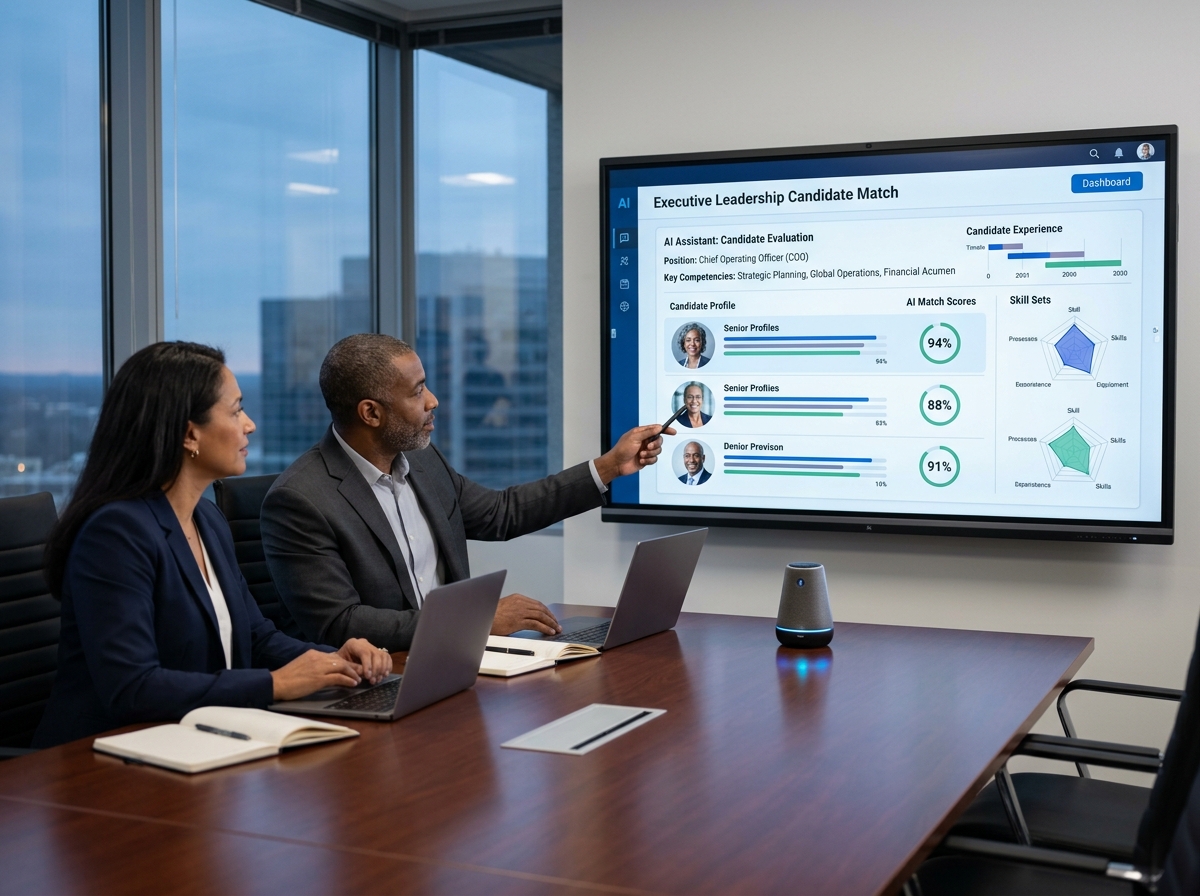
AI support in the recruitment of senior leadership positions – artistic impression. Image source: Alius Noreika / Google Gemini
Where AI Earns Its Place in Executive Search
AI supports senior leadership recruitment by compressing the research-heavy front half of a search, not by choosing the executive. Market mapping, candidate enrichment, outreach sequencing, scheduling and evidence organisation are all measurable work that scales poorly with human hours. Firms applying AI to those steps report C-suite search timelines of 14-16 weeks against the historical 18-20. The close still belongs to people.
The reason the front half is the bottleneck is structural. Executive candidates rarely apply for anything. They often maintain thin or outdated professional profiles, and the evidence that matters about them sits scattered across board databases, regulatory filings, conference recordings, patent records and academic publications. Only 22% of companies plan leadership succession with AI readiness in mind, according to Korn Ferry’s 2026 talent acquisition research, which means most C-suite openings start as a market scan from zero. That scan is exactly the kind of wide, tedious, cross-source retrieval that AI systems handle well.
The Five Places AI Delivers Measurable Value
Market Mapping and Longlist Construction
Platforms aggregating hundreds of millions of candidate profiles across dozens of sources can compress a two-week longlist build into a day or two for most VP and C-suite roles. The value is not the volume of names but the ability to surface people who are not visible through conventional channels: an operator running a division inside a large group, a founder whose company was acquired quietly, a leader whose name appears in filings rather than press releases.
Candidate Enrichment
Once a name exists, AI assembles the evidence around it. Board appointments, regulatory disclosures, published work, conference appearances, patents and press coverage produce a composite picture that a researcher would take days to build manually. This is retrieval and synthesis work, which current models do reliably when pointed at authoritative sources.
Assessment Design and Simulation
This is the newest and most interesting application. Korn Ferry reported in July 2026 that customised leadership simulations, including AI-supported ones, are increasingly used to help boards see how CEO candidates respond to realistic business situations. Candidates work through scenarios drawn from the organisation’s actual strategic position: margin compression, activist investor pressure, a failed acquisition, internal resistance to AI adoption, or a cybersecurity incident.
The shift this represents is worth stating clearly. Traditional executive assessment asks who has successfully done this job before. Simulation asks how a person thinks through a problem they have not seen. For roles where the job itself is changing faster than the pool of people who have held it, the second question is the more useful one.
Structured Evidence and Bias Reduction
AI can organise interview evidence against a consistent framework, which makes panel disagreement productive rather than anecdotal. Applied carefully, this reduces the weight of impression and recency in senior hiring decisions. Applied carelessly, it encodes whatever patterns exist in the training data, which is why the governance section below matters. Our analysis of how AI systems address attention bias for compliance covers the mechanics of getting this right.
Process Automation
Resume parsing, outreach sequencing through an applicant tracking system and automated reference scheduling are where the three workflow savings behind the timeline compression actually come from. None is glamorous. Together they account for most of the weeks recovered. The wider pattern of automation in hiring is covered in our guide to AI in the recruitment process.
What AI Cannot Do in C-Suite Hiring
| Search stage | AI contribution | Human requirement |
|---|---|---|
| Role specification | Benchmark comparable roles and compensation | Board alignment on what the role actually is |
| Market mapping | High: wide, fast, cross-source | Judgement on which segments to scan |
| Candidate enrichment | High: assembles verifiable evidence | Interpreting what the evidence means |
| Initial approach | Drafting and sequencing | Credibility of the person making the call |
| Assessment | Simulation design and evidence capture | Reading the person in the room |
| Off-record references | None | Entirely human, entirely relationship-based |
| Board and culture fit | None | Entirely human |
| Confidentiality management | Risk, not help | Human discretion throughout |
| Offer and close | Compensation data | Negotiation and trust |
The hardest limit is confidentiality. Senior searches routinely involve candidates whose current employers must not learn they are talking, and sometimes a sitting executive who does not know they are being replaced. Every system that touches that search widens the circle of systems holding the information. This is a reason to scope tooling narrowly in executive work, in direct contrast to volume hiring where broad integration is the point.
What Boards Now Look For, Which AI Changed
The technology altered the specification as much as the process. Korn Ferry’s research found only 11% of talent leaders said their executives were well prepared to lead through the AI transition, and just 22% believed their leaders could effectively manage teams combining humans and AI agents. Yet 52% planned to add autonomous agents to their teams during 2026, with some already creating employee records for AI agents in their HR systems.
That gap defines a new senior requirement: the capacity to run an organisation where a meaningful share of the work is done by systems. It is not a technical skill, which is why 73% of talent leaders ranked critical thinking as their top priority for 2026 while AI skills placed only fifth. The specific ability boards are screening for is the judgement to question an AI-generated recommendation, spot what a model left out, and decide when its answer is inadequate.
A second pressure sits underneath. Korn Ferry found 43% of companies planned to replace roles with AI, concentrated in operations and back office at 58% and entry-level at 37%. Cutting entry-level hiring saves money in 2026 and 2027 and drains the pipeline that produces senior leaders a decade later, which pushes more future searches into the external market that AI is now used to map. Our coverage of where businesses should focus their AI efforts in 2026 examines that trade-off across functions.
How the Major Search Firms Are Using AI
| Firm | Approach | Strongest fit |
|---|---|---|
| Korn Ferry | Intelligence Cloud, launched late 2021, trained on billions of proprietary data points and tens of millions of assessments | Global, multi-country leadership programmes |
| Heidrick & Struggles | Dedicated AI and Data search practice; designs AI leadership operating models | Enterprise AI organisation design, Chief AI Officer mandates |
| Egon Zehnder | In-house data science and an AI competency model for CAIO assessment | CEO and board-level AI mandates |
| Spencer Stuart | Executive Intelligence, a predictive assessment of senior potential | CEO and board search |
| Russell Reynolds | Leadership Analytics function assessing AI readiness | C-suite and data-driven succession |
| AI-native boutiques | Proprietary platforms mapping a market in days, consultants vet | Scarce technical leadership, at speed |
The pattern across the field is consistent: AI accelerates research and assessment evidence, while the recruiter retains the relationship, the reference calls and the placement. Korn Ferry’s Jeanne MacDonald put the limit directly: “Talent acquisition is about people — and human intelligence will always be the differentiator.”
Compliance: What the EU AI Act Now Requires
Recruitment and employee management systems sit in Annex III of the EU AI Act, the high-risk category. The compliance date moved. The Digital Omnibus on AI entered into force on 27 July 2026 and deferred standalone Annex III obligations from 2 August 2026 to 2 December 2027, with AI embedded in regulated products moving to 2 August 2028. The European Parliament endorsed the package on 16 June 2026 and the Council gave final approval on 29 June.
Two things were not deferred. Article 50 transparency obligations applied from 2 August 2026, meaning individuals interacting directly with an AI system must be told so, and AI-generated or manipulated content must be identified as such. Systems already on the market before that date received until 2 December 2026 to add machine-readable marking. The obligation on member states to run at least one regulatory sandbox moved to 2 August 2027.
The deferral is runway rather than repeal. Conformity assessments, technical documentation, human oversight controls and EU database registration are all still coming, and the EU postponed the timeline because national authorities and harmonised technical standards were not ready. Penalties for non-compliance with high-risk obligations reach €15 million or 3% of global annual turnover. Organisations treating the extra sixteen months as cancellation will face the same requirements later with less time to build controls.
| Obligation | Applies from |
|---|---|
| Article 50 transparency duties | 2 August 2026, already in force |
| Machine-readable marking, pre-existing systems | 2 December 2026 |
| Member state regulatory sandboxes | 2 August 2027 |
| Annex III high-risk obligations, including recruitment | 2 December 2027 |
| Annex I embedded high-risk systems | 2 August 2028 |
The Verification Problem Nobody Planned For
AI arrived on the candidate side of the table at the same time it arrived on the employer’s. Some 59% of hiring managers report suspecting AI misuse in applications, 41% of organisations report making a fraudulent hire, and 50% of businesses have encountered AI deepfake fraud. At executive level, where a single appointment carries disproportionate consequence, identity and credential verification has become a search requirement rather than an administrative step.
The candidate-side tooling is now substantial, as our overview of AI tools for job applications documents. Some organisations have responded by publishing explicit guidance on where AI assistance is acceptable in their process and where it is not, which gives candidates a clear standard and gives assessors a defensible basis for judging what they see.
A Practical Way to Deploy This
Start with market mapping and enrichment, where the returns are clearest and the governance burden lightest. Keep assessment tooling under human interpretation, with a documented rationale for every rejection at senior level. Scope confidentiality deliberately, granting each system access only to the searches it needs. Document your AI use now rather than in late 2027, since the high-risk obligations arrive whether or not your process is ready. And track outcomes rather than efficiency: a search that closed in fourteen weeks and produced an executive who left in eighteen months cost far more than the six weeks it saved.
The honest summary is that AI has changed the economics of executive search without changing its nature. The research that used to consume weeks now consumes days. The judgement that decides the appointment has not been automated, and there is no current evidence that it is close to being. Firms adopting these tools describe the same division of labour: AI compresses the slow steps, and the recruiter still owns the placement. Our broader survey of which agentic AI workflows work in production shows the same pattern holding across other professional functions.
This article summarises industry research and regulatory developments as of September 2026. It is informational and does not constitute legal advice. Organisations deploying AI in recruitment should seek qualified counsel on their obligations under the EU AI Act and applicable national employment law.
If you are interested in this topic, we suggest you check our articles:
- AI Hiring Process: Guide to Recruitment Automation
- How AI Systems Address Attention Bias for Full Compliance
- AI Tools for Job Applications: 5 Solutions That Work
- AI Business Focus 2026: ROI, Agents & Automation
- Agentic AI Real Use Cases: Beyond Hype to Working Solutions
Sources: Korn Ferry — Top Talent Acquisition Trends Shaping 2026, HR Lineup — AI for Executive Search: Transforming C-Suite Hiring, Recruiter Hustle — AI in Executive Search 2026, Hunt Scanlon Media — What Talent Acquisition Will Really Demand in 2026, Gibson Dunn — EU AI Act Omnibus Agreement
Written by Alius Noreika