Key Takeaways
- GPT-5.6 Luna costs $0.20 per million input tokens and $1.20 per million output tokens, after OpenAI cut the price by 80% on 30 July 2026.
- Cached input drops to $0.02 per million, a tenth of the standard input rate, which makes repeated-context workloads dramatically cheaper.
- Luna is 25 times cheaper than GPT-5.6 Sol and 50 times cheaper than GPT-6 Astra on input tokens.
- It is not the cheapest model available. Gemini 3.5 Flash-Lite costs $0.30 and $2.50 but scores lower on most reasoning measures.
- Cost-effectiveness holds for high-volume, well-defined tasks and collapses for open-ended reasoning, where retries erase the savings.
- Luna cannot be selected in standard ChatGPT conversations; it reaches developers through the API, Codex, ChatGPT Work and GitHub Copilot.
- Prompts over 272K input tokens are billed at double input and 1.5 times output for the whole request.
AI, ChatGPT – artistic impression. Image source:
Sanket Mishra via Pexels, free license
The Price, and What It Actually Means
GPT-5.6 Luna is among the most affordable frontier-family models available, at $0.20 per million input tokens and $1.20 per million output tokens. To put that in working terms, processing a million tokens of input, roughly 750,000 words, and generating 100,000 tokens of output costs about 32 cents. The same job on GPT-5.6 Sol costs $8.00, and on GPT-6 Astra it costs $15.00.
Those rates are recent. Luna launched on 9 July 2026 at $1.00 and $6.00 per million tokens. Three weeks later, on 30 July, OpenAI cut it by 80% in a single announcement that also reduced GPT-5.6 Terra by 20% while leaving Sol unchanged. Sam Altman described the intent on X: “We want to offer the best price/intelligence tradeoff at every level.” Developers already using Luna needed no code changes, no model switch and no migration; their bills simply fell by a factor of five overnight.
Full Pricing Breakdown
| Token type | Price per 1M tokens | Notes |
|---|---|---|
| Input | $0.20 | Text and image input supported |
| Cached input | $0.02 | One tenth of the standard input rate |
| Output | $1.20 | Includes reasoning tokens |
| Cache writes | 1.25x uncached input rate | Charged once per cached segment |
| Prompts over 272K input tokens | 2x input, 1.5x output | Applies to the full request, not the excess |
That final row is the trap. Luna advertises a 1,050,000-token context window, but crossing 272,000 input tokens reprices the entire request, not the portion above the threshold. A 300,000-token prompt costs $0.12 rather than $0.06, and the multiplier scales with the request. Teams stuffing large documents into single calls should chunk deliberately or accept the premium knowingly. Our explainer on tokens as the currency of generative AI covers how these thresholds work across providers.
How Luna Compares on Cost Alone
| Model | Input per 1M | Output per 1M | Multiple of Luna’s input cost |
|---|---|---|---|
| GPT-5.6 Luna | $0.20 | $1.20 | 1x |
| Gemini 3.5 Flash-Lite | $0.30 | $2.50 | 1.5x |
| Gemini 3.6 Flash (promotional) | $0.75 | $3.75 | 3.75x |
| Gemini 3.6 Flash (from Jan 2027) | $1.50 | $7.50 | 7.5x |
| GPT-5.6 Terra | $2.00 | $12.00 | 10x |
| Claude Opus 5 | $5.00 | $25.00 | 25x |
| GPT-5.6 Sol | $5.00 | $30.00 | 25x |
| Claude Fable 5.1 | $10.00 | $50.00 | 50x |
| GPT-6 Astra | $10.00 | $50.00 | 50x |
Luna is cheap but not cheapest. Gemini 3.5 Flash-Lite undercuts it on nothing, costing more on both input and output, while Meta’s Muse Contributor tier at $0.10 and $0.20 goes lower still with the condition that data from that tier can be used to improve Meta’s products. Within the tier of models that keep your data out of training by default, Luna currently sets the floor.
Where the Money Actually Goes
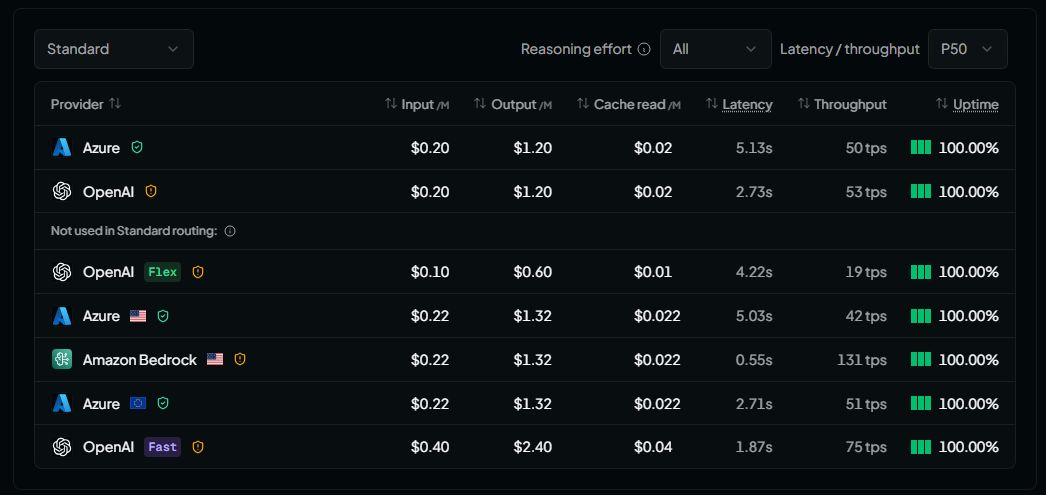
Different companies can host the same model. This table compares GPT-5.6 Luna cost when run from different platforms. Image source: OpenRouter
Cached Input Changes the Arithmetic
The $0.02 cached input rate matters more than the headline figure for any application that reuses context. Consider a support assistant that sends the same 50,000-token knowledge base with every query. Across 8,000 queries a month, that is 400 million input tokens. Paid at the full rate, the input alone costs $80. With an 80% cache hit rate, the same input costs about $22. Adding 75 million output tokens at $1.20 brings the monthly total from $170 down to roughly $112.
Cache writes bill at 1.25 times the uncached rate, so caching pays off from the second use onward. For agentic workflows that make dozens or hundreds of model calls against a stable system prompt and tool definitions, the saving compounds quickly. OpenAI specifically cited better prompt caching across multi-step agent workflows as one reason it could cut prices at all.
Monthly Cost at Different Volumes
| Workload profile | Monthly tokens | Approximate cost |
|---|---|---|
| Prototype or side project | 5M in / 1M out | Around $2 |
| Small production app | 50M in / 10M out | Around $22 |
| Mid-size classification pipeline | 400M in / 75M out | Around $170 |
| Same, 80% cached | 400M in / 75M out | Around $112 |
| High-volume moderation service | 4B in / 500M out | Around $1,400 |
Figures use published list prices and exclude tool call fees, image inputs and batch discounts. Batch processing carries separate queue limits that run from 5 million tokens on Tier 1 to 15 billion on Tier 5.
Cost-Effective for What, Exactly?
Affordability is only half the question. A model is cost-effective when the work it completes correctly outweighs what you spend, including the cost of the attempts it gets wrong.
Luna is built for what OpenAI’s developer materials call well-defined, high-volume work. It corresponds roughly to the nano tier in earlier GPT-5 families, and it earns its place on classification and routing, short-form content generation, real-time autocomplete and suggestion features, content moderation on short inputs, chatbot flows with straightforward question-and-answer patterns, background data processing, and mobile or edge deployments where latency is the binding constraint.
Its benchmark results support that positioning better than the nano label suggests. Luna posts 62.7% on SWE-Bench Pro, 67% on DeepSWE v1.1 and 84.7% on Terminal-Bench 2.1, beating Gemini 3.6 Flash on all three despite costing a fraction as much. It supports configurable reasoning effort across six levels from none through max, a pro reasoning mode for quality-first tasks, programmatic tool calling, persisted reasoning across turns, and a full tool set covering functions, web search, file search and computer use.
Where it stops being cost-effective is open-ended reasoning. On composite intelligence indexes Luna scores in the low 30s to low 50s depending on effort setting and measurement date, well below frontier models. Independent vision testing puts it at 74% average against Gemini 3.6 Flash’s 83%, with reasoning over images at 60% against 78%. If a task needs three attempts on Luna and one on a model costing ten times more, the cheap model has cost you more in tokens, latency and engineering attention. Teams choosing where each tier fits may find our tier list of the best LLMs for coding work a useful reference point.
Access: Cheap, but Not Where Most People Look
Luna is not selectable in standard ChatGPT conversations, which caused visible frustration when it became generally available. It is a developer and workflow model, reached through the OpenAI API, Codex, ChatGPT Work or GitHub Copilot, where it landed on 9 July across Pro, Pro+, Max, Business and Enterprise plans.
Free and Go users encounter Luna without choosing it: OpenAI made it the default model for those tiers, added unlimited text chats, and introduced a Think button that routes harder questions through higher reasoning, still on Luna. Limits continue to apply to file uploads, images and other tools. Paid ChatGPT users get GPT-5.6 Sol for Instant and the thinking options, with GPT-6 Astra available as GPT-6 Pro on eligible plans. Anyone weighing what a subscription buys against API access can compare in our 2026 AI subscription price comparison.
Why OpenAI Could Afford the Cut
The 80% reduction came from serving efficiency rather than a margin decision. OpenAI engineers rewrote production GPU kernels, cutting serving costs by about 20%. They redesigned Sol’s speculative decoding system, improving token generation efficiency by more than 15%. They updated the agent runtime to lean harder on prompt caching during multi-step workflows, reducing repeated prompt computation.
Competitive pressure supplied the motive. Lower-cost open-weight models from Chinese laboratories have been pushing commercial providers to compete on production pricing rather than benchmark margins, a dynamic covered in our analysis of whether cheap Chinese AI models can rival the established players. When developers can route easy steps to open models and reserve expensive APIs for hard ones, a 25-fold internal price gap between Luna and Sol becomes a retention tool. Anthropic moved in the same direction weeks later, cutting Claude Fable 5.1 cache reads by 75% to $0.25 per million.
Rate Limits by Tier
| Usage tier | Requests per minute | Tokens per minute | Batch queue limit |
|---|---|---|---|
| Free | Not supported | Not supported | Not supported |
| Tier 1 | 500 | 500,000 | 5,000,000 |
| Tier 2 | 5,000 | 2,000,000 | 20,000,000 |
| Tier 3 | 5,000 | 4,000,000 | 40,000,000 |
| Tier 4 | 10,000 | 10,000,000 | 1,000,000,000 |
| Tier 5 | 30,000 | 180,000,000 | 15,000,000,000 |
Luna has no free API tier, so evaluation requires a funded account. Tiers rise automatically with spend and request volume.
The Verdict
Luna is genuinely affordable and genuinely cost-effective, provided you use it for the work it was built for. At $0.20 and $1.20 per million tokens with $0.02 cached input, it makes high-volume automation economically sensible for teams that previously could not justify it, and it removes much of the incentive to self-host an open-weight model for routine work. A pipeline that would cost $4,250 a month on Sol runs at $170 on Luna.
The failure mode is using it as a general-purpose replacement. Pair it with a stronger model rather than substituting it, measure your error rate rather than your token rate, and watch the 272K threshold. Used that way, it is one of the better value propositions in production AI right now. A wider view of where each lab sits on price and capability is available in our comparison of xAI, OpenAI and Anthropic in 2026.
Pricing, rate limits and availability described here are current as of September 2026 and change frequently. Confirm current rates with OpenAI before budgeting. This article is informational and is not financial advice.
If you are interested in this topic, we suggest you check our articles:
- Tokens Explained: The Currency of Generative AI
- 2026 AI Subscription Prices: Gemini vs ChatGPT vs Claude
- Can Cheap Chinese AI Models Rival OpenAI and Anthropic?
- Best AI LLM for Vibe Coding: Complete 2026 Tier List
- xAI vs OpenAI vs Anthropic: Which AI Lab Wins in 2026?
Sources: OpenAI — GPT-5.6 Luna model documentation, The New Stack — OpenAI slashes API costs amid rising global competition, OpenAI — Improving GPT-5.6 Sol and expanding Luna access for free users, OpenAI Help Center — GPT-5.6 and GPT-6 Pro in ChatGPT, OpenRouter — GPT-5.6 Luna pricing
Written by Alius Noreika