Key Takeaways
- The data does not support replacement of the occupation, but it does show a sharp, measurable squeeze on entry-level hiring.
- Stanford’s revised August 2026 research found employment of workers aged 22 to 25 in AI-exposed occupations now sits 19 percent below where it would be had it tracked less-exposed peers — up from a 13 percent gap a year earlier.
- That divergence operates through reduced hiring rather than increased layoffs, and experienced workers show no comparable gap.
- The US Bureau of Labor Statistics still projects software developer employment growing about 15 to 16 percent between 2024 and 2034, adding roughly 267,700 jobs, against 3 to 4 percent for all occupations.
- Entry-level postings are down roughly 28 percent from their 2022 peak, while ML engineer openings are up 59 percent and AI/ML postings grew 85 percent year over year.
- Dario Amodei has said half of white-collar entry-level jobs could disappear within five years; IBM’s Arvind Krishna puts AI-written code at 20 to 30 percent, not 90 percent.
- Employment declines concentrate where AI automates work rather than augments it — the same occupation shows different outcomes depending on which mode dominates.
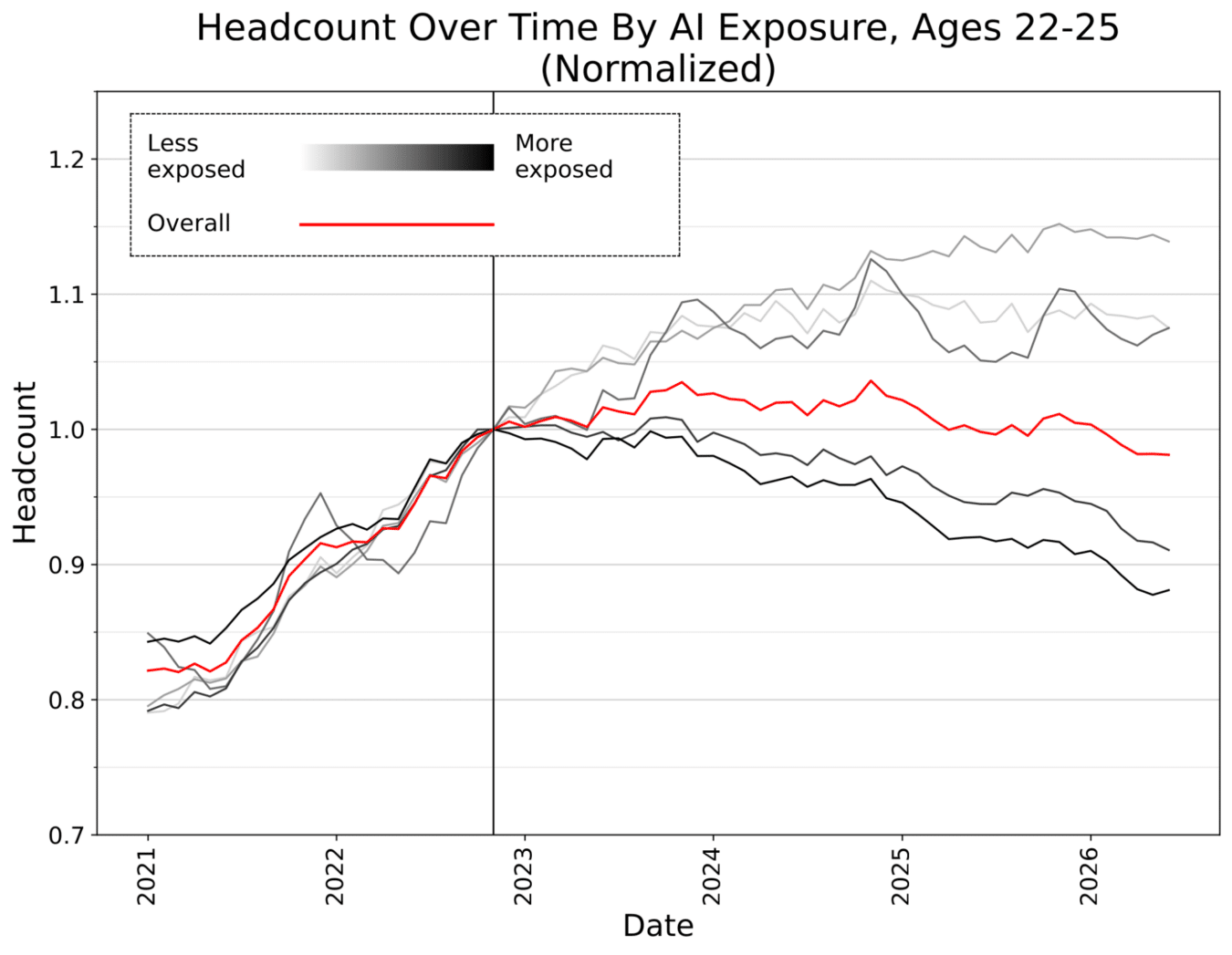
Employment changes by AI exposure for 22 to 25 year-olds, using exposure measures from Eloundou et al. (2024) via Stanford Digital Economy Lab
No, AI is not replacing software engineers as an occupation, and the strongest datasets available agree on that. What they also agree on is less comfortable: the job market has split. Senior and specialised engineers remain in demand, and the official ten-year forecast still has the occupation growing several times faster than the average job. Meanwhile the entry point has narrowed severely, and the narrowing is measurable in payroll records rather than inferred from anecdote.
That split is the actual finding. Researchers at the Stanford Digital Economy Lab, working with ADP payroll data covering millions of workers, state it plainly in their revised paper: there is no evidence of widespread, economy-wide job displacement, yet employment of 22- to 25-year-olds in AI-exposed occupations now stands 19 percent below where it would be had it kept pace with their less-exposed peers. Both sentences are true at once, and most coverage picks one.
What the Payroll Data Shows
The Stanford work, titled “Canaries in the Coal Mine?”, uses high-frequency ADP payroll records rather than surveys or job boards, which makes it the closest thing available to a direct measurement. The August 2026 revision updated findings first published a year earlier, and the gap had widened rather than closed.
| Finding | Detail |
|---|---|
| No aggregate displacement | No evidence of widespread, economy-wide job losses attributable to AI |
| Young-worker gap | 22–25 year-olds in AI-exposed occupations sit 19% below the counterfactual; the gap was 13% a year earlier |
| Experienced workers | No comparable gap; older age groups in the same occupations continued growing |
| Mechanism | Operates through reduced hiring of young workers, not increased separations |
| Levels change | Employment of 22–25s in the two most exposed quintiles fell about 11% between November 2022 and June 2026 |
| Software developers specifically | Employment for 22–25s fell close to 20% from its late-2022 peak in the earlier analysis |
The most useful distinction in the research is not exposure but mode. Entry-level employment declined in applications where AI automates work, with muted changes where it augments. Home health aides, in a less-exposed occupation, showed employment increases for the youngest workers over the same period. The occupation label alone does not determine the outcome — what the tools actually do inside it does.
The authors are careful about limits, and so should anyone citing them be. Some differential trends appear before generative AI was in wide use. Estimated gaps run larger in the ADP sample than in national survey benchmarks. And the post-zero-interest-rate environment compressed entry-level demand across tech independently of AI, a confound the researchers address but cannot fully separate. A Danish study using similar methodology found near-zero effects.
What the Job Postings Show
Posting data tells a compatible story with a different emphasis: the volume is still enormous, but the composition has shifted.
Software engineering remained among the highest-volume professional categories in January 2026 posting data, with 140,068 postings matching the title and 137,176 mentioning Python. That is not the profile of a collapsing field. Machine learning appeared in 77,214 postings, and skills tied to building and operating AI systems commanded strong salaries — an odd way for employers to behave if they believed the work was about to be automated away.
Underneath that volume, the distribution moved. Junior postings sit roughly 28 percent below their 2022 peak. New graduates now make up only about 7 percent of Big Tech hires. General software engineering openings remain around 49 percent below pre-pandemic baselines, while ML engineer openings run 59 percent above them and AI/ML postings grew 85 percent year over year. Cybersecurity postings grew 124 percent. Recent computer science graduates showed roughly 7 percent unemployment in New York Fed data by major.
| Specialisation | Demand direction | Why |
|---|---|---|
| ML and AI engineering | Very strong | Companies racing to ship AI products; machine learning is the top hiring priority |
| Security engineering | Very strong | Fast growth, high judgment load, resistant to automation |
| Data engineering | Strong | AI systems depend on the pipelines feeding them |
| Cloud, platform, DevOps | Strong | Infrastructure scale keeps growing; deployment is work teams do not delegate |
| Backend and full-stack generalist | Stable but competitive | Still the largest category; AI fluency now assumed |
| Frontend and web generalist | Softer | More exposed to AI-assisted productivity gains |
| QA and manual testing | Softer | Heavily affected by AI-assisted test generation |
The mechanism behind the entry-level squeeze is specific rather than mysterious. The work that historically trained juniors — small, well-defined, self-contained tickets — is exactly the work current models handle best. Removing those tickets removes the training ladder, which is a different problem from removing the job.
What the Official Forecast Says
The Bureau of Labor Statistics projects software developer employment growing about 15 percent between 2024 and 2034, from 1,693,800 to 1,961,400, adding roughly 267,700 positions. Some publications cite 15.8 or 16 percent depending on which BLS series and rounding they use; the earlier 2023–33 projection ran higher at 17.9 percent, so the direction of revision is downward while the level remains strong. Against 3 to 4 percent growth for all occupations, developers are still projected to grow several times faster than average, with roughly 129,200 annual openings across the broader developer, QA analyst and tester group once replacements are counted. Median pay was $133,080 in May 2024.
BLS is explicit that these projections already account for AI. Its own analysis notes that developers use AI to write, test and document code, while AI simultaneously creates demand for developers to build AI-based business solutions and maintain AI systems. The forecast treats the technology as both a productivity multiplier and a source of new work.
Where the Executive Predictions Diverge
The loudest forecasts come from people with commercial positions, and they disagree with each other by a wide margin.
Dario Amodei has put 90 percent confidence on AGI-level capability arriving within ten years, with his personal estimate for specific domains including coding as short as one to three years, and has publicly stated that 50 percent of white-collar entry-level jobs could disappear within five years. Against that, IBM’s Arvind Krishna challenged the widely repeated claim that AI would soon write 90 percent of code: “I think the number is going to be more like 20-30% of the code could get written by AI—not 90%. Are there some really simple use cases? Yes, but there’s an equally complicated number of ones where it’s going to be zero.” That disagreement is explored further in our coverage of IBM’s view that AI augments programmers rather than replacing them.
Developers themselves have drawn a firmer line than either camp. Roughly three-quarters say vibe coding is not part of their professional work, treating prompt-to-app generation as useful for prototypes rather than production systems — a pattern documented in our review of how developer interests shifted over five years of the AI boom. Tool choice has become its own discipline, with engineers matching the assistant to the task rather than routing everything through one.
What the Models Can and Cannot Do Now
Capability has moved fast enough that dismissing the question is no longer credible. GPT-6 Astra scores 57.9 percent on Terminal-Bench 4.0 against 37.3 percent for its predecessor, and 74.1 percent on DeepSWE. Claude Code reached $2.5 billion in annualised revenue by February 2026, and Anthropic holds roughly 54 percent of enterprise AI coding spend. These are production tools generating real revenue, not demos.
What they still do not do is own correctness. Employers increasingly expect engineers to use AI tools while remaining accountable for whether the output works, which changes the job’s centre of gravity rather than eliminating it. The tasks that resist automation are the ones requiring architectural judgment, understanding of a specific business, negotiation about what should be built, and responsibility when it breaks — a division examined in our analysis of whether frontier models can replace web developers.
The broader labour research points the same way. McKinsey found that fewer than 5 percent of jobs can be fully automated, while in about 60 percent of occupations at least a third of activities could be — which describes reshaping a role rather than removing it, as covered in our piece on how AI handles repetitive work inside teams.
What This Means If You Are Entering or Already In the Field
For people starting out, the data suggests three things. The entry-level door is genuinely narrower, so competing on a generalist résumé without demonstrable work is harder than it was. The openings that grew fastest are in ML engineering, security, data engineering and platform work, not general application development. And evidence of shipped systems now carries more weight than credentials, because the signal employers used to get from watching someone work through junior tickets no longer exists.
For those already employed, the exposure runs by task rather than title. Work that is well-specified, self-contained and repeatable is the most automatable portion of any role. Work involving ambiguity, cross-team judgment, production accountability and domain knowledge is the least. The practical response is to move toward the second category and treat AI fluency as assumed rather than differentiating — the direction most enterprises are already planning around, as our overview of where businesses are focusing AI investment in 2026 describes.
The forecast that fits the evidence is neither replacement nor continuity. It is an occupation that keeps growing in aggregate while changing what it asks of people at the start of it, with the training ladder as the unresolved problem. Nobody has yet explained how the industry produces senior engineers a decade from now if the junior work that made them is gone.
If you are interested in this topic, we suggest you check our articles:
- IBM CEO: AI Will Augment Programmers, Not Replace Them
- Can Gemini 3 Replace Web Developers? The Truth About AI
- How the AI Boom Reshaped Developer Interests in 5 Years
- How AI Supports Teams by Handling Repetitive Tasks
- AI Business Focus 2026: ROI, Agents & Automation
Sources: Stanford Digital Economy Lab, Canaries Dashboard, US Bureau of Labor Statistics, Tech Times, OpenAI
Written by Alius Noreika