TL;DR – the cost of Grok 4.5
- Grok 4.5 costs $2.00 per million input tokens and $6.00 per million output tokens on the xAI API, with a 500,000-token context window.
- Cached input is widely listed at $0.50 per million, a 75% discount, though xAI’s own pricing page did not confirm the rate on launch day.
- Web and X search tool calls bill separately at $5.00 per 1,000 calls, and priority processing doubles token rates to $4 / $12.
- No batch discount is published for grok-4.5, unlike the 20% offered on grok-4.3 and the grok-4.20 family.
- Consumer access ranges from a free tier to SuperGrok Heavy at $300 per month, with SuperGrok at $30 and SuperGrok Lite at $10.
- As of July 2026, Heavy is the only consumer plan with confirmed full Grok 4.5 access; lower tiers receive it in staged rollout.
- Grok 4.5 is more expensive per token than the model it succeeded — grok-4.3 lists at $1.25 / $2.50 with double the context window.
- Developers can draw up to $175 per month in free API credits through xAI’s data-sharing programme.
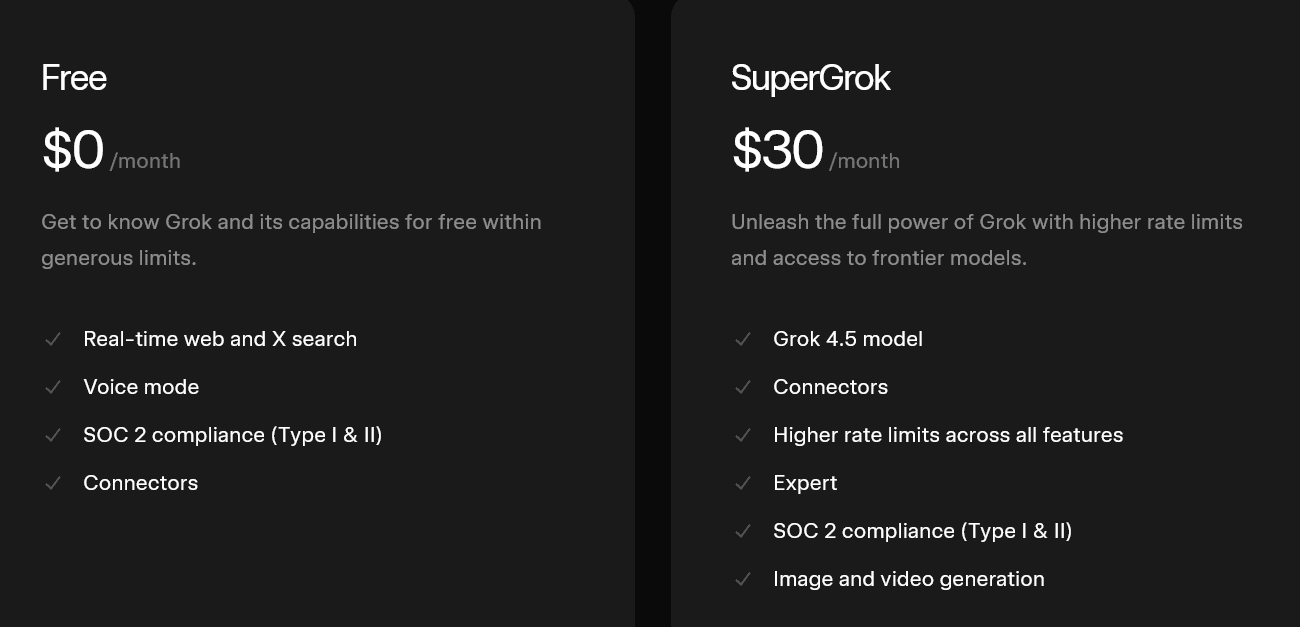
Grok 4.5 pricing tiers – for individuals. Image credit: xAI
Grok 4.5 costs $2.00 per million input tokens and $6.00 per million output tokens through the xAI API, with a 500,000-token context window. If you want it inside a chat app instead of a codebase, the standalone SuperGrok plan runs $30 per month, and SuperGrok Heavy, the only consumer tier with confirmed full access to the model as of July 2026, costs $300 per month.
Those two numbers cover most people’s question, but they hide the parts of the bill that actually move. Search tool calls, priority processing, the missing batch discount, and the higher-context surcharge above 200,000 prompt tokens all sit outside the headline rate.
This guide lays out every published figure, flags the ones that sources disagree on, and works through what real usage costs.
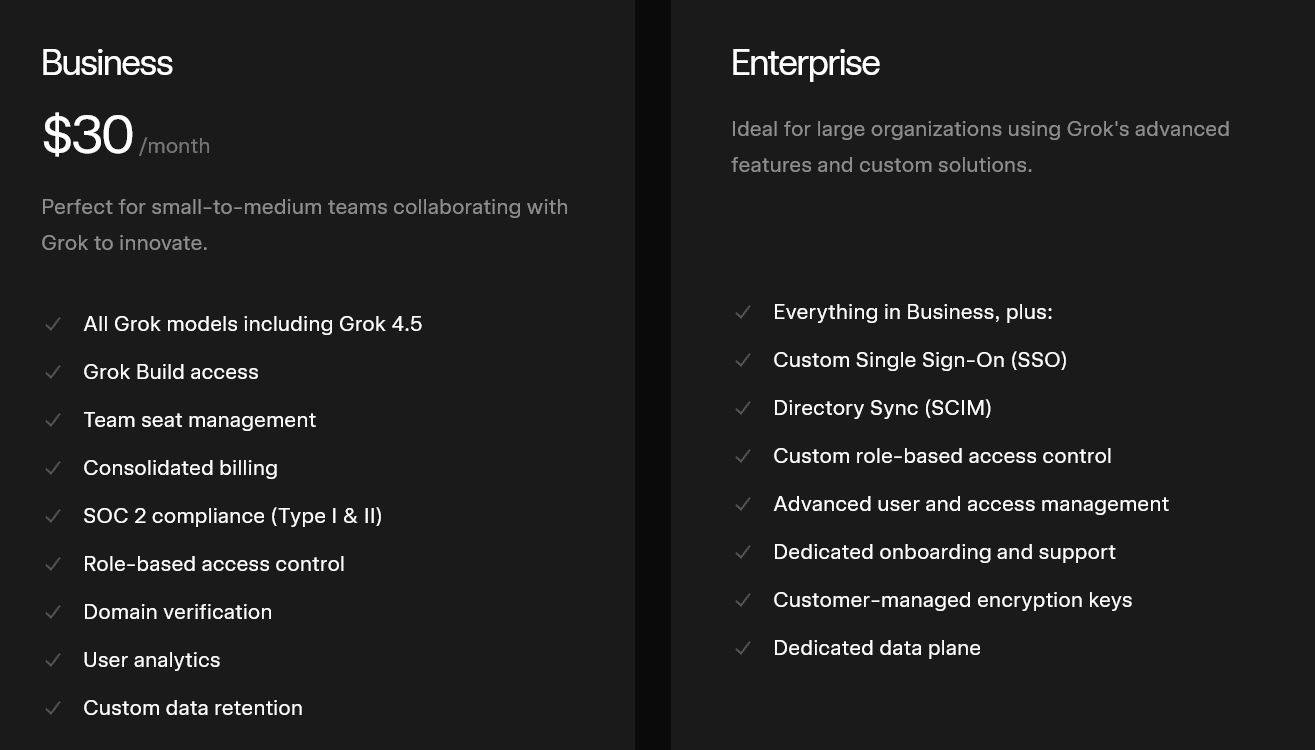
Grok 4.5 pricing tiers – for business teams. Image credit: xAI
Grok 4.5 API Pricing: The full rate card
xAI launched Grok 4.5 on 8 July 2026 and priced it below every model in its claimed capability class. The rates below come from xAI’s published documentation and pricing trackers that sync from it, verified as of 28 July 2026.
| Item | Rate |
|---|---|
| Input tokens | $2.00 per 1M |
| Cached input tokens | $0.50 per 1M (reported 75% discount — see note below) |
| Output tokens | $6.00 per 1M |
| Context window | 500,000 tokens |
| Requests at or above 200K prompt tokens | Higher-context rates apply |
| Priority processing (service tier) | 2x standard, or $4 / $12 per 1M |
| Web and X search tool calls | $5.00 per 1,000 calls |
| Batch discount | None listed for grok-4.5 |
| Free developer credits | Up to $175 per month via data-sharing programme |
The cached-input figure worth checking yourself
On launch day, several trackers and OpenRouter listings reported cached input at $0.50 per million. Apidog’s review noted that neither xAI’s release page nor its docs pricing page confirmed a cached rate for grok-4.5 as of 9 July.
Later pricing registries, including BenchLM, describe $0.50 as xAI’s official published price.
The practical advice: check the console before building a cache-heavy cost model, because prompt caching routinely halves agent bills when it is real, and the difference between $0.50 and $2.00 on input is the difference between a workable margin and a surprise invoice.
Tool calls are the line item people miss
Token dashboards do not show search invocations. A research agent that fires 20,000 web or X lookups in a month adds $100 to the bill before a single token is counted. Log those calls separately from the start.
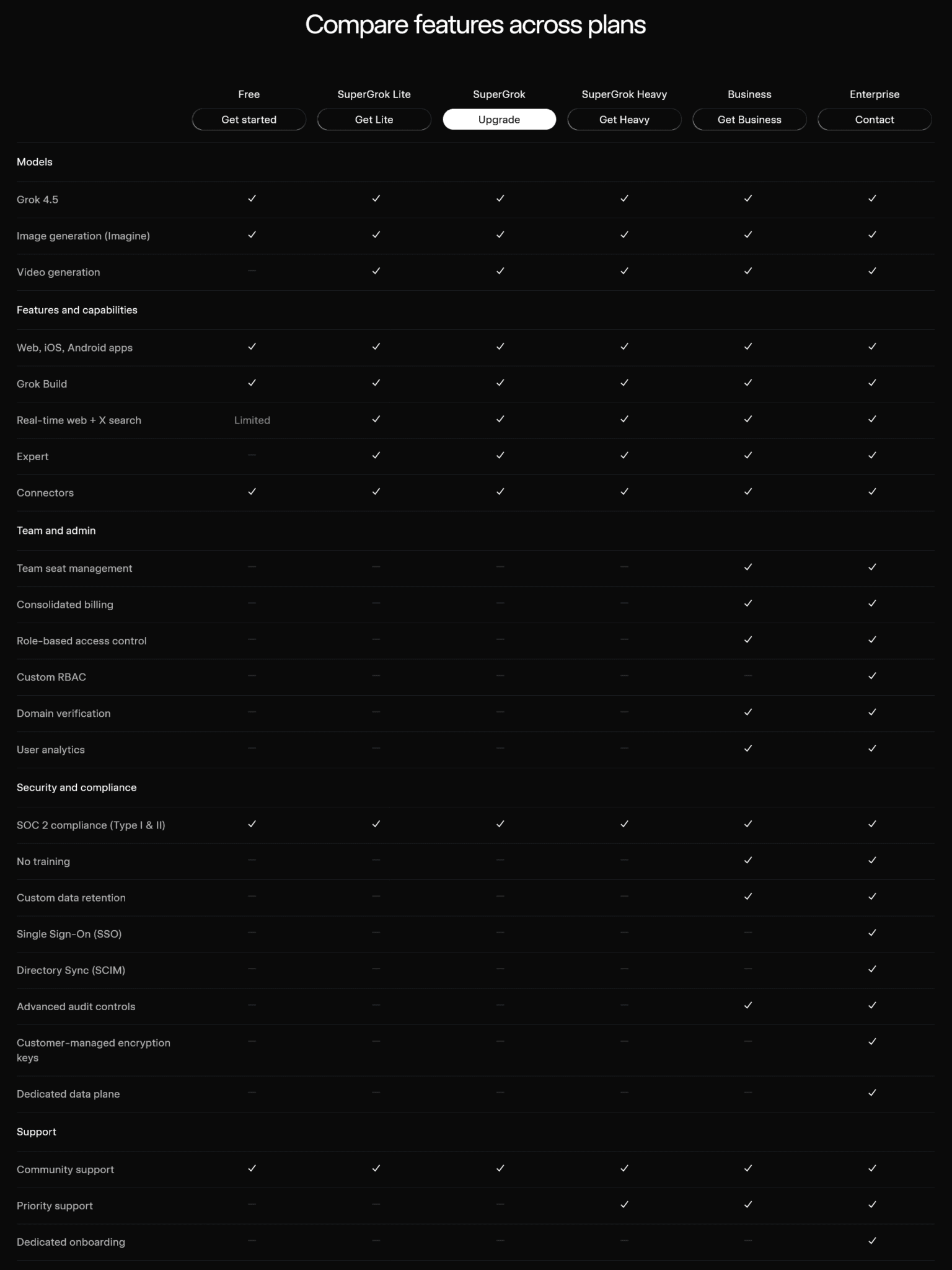
Grok 4.5 feature comparison across different pricing tiers. Image credit: xAI
Why Grok 4.5 costs more than Grok 4.3
xAI’s catalogue has an unusual shape: the newer flagship is the pricier one. Grok 4.3 lists at $1.25 input and $2.50 output with a one-million-token window and a 20% batch discount.
Grok 4.5 charges 60% more on input, 140% more on output, holds half the context, and carries no published batch rate.
That makes “upgrade to the newest model” a decision rather than a default. Long-context retrieval, document analysis, and overnight bulk jobs belong on grok-4.3. Grok 4.5 earns its premium on agentic and coding work, where its capability per token does the arguing.
Anyone tracking how xAI’s model roadmap has developed through 2026 will recognise the pattern: each release is positioned as a capability tier rather than a straight replacement.
Grok consumer plans and subscription costs
xAI sells Grok on two storefronts. SuperGrok tiers come from grok.com and centre on the model itself. X Premium tiers arrive through X and bundle Grok with platform perks such as a verified badge and reduced advertising.
| Plan | Price | What it covers |
|---|---|---|
| Free | $0 | Limited daily use on grok.com and X; image and video generation removed from the free tier in March 2026 |
| X Premium | $8 / month | Grok inside X with platform-specific limits |
| SuperGrok Lite | $10 / month | Entry standalone tier launched 25 March 2026; capped video generation |
| SuperGrok | $30 / month or $300 / year | Main paid tier; DeepSearch, Big Brain, Voice; Grok 4.5 in staged rollout |
| X Premium+ | $40 / month | Grok plus X platform benefits; Grok 4.5 in stages |
| SuperGrok Heavy | $300 / month | Confirmed full Grok 4.5 access, Grok 4 Heavy multi-agent model, highest rate limits |
Annual SuperGrok billing brings the effective monthly cost to $25, roughly a 17% saving.
The gap that matters more than price is access: tier names do not map cleanly to model versions during staged rollouts, so a $30 subscriber may hit an older variant on any given query. Heavy removes that ambiguity, at ten times the cost.
What Grok 4.5 costs on real workloads
Rate cards mean little until you multiply them by traffic. Three worked examples at list prices, all excluding cache discounts:
A single long prompt. A 100,000-token input with a 2,000-token answer costs about $0.212 on Grok 4.5 — $0.20 of input plus $0.012 of output. The same request on Grok 4.3 comes to roughly $0.130. Run it a million times a month and the gap is $212,000 against $130,000.
A support chatbot. At 500 input and 300 output tokens per exchange across 100,000 exchanges a month, you consume 50M input and 30M output tokens: $100 plus $180, or about $280 per month.
An agentic coding pipeline. Two hundred tasks a day at roughly 30,000 input and 16,000 output tokens each works out to about 180M input and 96M output tokens monthly – $360 plus $576, or roughly $936 per month.
How Grok 4.5 compares on price
Against the rest of the frontier tier, Grok 4.5 sits in the cheaper half without being the cheapest. The table below lists standard rates per million tokens as of late July 2026.
| Model | Input | Output | Context |
|---|---|---|---|
| Meta Muse Spark 1.1 | $1.25 | $4.25 | 1M (some listings cite 262K) |
| Grok 4.3 | $1.25 | $2.50 | 1M |
| Grok 4.5 | $2.00 | $6.00 | 500K |
| Claude Sonnet 5 | $2.00 intro / $3.00 standard | $10.00 intro / $15.00 standard | 1M |
| Claude Opus 5 | $5.00 | $25.00 | 1M |
| Claude Fable 5 | $10.00 | $50.00 | 1M |
Grok 4.5’s output-to-input ratio is 3:1, where most rivals charge five to six times more for output than input. That shape favours generation-heavy work – long answers, content production, verbose agents – and matters less for retrieval pipelines where input dominates. For a wider view of where each vendor has landed, our comparison of Gemini, ChatGPT, Claude and Grok subscription prices covers the consumer side of the same question.
Keeping the bill down
Four levers do most of the work. Measure before migrating: run your actual prompts against grok-4.5 and your current model, then read the usage object in the responses. If Grok’s outputs on your prompts are not shorter, the efficiency argument does not transfer. Route by task, sending retrieval and long-document work to grok-4.3 and reserving 4.5 for agentic and coding jobs. Log search tool calls separately from tokens. And take advantage of the free windows while they exist — Grok Build and Cursor have both included free Grok 4.5 usage since launch.
One more caution. Launch pricing is a customer-acquisition tool. xAI wants developers to switch, and week-one rates carry that intent. Any architecture decision that locks you to a single provider deserves a margin of safety against future increases.
Where the pricing sits today
Grok 4.5 buys near-frontier capability at roughly 40% of Claude Opus 5’s input rate and 24% of its output rate. It does not buy the frontier – xAI’s own published charts put Claude Fable 5 ahead on every benchmark it listed. What it buys is intelligence per dollar, which is a different product and, for a large share of production workloads, the more useful one. If you are weighing the model against its direct rivals rather than its price sheet, our breakdown of how xAI stacks up against OpenAI and Anthropic covers the capability side.
All figures are anchored to 28 July 2026 and taken from vendor documentation and pricing registries. AI pricing changes frequently; confirm current rates in the xAI console before committing budget. This article is informational and not purchasing advice.
If you are interested in this topic, we suggest you check our articles:
- 2026 AI Subscription Prices: Gemini vs ChatGPT vs Claude
- What to Expect from Grok in 2026
- xAI vs OpenAI vs Anthropic: Which AI Lab Wins in 2026?
- How Long Will Grok-3 Be Free to Use, What Will Costly Pricing Be?
- The Meaning Behind xAI’s ‘Grok’ and Its AI Ambitions
Sources: Apidog, BenchLM, Fello AI, OpenRouter, Spheron, AI Tool Analysis
Written by Alius Noreika