The Puzzle of the Scrolls
Since their dramatic discovery in the Judean Desert in the late 1940s, the Dead Sea Scrolls have reshaped modern understanding of ancient Jewish history, religion, and culture. These thousands of parchment and leather fragments, found tucked into clay jars in desert caves near Qumran, include some of the oldest surviving copies of Hebrew scriptures, along with sectarian laws, hymns, and apocalyptic visions.
For nearly eighty years, scholars have attempted to piece together the scrolls’ story: Who wrote them? When were they composed? What role did they play in a turbulent region under Greek and Roman rule? Yet one persistent challenge has remained: determining precise dates for these texts. Most fragments do not mention kings, historical events, or other obvious temporal markers. Researchers have typically turned to handwriting styles and carbon-14 dating – methods that are helpful, but often imprecise.
Introducing Enoch
Now, a team of researchers led by Mladen Popović at the University of Groningen has introduced a new tool: artificial intelligence. In a recent study published in PLOS ONE, the group unveiled a machine learning model – named Enoch, after the ancient Hebrew sage – designed to analyze Dead Sea Scroll fragments through a blend of radiocarbon data and the geometry of handwritten letters.
The model’s goal isn’t to replace traditional methods but to complement them. By training on dated fragments, Enoch learns to detect subtle patterns in the shape and stroke of letters that may correspond with specific time periods. In roughly 80 percent of cases, Enoch’s predictions placed scrolls earlier than previously thought – sometimes by as much as a century.
New timelines, new questions
These earlier estimates are not just chronological footnotes. They have the potential to reframe long-standing scholarly narratives about how Jewish communities in the Second Temple period recorded and transmitted knowledge. For instance, the transition between two major scripts, known as Hasmonean and Herodian, has long been associated with specific political eras. Hasmonean styles were thought to dominate until around the first century B.C.E., after which the Herodian script became standardized under Roman rule.
But Enoch suggests this shift may not have been so clean-cut. In some cases, scrolls written in a “Herodian” style may predate King Herod himself by decades. This raises new questions about how scribes adapted writing practices over time and challenges assumptions about the relationship between script and political chronology.
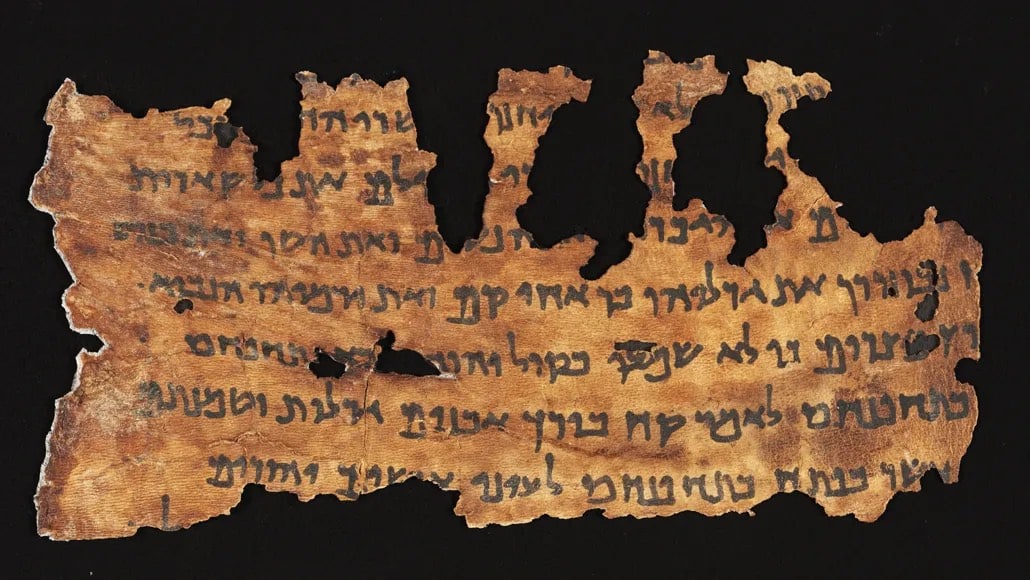
Image source: Science News
Still a human discipline
Despite these advancements, Enoch is not the final word. Scholars emphasize that AI is a tool, not a replacement. “AI needs human beings, especially in its development,” Popović said in an interview. “It’s a tool like the microscope is a tool for a biologist.”
Paleographers, who study ancient handwriting by hand, largely agree. Christopher Rollston, a professor of Semitic languages at George Washington University, points out that Enoch’s date range for one scroll – 4Q114, containing portions of the Book of Daniel – closely aligns with previous human estimates.
“There’s a certain vindication here,” he notes. Enoch predicted a window between 230 and 160 B.C.E., confirming the hypothesis that the scroll dates to around the Maccabean revolt.
The limits of algorithms
Not everyone is ready to redraw timelines just yet. Drew Longacre, a researcher at Duke Divinity School who was not involved in the study, warns that script analysis, even with AI, is inherently interpretive. “We kind of create this picture—this metanarrative – about how the script works,” he says. Handwriting, like pottery or architecture, reflects regional variation, education, and even the quirks of individual scribes.
Moreover, machine learning models require labeled data, examples with known dates, to improve. For texts as fragmented and contested as the Dead Sea Scrolls, that can be a major constraint.
An ongoing dialogue
The work of dating the Dead Sea Scrolls is far from over. But the addition of AI into the scholar’s toolkit opens new possibilities – not only for refining timelines but for rethinking how ancient texts are studied. While human expertise remains indispensable, models like Enoch offer an extra set of eyes: fast, tireless, and capable of catching patterns a human might miss.
The scrolls remain what they’ve always been: a fragile yet profound window into a lost world. Now, thanks to the quiet work of algorithms, that window has opened a little wider.
Sources: Science.org