Key Takeaways
- Start narrow. Pick one bounded, high-volume workflow with a measurable outcome instead of attempting a company-wide rollout.
- The model is rarely the blocker. By 2026, capability is no longer the main constraint; deployment, workflow redesign and adoption are where projects stall.
- Set a baseline before you build. Roughly 88% of agent pilots never reach production, and unclear success criteria are the single most common reason they fail.
- Govern before you scale. Only about one in five organizations has a mature plan for supervising AI agents, and many cannot quickly shut a misbehaving one down.
- The returns are real for those who finish. The minority of agent projects that reach production report average returns well above traditional automation, with a median payback near five months.
- Embed AI in tools people already use. Adoption rises when capabilities appear inside existing software rather than as yet another app to learn.
- Adoption moves at the speed of the business, not the technology. Treat it as an operational and people change, not a software purchase.
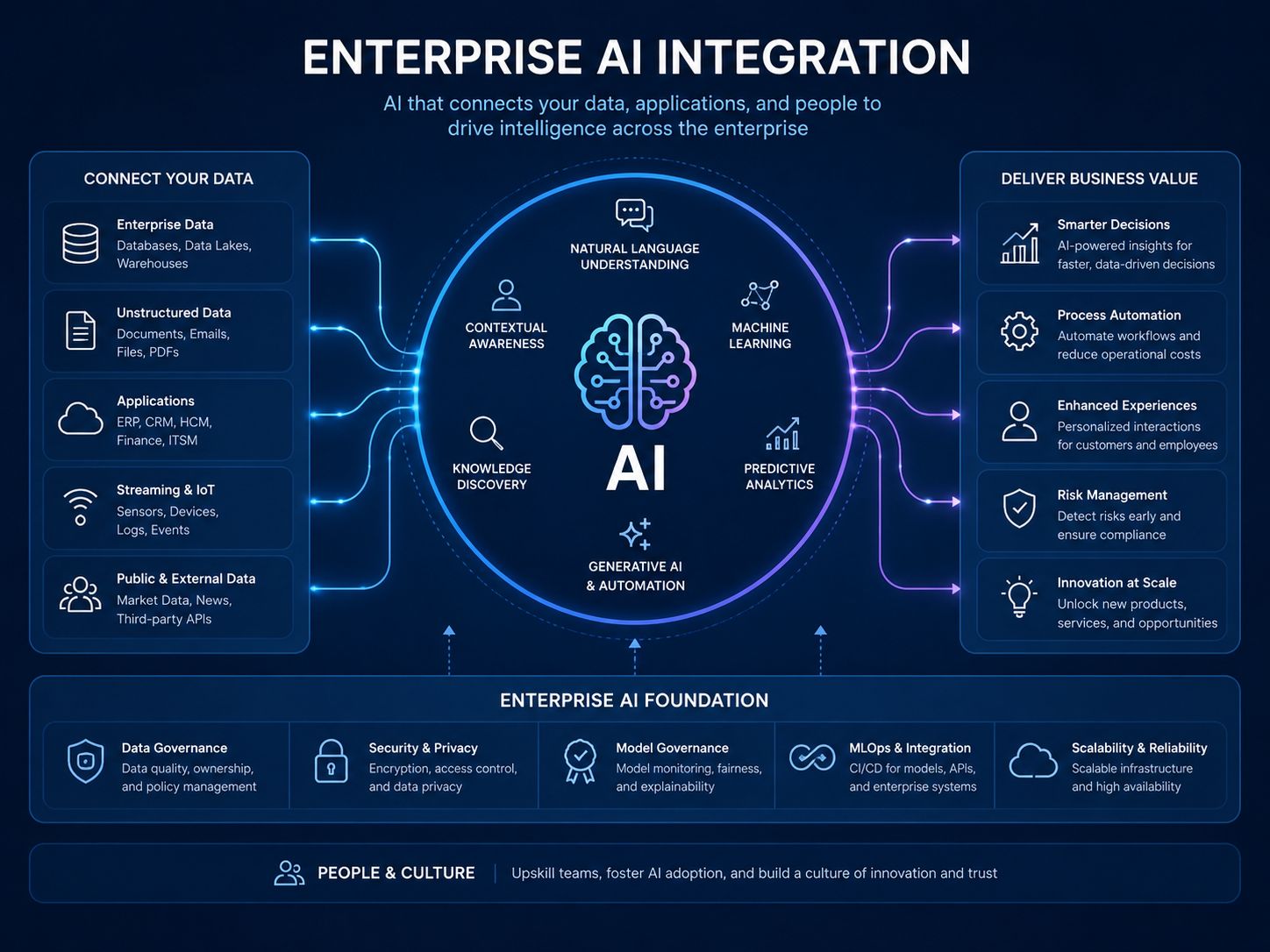
Enterprise AI integration – artistic impression. Image credit: Alius Noreika / AI
Businesses should approach AI integration the way a careful operator approaches any major process change: choose one workflow where the payoff is measurable, set a baseline, put guardrails in place before going wide, and scale only what clears a defined value bar. The temptation in 2026 is to do the opposite, to buy a platform, switch on agents everywhere, and wait for transformation. The data says that path mostly produces abandoned pilots and frustrated staff.
The reason is a shift in where the difficulty now sits. For years the assumption was that the next, smarter model would unlock the next wave of value. That is no longer true. As OpenAI told its own customers when it announced a push to certify hundreds of thousands of implementation consultants, model capability is no longer the main barrier; the hard part is repeatedly finding the right use cases, redesigning workflows, wiring AI into existing systems, and getting people to use it. That assessment, covered in our report on OpenAI’s plan to build a 300,000-strong consultant network, is the single most important framing for any leader planning an integration.
The gap between using AI and getting value from it
Almost every company now uses AI in some form. McKinsey’s latest global survey found that close to nine in ten organizations report regular use. The trouble is that wide use has not converted into wide value. In the same research, only about 39% of organizations report a measurable impact on enterprise earnings, even as 64% say AI is helping them innovate. PwC’s 2026 survey of more than 4,400 chief executives sharpened the point: just 12% could claim both higher revenue and lower costs from their AI efforts.
The agent layer shows the gap most starkly. The most-cited figure in 2026 enterprise conversations is that roughly 88% of agent pilots never reach production. Among the small share that do, results are strong, average returns reported well above what traditional automation delivers, but the path there is harder than any demo suggests. The table below sets the scene before getting to what separates the winners.
| Measure | Figure | Source |
|---|---|---|
| Organizations regularly using AI | ~90% | McKinsey, State of AI |
| Reporting enterprise-level earnings impact | ~39% | McKinsey |
| CEOs reporting both revenue gain and cost cut | 12% | PwC 2026 CEO Survey |
| Agent pilots that never reach production | ~88% | Forrester / Anaconda |
| Organizations with a mature agent governance model | ~21% | Deloitte |
Start with one workflow, not a strategy deck
Deloitte’s year-long study of enterprise adoption reached a blunt conclusion: AI moves at the “speed of business, not the speed of technology.” Organizational change is slow, so attempting a full overhaul from day one tends to collapse under its own weight. The firms that capture value do the opposite. They pick a small number of high-impact use cases, layer AI on top of an existing process, prove the gain, and use that win to fund the next step.
The workflows that convert first share a profile. They are high in volume, structured in their inputs, measurable in their outputs, and short in their feedback loops. Ticket triage, code review, invoice matching, internal search and operations coordination keep showing up in early production for exactly this reason. A bounded task with a clear right answer is far easier to deploy, evaluate and trust than an open-ended one. Resist the pull to start with the most ambitious, judgment-heavy process; start where success is obvious and countable.
Define the metric before you write a line of code
The most common failure mode is not technical. When Forrester traced why agent projects fall short, 41% of failures came down to unclear success criteria, 33% to insufficient access to the right tools or data, and 26% to drift in how outputs were evaluated. None of those are model-quality problems. They are scoping and ownership problems.
The practical fix is to tie every deployment to one concrete outcome on one workflow, cycle time, cost per task, quality, or response speed, and to record the current value of that metric before anything launches. Seat counts and broad usage numbers are too weak to steer decisions; they tell you people opened a tool, not that the work improved. A baseline turns a vague promise of productivity into a number you can defend or kill.
Put governance in before you scale, not after
Agentic systems raise a different class of risk than a chatbot that occasionally says the wrong thing. An agent can take the wrong action, misuse a tool, or operate past its guardrails. The survey evidence suggests most organizations are underprepared for that. In one 2026 study of 1,200 executives, 67% believed their company had already suffered a data leak through unapproved AI tools, 36% had no formal plan to supervise agents, and 35% admitted they could not immediately pull the plug on a rogue one. Across Deloitte’s research, 73% of leaders named security and privacy as top concerns, yet only about 21% had a mature governance model.
The organizations that will own this category by 2027 are the ones doing the unglamorous work now: building identity and permission systems for their agents, keeping audit trails, running red-team exercises, and wiring in human-in-the-loop checks and a reliable off switch. Gartner expects more than 40% of agentic projects to be cancelled by 2027, and the cancellations will cluster among teams that scaled before they could govern. Treat governance as a precondition for scaling, not a cleanup task that follows it.
Embed AI in tools people already use
Even a well-scoped, well-governed deployment fails if no one adopts it. Tool overload is a measurable drag: the share of companies scrapping most of their AI initiatives jumped from 17% in 2024 to 42% in 2025, the average organization abandoned nearly half of its proofs of concept, and workers using generative tools reported that almost 80% of the time the tools added to their workload rather than lightening it. Frequent AI users even reported higher burnout than occasional ones.
The antidote is to reduce friction. Capabilities that surface inside software employees already open, an email client, a spreadsheet, a chat tool, avoid the cognitive tax of switching between separate apps and logins. Engaged employees are far more likely to back a rollout when leaders visibly commit to it and when the change arrives through familiar interfaces. We explore this dynamic, and how to add AI without overwhelming your team, alongside the way platforms such as Microsoft Copilot’s 2026 agents embed directly into existing workflows.
Get the data and the deployment foundations right
Models built on messy, incomplete or mislabeled data produce poor results no matter how capable the algorithm. Many companies discover this only after a pilot stalls. A serious integration plan treats data collection, cleaning, integration and security as the first engineering task, not an afterthought, the same foundation that underpins any working AI factory. For teams handling sensitive material, keeping models and data in-house through open-source models you can deploy yourself is a way to keep control over where information travels.
What the payoff looks like when it works
The discipline pays. Among organizations that get agents into production, around three-quarters reach a positive return within the first year, and the median time to value across functions sits near five months. The payback varies by use case: sales-development agents tend to recoup their cost fastest, while finance and operations agents take longer because the workflows are more entangled. Production adoption is also uneven by industry, banking and insurance lead, healthcare and government lag, which is a reminder to calibrate ambition to your own data and regulatory reality.
| Function | Typical first use case | Median payback |
|---|---|---|
| Sales development | Lead qualification and outreach | ~3.4 months |
| Customer service | Ticket triage and deflection | ~5 months |
| Finance and operations | Invoice matching, forecasting | ~8.9 months |
Set against the scale of the prize, McKinsey estimates AI agents could add somewhere between $2.6 trillion and $4.4 trillion in value a year across business use cases, the case for getting integration right is hard to dismiss. The figure is a projection, not a promise, but it explains why so much capital is moving even as most pilots stumble.
A sequence leaders can follow
Pulled together, the approach is less about choosing the perfect model and more about running a disciplined operating loop. Pick one bounded workflow with a measurable outcome. Record the baseline. Confirm the agent can reach the data and tools it needs. Build the governance, audit logs, permissions and a kill switch, before scaling. Embed the tool where work already happens, and train people in short, role-specific steps rather than dumping a broad capability on them at once. Measure against the baseline, expand what clears the bar, and shut down what does not.
That loop is deliberately modest, and that is the point. The companies pulling ahead in 2026 are not the ones with the flashiest deployments; they are the ones treating AI as an accountable system with clear responsibilities, scoped to problems they can define and measure. The technology works. Whether it works for your business is decided by how you integrate it, not by which model you pick.
If you are interested in this topic, we suggest you check our articles:
- Does OpenAI Want Over 300,000 AI Consultants?
- AI Copilot Fatigue: 4 Ways to Integrate AI Tools Smoothly
- How AI Factory Engineering Works and Top Sectors to Benefit
- Open-Source LLMs You Can Deploy: 11 Best Models
- How AI Is Reshaping Enterprise Legal Management Platforms
Sources: McKinsey, State of AI, McKinsey AI Trust Survey, WRITER Enterprise AI Adoption 2026, Digital Applied (Forrester/BCG/S&P data), Turion.ai, Klover.ai (Deloitte/Gartner synthesis)
Written by Alius Noreika