Key Takeaways
- On June 23, 2026 the KOSPI fell 9.99%, or 910.71 points, to close at 8,203.84 – its largest point decline on record – triggering a 20-minute circuit breaker.
- An overnight selloff in US technology stocks lit the fuse: the Nasdaq had dropped 2.21% as investors dumped semiconductor and AI shares.
- Concentration turned the spark into a fire. Samsung Electronics and SK Hynix make up close to half of the index and supplied roughly 70% of its 2026 gains; both fell about 12%.
- Foreign investors sold about 5.79 trillion won (roughly $3.8 billion) of Korean shares during the session, and only 46 KOSPI stocks rose against 859 that fell.
- The crash followed a record run – the KOSPI had hit an intraday high near 9,385 days earlier and was up more than 90% for the year.
- The market rebounded fast: after a wobbly June 24, a blowout Micron earnings report sent the KOSPI up more than 5% on June 25.
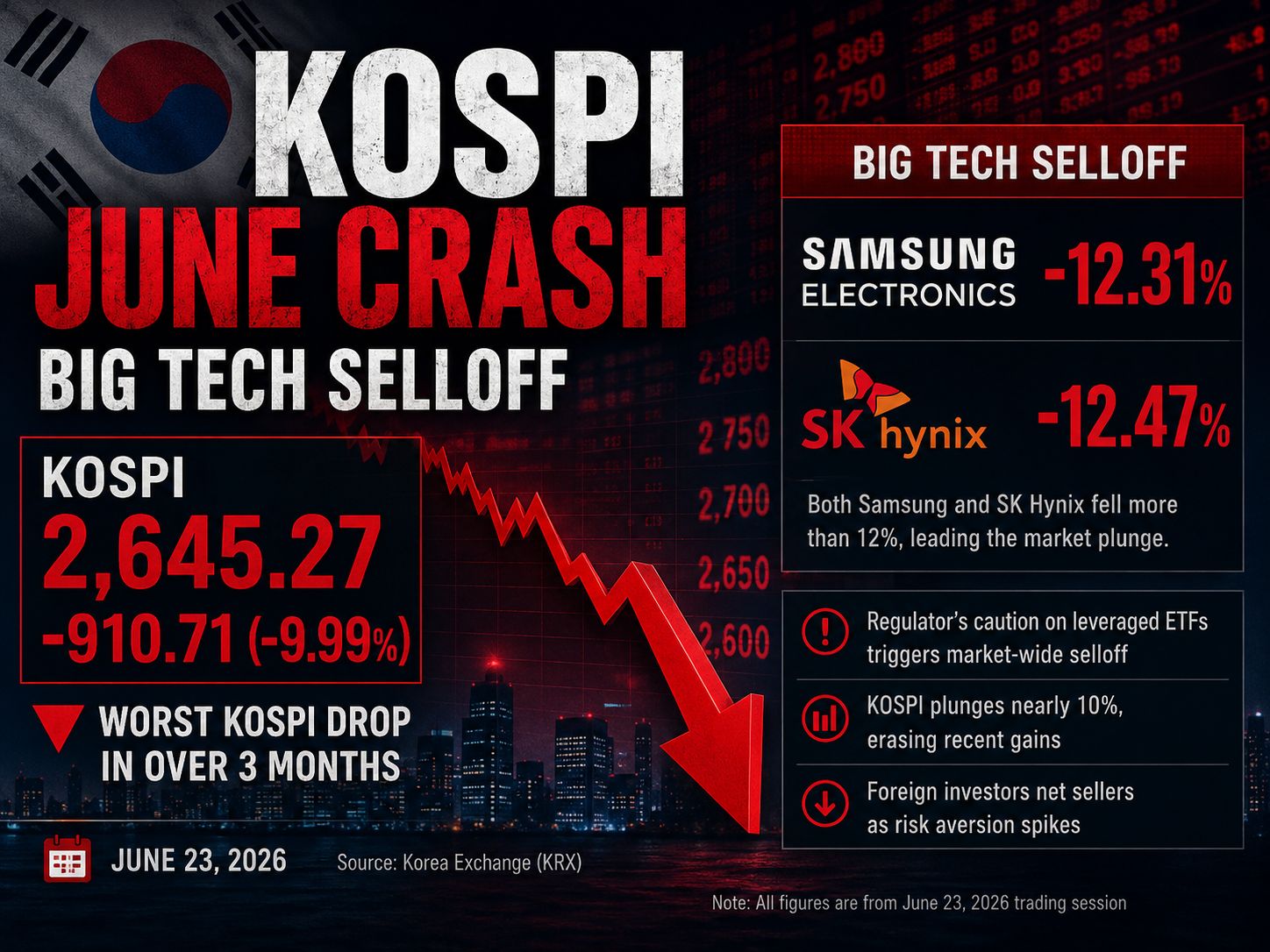
The KOSPI crash in June 2026 – infographic. Image credit: Alius Noreika / AI
The KOSPI’s near-10% plunge on June 23, 2026 was set off by a Big Tech selloff that started the night before in the United States. As US investors sold chip and AI shares and the Nasdaq fell 2.21%, the weakness rolled into Asia at the open and turned into outright panic in Seoul, where the index dropped 9.99% and tripped a market-wide circuit breaker for 20 minutes.
But the overnight selloff only explains the trigger. What made the move so violent was structure: South Korea’s benchmark is dangerously concentrated in two memory-chip giants, Samsung Electronics and SK Hynix, and when both fell about 12% in a single session, no other stock on the exchange could offset the arithmetic. The result was the largest point drop the KOSPI has ever recorded.
What Happened on June 23
South Korea had been the standout winner of the AI boom. After bottoming near 2,268 in April 2025, the KOSPI climbed past 9,300, repeatedly setting records and rising more than 90% for the year. On Monday, June 22, it closed at a record 9,114.55, and SK Hynix briefly overtook Samsung as the country’s most valuable listed company.
The next day the rally cracked. The Korea Exchange activated its circuit breaker at around 2:33 p.m. local time, halting trading for 20 minutes as the index fell more than 8% from the prior close. By the bell, the KOSPI had shed 910.71 points to finish at 8,203.84. Breadth was brutal – 859 stocks fell and just 46 rose – and main-board market value dropped by roughly 743 trillion won in one day.
| Date | KOSPI move | Driver |
|---|---|---|
| June 19, 2026 | Intraday record near 9,385 | Peak of the AI memory rally |
| June 22, 2026 | Record close 9,114.55 | SK Hynix overtakes Samsung by value |
| June 23, 2026 | -9.99% to 8,203.84 | US tech selloff plus chip-stock concentration |
| June 24, 2026 | Early bounce fades | Caution before Micron earnings |
| June 25, 2026 | +5% at the open, back above 8,900 | Micron’s earnings beat |
Why the Big Tech Selloff Hit Korea Hardest
The overnight catalyst came from Wall Street, where profit-taking in semiconductors after a historic run combined with renewed worries about higher US interest rates. The Nasdaq fell 2.21% and the S&P 500 dropped 1.44%, with Micron sliding more than 10%, Marvell down 8%, and SanDisk off 11%. Because the same memory chips power the global build-out of AI data centers, that weakness flowed directly into the names that dominate the Korean market.
Concentration is the mechanism that amplified everything. Samsung and SK Hynix together represent close to half of the KOSPI’s market value and produced about 70% of its 2026 climb. When both fall 12% at once, the index level cannot escape the math no matter how the other 900-odd companies trade. The same concentration that made the rally so powerful on the way up – investors were buying a direct claim on the AI hardware cycle, and SK Hynix leads the high-bandwidth memory market that sits beside accelerators in AI servers – made the correction just as sharp. A stock-specific worry added fuel: reports that SK Hynix was slowing its HBM4 expansion and shifting capacity toward conventional DRAM, where margins had recently been higher, raised questions about whether demand for the most lucrative memory was cooling. The structural reasons memory has become this valuable run through the memory wall in AI infrastructure and the NVIDIA Blackwell systems that consume it.
The Selloff Spread Across Asia and Beyond
This was not only a Korean story. Japan’s Nikkei 225 fell and SoftBank sank sharply, Chinese and Hong Kong indexes lost ground, and European chip names such as STMicroelectronics and ASMI dropped more than 7% as the Stoxx 600 Technology index slid 3.2%. Foreign investors pulling roughly $3.8 billion out of Korean equities in a day showed how quickly global money exits a crowded trade once the wind changes. The same scarcity-driven volatility recently surfaced in consumer hardware too, where an AI-fueled memory shortage pushed the price of premium storage to extreme levels.
The Rebound and What It Means
Analysts framed the move as profit-taking after a historic run rather than a sign of deterioration in the underlying businesses, and the recovery backed that reading. After a choppy June 24 – early gains faded as traders held back before a key earnings report – the picture flipped on June 25. Micron’s fiscal third-quarter results landed well above expectations, with revenue of $41.46 billion (more than four times the figure a year earlier) and adjusted earnings of $25.11 a share against a consensus near $20.78. The print reset confidence in the AI memory cycle, sending the KOSPI up more than 5% at the open and back above 8,900, with SK Hynix climbing more than 10% and Samsung gaining about 5%.
The episode is best understood as a concentration-and-leverage shock, not the end of the AI trade. The volatility is the flip side of a scarcity-driven boom: as long as a handful of memory makers carry the index and the global rush for chips, power, and cooling continues, dramatic swings in both directions are likely to remain a feature of this market. The demand keeping money in these names is the same force shaping the broader AI infrastructure stack.
If you are interested in this topic, we suggest you check our articles:
- How Big a Role Does AI Infrastructure Play in Model Performance?
- NVIDIA Blackwell Server: Specs, Power and Capabilities
- How Much Electrical Power Does AI Require?
- AI Infrastructure: Essential Components in Modern ML Systems
- European Countries With the Most Data Centers 2026
Sources: CNN Business, Bloomberg, Yahoo Finance, CNBC
Written by Alius Noreika