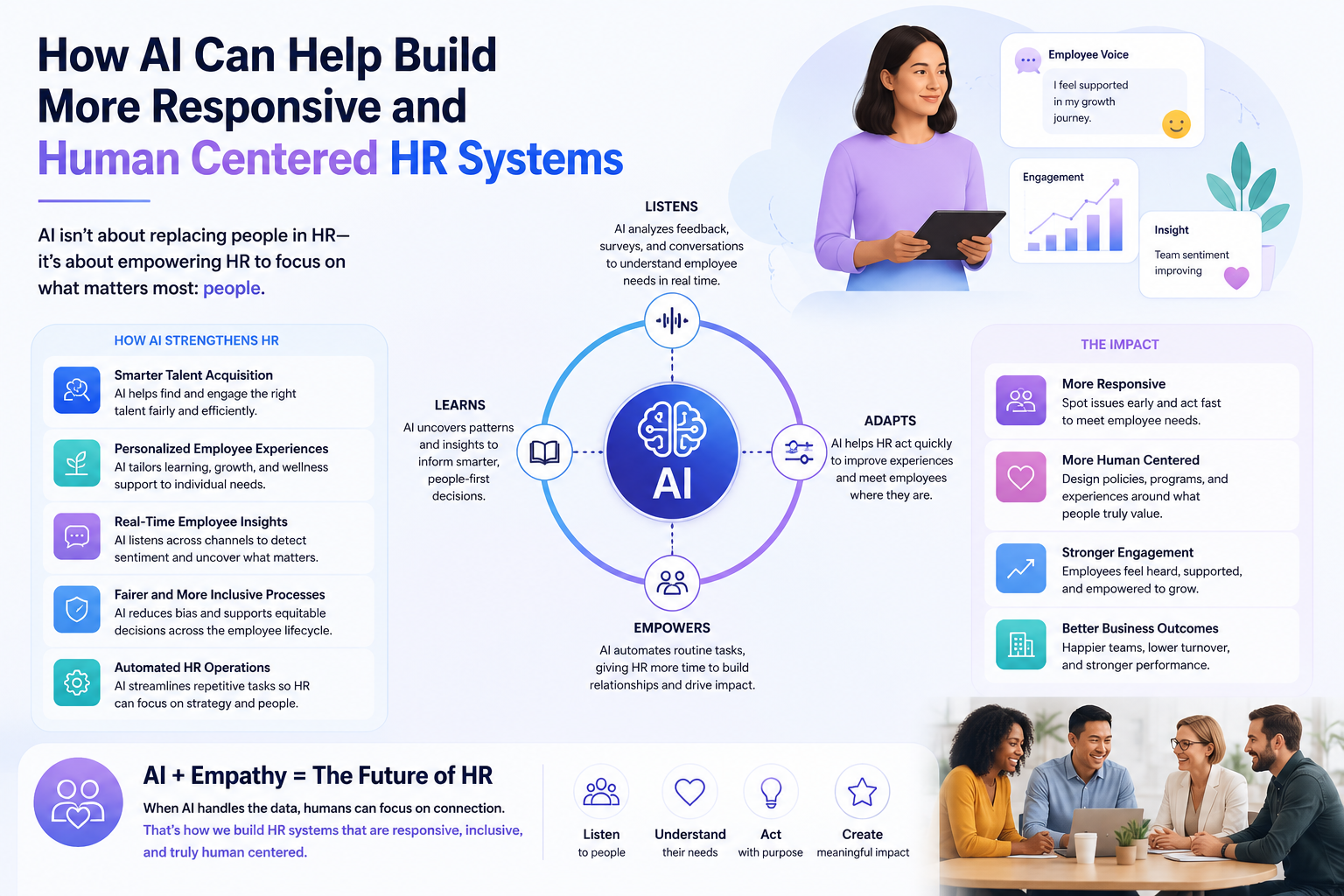
How AI can help build more responsive and human centered HR systems – infographic. Image credit: Alius Noreika / AI
Human resources teams are expected to manage a wide range of responsibilities. They support employees, answer policy questions, organize records, coordinate hiring, manage leave requests, assist managers, and help resolve workplace concerns.
These tasks become harder as a company grows.
Employees expect quick answers, clear instructions, and simple processes. Managers need accurate information so they can respond appropriately. HR professionals must also protect privacy and make sure important requests are handled consistently.
Artificial intelligence can help HR teams meet these demands. It can organize information, automate routine work, capture important conversations, and guide employees toward the right resources. When used carefully, AI can make HR systems more responsive without removing the human judgment that sensitive workplace situations require.
For example, companies building tools that document virtual HR discussions may use a recorder API to capture approved meetings across common communication platforms. With proper consent and privacy controls, these records can help HR teams confirm what was discussed, identify agreed next steps, and reduce confusion after important conversations.
AI can also support employees who need help with formal medical leave. When a worker is navigating a qualifying health or caregiving situation, access to clear information about FMLA certification can make the documentation process easier to understand. Connecting employees with the right resources early can reduce delays and let HR focus on providing thoughtful guidance.
Responsive HR Starts With Easier Access to Information
Employees often contact HR because they do not know where to find an answer.
They may have questions about benefits, sick leave, medical documentation, payroll, remote work, company policies, or time off. The information may already exist, but it could be buried in an employee handbook, scattered across several portals, or written in language that is difficult to understand.
AI powered search and chat tools can make that information easier to access.
An employee could ask a question in plain language and receive a clear answer based on approved company documents. The tool could also direct the employee to the right form, policy, or HR contact.
This does not mean an automated assistant should make sensitive decisions. Its role is to help employees find basic information and understand their next step.
When simple questions are answered quickly, HR professionals have more time for situations that require empathy, judgment, and personal attention.
Automation Can Reduce Repetitive Administrative Work
A large part of HR work involves routine tasks.
Teams may need to send reminders, organize forms, schedule interviews, update employee records, confirm document receipt, and answer repeated questions. Each task may be small, but together they can consume a significant part of the workday.
AI can support these processes by handling predictable steps.
A system might remind an employee that a form is incomplete. It might route a request to the correct HR specialist. It could organize incoming documents, suggest calendar options, or prepare a basic summary of a request for review.
This helps HR teams respond faster while reducing the chance that an important item will be overlooked.
Automation should not remove human oversight. HR professionals still need to review sensitive information and make final decisions. The goal is to reduce manual effort so people can focus on work that requires care and experience.
Better Records Support Clearer Decisions
HR decisions often depend on good records.
A misunderstanding about what was requested, promised, or approved can create stress for employees and managers. Important details may be spread across emails, meeting notes, forms, and chat messages.
AI can help organize this information into a clearer record.
For example, an approved meeting transcript could be connected to a case file. A leave request could include the submitted forms, status updates, and communication history in one secure place. A manager could review the approved details without searching through several systems.
Clear records help HR teams respond consistently.
They also make it easier to explain why a decision was made and what needs to happen next. This can strengthen trust because employees are less likely to receive conflicting instructions from different people.
AI Can Improve Medical Leave Workflows
Medical leave is one of the most sensitive areas of HR.
Employees may be dealing with illness, recovery, pregnancy, mental health needs, or the responsibility of caring for a family member. They may feel worried about their job, income, privacy, or workload.
A confusing process adds more pressure.
AI can help guide employees through the administrative steps without asking them to understand the entire process on their own. A digital system could explain which forms are needed, show the current status of a request, and alert the employee when more information is required.
It could also help HR professionals track deadlines and keep documents organized.
The system should not determine whether a person has a qualifying medical condition. That decision requires proper review and documentation. AI is most useful when it supports the workflow and helps everyone understand what comes next.
Managers Need Responsive HR Support Too
Managers are often the first people employees approach with workplace concerns.
An employee may say they are struggling with their health, need time away, or cannot keep up with their current schedule. The manager may want to help but may not know what they are allowed to ask or what process to follow.
AI tools can give managers quick access to approved guidance.
A manager could find instructions on how to respond to a medical leave request, when to involve HR, and how to protect employee privacy. The system could also provide templates for neutral and respectful communication.
This helps managers avoid careless questions or promises they cannot keep.
It also creates a more consistent employee experience. Workers should not receive completely different guidance simply because they report to different managers.
AI Can Help HR Notice Patterns Earlier
Responsive HR is not only about reacting to individual requests.
It is also about identifying workplace patterns before they become larger problems. AI can help teams review information across employee surveys, support requests, absence records, and internal feedback.
This may reveal that employees are confused about a policy, struggling with a particular system, or repeatedly asking for the same type of support.
HR can use these signals to improve the employee experience.
For example, repeated questions about medical leave might suggest that the policy is difficult to understand. A rise in workload complaints within one department might show that managers need more support. Frequent errors in one form might indicate that the instructions need to be rewritten.
AI can point to patterns, but people must interpret them carefully. Data does not always explain why something is happening. HR professionals still need to listen to employees and consider the larger context.
Privacy Must Remain a Core Priority
HR systems contain sensitive information.
Medical documents, performance records, personal details, compensation information, and private workplace concerns must be protected. Adding AI to these systems creates new questions about access, storage, security, and appropriate use.
Companies should decide exactly what information an AI tool can access.
They should also control who can view meeting records, transcripts, summaries, and employee documents. Sensitive information should not be used to train unrelated systems or shared with people who do not need it.
Employees should understand how their information is handled.
If a meeting is recorded or transcribed, participants should be informed. If an automated system is being used to process a request, the company should explain its role.
Trust depends on transparency.
Human Judgment Should Guide Sensitive Decisions
AI can make HR systems faster, but speed is not the only goal.
Employees need to feel that their situation has been understood. A person facing illness, caregiving pressure, workplace conflict, or a serious personal issue may need a real conversation.
An automated response cannot provide the same level of care.
AI should support HR professionals by gathering information, organizing records, and reducing administrative work. It should not replace empathy or make final decisions about complex employee needs without meaningful human review.
The strongest HR systems combine efficient technology with thoughtful people.
Technology handles the predictable tasks. HR professionals handle the situations where context, fairness, and compassion matter most.
Building a More Responsive Employee Experience
A responsive HR system should be easy to use.
Employees should know where to ask questions, how to submit requests, and when they can expect a reply. They should not need to search through several portals or repeat the same information to different people.
AI can help create a smoother experience by connecting systems and guiding users through each step.
It can provide immediate answers to common questions, notify HR when a request needs attention, and update employees as the process moves forward. It can also help translate complex policies into clearer language.
The result should feel simpler, not more technical.
Employees do not need to understand how the AI works. They need to know that the system is reliable, private, and easy to navigate.
Final Thoughts
AI can play an important role in building more responsive HR systems.
It can reduce routine administrative work, improve access to information, organize records, support managers, and help employees understand complex processes. It can also make medical leave and other sensitive workflows easier to navigate.
But successful HR technology must remain human centered.
Employees need privacy, clarity, consistency, and real support. AI should give HR professionals more time to provide those things, not create distance between the company and its people.
A responsive HR system is not simply one that answers quickly. It is one that gives employees the right help, protects their information, and treats their needs with care.
When technology and human judgment work together, HR teams can respond faster while building a more supportive workplace.